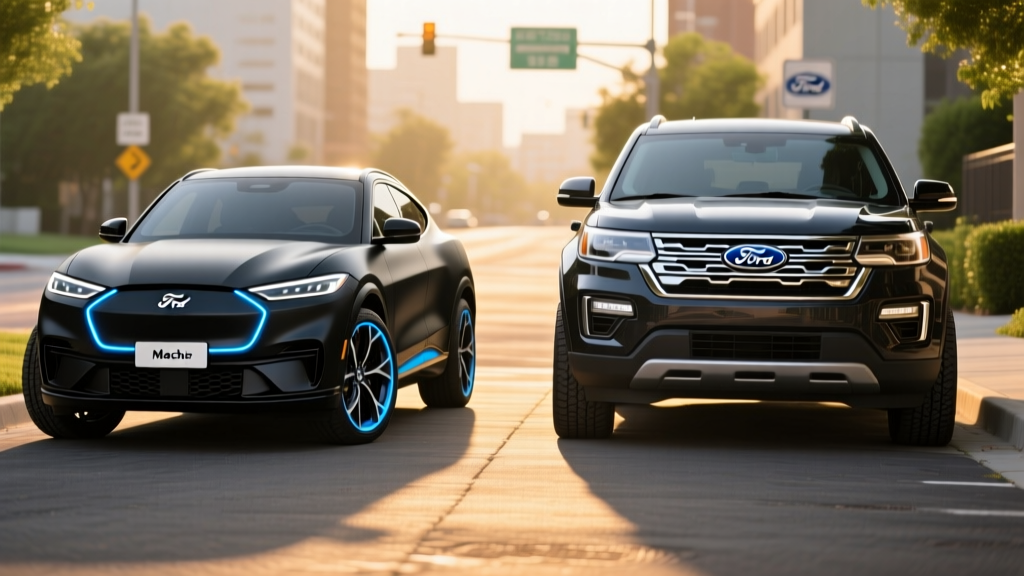
Ford's Mustang badge has expanded far beyond its two-door coupe roots, and buyers searching for a Mustang SUV often hit a confusing question: are all Mustang SUVs electric? The short answer is no. Ford currently sells the Mustang Mach-E, a fully electric SUV that carries the Mustang nameplate, but the broader Ford SUV lineup includes several gas-powered and hybrid models. The Mach-E is the only Mustang-branded vehicle that is fully electric, and understanding what that means for your wallet, your daily driving, and your charging setup is critical before signing a purchase agreement.
The Quick Answer: Mustang SUV Lineup in 2026
Direct answer: Not all Mustang SUVs are electric. The Ford Mustang Mach-E is a battery-electric vehicle (BEV) and the only Mustang-badged SUV. Ford does not sell a gas-powered "Mustang SUV." However, Ford's broader SUV portfolio — including the Explorer, Bronco Sport, and Escape — offers gas and hybrid powertrains. If you want a Mustang SUV, you're looking at the electric Mach-E.
The Mach-E debuted for the 2021 model year and has been updated annually. For 2026, Ford offers the Mach-E in Select, Premium, California Route 1 (RWD only), and GT trims. It rides on Ford's dedicated EV platform (GE2) and is available with rear-wheel drive (RWD) or all-wheel drive (eAWD). No internal combustion engine is offered under the Mach-E's hood — it is exclusively a battery-electric vehicle.
2026 Mustang Mach-E: Specs, Range, and Charging
Before comparing the Mach-E to gas alternatives, here's what you're actually buying. The numbers below reflect 2026 model-year data as published by Ford and the EPA.
| Spec | Select RWD (Std Range) | Premium RWD (Ext Range) | GT (Ext Range AWD) |
|---|---|---|---|
| Base MSRP | $42,995 | $48,995 | $59,995 |
| Battery (usable kWh) | 72 kWh (LFP) | 91 kWh (NMC) | 91 kWh (NMC) |
| EPA Range | 250 mi | 320 mi | 290 mi |
| Real-World Range (highway/cold) | ~200-220 mi | ~260-285 mi | ~235-260 mi |
| Motor Power | 266 hp | 290 hp | 480 hp |
| 0-60 mph | 5.8 sec | 5.5 sec | 3.5 sec |
| Max DC Fast Charge | 150 kW | 150 kW | 150 kW |
| 10-80% DCFC Time | ~33 min | ~40 min | ~40 min |
| Level 2 Home Charging | 10.5 kW (33 mi/hr) | 10.5 kW (33 mi/hr) | 10.5 kW (33 mi/hr) |
| EPA Combined MPGe | 101 MPGe | 101 MPGe | 84 MPGe |
| Battery/Powertrain Warranty | 8 years / 100,000 miles | ||
Real-world range reality check: The EPA range figures assume moderate temperatures and mixed driving. On sustained highway trips at 75 mph, expect a 10-15% reduction. In freezing temperatures (below 32°F), range can drop 20-30% due to battery heating demands and cabin climate load. The Extended Range models use NMC (nickel manganese cobalt) chemistry, which offers higher energy density but is more sensitive to cold. The Standard Range LFP (lithium iron phosphate) battery tolerates daily 100% charging better and degrades more slowly over time, but sacrifices about 70 miles of EPA range.
Charging curve reality: The Mach-E's peak 150 kW rate is not sustained across the entire session. Charging is fastest between 10-50% state of charge (SoC), then tapers progressively. A 10-80% session at a 150+ kW DC fast charger takes roughly 33-40 minutes depending on battery temperature and starting SoC. Preconditioning the battery (via the vehicle's navigation-routed preconditioning feature) before arriving at a fast charger is essential to hitting these numbers — skip it, and you may peak closer to 100 kW.
Cost Breakdown: Mach-E EV vs Gas SUV
The Mach-E's starting price is higher than a comparably equipped Ford Explorer or Escape. But purchase price is only one part of the ownership equation. Here's a five-year cost comparison between the Mach-E Premium RWD and a gas-powered Ford Explorer XLT, both driven 15,000 miles per year.
| Cost Category | Mach-E Premium RWD | Explorer XLT AWD |
|---|---|---|
| Base MSRP | $48,995 | $42,500 |
| Federal Tax Credit (§30D) | Up to $7,500* | $0 |
| Effective Purchase Price | ~$41,495 | $42,500 |
| 5-Year Fuel/Energy (75,000 mi) | ~$4,500 (home L2 avg) | ~$10,125 (gas, 24 mpg combined @ $3.25/gal) |
| 5-Year Maintenance | ~$1,200 | ~$3,800 |
| 5-Year Insurance (est.) | ~$9,500 | ~$7,800 |
| Estimated 5-Year Depreciation | ~$18,000 | ~$16,500 |
| 5-Year Total Cost of Ownership | ~$74,695 | ~$80,725 |
*Federal §30D tax credit eligibility depends on your modified adjusted gross income (AGI), the vehicle's MSRP (must be ≤$80,000 for SUVs), battery component and critical mineral sourcing requirements, and manufacturer eligibility. The credit can be applied as a point-of-sale rebate through a registered dealer. Always verify current eligibility at IRS.gov and consult a tax professional.
Key takeaways from the cost data:
- The Mach-E's effective purchase price after the federal credit can be lower than the Explorer's, but only if you qualify for the full $7,500.
- Energy savings are significant: roughly $5,600 less in fuel/energy over five years when charging primarily at home.
- Maintenance is dramatically lower — no oil changes, no transmission fluid, no spark plugs, and regenerative braking extends pad life.
- Insurance is typically 15-25% higher for EVs due to higher repair costs and battery replacement exposure.
- Depreciation on EVs has been steeper than gas vehicles in recent years, though the gap is narrowing as the used EV market matures.
Charging at Home: What First-Time Buyers Need to Know
Home charging access is the single biggest factor in EV ownership satisfaction. If you can install a Level 2 (240V) charger at home, the Mach-E becomes remarkably convenient — you wake up every morning with a full charge. If you cannot charge at home (apartment living, no garage, landlord restrictions), ownership becomes significantly more challenging and you'll rely on public DC fast charging or Level 2 destination chargers.
| Component | Estimated Cost Range |
|---|---|
| Level 2 Charger (40-48A, hardwired) | $400 - $750 |
| Electrician Labor (240V circuit, 50-60A breaker) | $800 - $2,500 |
| Electrical Permit | $50 - $200 |
| Panel Upgrade (if needed — 100A to 200A service) | $1,500 - $4,000 |
| Total (no panel upgrade) | $1,250 - $3,450 |
| Total (with panel upgrade) | $2,750 - $7,450 |
The Mach-E's onboard charger accepts up to 10.5 kW on Level 2, adding roughly 33 miles of range per hour of charging. A full 0-100% charge on the Extended Range battery takes about 9-10 hours — perfectly suited to overnight charging. On a standard 120V household outlet (Level 1), you'll gain only about 3-4 miles per hour, which is impractical as a primary charging method for anything beyond short daily commutes.
Panel capacity check: Before budgeting for a charger, have a licensed electrician evaluate your panel's available amperage. A 50A circuit for a Level 2 charger requires headroom on your panel. Many older homes with 100A service will need an upgrade to 200A, which adds $1,500-$4,000 to the project. This is the most commonly overlooked cost in EV ownership planning.
Common Misconceptions About the Mustang Mach-E
| Myth | Fact |
|---|---|
| "The Mach-E isn't a real Mustang." | It's a Ford-branded Mustang performance SUV. It shares no platform with the coupe, but GT trims deliver 480 hp and a 3.5-second 0-60 — faster than any gas Mustang EcoBoost. |
| "EV batteries need replacing every few years." | Ford warranties the Mach-E battery for 8 years/100,000 miles with a capacity retention threshold of 70%. Real-world degradation data from similar NMC and LFP packs shows most retain 85-92% capacity at 100,000 miles. Full replacement costs $12,000-$18,000 if out of warranty, but this is rare within the first decade. |
| "You can't road-trip an EV." | The Mach-E supports DC fast charging on Electrify America, EVgo, and (with adapter or native NACS port on newer builds) Tesla Supercharger networks. With 320 miles of EPA range and 33-40 minute charge stops, road trips are viable — they just require 10-15 minutes more planning per stop than a gas fill-up. |
| "Charging an EV costs the same as gas." | At the US average residential electricity rate of ~$0.17/kWh, charging the Mach-E Extended Range at home costs roughly $15.50 for a full 91 kWh fill — equivalent to about 4.5 gallons of gas. That's roughly $0.06 per mile vs $0.135 per mile for a 24 mpg gas SUV at $3.25/gallon. Public DC fast charging is more expensive ($0.30-$0.50/kWh), narrowing the savings. |
| "The Mach-E qualifies for the full $7,500 tax credit for everyone." | Credit eligibility depends on your income (AGI ≤$150K single / $300K joint), the vehicle's MSRP cap, battery sourcing rules, and point-of-sale dealer registration. Not every buyer qualifies. Verify at IRS.gov. |
Decision Framework: Is the Mach-E Right for You?
Choose the Mustang Mach-E if:
- You have access to Level 2 home charging (garage, driveway, or workplace)
- Your daily commute is under 100 miles round-trip (covers 95%+ of US drivers)
- You want performance SUV acceleration (GT trim: 480 hp, 3.5s 0-60) without gas costs
- You qualify for the federal §30D tax credit, making the effective price competitive with gas SUVs
- You drive in moderate or warm climates where range loss is minimal
Consider a gas or hybrid SUV instead if:
- You live in an apartment or condo with no charging access and limited public infrastructure nearby
- You frequently drive 400+ mile one-way trips in regions with sparse DC fast charging (rural Mountain West, parts of the Midwest)
- You regularly tow — the Mach-E's 2,200 lb max towing capacity trails the Explorer's 5,600 lb rating
- You live in extreme cold climates (consistent sub-zero °F) where 25-30% range loss compounds with already long trips
- Your budget is under $35,000 and you need a three-row family hauler — the Mach-E is a two-row, five-passenger SUV
Consider a plug-in hybrid (PHEV) like the Ford Escape PHEV if:
- You want some electric-only driving (37 miles EPA electric range on the Escape PHEV) but need the flexibility of a gas engine for longer trips
- You can charge at home but frequently take trips beyond the EV's comfortable range
- You're not ready to commit to a full BEV but want lower fuel costs for daily commuting
Frequently Asked Questions
Is the Ford Mustang Mach-E the only electric Mustang?
As of 2026, yes. The Mach-E is the only fully electric vehicle wearing the Mustang badge. The traditional Mustang coupe and convertible remain gas-powered (EcoBoost and V8). Ford has not announced an electric Mustang coupe, though industry speculation continues.
Does the Mach-E use Tesla's NACS charging connector?
Ford adopted the North American Charging Standard (NACS) port for new Mach-E builds starting in 2025. If you're buying a 2025 or 2026 model, it should come with a native NACS port, granting access to Tesla Supercharger stations without an adapter. Earlier model years (2021-2024) use CCS1 and require a Ford-provided adapter for Supercharger access. Always confirm the connector type on the specific vehicle you're purchasing.
How does the Mach-E's cargo space compare to the gas Explorer?
The Mach-E offers 29.7 cubic feet behind the rear seats and 59.7 cubic feet with the rear seats folded. The Ford Explorer provides 18.2 cubic feet behind the third row, 47.9 behind the second row, and 87.8 with both rear rows folded. If you need three rows or maximum cargo volume, the Explorer wins. For a two-row crossover, the Mach-E's space is competitive with rivals like the Hyundai Ioniq 5 and Tesla Model Y.
What happens if the battery degrades significantly?
Ford's battery warranty covers capacity below 70% of original for 8 years or 100,000 miles. Based on fleet data from similar NMC and LFP packs, most Mach-E owners report 8-12% degradation at 60,000-80,000 miles — well above the warranty threshold. If a replacement is needed out of warranty, expect $12,000-$18,000 including labor, though this cost is expected to decline as battery manufacturing scales. LFP-equipped Standard Range models tend to show slower degradation and can be charged to 100% daily without significant longevity concerns.
Can I charge a Mach-E on a regular household outlet?
Yes, but it's slow. A standard 120V Level 1 outlet delivers about 1.3 kW, adding roughly 3-4 miles of range per hour. A full charge of the Extended Range battery would take over 60 hours on Level 1. For daily commutes under 30 miles, Level 1 can technically work, but a Level 2 (240V) home charger is strongly recommended for practical EV ownership.
Sources: EPA range and efficiency data from fueleconomy.gov; federal tax credit rules from IRS.gov; vehicle specifications from Ford's official press and specification pages.