Quick Answer: Which Mercedes Electric SUV Fits You?
If you're searching for a Mercedes SUV electric model in 2026, you have three core battery-electric options: the compact EQB (EPA ~245 miles, ~$54,000), the midsize EQE SUV (EPA ~305 miles, ~$78,000), and the flagship EQS SUV (EPA ~305–330 miles, ~$105,000). The EQB suits urban commuters who need a third row; the EQE SUV balances range, space, and daily drivability for most families; the EQS SUV delivers maximum luxury and long-distance comfort. None currently qualify for the full $7,500 federal §30D tax credit due to battery-sourcing rules, so budget accordingly.
Mercedes Electric SUV Lineup: The Three Models at a Glance
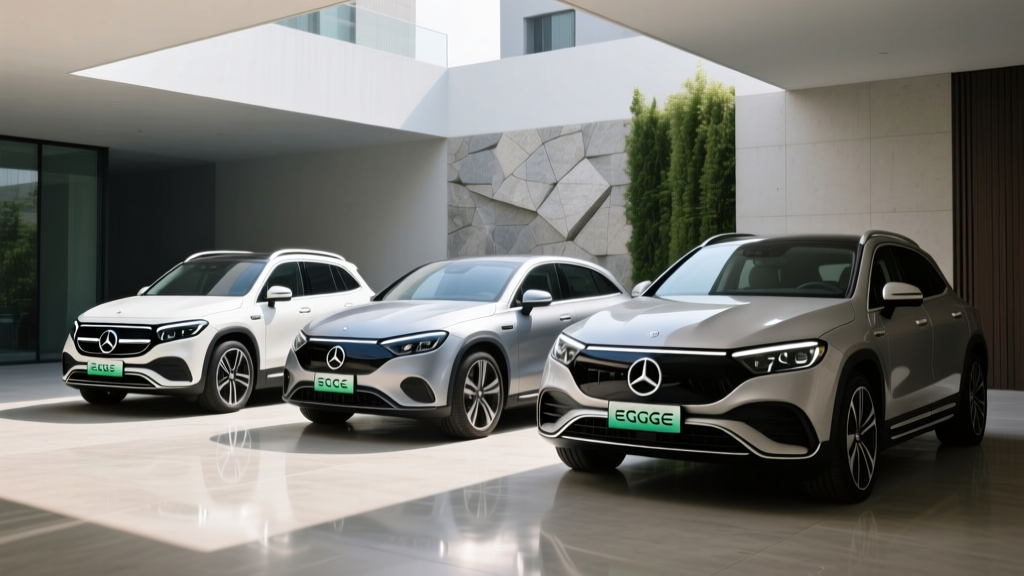
Mercedes-Benz fields three fully electric SUVs for the 2026 model year, each built on dedicated EV architecture (the EVA and EVA2 platforms). Before we get into real-world ownership, here's how they stack up on paper.
| Spec | 2026 EQB 300 4MATIC | 2026 EQE 350 4MATIC SUV | 2026 EQS 450 4MATIC SUV |
|---|---|---|---|
| EPA Range | ~245 mi | ~305 mi | ~330 mi |
| Battery (usable) | 66.5 kWh (NMC) | 90.6 kWh (NMC) | 108.4 kWh (NMC) |
| Max DC Charge Rate | 100 kW | 170 kW | 200 kW |
| 10–80% DC Time | ~32 min | ~32 min | ~31 min |
| Level 2 AC Rate | 9.6 kW | 9.6 kW | 9.6 kW |
| Horsepower | 225 hp | 288 hp | 355 hp |
| 0–60 mph | 7.7 sec | 6.4 sec | 5.8 sec |
| MPGe (combined) | ~96 MPGe | ~84 MPGe | ~82 MPGe |
| Seating | 5–7 (optional 3rd row) | 5 | 5–7 (optional 3rd row) |
| Cargo (behind 2nd row) | ~17 cu ft (5-seat) | ~14 cu ft | ~22 cu ft |
| Base MSRP | ~$54,000 | ~$78,000 | ~$105,000 |
| Powertrain Warranty | 4 yr / 50,000 mi | 4 yr / 50,000 mi | 4 yr / 50,000 mi |
| Battery Warranty | 8 yr / 100,000 mi | 8 yr / 100,000 mi | 8 yr / 100,000 mi |
Sources: EPA / fueleconomy.gov, Mercedes-Benz USA spec sheets. Figures reflect 2026 model-year data where published; some are carryover estimates pending official EPA certification.
Real-World Range Reality Check
EPA estimates assume a mix of city and highway driving at moderate temperatures. In real-world testing:
- Highway-only at 75 mph: Expect 10–15% less than EPA. The EQE 350 4MATIC SUV delivers roughly 260–275 miles on a flat interstate run.
- Cold weather (below 32°F): Lithium-ion NMC batteries lose 20–30% range in sustained cold without preconditioning. The EQB could drop to ~170–195 miles on a freezing winter commute.
- Mountain driving: Regenerative braking recovers some energy on descents, but sustained climbs will cut range significantly. Plan conservatively.
Mercedes' thermal management system and heat pump (standard on EQE/EQS, optional on EQB) mitigate cold losses, but physics still applies. Always plan road trips around 80% of EPA range to avoid stress.
Charging Speeds and What They Mean for Daily Life
Understanding the difference between kW (power, or how fast energy flows) and kWh (energy, or how much the battery holds) is essential. A 100 kW charger doesn't deliver 100 kWh in an hour — and no EV sustains its peak charge rate from empty to full. The charge curve tapers significantly above 80% state of charge to protect battery health.
| Charging Level | Power (kW) | Approx. Miles Added/Hour | Best For |
|---|---|---|---|
| Level 1 (120V household) | 1.4 kW | 3–5 mi/hr | Emergency top-ups, PHEVs |
| Level 2 (240V home/public) | 9.6 kW | 25–35 mi/hr | Daily home charging, overnight |
| DC Fast Charge (EQB) | 100 kW peak | ~150 mi in 30 min | Road trips |
| DC Fast Charge (EQE/EQS) | 170–200 kW peak | ~180–200 mi in 30 min | Road trips, highway stops |
The charging-curve reality: The EQS SUV's 200 kW peak rate only holds roughly from 10–40% SoC. By 60%, it tapers to ~120 kW, and above 80% it drops below 50 kW. This is normal for NMC chemistry. Mercedes' 10–80% claim of ~31 minutes accounts for this taper, but if you need a full charge for a long leg, budget 50+ minutes.
Connector note: All 2026 Mercedes EVs sold in North America use the NACS (Tesla-style) charge port, following Mercedes' transition from CCS1. This grants access to Tesla Supercharger stalls with native NACS connectors, significantly expanding the usable fast-charging network for road trips.
Mercedes Electric SUV vs. Gas and Hybrid: Cost Comparison
Many buyers cross-shop the EQE SUV against the gas-powered GLE or the plug-in hybrid GLE 350e. Here's how the numbers compare over five years of ownership, assuming 12,000 miles/year.
| Cost Factor | EQE 350 4MATIC SUV (EV) | GLE 350 4MATIC (Gas) | GLE 350e (PHEV) |
|---|---|---|---|
| Base MSRP | ~$78,000 | ~$62,000 | ~$68,000 |
| Federal Tax Credit (§30D) | $0–$3,750* | $0 | $0–$3,750* |
| 5-Year Fuel/Energy Cost | ~$3,600† | ~$10,500† | ~$5,800† |
| 5-Year Maintenance | ~$1,800 | ~$4,200 | ~$3,500 |
| 5-Year Insurance (est.) | ~$14,000 | ~$11,000 | ~$12,000 |
| Estimated 5-Yr Depreciation | ~$32,000 | ~$24,000 | ~$28,000 |
| 5-Year Total Cost | ~$95,400 | ~$87,700 | ~$89,300 |
* Federal §30D credit eligibility for Mercedes EVs is limited. Due to battery-component and critical-mineral sourcing requirements under current IRS rules, most Mercedes EVs qualify for $0 or $3,750, not the full $7,500. Income caps ($150K single / $300K joint) and the $80,000 SUV MSRP cap also apply. Verify eligibility at purchase.
† Energy/fuel costs based at $0.15/kWh (home charging average) and $3.50/gallon (premium unleaded). Actual costs vary by region and utility rate. Public DC fast charging at $0.40–0.50/kWh will raise EV energy costs significantly.
Common Mercedes EV Misconceptions
| Myth | Fact |
|---|---|
| "All Mercedes EVs get the $7,500 tax credit." | Most don't qualify for the full amount due to §30D battery-sourcing rules. Verify per VIN before purchase. |
| "I'll never need to charge — one fill-up lasts a month." | At 12,000 mi/yr and 2.5 mi/kWh, you'll consume ~4,800 kWh annually. Home Level 2 charging is essential for convenience. |
| "The battery will need replacing in 5 years." | Mercedes warranties the traction battery for 8 years / 100,000 miles against dropping below ~70% capacity. Real-world NMC degradation averages 10–15% over 100K miles. |
| "EVs cost more to insure." | Often true: EV insurance premiums run 15–25% higher due to repair costs and battery value. Get quotes before committing. |
| "DC fast charging ruins the battery." | Occasional DC fast charging is fine. Sustained daily use without home Level 2 will accelerate degradation slightly, but the thermal management system mitigates most risk. |
Real-World Ownership: What First-Time Buyers Must Know
Buying a Mercedes electric SUV involves more than picking a trim. Here's what affects your daily experience:
Home Charging Access Is Non-Negotiable
Without a Level 2 (240V) home charger, EV ownership becomes a chore. A 9.6 kW home charger adds roughly 30 miles of range per hour — enough to fully replenish an EQE SUV's 90.6 kWh battery in about 10 hours (overnight). Installation costs typically run $1,200–$2,800 for a NEMA 14-50 outlet with a quality EVSE (electric vehicle supply equipment), assuming your electrical panel has capacity. A panel upgrade from 100A to 200A can add $2,000–$4,000. Always get a licensed electrician's assessment before purchasing.
Public Charging Reliability Varies
Mercedes has invested in its own Mercedes-Benz High Power Charging Network with premium stalls, and the NACS connector opens access to Tesla Superchargers. However, public charger uptime still averages 85–90% nationally. For road trips, plan stops using the Mercedes me app or PlugShare, and always identify a backup charger within 15–20 miles.
Climate Matters More Than You Think
If you live in northern states with sustained sub-freezing winters, expect 20–30% range loss on the EQB and 15–25% on the EQE/EQS (which have more robust thermal management). Preconditioning the battery while plugged in — using the Mercedes me app to set departure times — recovers much of this loss and enables faster DC charging at your first stop.
Driving Patterns Determine Which Model Works
A 40-mile round-trip commute with home charging? Any of the three will work, and you'll rarely visit a public charger. Regular 300-mile road trips? The EQS SUV's larger battery and faster charging make it the clear pick. Mostly city driving with occasional third-row needs? The EQB's compact footprint and optional seven seats are ideal.
Decision Framework: Which Mercedes Electric SUV Is Right for You?
Choose Based on Your Situation
- Choose the EQB if: You want the most affordable entry into a Mercedes EV, your daily driving is under 100 miles, you occasionally need a third row for kids, and you have reliable home charging. Budget: ~$54,000 before incentives.
- Choose the EQE SUV if: You need a practical family SUV with 250+ real-world highway miles, value a balance of performance and efficiency, and take road trips 4–6 times per year. This is the volume pick. Budget: ~$78,000.
- Choose the EQS SUV if: You want flagship luxury, maximum range for frequent long-distance driving, three-row seating for adults, and budget is secondary. The 108.4 kWh battery and 200 kW charging make it the most road-trip-capable. Budget: ~$105,000.
- Choose a PHEV (GLE 350e) instead if: You lack reliable home charging, frequently drive 400+ miles without stopping, or your budget is under $70,000. You'll get ~45 miles of electric-only range for commutes with gas-engine backup for road trips.
Federal Tax Credit and Incentive Reality for Mercedes EVs
The §30D federal tax credit remains a major purchase consideration, but Mercedes buyers face limitations:
- MSRP cap: SUVs must have an MSRP at or below $80,000. The EQB and base EQE 350 qualify; the EQS SUV and higher-trim EQE models (AMG variants) exceed the cap.
- Buyer income cap: Modified AGI must not exceed $150,000 (single), $225,000 (head of household), or $300,000 (joint). Check your prior-year or current-year tax return.
- Battery sourcing: As of 2026, both battery components and critical minerals must meet North American/free-trade-agreement sourcing thresholds. Mercedes' supply chain currently qualifies for $0–$3,750 of the $7,500 maximum on most models. This changes as sourcing shifts — always confirm per VIN at the dealer.
- Point-of-sale transfer: You can transfer the credit to the dealer at purchase, reducing your out-of-pocket cost immediately rather than waiting for tax filing.
Some states offer additional rebates (California's CVRP, Colorado's innovative motor vehicle credit, etc.), but amounts and eligibility vary by jurisdiction. Check your state energy office or AFDC state incentives database for current programs.
Maintenance, Warranty, and Long-Term Costs
Electric Mercedes SUVs eliminate oil changes, spark plugs, transmission fluid, and exhaust system repairs. Brake pad life extends significantly thanks to regenerative braking — many owners report 80,000+ miles on original pads.
What you'll still pay for:
- Cabin air filter replacement (~$150–200 annually)
- Tire rotation and replacement (EVs are heavier and produce instant torque; expect tire life of 25,000–40,000 miles depending on compound)
- Brake fluid flush (every 2 years)
- Windshield washer fluid and wiper blades
- Software updates (typically OTA, no cost)
Battery replacement cost: If the NMC traction battery fails outside warranty, replacement costs range from $15,000 (EQB) to $30,000+ (EQS SUV). However, catastrophic battery failure is rare — most degradation is gradual and covered under the 8-year/100,000-mile warranty if capacity drops below ~70%.
Frequently Asked Questions
Do Mercedes electric SUVs qualify for the $7,500 federal tax credit?
Most do not qualify for the full $7,500 under current §30D rules. Due to battery-sourcing requirements, eligibility typically ranges from $0 to $3,750 depending on the specific model and production batch. The EQS SUV also exceeds the $80,000 MSRP cap for SUVs. Always verify credit eligibility with your dealer and consult a tax professional before relying on the credit in your purchase decision.
How long does it take to charge a Mercedes electric SUV at home?
On a 9.6 kW Level 2 home charger, the EQB (66.5 kWh) charges from empty to full in about 7 hours. The EQE SUV (90.6 kWh) takes roughly 9.5 hours, and the EQS SUV (108.4 kWh) takes about 11.5 hours. Most owners charge from 20–80% daily, which takes proportionally less time and preserves long-term battery health.
Is the Mercedes EQB too small for a family?
The EQB offers an optional third row, but it's best suited for children. Cargo space behind the third row is minimal (~7 cu ft). With the third row folded, you get ~17 cu ft — adequate for groceries and strollers but tight for road-trip luggage. If you regularly haul five adults and cargo, the EQE or EQS SUV is a better fit.
What happens if the battery degrades?
Mercedes warranties the high-voltage battery for 8 years or 100,000 miles, whichever comes first, against capacity loss below approximately 70%. Real-world NMC degradation data from similar platforms suggests most batteries retain 85–90% capacity at 100,000 miles with normal use (mix of Level 2 and occasional DC fast charging, avoiding sustained storage at 100% or 0% SoC).
Can I tow with a Mercedes electric SUV?
The EQE SUV and EQS SUV are rated for up to 3,500 pounds of towing capacity when properly equipped. The EQB is not rated for towing in the US market. Keep in mind that towing reduces range by 30–50% depending on trailer weight and aerodynamics — plan charging stops accordingly.
How does Mercedes' driver assistance compare to Tesla Autopilot?
Mercedes offers Driver Assistance Package with adaptive cruise, lane-keeping, and automated lane changes — this is SAE Level 2, meaning the driver must remain fully engaged with hands on the wheel and eyes on the road. It is not self-driving. Mercedes also offers Drive Pilot (SAE Level 3) on select models in approved conditions (limited-access highways, below 40 mph, clear weather), which allows the driver to look away from the road — but this is geofenced and not available everywhere. Only Level 4 robotaxi services like Waymo operate without a human driver.
Always verify specifications, pricing, and incentive eligibility with your local Mercedes-Benz dealer and the IRS §30D guidance page before purchasing. Model-year specs may change, and this guide reflects data available as of the 2026 model year.