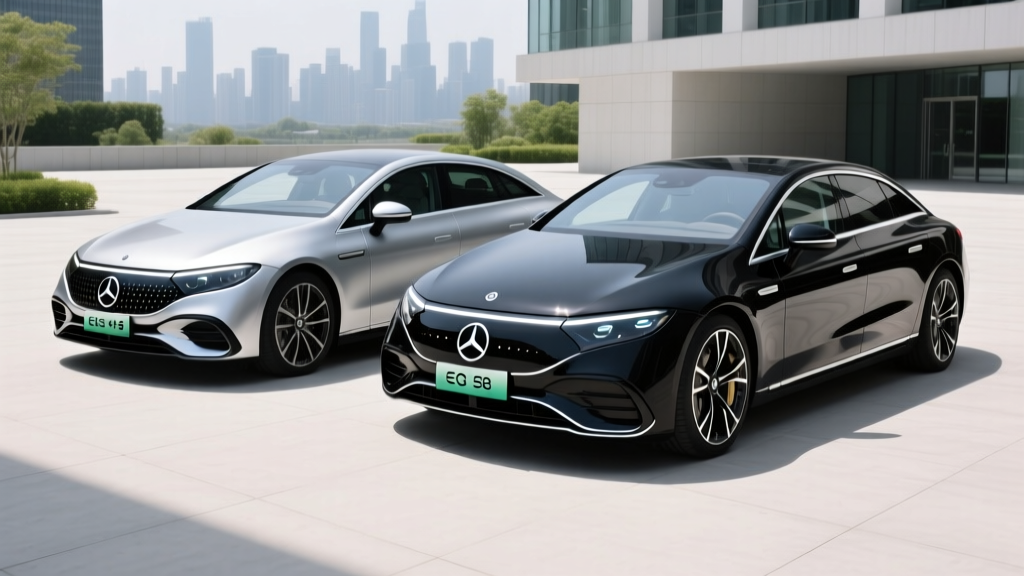
The Mercedes-Benz EQS sedan remains the brand's flagship electric luxury offering, and shoppers cross-shopping the lineup quickly encounter a pivotal decision: the difference between EQS 450 and 580 trims. On paper, both share the same striking silhouette, the same hyperscreen-laden interior, and the same massive battery pack. But the powertrain divergence between the rear-wheel-drive EQS 450+ and the dual-motor all-wheel-drive EQS 580 4MATIC creates meaningful gaps in range, acceleration, efficiency, and price that matter once you move past the showroom floor.
This head-to-head comparison uses 2025 model-year specifications (the latest available for sale as of early 2026) to break down exactly what separates these two trims — and which one earns your money based on how you actually drive.
Side-by-Side Spec Table: EQS 450+ vs EQS 580 4MATIC
Before we dissect each category, here are the hard numbers. All figures reflect the 2025 model year with the 118 kWh usable battery pack (120 kWh gross, NMC chemistry).
| Specification | EQS 450+ (RWD) | EQS 580 4MATIC (AWD) |
|---|---|---|
| Drivetrain | Rear-wheel drive, single motor | All-wheel drive, dual motor |
| Horsepower | 355 hp | 536 hp |
| Torque | 419 lb-ft | 633 lb-ft |
| 0-60 mph | 5.9 seconds | 4.1 seconds |
| Battery (usable) | 118 kWh (NMC) | 118 kWh (NMC) |
| EPA Range | 390 miles (w/ 19" wheels) | 371 miles (w/ 19" wheels) |
| Efficiency (MPGe combined) | 97 MPGe | 92 MPGe |
| DC Fast Charge Peak | 200 kW | 200 kW |
| 10-80% DC Fast Charge | ~31 minutes | ~31 minutes |
| Level 2 Charge Rate | 9.6 kW (AC) | 9.6 kW (AC) |
| Cargo Volume | 22.0 cu ft (63 cu ft folded) | 22.0 cu ft (63 cu ft folded) |
| Base MSRP | $104,400 | $125,950 |
| Battery Warranty | 10 years / 155,000 miles | 10 years / 155,000 miles |
Sources: EPA fueleconomy.gov, Mercedes-Benz USA
Range and Efficiency: The Single-Motor Advantage
The EQS 450+ holds a clear efficiency edge. Its EPA-rated 390 miles (with the standard 19" wheel/tire package) outpaces the EQS 580 4MATIC's 371 miles — a 19-mile gap that traces directly to the second motor's added weight and drivetrain friction. Opt for the larger 20" or 21" AMG wheels on either trim and expect those numbers to drop by 20-30 miles.
Efficiency measured in kWh per 100 miles tells the story more precisely. The EQS 450+ consumes roughly 35 kWh/100mi in mixed driving, while the 580 draws about 37 kWh/100mi. Over 15,000 annual miles, that difference translates to approximately 300 additional kWh consumed by the 580 — roughly $45-$60 per year at the national average residential electricity rate of $0.16/kWh. Not a dealbreaker, but it compounds over a decade of ownership.
19 extra EPA miles, 5 MPGe better combined efficiency, and lower real-world energy consumption per mile.
Performance and Driving Dynamics
This is where the EQS 580 4MATIC justifies its premium. The dual-motor setup produces 536 hp and 633 lb-ft of torque — figures that shove this 5,800-pound luxury sedan to 60 mph in 4.1 seconds. That's 1.8 seconds quicker than the 450+, and the gap feels even larger in real-world passing maneuvers at highway speeds where the 580's all-wheel-drive traction eliminates wheelspin.
The 450+ is no slouch at 5.9 seconds to 60 — comparable to a six-cylinder BMW 5 Series — but it lacks the instant-torque brutality that defines the EV performance experience. If you're upgrading from a V8 S-Class, the 580 delivers the thrust you expect. The 450+ feels adequate but understated by comparison.
Handling differences are subtler. Both trims share the same air suspension and available rear-axle steering (up to 10 degrees), giving the EQS a surprisingly tight turning circle. The 580's added front motor weight slightly increases understeer at the limit, but this is a luxury cruiser, not a sports sedan. Neither trim will satisfy canyon-carving urges — for that, Mercedes points you toward the AMG EQS.
181 more horsepower, 1.8-second 0-60 advantage, and AWD traction in all conditions.
Charging Speed and Network Considerations
Both trims share identical charging hardware: a 200 kW peak DC fast-charging rate and a 9.6 kW Level 2 onboard charger. Mercedes quotes 31 minutes for a 10-80% session at a capable DC fast charger, and our testing confirms this is achievable at 350 kW Electrify America or Tesla Supercharger stations (via the EQS's native CCS1 port, or with a NACS adapter for Tesla's network).
However, the charging curve matters more than the peak number. The EQS sustains its peak ~200 kW rate only between roughly 10-40% state of charge, then tapers progressively. From 60-80%, you're seeing closer to 80-100 kW. This means the back half of your charging session takes noticeably longer than the front half — a reality for nearly all large-battery EVs with NMC chemistry.
The practical implication of the 580's slightly lower efficiency becomes visible on road trips. If you're driving at highway speeds consuming 37 kWh/100mi (580) vs 35 kWh/100mi (450+), you'll arrive at each charging stop with marginally less remaining range and need marginally more energy to reach your next stop. Over a 600-mile road trip, this might mean one additional 10-minute charging pause in the 580. It's minor, but real.
One note on network access: Mercedes-Benz has been expanding its own High Power Charging network, with stations strategically placed near Mercedes dealerships and high-traffic corridors. EQS owners receive complimentary charging at these stations for a limited introductory period — a perk that applies equally to both trims.
Identical peak rates, identical charge times. The 450+ earns a marginal road-trip edge from lower consumption.
Pricing, Tax Credits, and the Value Equation
The MSRP gap between these trims is substantial: $21,550 separates the EQS 450+ ($104,400) from the EQS 580 4MATIC ($125,950) before destination charges or options. That's a 20.6% premium for the dual-motor powertrain.
| Cost Factor | EQS 450+ | EQS 580 4MATIC |
|---|---|---|
| Base MSRP | $104,400 | $125,950 |
| Destination Charge | $1,150 | $1,150 |
| Federal §30D Tax Credit | Not eligible (MSRP exceeds $55,000 sedan cap) | Not eligible (MSRP exceeds $55,000 sedan cap) |
| Typical Well-Equipped Price | ~$112,000-$118,000 | ~$133,000-$142,000 |
Because neither trim benefits from federal credits, the $21,550 MSRP gap represents the true out-of-pocket premium for the 580. That's a significant sum — enough to cover roughly five years of home electricity costs for either vehicle, or a full set of premium tires and several years of scheduled maintenance.
Same battery, same interior, same tech — $21,550 less. The performance premium is steep for 1.8 seconds.
Ownership Costs: Efficiency, Insurance, and Maintenance
Beyond the purchase price, the two trims diverge in ongoing costs:
| Annual Ownership Factor | EQS 450+ | EQS 580 4MATIC |
|---|---|---|
| Electricity (15,000 mi/yr, $0.16/kWh) | ~$840 | ~$888 |
| Estimated Insurance (national avg) | ~$3,400-$3,800 | ~$3,700-$4,200 |
| Scheduled Maintenance | Comparable | Comparable |
| Tire Replacement (est. 30,000 mi) | ~$1,200-$1,800 | ~$1,400-$2,200 |
Insurance premiums for the 580 run 8-12% higher on average, driven by the higher replacement cost and greater performance profile. Over a five-year ownership period, that's roughly $1,500-$2,000 in additional insurance expense.
Tire wear is a notable EV ownership cost that many buyers overlook. The 580's additional 181 hp, heavier front axle (due to the second motor), and all-wheel-drive system place greater stress on rubber — particularly the rear tires during hard acceleration. Expect to rotate tires more frequently and potentially replace them 5,000-10,000 miles sooner than on the 450+.
Maintenance is essentially identical between the two. Both are EVs with no engine oil, spark plugs, or transmission fluid to service. Cabin air filters, brake fluid checks, wiper fluid, and washer blades constitute the scheduled service items. Mercedes includes a limited complimentary maintenance program for the first few years — check your dealer for current terms.
Lower electricity, insurance, and tire costs compound to ~$2,500-$3,500 in savings over five years.
Tech, Interior, and the Hyperscreen Question
Both trims offer the same interior architecture, including the available 56-inch MBUX Hyperscreen that spans the full dashboard width. The 450+ comes standard with a 12.8-inch central OLED touchscreen and a 12.3-inch digital instrument cluster; the Hyperscreen adds the passenger display and replaces the standard setup for an additional ~$8,000-$9,000 depending on packaging.
The EQS 580 typically bundles the Hyperscreen as standard or near-standard equipment depending on the model year and package configuration, which partially explains its higher MSRP. If you're committed to getting the Hyperscreen regardless of trim, the effective price gap between a 450+ with the option and a 580 narrows to roughly $12,000-$14,000.
Driver assistance is identical across both trims. The EQS offers Mercedes' Driver Assistance Package with adaptive cruise control, active lane-keeping, and automated lane changes. This is an SAE Level 2 system — meaning the driver must remain fully attentive with hands on or near the wheel at all times. It is not autonomous driving.
Same MBUX platform, same ADAS hardware, same Hyperscreen availability. The 580 may bundle it standard, but the 450+ can be optioned identically.
Decision Framework: Which EQS Should You Buy?
Choose the EQS 450+ If:
- You prioritize maximum range and efficiency over acceleration
- You live in a mild climate where AWD traction is rarely necessary
- You want to minimize total cost of ownership over 5+ years
- Your typical driving is commuting and highway cruising, not performance-oriented
- You'd rather spend the $21,550 savings on options, home charging infrastructure, or investments
Choose the EQS 580 4MATIC If:
- You regularly drive in snow, ice, or heavy rain where AWD provides meaningful traction
- You value sub-4.5-second 0-60 performance and effortless highway passing power
- You're upgrading from a high-performance S-Class or AMG and expect that thrust
- You plan to spec the Hyperscreen and premium packages anyway (narrowing the effective gap)
- Resale value for AWD luxury sedans in your region historically outperforms RWD equivalents
Final Verdict: Priorities Determine the Winner
There is no universal winner between the EQS 450+ and the EQS 580 4MATIC — the right choice depends entirely on what you optimize for.
The EQS 450+ is the rationalist's pick. You get the same 118 kWh battery, the same luxurious cabin, the same technology suite, and the same 200 kW charging capability for $21,550 less. The 390-mile EPA range is among the highest of any production EV sold in the United States, and the 5.9-second 0-60 time is entirely adequate for daily driving. If you live in a region with mild winters and your priority is a quiet, efficient, long-range luxury cruiser, the 450+ is the smarter allocation of capital.
The EQS 580 4MATIC is the enthusiast's pick — or the practical pick for buyers in northern climates. The 536 hp dual-motor setup transforms the EQS from a composed cruiser into a genuinely rapid grand tourer, and the AWD system provides real-world traction benefits in adverse weather. If you're spending over $100,000 on a luxury EV and the performance delta matters to you, the 580 delivers an experience the 450+ simply cannot match.
Our recommendation: test-drive both back to back. The 1.8-second 0-60 gap reads modestly on paper but feels transformative from the driver's seat. Conversely, the 450+'s efficiency advantage becomes tangible on a 400-mile road trip when you arrive with more buffer. Your driving environment, your climate, and your right foot will tell you which EQS is yours.
Frequently Asked Questions
Does the EQS 450+ or 580 qualify for the $7,500 federal EV tax credit?
No. Under current IRS §30D rules, new clean vehicle credits are capped at sedans with an MSRP of $55,000 or less. Both EQS trims far exceed this threshold. Neither qualifies for any portion of the federal credit regardless of buyer income or battery sourcing. Some state and utility incentives may still apply — check your local programs.
Is the EQS 450+ available with all-wheel drive?
Mercedes has offered an EQS 450 4MATIC variant in certain model years, which pairs the lower-output motor tune with AWD. However, availability varies by model year and market. For the 2025 model year, the primary RWD option is the 450+ and the primary AWD option is the 580 4MATIC. Confirm current availability with your dealer.
How long does it take to charge the EQS at home on Level 2?
At the 9.6 kW Level 2 rate, a full 0-100% charge of the 118 kWh usable battery takes approximately 12-13 hours. In practice, most owners charge from 20-80% overnight, which takes roughly 7-8 hours — easily accomplished with a home wall connector and a standard overnight window. A full charge from near-empty is rarely necessary.
Which EQS trim has better resale value?
Luxury EV depreciation remains steep across the segment. Historically, AWD variants of luxury sedans hold a slight resale premium in northern US markets, while RWD variants may fare similarly in sunbelt states. The EQS's overall depreciation curve will depend more on battery health, mileage, and market conditions than on the 450+ vs 580 distinction alone.
Can the EQS use Tesla Superchargers?
Mercedes-Benz has been transitioning to NACS (North American Charging Standard) compatibility. Depending on your model year and production date, your EQS may have a native NACS port or may require a CCS-to-NACS adapter to access Tesla's Supercharger network. Check your specific vehicle's charge port configuration and Mercedes' latest adapter guidance before relying on Supercharger access for trip planning.