Quick Verdict: Two Flavors of Electric Luxury
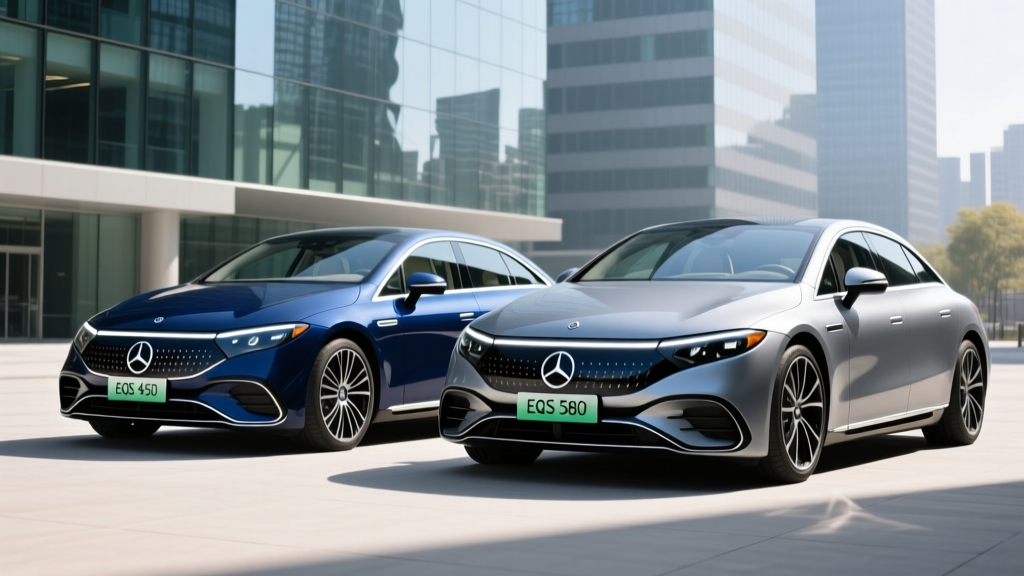
The Mercedes-Benz EQS sedan lineup splits into two distinct personalities. The EQS 450+ prioritizes maximum range and efficiency with a single rear motor, while the EQS 580 4MATIC trades some efficiency for dual-motor all-wheel drive and serious acceleration. Both share the same 108.4 kWh usable battery pack (NMC chemistry) and the same striking aerodynamic silhouette, but the ownership experience diverges in meaningful ways once you look past the badge.
This comparison uses current 2025/2026 model-year data from fueleconomy.gov and Mercedes-Benz USA specifications. If you're cross-shopping these two trims, the decision almost always comes down to three variables: how many miles you drive daily, whether you need all-wheel drive, and how much you value outright acceleration over efficiency.
Side-by-Side Specs: EQS 450+ vs EQS 580 4MATIC
| Specification | EQS 450+ | EQS 580 4MATIC |
|---|---|---|
| Drivetrain | RWD (single motor) | AWD (dual motor) |
| Horsepower | 355 hp | 536 hp |
| Torque | 419 lb-ft | 633 lb-ft |
| 0–60 mph | 5.9 sec | 4.1 sec |
| Battery (usable) | 108.4 kWh (NMC) | 108.4 kWh (NMC) |
| EPA Range | 390 mi | 371 mi |
| Efficiency (combined) | 97 MPGe | 92 MPGe |
| DC Fast Charge (peak) | 200 kW | 200 kW |
| 10–80% DCFC Time | ~31 min | ~31 min |
| Level 2 Charge Rate | 9.6 kW | 9.6 kW |
| Cargo Volume | 22.0 cu ft | 22.0 cu ft |
| Curb Weight | ~5,600 lbs | ~5,800 lbs |
| Base MSRP | $104,400 | $125,950 |
| Battery Warranty | 10 yr / 155,000 mi | 10 yr / 155,000 mi |
Range & Efficiency: Where the 450+ Pulls Ahead
The EQS 450+ carries an EPA-estimated 390 miles of range — one of the highest of any production EV sold in the U.S. The 580 4MATIC drops to 371 miles, a 19-mile gap driven by the second motor's weight, mechanical drag, and higher energy consumption under load.
EQS 450+: EPA 390 mi. Expect ~320–340 mi in mixed highway driving at 70–75 mph, and ~260–280 mi in sustained cold weather (below 32°F) without preconditioning.
EQS 580 4MATIC: EPA 371 mi. Expect ~300–320 mi highway, ~240–260 mi cold weather. The AWD system recovers slightly more energy through regen on deceleration, partially offsetting its efficiency penalty in stop-and-go traffic.
Efficiency data from fueleconomy.gov confirms the gap: the 450+ consumes roughly 35 kWh per 100 miles combined, while the 580 draws about 37 kWh/100 mi. Over a 15,000-mile driving year, that translates to approximately 75 kWh more electricity consumed in the 580 — roughly $12–$18 in additional annual charging cost at national-average residential rates. Not a dealbreaker, but it compounds over a decade of ownership.
Category Winner: EQS 450+ — for buyers who prioritize maximum distance between charges and lowest energy cost per mile.
Charging Speed & Network Reality
Both trims share identical charging hardware: a peak DC fast-charge rate of 200 kW and a Level 2 onboard charger rated at 9.6 kW. Mercedes quotes a 10–80% DC fast-charge time of approximately 31 minutes for both models, and in our experience the charge curve is nearly identical since the battery pack is the same.
A note on the charge curve: both EQS models sustain close to peak power up to roughly 40–50% SoC, then begin tapering. Above 80%, charging slows dramatically to protect the NMC cells — expect 80–100% to take an additional 25+ minutes. Plan your road-trip stops around 10–80% sessions for optimal time efficiency.
| Level | Power | Miles Added per Hour | Typical Use Case |
|---|---|---|---|
| Level 1 (120V) | ~1.4 kW | ~4 mi/hr | Emergency / overnight trickle |
| Level 2 (240V, 40A) | 9.6 kW | ~28 mi/hr | Home daily charging |
| DC Fast Charge | 200 kW peak | ~180 mi in 15 min (to ~50%) | Road trips |
On the network front, Mercedes-Benz has been expanding its own branded charging network (Mercedes-Benz High Power Charging) with sites co-located near dealerships and high-traffic corridors. Both EQS models also use the CCS1 connector natively and, with Mercedes' provided adapter or newer model-year NACS integration, can access Tesla Supercharger stations. This dual-network access is a genuine advantage for road-trip flexibility.
Category Winner: Tie — identical charging hardware and speeds.
Performance & Driving Dynamics
This is where the 580 4MATIC justifies its $21,550 premium. With 536 hp and 633 lb-ft of torque on tap, it hits 60 mph in 4.1 seconds — sports-sedan territory in a 5,800-pound luxury flagship. The dual-motor AWD system provides confident traction in rain and light snow, and the torque-vectoring rear bias gives it a surprisingly agile feel for its size.
The 450+ is no slouch at 5.9 seconds to 60 with 355 hp, and its rear-wheel-drive layout gives it a slightly lighter, more traditional luxury-sedan steering feel. For daily commuting and highway cruising, the 450+ delivers more than adequate passing power and a whisper-quiet cabin. The performance gap matters most at highway merge speeds and in adverse traction conditions.
Both models come standard with AIRMATIC air suspension and rear-axle steering (up to 10 degrees), which dramatically tightens the turning circle and makes this 17-foot sedan maneuverable in parking structures.
Category Winner: EQS 580 4MATIC — for buyers who want all-weather confidence and effortless acceleration.
Interior, Tech & Features
The cabin experience is nearly identical between the two trims. Both feature the available MBUX Hyperscreen — a 56-inch curved glass panel spanning the entire dashboard — along with Burmester 3D surround sound, heated and ventilated front seats, and ambient lighting with 64 colors. Rear-seat space is generous, and the hatchback-style trunk opening (22.0 cu ft) makes cargo loading practical despite the sedan silhouette.
On the driver-assistance front, both trims include Mercedes' latest Driver Assistance Package with Active Distance Assist DISTRONIC (adaptive cruise), Active Steering Assist, and Active Lane Change Assist. This is an SAE Level 2 system: it can manage speed, steering, and lane changes under specific conditions, but the driver must remain engaged with hands on the wheel at all times. It is not autonomous driving.
Mercedes' Active Steering Assist is a Level 2 driver-assist system. It requires continuous driver supervision. It will not navigate construction zones, handle all weather conditions, or drive without human oversight. Always keep your hands on the wheel and eyes on the road.
The 580 4MATIC includes a few additional standard features over the 450+, such as multicontour front seats with massage and a slightly upgraded interior trim package, but most differences can be optioned onto the 450+ through packages.
Category Winner: Tie — with the caveat that the 580 bundles some options as standard that cost extra on the 450+.
Pricing, Tax Credits & Total Cost of Ownership
Here's where the math gets interesting — and where federal incentive rules create a real divergence between these two trims.
| Factor | EQS 450+ | EQS 580 4MATIC |
|---|---|---|
| Base MSRP | $104,400 | $125,950 |
| §30D Federal Tax Credit | $0 (exceeds MSRP cap) | $0 (exceeds MSRP cap) |
| MSRP Cap for Sedans (§30D) | $55,000 — both exceed | |
| Estimated Insurance (annual) | ~$2,800–$3,400 | ~$3,200–$3,900 |
| Annual Electricity (15k mi) | ~$790 | ~$840 |
| 5-Year Total Energy Cost | ~$3,950 | ~$4,200 |
Neither EQS qualifies for the §30D federal EV tax credit. The IRS caps eligible sedans at an MSRP of $55,000 under current rules (see irs.gov for the latest). Both trims exceed this threshold by a wide margin. State and local incentives may still apply — check your jurisdiction's energy office or DMV for current rebate programs — but do not factor a $7,500 federal credit into your budget.
Insurance costs run higher on the 580 4MATIC due to its greater horsepower, higher replacement value, and AWD drivetrain complexity. Based on national averages for luxury EVs, expect to pay $400–$500 more per year to insure the 580. Over five years, that's roughly $2,000–$2,500 in additional insurance expense.
Maintenance costs are comparable between the two — neither has an internal combustion engine, so there are no oil changes, spark plugs, or transmission fluid services. Brake wear is minimal thanks to aggressive regenerative braking. The main long-term cost variable is the battery: Mercedes warranties the pack for 10 years or 155,000 miles against dropping below 70% state of health. Out-of-warranty replacement for a pack this size currently runs $20,000–$30,000, though degradation data on the EQS platform has been favorable so far.
Category Winner (Value): EQS 450+ — $21,550 less at base, lower insurance, marginally lower energy cost, and identical core technology.
Decision Framework: Which EQS Fits Your Life?
Choose the EQS 450+ if:
- You drive 40+ miles daily and want to minimize charging frequency
- You live in a mild climate where AWD is unnecessary
- You value range maximization for road trips (390 mi EPA gives a real-world 320+ mi buffer)
- You want the lowest total cost of ownership in the EQS lineup
- 5.9 seconds to 60 mph is more than adequate for your needs
Choose the EQS 580 4MATIC if:
- You regularly drive in rain, snow, or mountain conditions where AWD traction matters
- You want sub-4.5-second acceleration for highway merging and passing confidence
- You prefer having additional standard luxury features bundled in the base price
- The ~$21,500 premium fits comfortably within your budget without stretching
- You value the dual-motor redundancy for all-weather safety
Real-World Ownership Considerations
Beyond the spec sheet, a few ownership realities apply to both EQS models equally:
Home charging is essential. With a 108.4 kWh battery, Level 1 (120V) charging adds only about 4 miles per hour — essentially useless for daily replenishment. A Level 2 home charger (240V, 40A circuit) delivers roughly 28 miles per hour and can fully recharge the pack in about 11–12 hours. Budget $800–$2,500 for professional Level 2 installation depending on your electrical panel capacity and run length. A 200-amp panel upgrade, if needed, can add $1,500–$3,000.
Cold-weather range loss is real. The EQS uses a heat pump for cabin heating, which is more efficient than resistive heaters, but NMC batteries still lose 20–30% of their effective range in sustained sub-freezing temperatures. Preconditioning the battery while plugged in mitigates this significantly — always schedule departure preconditioning through the MBUX app.
Depreciation remains a wildcard. Luxury EVs, including the EQS, have experienced steeper depreciation than comparable ICE luxury sedans in the 2023–2025 market. If you plan to sell or trade within 3–4 years, factor in a potential 45–55% value loss. Leasing may be the smarter financial play for buyers who want the latest tech without long-term depreciation risk.
Frequently Asked Questions
Does the EQS 580 have more range than the 450+?
No. The EQS 450+ has an EPA-estimated 390 miles of range versus 371 miles for the 580 4MATIC. The dual-motor AWD system in the 580 adds weight and mechanical drag, reducing efficiency despite the identical 108.4 kWh battery.
Can either EQS qualify for the $7,500 federal tax credit?
No. Under current IRS §30D rules, new EV sedans must have an MSRP at or below $55,000 to qualify. Both the EQS 450+ ($104,400) and 580 4MATIC ($125,950) far exceed this cap. Check irs.gov for the latest eligibility details, and consult a tax professional for your specific situation.
Is the EQS self-driving?
No. The EQS offers Mercedes' Active Steering Assist and Active Distance Assist, which are SAE Level 2 driver-assistance features. They can manage steering, speed, and lane changes on highways, but the driver must remain fully engaged. The EQS does not offer autonomous or driverless capability.
How long does it take to charge the EQS at home?
On a Level 2 home charger (9.6 kW), a full 0–100% charge takes approximately 11–12 hours. Most owners charge from 20–80% daily, which takes roughly 6–7 hours — easily accomplished overnight. On a 200 kW DC fast charger, 10–80% takes about 31 minutes.
What's the battery replacement cost for the EQS?
Out-of-warranty replacement for the 108.4 kWh NMC pack is estimated at $20,000–$30,000 based on current luxury EV battery pricing. Mercedes warranties the battery for 10 years or 155,000 miles against dropping below 70% state of health. Real-world degradation data for the EQS platform has been encouraging, with most owners reporting minimal capacity loss in the first 2–3 years.
Is the EQS 450+ or 580 better for road trips?
The 450+ has a slight edge due to its 19 additional miles of EPA range, which translates to fewer charging stops on long trips. However, the 580's AWD system provides more confidence in adverse weather conditions you may encounter on cross-country drives. Both charge at the same 200 kW peak rate, so road-trip charging downtime is identical.