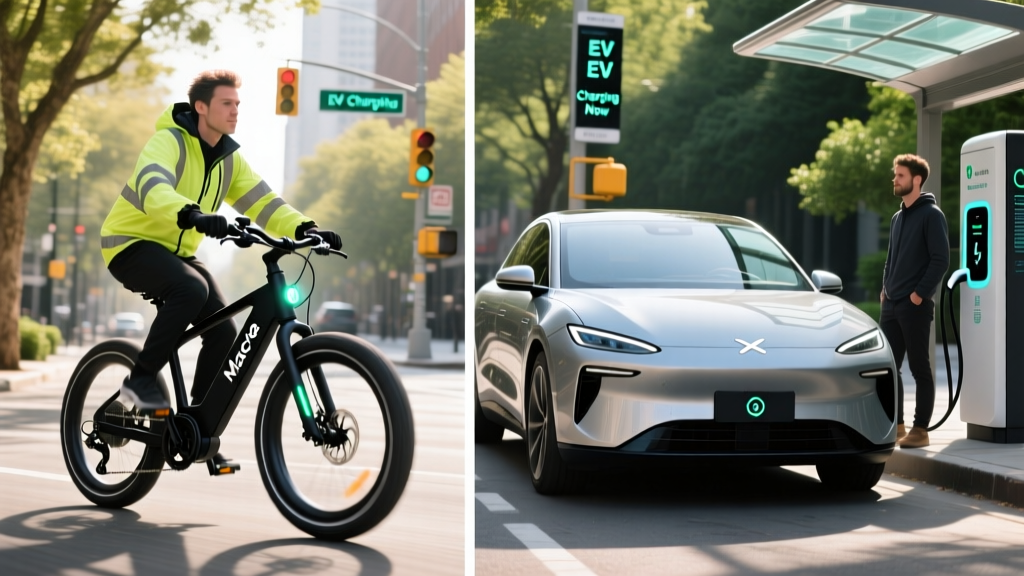
If you're searching for Macwheel electric bikes, you're likely weighing a low-cost electric commute against a full electric vehicle. Here's the direct answer: a Macwheel e-bike (typically $800–$1,500) covers 15–40 miles per charge at pennies per day, making it ideal for solo urban commutes under 15 miles round-trip. A budget EV like the Chevy Equinox EV or Nissan Leaf costs $28,000–$35,000 after incentives but delivers 200+ miles of range, weather protection, cargo space, and highway capability. The right choice depends entirely on your commute distance, climate, and whether you need a car for other trips.
What Macwheel Electric Bikes Actually Offer
Macwheel is a budget e-bike brand sold primarily through Amazon and direct-to-consumer channels. Their lineup typically includes commuter and folding models in the $800 to $1,500 range. Here's what you can expect from a typical Macwheel commuter e-bike in 2026:
- Motor: 350W–500W rear-hub motor (Class 2, throttle-assisted, up to 20 mph)
- Battery: 36V / 10–15 Ah lithium-ion (360–540 Wh usable capacity)
- Range: 20–40 miles per charge (pedal-assist); 15–25 miles on throttle only
- Charge time: 4–6 hours on a standard 120V outlet (2A charger, ~80W draw)
- Weight: 50–60 lbs
- Warranty: Typically 1 year on frame and motor, 6 months on battery
For context, 540 Wh of battery capacity is roughly equivalent to 0.54 kWh — about 1/120th the usable capacity of a Chevy Equinox EV's ~85 kWh pack. That's why e-bike range is measured in tens of miles, not hundreds.
Macwheel E-Bike vs. Budget EV: The Numbers Side by Side
To make this comparison concrete, we're pitting a representative Macwheel commuter e-bike (~$1,200) against a 2026 Chevrolet Equinox EV LT (base MSRP ~$33,000, eligible for up to $7,500 under IRS §30D if you meet income, MSRP, and battery-sourcing requirements). The Equinox EV is one of the most affordable long-range EVs on the market.
| Spec | Macwheel E-Bike (Typical) | 2026 Chevy Equinox EV LT |
|---|---|---|
| Purchase Price | $1,200 | $33,000 MSRP (~$25,500 after §30D credit) |
| Battery Capacity | 0.54 kWh (36V/15Ah) | ~85 kWh usable (NMC) |
| Range per Charge | 20–40 mi (pedal-assist) | 319 mi EPA (expect ~260–280 mi highway) |
| Top Speed | 20 mph (Class 2) | ~110 mph (electronically limited) |
| Charging Time (Full) | 4–6 hours (120V) | ~9.5 hrs (Level 2, 11.5 kW); 10–80% in ~25 min (DC, 150 kW peak) |
| Energy Cost per Mile | ~$0.003/mi | ~$0.04/mi (at $0.16/kWh, 3.5 mi/kWh) |
| Annual Insurance | $0–$150 (optional) | $1,400–$2,200 (varies by state/profile) |
| Maintenance/Year | $50–$150 (tires, brakes, chain) | $300–$600 (tires, cabin filter, fluid top-offs) |
| Passengers | 1 (rider only) | 5 |
| Cargo | Panniers / backpack (~30 lbs max) | 26.4 cu ft rear (57.2 cu ft folded) |
| Weather Protection | None (rider exposed) | Full climate control, heat pump available |
| Warranty (Battery) | 6 months | 8 years / 100,000 miles |
Real Cost of Ownership: 5-Year Breakdown
The sticker price is only part of the equation. Here's what five years of ownership actually costs for each option, assuming a 10-mile round-trip commute, 250 workdays per year (2,500 miles/year), and national average electricity rates.
| Cost Category | Macwheel E-Bike (5 Years) | Chevy Equinox EV (5 Years) |
|---|---|---|
| Purchase (after incentives) | $1,200 | $25,500 |
| Electricity / Energy | $56 (5 yrs × ~$11/yr) | $1,430 (5 yrs × ~$286/yr at 8,750 mi/yr total driving) |
| Insurance | $375 (avg $75/yr optional) | $9,000 (avg $1,800/yr) |
| Maintenance | $500 | $2,250 |
| Battery Replacement | $300–$500 (year 3–4 likely) | $0 (under warranty) |
| Registration / Taxes | $0 | $750 (avg $150/yr) |
| 5-Year Total | $2,431–$2,631 | $38,930 |
| Cost per Commute Mile | ~$0.02 | ~$0.31 |
Key insight: The e-bike costs roughly $36,000 less over five years — but it only covers commuting. If you also need a vehicle for groceries, road trips, family transport, and bad weather, you'll still own or lease a car alongside the e-bike, which changes the math entirely.
Real-World Ownership Considerations
Climate and Seasonality
E-bike range drops 20–30% in cold weather (below 40°F) due to increased battery internal resistance and the rider's body generating less heat. A Macwheel rated for 35 miles in summer may deliver only 22–28 miles in winter. Rain, snow, and ice make cycling impractical or dangerous in many regions. An EV's range also drops 15–30% in cold weather, but the cabin stays heated and the vehicle remains operable.
Home Charging Access
Both options charge on a standard 120V household outlet. The Macwheel draws ~80W (like a laptop charger) and needs no electrical upgrades. The Equinox EV draws up to 1.4 kW on Level 1, adding roughly 4 miles of range per hour — adequate for overnight top-ups if your daily driving is under 40 miles. For faster Level 2 home charging (11.5 kW, ~40 miles/hour), you'll need a 240V circuit installed by a licensed electrician, typically costing $500–$2,000 depending on panel capacity and run length.
Driving Patterns
If your daily routine is a 10-mile commute plus occasional errands within 5 miles, an e-bike handles most trips. If you regularly drive 40+ miles, carry passengers, tow, or take highway trips, an EV is the practical primary vehicle. Many EV owners use an e-bike for short solo errands and the EV for everything else.
Common Misconceptions: Myth vs. Fact
| Myth | Fact |
|---|---|
| "E-bikes are just as good as EVs for commuting." | For fair-weather, short solo commutes, yes. But e-bikes lack weather protection, cargo capacity, highway speed, and passenger seats — limiting them to a subset of trips. |
| "EVs are too expensive compared to e-bikes." | An e-bike is cheaper for commuting alone, but an EV replaces your entire car. Comparing a $1,200 e-bike to a $33,000 EV ignores that you'd still need a car for many trips. |
| "E-bike batteries last as long as EV batteries." | Budget e-bike batteries (typically generic NMC cells) often degrade noticeably within 2–3 years and cost $300–$500 to replace. EV batteries carry 8-year/100,000-mile warranties and are engineered for 1,000+ full cycles with <10% degradation. |
| "I don't need a car if I have an e-bike." | Possibly — if you live in a bike-friendly city with mild weather and no passengers or cargo needs. For most US households, an e-bike supplements a car rather than replacing it. |
| "Macwheel bikes qualify for EV tax credits." | They do not. The federal §30D credit applies only to four-wheeled plug-in vehicles meeting MSRP, income, and battery-sourcing requirements. Some states and localities offer e-bike rebates — check your utility or city programs. |
Decision Framework: Which Should You Choose?
Choose a Macwheel electric bike if:
- Your one-way commute is under 15 miles and mostly on bike lanes or low-speed roads
- You live in a region with 8+ months of rideable weather per year
- You already own a car (or have reliable access to one) for longer trips and bad weather
- You want to minimize commute cost to under $0.05/mile
- You have secure bike storage at home and work (theft is a major e-bike risk)
- Your budget is under $1,500 and you don't want a car payment
Choose a budget EV (Equinox EV, Leaf, Bolt, etc.) if:
- You need one vehicle that handles commuting, errands, road trips, and bad weather
- Your commute includes highway segments (e-bikes are illegal on most highways and unsafe at speed differentials)
- You regularly carry passengers, groceries, or cargo
- You live in a region with harsh winters or frequent rain
- You qualify for the §30D tax credit (check IRS guidelines for income caps: $150K single / $300K joint, and MSRP caps: $55K sedans / $80K SUVs)
- You have or can install Level 2 home charging for daily convenience
Choose both if:
- You own an EV as your primary vehicle and want an e-bike for short solo errands to reduce wear, parking hassle, and energy use — a combination many EV owners find ideal
What First-Time Buyers Should Know About Each Option
Buying a Macwheel E-Bike
Macwheel sells primarily through online channels. Before purchasing, verify the bike's Class rating (Class 1: pedal-assist to 20 mph; Class 2: throttle to 20 mph; Class 3: pedal-assist to 28 mph) and confirm it's legal on your local bike paths. Budget for a quality U-lock ($50–$100), a helmet, lights, and fenders. Battery replacement is the biggest long-term cost — expect to buy a new pack every 2–4 years depending on use. Store the battery indoors and avoid leaving it at 100% or 0% charge for extended periods to maximize lifespan.
Buying a Budget EV
First-time EV buyers should prioritize three things: real-world range (expect 20–30% less than the EPA sticker on highway drives or in cold weather), home charging feasibility (a Level 2 installation quote from a licensed electrician before purchase), and tax credit eligibility (the §30D credit has specific battery-sourcing and critical-minerals requirements that change annually — verify on fueleconomy.gov before committing). Test-drive in conditions that match your actual commute, and check public charging availability along your most common routes using apps like PlugShare or A Better Routeplanner.
Frequently Asked Questions
Can a Macwheel e-bike replace my car entirely?
For a small minority of riders — those in bike-friendly cities with mild weather, no passengers, and short commutes — yes. For most US households, an e-bike replaces 30–60% of car trips but not all of them. You'll likely still need a car or access to one for highway travel, bad weather, large cargo, and passenger trips.
Do Macwheel e-bikes qualify for any tax credits or rebates?
Not the federal §30D clean vehicle credit, which applies only to four-wheeled plug-in vehicles. However, some states, cities, and utility companies offer e-bike purchase rebates ranging from $100 to $1,500. Check your local utility's website or your city's transportation department for current programs.
How long does a Macwheel e-bike battery last before it needs replacing?
Budget e-bike batteries typically deliver 500–800 full charge cycles before capacity drops below 80% of original. With daily commuting use, expect noticeable range degradation by year 2–3 and likely replacement by year 3–5. A replacement battery costs $300–$500. This contrasts sharply with EV batteries, which are warranted for 8 years / 100,000 miles and typically retain 90%+ capacity over that period.
Is it cheaper to commute by e-bike or by EV?
Per mile, the e-bike is dramatically cheaper: roughly $0.003/mile in electricity vs. $0.04/mile for an EV (and $0.12–$0.18/mile for a gas car at 25 MPG and $3.50/gallon). But total cost of ownership depends on whether the e-bike replaces your car or supplements it. If you still need a car, the e-bike is an add-on expense, not a replacement.
What's the safest way to charge a Macwheel e-bike at home?
Use only the manufacturer-provided charger, plug it into a standard 120V outlet (avoid extension cords), and charge in a dry, ventilated area away from flammable materials. Don't leave the battery charging unattended overnight if possible. Budget e-bike chargers typically lack the sophisticated battery management systems found in EV chargers, so monitoring is prudent.