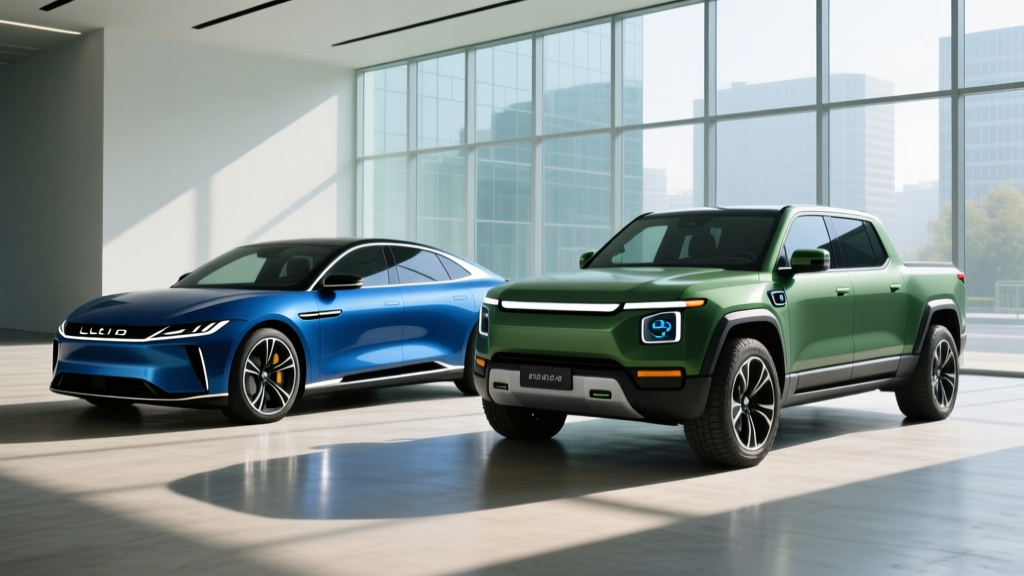
If you're cross-shopping American-built premium electric vehicles, the Lucid vs Rivian debate comes up constantly — and for good reason. Both companies design and manufacture their vehicles in the United States, both push EV technology forward in distinct ways, and both target buyers willing to spend $70,000 or more on an electric vehicle that does something genuinely different from the legacy luxury crowd. But they solve fundamentally different problems.
Lucid builds hyper-efficient luxury sedans and SUVs obsessed with maximizing miles per kilowatt-hour. Rivian builds adventure-ready electric trucks and SUVs engineered to go off-road, tow, and haul gear while still commuting credibly. This comparison pits the 2026 Lucid Air Pure (the volume sedan) and the 2026 Lucid Gravity Touring (the new SUV) against the 2026 Rivian R1S Dual-Motor (three-row SUV) and 2026 Rivian R1T Dual-Motor (pickup truck). We'll break down range, charging, price, tax credit eligibility, and real-world ownership to help you pick the right tool for your life.
Side-by-Side Specs: Lucid Air, Lucid Gravity, Rivian R1S, and Rivian R1T
Before the subjective analysis, here are the hard numbers. All figures reflect 2026 model-year EPA data and manufacturer specifications. Where a range of values appears, it reflects available battery packs and trim configurations.
| Spec | Lucid Air Pure | Lucid Gravity Touring | Rivian R1S Dual-Motor | Rivian R1T Dual-Motor |
|---|---|---|---|---|
| EPA Range | 419 mi | 440 mi (est.) | 352–410 mi | 352–420 mi |
| Battery (usable kWh) | 88 kWh | 118 kWh (est.) | 106 kWh (Standard) / 141 kWh (Max) | 106 kWh (Standard) / 141 kWh (Max) |
| Chemistry | NMC | NMC | NMC (Samsung SDI 2170 / 4680) | NMC (Samsung SDI 2170 / 4680) |
| Peak DC Fast Charge | 200+ kW | 300+ kW (est.) | 200 kW (Std) / 220+ kW (Max/4680) | 200 kW (Std) / 220+ kW (Max/4680) |
| 10–80% DC Charge Time | ~25 min | ~20 min (est.) | ~27 min (Std) / ~21 min (Max) | ~27 min (Std) / ~21 min (Max) |
| Horsepower | 430 hp (RWD) | 823 hp (AWD, est.) | 533 hp (Dual-Motor) / 665 hp (Performance) | 533 hp (Dual-Motor) / 665 hp (Performance) |
| 0–60 mph | 5.0 sec | 3.5 sec (est.) | 4.5 sec (DM) / 3.4 sec (Perf) | 4.5 sec (DM) / 3.4 sec (Perf) |
| Efficiency (MPGe) | 146 MPGe combined | ~120 MPGe (est.) | 97–105 MPGe combined | 97–105 MPGe combined |
| Cargo Volume | 32 cu ft (trunk + frunk) | 112 cu ft (max, est.) | 104 cu ft (max, all rows folded) | 54 cu ft bed + 11 cu ft frunk + Gear Tunnel |
| Towing Capacity | Not rated | 6,000+ lb (est.) | 7,700 lb | 11,000 lb |
| Starting MSRP | $69,900 | $79,900 (est.) | $79,900 | $73,000 |
| Battery/Powertrain Warranty | 8 yr / 100,000 mi | 8 yr / 100,000 mi | 8 yr / 175,000 mi | 8 yr / 175,000 mi |
Range and Efficiency: Lucid's Dominant Advantage
Range is where Lucid separates itself from virtually every competitor, not just Rivian. The Lucid Air Pure achieves 419 miles on the EPA cycle while consuming just 23 kWh per 100 miles — a figure that translates to roughly 4.3 miles per kWh, the best of any production EV sold in the U.S. at this price point. The EPA's fueleconomy.gov data confirms this efficiency leadership.
Rivian's R1S and R1T, by contrast, consume 33–35 kWh per 100 miles (roughly 2.9–3.1 mi/kWh). That's not a criticism — it's physics. A 7,000-pound truck-shaped vehicle with the aerodynamic profile of a brick will consume more energy than a 4,800-pound teardrop-shaped sedan. Even with Rivian's larger Max Pack battery (141 kWh usable), the R1S tops out around 410 miles EPA, and most Dual-Motor Standard Pack buyers will see 352 miles.
The Lucid Gravity, as an SUV, splits the difference — its projected 440-mile EPA estimate benefits from Lucid's compact, high-output powertrain modules and 900V+ electrical architecture. But it still can't match the Air sedan's drag coefficient of 0.197.
Verdict on range and efficiency: If maximizing miles between charges is your top priority — whether for road trips, sparse charging infrastructure in your region, or minimizing electricity costs — Lucid wins decisively. The Air Pure's 146 MPGe combined is 40% more efficient than the R1S's ~100 MPGe.
Charging Speed and Network Access
Charging speed is where the comparison gets more nuanced, because peak kW figures only tell part of the story. What matters is the charge curve — how long the vehicle sustains high charging rates before tapering.
Lucid's 900V+ architecture (compared to Rivian's ~400V system) allows the Air and Gravity to accept higher peak power with less current, reducing heat generation. The Air Pure peaks above 200 kW and sustains strong rates through 60% SoC, completing a 10–80% session in approximately 25 minutes. The Gravity's next-generation architecture is expected to push peak rates past 300 kW, potentially cutting 10–80% to roughly 20 minutes.
Rivian's Standard Pack (106 kWh) peaks at about 200 kW with a 10–80% time around 27 minutes. The Max Pack with newer 4680-format cells improves to approximately 220+ kW and ~21 minutes. Both are competitive, but Rivian's lower voltage system means more taper above 70% SoC.
Price, Tax Credits, and Total Cost of Ownership
Sticker price alone doesn't tell the full story. Federal tax credit eligibility under IRS §30D can shift the value equation by up to $7,500, but only if you, the vehicle, and its battery sourcing all meet the requirements.
| Factor | Lucid Air Pure | Lucid Gravity Touring | Rivian R1S Dual-Motor | Rivian R1T Dual-Motor |
|---|---|---|---|---|
| Base MSRP | $69,900 | $79,900 (est.) | $79,900 | $73,000 |
| Under $55,000 Sedan Cap? | No (sedan cap: $55K) | N/A (SUV) | N/A (SUV) | N/A (truck) |
| Under $80,000 SUV/Truck Cap? | N/A | Yes (under $80K cap) | Yes ($79,900 base) | Yes ($73,000 base) |
| Battery Sourcing Compliance | Partial (varies by build date) | Partial (varies) | Partial (varies by pack) | Partial (varies by pack) |
| Buyer Income Cap (AGI) | $150K single / $300K joint | $150K single / $300K joint | $150K single / $300K joint | $150K single / $300K joint |
| Maximum Potential Credit | $0–$7,500 | $0–$7,500 | $0–$7,500 | $0–$7,500 |
Five-Year Ownership Cost Snapshot
Beyond the purchase price, ongoing costs diverge meaningfully:
| Cost Factor | Lucid Air Pure | Rivian R1S (Standard Pack) | Rivian R1T (Standard Pack) |
|---|---|---|---|
| Electricity (home L2, $0.14/kWh avg) | ~$3,020 | ~$4,580 | ~$4,580 |
| Insurance (avg annual premium) | $2,800–$3,400/yr | $2,600–$3,200/yr | $2,400–$3,000/yr |
| Maintenance (tires, cabin filter, fluid) | ~$2,500 | ~$3,200 | ~$3,200 |
| Est. Depreciation (5-yr) | 45–55% | 40–50% | 35–45% |
Lucid's efficiency advantage translates directly into lower charging costs — roughly $1,500 less in electricity over five years compared to Rivian. However, Rivian's R1T has demonstrated stronger residual values, aided by high demand and limited supply in the electric truck segment. Insurance premiums are elevated for both brands relative to mainstream EVs, reflecting high repair costs and limited body-shop networks.
Performance, Capability, and Practical Use
This is where the Lucid vs Rivian comparison becomes less about specs and more about lifestyle. These vehicles are engineered for fundamentally different use cases.
Lucid Air: The Efficiency and Luxury Play
The Air Pure delivers 430 horsepower from a single rear motor, achieving 0–60 mph in 5.0 seconds — quick for daily driving, relaxed by Lucid standards. Step up to the Air Grand Touring or Sapphire and you enter supercar territory (1,234 hp, 0–60 in 1.89 seconds), but at $249,000, that's a different conversation. The Air's cabin is spacious, minimalist, and trimmed in premium materials, with a 34-inch curved glass canopy display. Rear-seat legroom is exceptional for a sedan, and the 32-cubic-foot trunk (combined with a small frunk) out-cargoes many compact SUVs.
Lucid Gravity: The Family EV SUV
The Gravity brings Lucid's efficiency obsession to the three-row SUV segment. With seating for seven, projected 440 miles of range, and available all-wheel drive, it targets families who want maximum range without the sedan form factor. Its air suspension provides adjustable ride height, and Lucid claims a towing capacity exceeding 6,000 pounds — credible for a boat or small trailer, but not in Rivian territory.
Rivian R1S: The Adventure SUV
The R1S is a body-on-frame three-row SUV with genuine off-road capability: 14.9 inches of ground clearance (max), quad-motor tank turns (on Quad-Motor trims), approach/departure angles that embarrass dedicated off-roaders, and a wading depth of over 3 feet. It also delivers 7,700 pounds of towing capacity and seats up to seven. The trade-off is efficiency — you'll visit chargers more often on road trips, and tire replacement costs are significant (20-inch all-terrain tires run $350–$500 each).
Rivian R1T: The Electric Truck
The R1T is a crew-cab pickup with a 4.5-foot bed, a unique Gear Tunnel (pass-through storage behind the rear seats), and an 11,000-pound tow rating. It's the only vehicle in this comparison that can genuinely serve as a work truck, haul a horse trailer, or carry a bed full of lumber. Its dual-motor powertrain delivers 533 hp and 610 lb-ft of torque standard. For buyers who need a truck first and an EV second, there is currently no other credible electric pickup at this price point with R1T's refinement.
Technology, ADAS, and Software
Both Lucid and Rivian develop their driver-assistance systems in-house, and both remain firmly at SAE Level 2 — meaning the driver must remain fully engaged and responsible at all times.
Lucid DreamDrive Pro uses 32 sensors including lidar (on higher trims), offering adaptive cruise, lane centering, and automatic emergency braking. The system is competent but not class-leading — Lucid has been slower to roll out hands-free highway features compared to GM's Super Cruise or Ford's BlueCruise.
Rivian Driver+ provides highway assist with lane centering and adaptive cruise. Rivian has been steadily improving the system via over-the-air updates, and the company's software development pace is notably faster than Lucid's. Rivian's infotainment system — built on a custom OS with a 15.6-inch center display — is more polished and responsive than Lucid's, with better app integration and more frequent OTA feature drops.
Rivian also earns points for its connected adventure ecosystem: built-in trail guides, camping mode with climate control, and a gear-shop integration. Lucid's software is more focused on driving-data visualization and efficiency coaching.
Decision Framework: Which Should You Choose?
Choose Lucid Air or Gravity If:
- Range and efficiency are your top priorities — the Air Pure's 419 miles and 146 MPGe are unmatched in this price range, meaning fewer charging stops and lower electricity costs.
- You primarily drive on-road — sedans and crossovers don't need 14 inches of ground clearance, and Lucid's lower, sleeker design pays dividends in highway efficiency.
- You value a luxury sedan experience — the Air's cabin quietness, ride quality (standard air suspension), and minimalist design compete directly with Mercedes EQS and BMW i7 at a lower price.
- You want maximum range in an SUV — the Gravity's projected 440 miles would make it the longest-range three-row electric SUV available.
- You don't need to tow heavy loads — Lucid vehicles are not designed for heavy towing.
Choose Rivian R1S or R1T If:
- You need truck or off-road capability — 11,000-lb towing (R1T), genuine rock-crawling modes, and a body-on-frame architecture have no Lucid equivalent.
- You regularly carry gear, tow, or go off-pavement — the R1T's bed and Gear Tunnel, or the R1S's roof-rack ecosystem, are purpose-built for adventure.
- You need three rows and real cargo volume — the R1S offers 104 cubic feet with rows folded, plus under-floor storage.
- Residual value matters — Rivian's strong demand and limited production have supported better resale values than Lucid's sedans.
- You prefer faster software iteration — Rivian's OTA update cadence and feature additions have been more aggressive.
- You want a longer powertrain warranty — Rivian's 8-year/175,000-mile battery and driveunit warranty exceeds Lucid's 8-year/100,000-mile coverage by 75,000 miles.
Category Winners at a Glance
Frequently Asked Questions
Which is cheaper to own over five years, Lucid or Rivian?
The Lucid Air Pure costs less to charge (~$1,500 less over five years due to 40% better efficiency) and starts at a lower MSRP. However, Rivian vehicles — particularly the R1T — have held residual value better, which can offset higher operating costs at trade-in time. Insurance is expensive for both. If you drive high annual miles (15,000+), Lucid's efficiency advantage compounds. If you plan to sell in 3–4 years, Rivian's stronger resale may win.
Does the Lucid Air qualify for the $7,500 federal tax credit?
No, in most cases. Under IRS §30D rules, sedans must have an MSRP at or below $55,000 to qualify. The Air Pure starts at $69,900, exceeding this cap. The Lucid Gravity (classified as an SUV) and both Rivian models fall under the $80,000 SUV/truck cap and may qualify, subject to battery sourcing rules and buyer income limits. Always verify current eligibility before purchasing.
Can Rivian vehicles go off-road as well as a Jeep or Land Rover?
Yes, with caveats. The R1S and R1T offer adjustable air suspension with up to 14.9 inches of ground clearance, dedicated off-road drive modes, and impressive approach/departure angles. In real-world trail testing, they outperform most unibody SUVs and compete with body-on-frame off-roaders. The limitation is weight (7,000+ lbs) and tire selection — aggressive rock crawling generates more wear on heavy EVs. For overlanding and moderate-to-difficult trails, Rivian is genuinely capable.
Is Lucid's charging network better than Rivian's?
Neither brand operates a large proprietary charging network comparable to Tesla's. Both now use the NACS connector, providing native access to Tesla Superchargers. Rivian has begun deploying its Adventure Network along popular road-trip routes, but coverage remains limited. In practice, both rely on the same public infrastructure: Superchargers, Electrify America, and ChargePoint. The Lucid Air's superior efficiency means fewer total charging stops on long trips, which is a meaningful practical advantage.
Which brand has better long-term reliability data?
Both Lucid and Rivian are young companies with limited long-term track records compared to legacy automakers. Rivian has produced over 100,000 vehicles (including Amazon EDV delivery vans) and has more fleet-mileage data. Lucid's production volumes are lower. Both companies have faced early-production quality issues typical of startups. Rivian's 8-year/175,000-mile powertrain warranty provides more mileage coverage, which matters for high-use owners. Independent reliability surveys from Consumer Reports and J.D. Power have rated both brands as average or below-average in initial quality — typical for new EV manufacturers still scaling production.