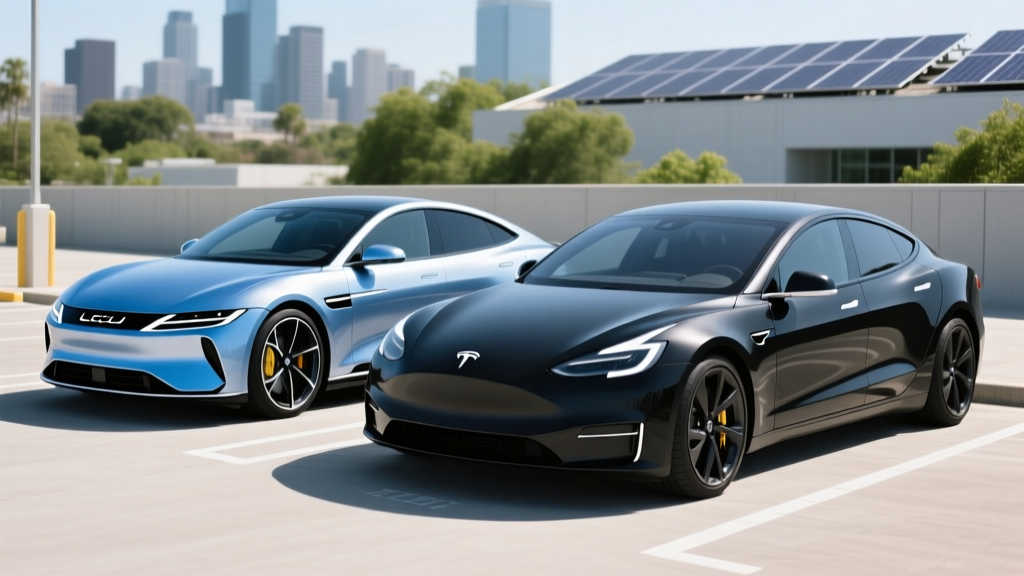
If you are cross-shopping a premium electric sedan or a three-row electric SUV in 2026, the Lucid Motors vs Tesla decision is less about which brand is "better" and more about which engineering philosophy fits your driving life. Lucid prioritizes efficiency-per-kWh and long-range cruising; Tesla prioritizes software, the Supercharger network, and rapid product iteration. Both are compelling, but the spec sheets tell very different stories.
This comparison uses the 2026 Lucid Air Pure (the volume sedan) against the 2026 Tesla Model S Long Range, plus the 2026 Lucid Gravity Grand Touring against the 2026 Tesla Model X Long Range. We'll cover EPA range, real-world expectations, DC fast-charge curves, ownership economics, and the federal §30D tax-credit rules that can swing value by thousands of dollars.
Side-by-Side Spec Table: Sedans and SUVs
| Spec | 2026 Lucid Air Pure | 2026 Tesla Model S LR | 2026 Lucid Gravity GT | 2026 Tesla Model X LR |
|---|---|---|---|---|
| EPA range | 419 mi | 402 mi | 440 mi | 348 mi |
| Battery (usable kWh) | 88 kWh (NMC) | ~95 kWh (NMC) | 112 kWh (NMC) | ~100 kWh (NMC) |
| Efficiency (MPGe / kWh/100mi) | 146 MPGe / 23 kWh | 124 MPGe / 28 kWh | ~118 MPGe / 29 kWh | 109 MPGe / 32 kWh |
| Peak DC charge rate | ~220 kW | ~250 kW (V4) | ~250 kW | ~250 kW |
| 10-80% DC time | ~22 min | ~25 min | ~22 min | ~27 min |
| Level 2 onboard | 19.2 kW | 11.5 kW | 19.2 kW | 11.5 kW |
| 0-60 mph | 5.0 sec | 3.1 sec | 3.5 sec | 3.8 sec |
| Horsepower | 430 hp (RWD) | 670 hp (AWD) | 800+ hp (AWD) | 670 hp (AWD) |
| Cargo (cu ft, rear seats up) | 32 (trunk+frunk) | 28 (trunk+frunk) | 46 (behind 3rd row + frunk) | ~15 (behind 3rd row) |
| Starting MSRP | $69,900 | $79,990 | $94,900 | $89,990 |
| Basic / Powertrain warranty | 4/50k · 8/100k | 4/50k · 8/120k | 4/50k · 8/100k | 4/50k · 8/120k |
Sources: fueleconomy.gov (EPA range/MPGe), Lucid Motors and Tesla spec pages.
Range and Efficiency: Where Lucid's Physics Wins
Lucid's advantage is not just a bigger battery — it's efficiency. The Air Pure RWD posts roughly 23 kWh per 100 miles, meaning it extracts more miles from every kilowatt-hour than the Model S Long Range at ~28 kWh/100mi. Over a year of 12,000 miles, that gap equals roughly 1,000 fewer kWh consumed, or ~$150-$250 in home-charging savings depending on your utility rate.
For the SUV matchup, the Gravity Grand Touring's 440-mile EPA rating is extraordinary for a three-row vehicle, but it rides on a 112 kWh pack that adds weight. The Model X LR, despite a comparable battery size, yields only 348 miles EPA — a 92-mile gap that matters on road trips.
Charging Speed and Network: The Tesla Moat
Peak DC charge rate is only part of the story; the charge curve (how long peak kW is sustained) and network reliability matter more on a 500-mile trip.
| Level | Lucid Air Pure | Tesla Model S LR |
|---|---|---|
| Level 1 (120V, 1.4 kW) | ~5 mi/hr | ~5 mi/hr |
| Level 2 home (240V, 11.5 kW) | ~47 mi/hr | ~47 mi/hr |
| Level 2 home (240V, 19.2 kW, Lucid max) | ~78 mi/hr | N/A (car capped at 11.5 kW) |
| DC fast (peak) | ~220 kW / 10-80% in ~22 min | ~250 kW / 10-80% in ~25 min |
Both cars taper charging power sharply above ~80% State of Charge (SoC) to protect the battery — a normal lithium-ion behavior. Plan DC stops around 80% for best time-efficiency.
Network reality: Tesla's Supercharger network remains the most reliable DC fast-charging ecosystem in the U.S., with 6,000+ stations and strong uptime. Lucid owners can now use NACS adapters to access Superchargers (V2 stalls limited to ~150 kW; V3/V4 stalls closer to the car's peak), but the experience is second-class compared to native Tesla plug-and-charge. Lucid's partnered Electrify America network has improved but still trails Supercharger reliability per J.D. Power and user surveys.
Category Verdicts: Where Each Brand Wins
Range & Efficiency Winner: Lucid
Air Pure's 419 EPA miles and 23 kWh/100mi set the class benchmark. Gravity GT's 440 miles in a 3-row SUV is unmatched.
Performance Winner: Tesla
Model S LR's 3.1-second 0-60 and 670 hp AWD outgun the RWD Air Pure. For raw acceleration, Tesla's dual-motor setup wins the sedan matchup handily.
Charging Network Winner: Tesla
Native Supercharger access, plug-and-charge billing, and superior uptime make road-trip charging materially easier in a Tesla.
Home Charging Winner: Lucid
19.2 kW onboard AC charging (vs Tesla's 11.5 kW) refills the Air ~65% faster on a properly wired Level 2 home circuit — a big deal for high-mileage drivers.
Tech & Software Winner: Tesla
Tesla's UI, OTA cadence, app ecosystem, and Autopilot/FSD (Supervised) feature set remain the industry reference. Lucid's UX is cleaner than most legacy OEMs but still catching up.
Interior & Cargo (SUV) Winner: Lucid
Gravity's 46 cu ft behind the 3rd row plus a usable frunk crushes the Model X's cramped ~15 cu ft behind its third row. Materials and fit in the Gravity also read a class above.
Value (Pre-Credit) Winner: Lucid
Air Pure undercuts Model S LR by ~$10,000 at MSRP while delivering more range.
Price and Federal Tax Credit: The §30D Wild Card
Sticker price is only the opening move. The federal IRS §30D clean-vehicle credit can shift the value calculus by up to $7,500 — but eligibility depends on MSRP caps, buyer income, battery sourcing, and critical-minerals rules that change yearly.
2026 Pricing Snapshot (subject to IRS rules at purchase)
- Lucid Air Pure: $69,900 MSRP — under the $55,000 sedan cap? No, it exceeds the §30D sedan MSRP cap, so it does not qualify for the new-vehicle credit unless Lucid restructures trims or pricing. Used-Air purchases may qualify for the separate $4,000 used-EV credit (income caps apply).
- Tesla Model S LR: $79,990 MSRP — also above the $55,000 sedan cap, so also ineligible for §30D new-vehicle credit.
- Lucid Gravity (SUV cap $80,000): Grand Touring at $94,900 exceeds the SUV/van/pickup cap. Lower trims (if offered under $80k) could qualify — verify on the IRS source list at purchase.
- Tesla Model X LR: $89,990 MSRP — above the $80,000 SUV cap, ineligible for §30D new credit.
Bottom line: neither of these premium trims typically qualifies for the $7,500 new-vehicle credit in 2026. Buyers should check the IRS eligible-vehicle list and their AGI before assuming any credit. State/local incentives may still apply — consult your state DMV or energy office.
Ownership Cost: Efficiency, Insurance, Maintenance
Five-year total cost of ownership (TCO) for these vehicles is dominated by depreciation and insurance, not fuel. That said, Lucid's efficiency edge yields real savings:
- Energy cost: At $0.16/kWh national average, the Air Pure's ~23 kWh/100mi costs ~$3.68 per 100 miles vs Model S LR's ~$4.48. Over 60,000 miles, that's ~$480 in Lucid's favor.
- Insurance: Both brands carry higher-than-average premiums. Teslas tend to be costlier to insure in many states due to repair complexity and parts pricing; get quotes from your carrier before buying.
- Maintenance: EVs need no oil changes, but tire wear, cabin filters, wipers, and brake-fluid checks remain. Tesla's larger service network is a tangible advantage if you live outside a metro with a Lucid service center.
- Depreciation: Tesla benefits from higher volume and broader brand recognition; Lucid's residual values have been more volatile. Check current lease money factors and third-party residual guides for real numbers.
ADAS and Autonomy: Level 2, Not Level 4
Tesla's FSD (Supervised) offers the broadest feature set (city-street assist, lane changes, parking) but remains controversial on safety claims; NHTSA continues to scrutinize Autopilot-involved incidents. Lucid's DreamDrive Pro is more conservative in capability but competent for highway cruising. If you prioritize hands-off-the-wheel convenience on long trips, test-drive both with supervision expectations clearly set.
Decision Framework: Which Should You Buy?
Choose Lucid Air or Gravity if...
- You drive long highway routes and want maximum EPA range per charge
- You can install a 19.2 kW (80A circuit) Level 2 charger at home
- You value a quieter, more traditionally luxurious interior
- You need usable 3rd-row cargo in an SUV (Gravity)
- You don't mind relying partly on Electrify America plus a NACS adapter for Superchargers
Choose Tesla Model S or Model X if...
- You road-trip often and want the most reliable DC charging network
- You value OTA updates, app integration, and software polish
- You want AWD performance in the sedan (3.1s 0-60 Model S LR)
- You live near a Tesla service center and want parts/parts availability at scale
- FSD (Supervised) features are a priority for your commute
Real-World Ownership Notes From the Driver's Seat
Two practical realities rarely show up in spec sheets:
- Cold-weather preconditioning: Both brands precondition the battery for fast charging when you navigate to a DC station, but Tesla's thermal management is battle-tested across millions of vehicles in sub-zero climates. Lucid's system works, but real-world winter charge-curve data is thinner.
- Service access: Tesla operates 1,200+ service locations in the U.S. Lucid's service footprint is far smaller — often relying on mobile rangers and third-party body shops. If you live 90+ minutes from a Lucid service center, factor that into ownership friction.
FAQ: Lucid Motors vs Tesla
Is Lucid owned by Tesla?
No. Lucid Motors is an independent publicly traded company (NASDAQ: LCID), headquartered in Newark, California. Tesla is a separate competitor (NASDAQ: TSLA).
Can a Lucid charge at a Tesla Supercharger?
Yes, using a NACS adapter on newer Lucid vehicles. However, older V2 Supercharger stalls cap at ~150 kW, and the adapter experience is not as seamless as native Tesla plug-and-charge. Expect some stalls to deliver less than Lucid's peak 220-250 kW capability.
Which holds value better, Lucid or Tesla?
Historically Tesla has shown stronger residual values due to brand recognition and volume. Lucid's residuals have been softer, which can actually benefit used-EV buyers hunting for depreciation deals — and may qualify a used Air for the $4,000 used-clean-vehicle credit (income caps apply).
Which is cheaper to own over 5 years?
Depreciation dominates. On pure energy cost, Lucid's efficiency advantage saves a few hundred dollars. Insurance tends to be higher on Teslas in many states. Get real quotes and real residual projections before deciding.
Do either qualify for the $7,500 federal tax credit in 2026?
The Air Pure, Model S LR, Gravity GT, and Model X LR all exceed their §30D MSRP caps ($55,000 sedan / $80,000 SUV) at current MSRPs. Always verify on the IRS eligible-vehicle list at the time of purchase, and consult a tax professional for your specific situation.
Which is safer?
Check the latest NHTSA star ratings and IIHS evaluations for each model year. Both brands engineer to 5-star targets, but ratings can differ by model year and test protocol.
The Lucid Motors vs Tesla decision ultimately maps to priorities: range and efficiency (Lucid) versus network, software, and performance breadth (Tesla). Test-drive both, pull real insurance quotes, and verify tax-credit eligibility on the IRS site before signing — the right answer depends on the miles you actually drive and the charger you can actually install.