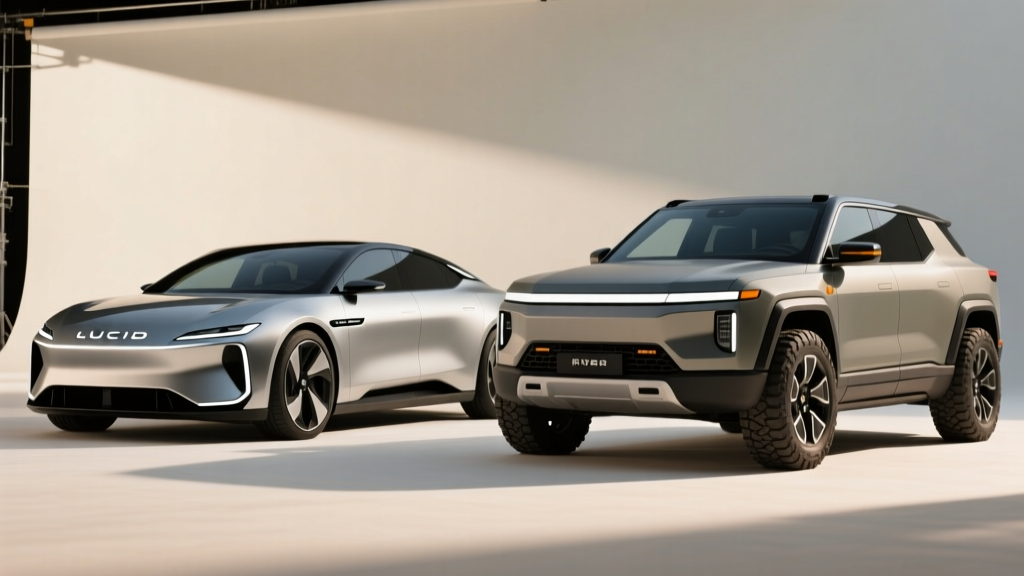
The compact luxury EV crossover segment just got two compelling new entries. The Lucid Cosmos aims to bring Lucid's industry-leading efficiency to a smaller, more accessible package, while the Rivian R2 promises the adventure-ready DNA of the R1S in a footprint that actually fits a standard garage. Both target the $45,000–$55,000 price band, but they approach the EV buyer's checklist from fundamentally different directions.
This head-to-head breaks down every spec that matters — EPA range, real-world charging curves, cargo practicality, federal tax credit eligibility under current IRS §30D rules, and five-year ownership costs. Neither vehicle is universally "better." The right choice depends entirely on whether you prioritize highway efficiency or weekend versatility.
Side-by-Side Spec Table: Lucid Cosmos vs Rivian R2
| Specification | Lucid Cosmos Touring AWD | Rivian R2 Dual-Motor AWD |
|---|---|---|
| EPA Range (est.) | 340 miles | 330 miles |
| Battery Capacity (usable) | 92 kWh (NMC) | 95 kWh (NMC, 4680 cells) |
| Efficiency (MPGe combined, est.) | 130 MPGe / 26 kWh/100mi | 112 MPGe / 30 kWh/100mi |
| Peak DC Fast Charge Rate | 250 kW | 220 kW |
| 10–80% DC Fast Charge Time | ~20 minutes | ~24 minutes |
| Level 2 Charge Rate (kW) | 19.2 kW (48A) | 11.5 kW (48A, single-phase) |
| 0–60 mph | 3.8 seconds | 4.5 seconds |
| Horsepower | 500 hp | 450 hp |
| Towing Capacity | Not rated | 4,400 lbs |
| Cargo Volume (rear seats up / folded) | 28 / 62 cu ft | 34 / 72 cu ft (incl. frunk + gear tunnel) |
| Ground Clearance | 6.8 inches | 8.5 inches (adjustable air suspension) |
| Base MSRP | $52,900 | $47,900 |
| Battery/Powertrain Warranty | 8 yr / 100,000 mi | 8 yr / 120,000 mi |
Note: Both vehicles are announced for 2026 production. Specifications above reflect manufacturer preliminary estimates and may shift before final EPA certification. Always verify with fueleconomy.gov once official ratings are published.
Range and Efficiency: Lucid's Secret Weapon
Lucid Cosmos: EPA est. 340 mi — Expect ~290–310 mi in mixed highway driving; ~240–260 mi in sustained cold weather (below 30°F) at highway speeds.
Rivian R2: EPA est. 330 mi — Expect ~275–295 mi in mixed highway driving; ~220–245 mi in cold weather, given the boxier aero profile and higher curb weight.
Lucid's advantage here isn't just about packing in more kilowatt-hours — it's about using fewer of them per mile. The Cosmos leverages Lucid's miniaturized drivetrain technology and a slippery drag coefficient (est. 0.23 Cd) to achieve roughly 26 kWh per 100 miles. That's meaningfully better than the R2's estimated 30 kWh/100mi, which reflects Rivian's taller, wider stance and off-road-capable suspension geometry.
On a 300-mile highway road trip at 75 mph in 40°F weather, the Cosmos will likely arrive with 40–50 miles of buffer remaining. The R2, by contrast, will be cutting it closer — potentially needing a brief top-up stop. For buyers who regularly drive long corridors (I-5, I-95, I-70), this efficiency gap compounds into real convenience.
However, the R2's larger 95 kWh battery partially offsets the efficiency disadvantage. Raw kWh capacity still matters when terrain, headwinds, and HVAC loads stack up. If you tow even occasionally, expect the R2's range to drop 30–40% with a loaded trailer — but it's the only vehicle here that can tow.
Charging Speed and Network Access
| Charging Level | Lucid Cosmos | Rivian R2 |
|---|---|---|
| Level 1 (120V, 12A) | ~1.4 kW / ~5 mi/hr | ~1.4 kW / ~4 mi/hr |
| Level 2 (240V, 48A) | 19.2 kW / ~68 mi/hr | 11.5 kW / ~38 mi/hr |
| DC Fast Charge (peak) | 250 kW / ~245 mi in 20 min | 220 kW / ~190 mi in 24 min |
| Connector | NACS (native) | NACS (native) |
| Tesla Supercharger Access | Yes (full network) | Yes (full network) |
Both vehicles ship with native NACS ports, granting full access to the Tesla Supercharger network — currently the most reliable DC fast-charging infrastructure in the U.S. This eliminates the CCS-to-NACS adapter hassle that plagued earlier EVs.
The Cosmos charges faster on paper (250 kW peak vs. 220 kW), but sustained charge rate matters more than peak. Lucid's charge curve holds above 200 kW through roughly 50% state of charge before tapering, giving it a meaningful 10–80% advantage of about four minutes. On a road trip with two DC stops, that saves roughly 8–10 minutes total — noticeable but not transformative.
The bigger differentiator is Level 2 home charging. The Cosmos supports 19.2 kW on a hardwired 80-amp circuit, meaning a full overnight replenishment even after a nearly depleted battery. The R2 tops out at 11.5 kW on a standard 48-amp Level 2 setup. For most daily driving (30–50 miles), this gap is irrelevant — both recover overnight easily. But if you regularly drain the battery below 20% and need a full charge by morning, the Cosmos refills roughly 65% faster at home.
One caveat: achieving 19.2 kW at home requires a 100-amp dedicated circuit and a panel that can support it. Many homes with 200-amp main panels will need an upgrade ($2,000–$4,000) to unlock the Cosmos's full Level 2 potential. The R2's 11.5 kW works with a more common 60-amp circuit.
Performance, Capability, and Cargo
This is where the two vehicles diverge most sharply. The Cosmos is a luxury sport crossover tuned for pavement. The R2 is a compact adventure SUV built around capability.
Lucid Cosmos: 500 hp, 3.8-second 0–60, and a low-slung ride height give it sports-sedan reflexes in a crossover body. The tradeoff: 6.8 inches of ground clearance, no tow rating, and a cargo area that's adequate but not generous for the segment. The rear hatch opening is relatively narrow, limiting what you can slide in. Think of it as a raised luxury grand tourer.
Rivian R2: 450 hp and a 4.5-second 0–60 are still quick by any measure, but the R2's engineering budget went elsewhere. Adjustable air suspension lifts ground clearance to 8.5 inches for trail use. The 4,400-pound tow rating handles a small boat or camper. Cargo volume includes a front trunk (frunk) and Rivian's signature gear tunnel — a pass-through storage compartment behind the rear seats that swallows skis, camping gear, or groceries that won't fit in the main cargo area.
For families who camp, ski, kayak, or tow, the R2's capability advantage isn't close. For commuters who value acceleration and handling on twisty canyon roads, the Cosmos delivers a more engaging drive.
Category Winner — Capability & Cargo: Rivian R2 (towing, ground clearance, gear tunnel, frunk).
Price, Tax Credits, and Value
| Cost Factor | Lucid Cosmos Touring AWD | Rivian R2 Dual-Motor AWD |
|---|---|---|
| Base MSRP | $52,900 | $47,900 |
| As-Tested (typical options) | ~$57,000 | ~$53,500 |
| Federal §30D Tax Credit Eligibility | Partial — subject to battery sourcing rules | Likely eligible (U.S. assembly, domestic battery sourcing) |
| Est. Credit Amount | $3,750–$7,500 | $7,500 |
| Effective Price After Credit | ~$49,150–$45,400 | ~$40,400 |
| MSRP Cap (SUVs: $80,000) | Passes ✓ | Passes ✓ |
| Buyer Income Cap (Joint: $300k) | Applies | Applies |
| Point-of-Sale Transfer Available | Yes | Yes |
The Rivian R2 holds a significant price advantage before incentives — $5,000 lower at base MSRP. After the federal §30D clean vehicle credit, that gap can widen to $7,500 or more, depending on whether the Cosmos qualifies for the full credit.
Here's why that's uncertain: the §30D credit has two $3,750 components — one for critical minerals sourcing and one for battery component manufacturing. Both must be met for the full $7,500. Rivian assembles the R2 at its Normal, Illinois factory and has secured domestic battery cell supply, positioning it well for full eligibility. Lucid assembles the Cosmos in Casa Grande, Arizona, but battery cell and critical-mineral sourcing details for the Cosmos-specific pack have not been fully confirmed as of early 2026.
Both vehicles fall under the $80,000 MSRP cap for SUVs/crossovers and are subject to buyer income limits ($300,000 joint / $225,000 head of household / $150,000 individual modified AGI). The point-of-sale transfer option lets you apply the credit as a down payment reduction at the dealer, rather than waiting for a tax refund.
Important: Tax credit eligibility rules shift frequently. Always verify current requirements on IRS.gov or consult a tax professional before purchase.
Tech, ADAS, and Interior
Lucid Cosmos carries forward Lucid's glass-canopy dashboard — a 34-inch curved OLED display spanning the driver's field of view. The interface is clean and responsive, though Lucid's software ecosystem is still maturing compared to Tesla or Rivian. Lucid's DreamDrive Pro ADAS suite includes adaptive cruise, lane centering, and automatic lane changes on highways. This is an SAE Level 2 system — you must keep your hands on the wheel and eyes on the road at all times. It is not self-driving.
Rivian R2 uses a 15.6-inch center touchscreen and a compact driver display, with Rivian's latest software stack that has consistently improved via OTA updates. The R2's Driver+ system also provides Level 2 highway assist with lane centering and adaptive cruise. Rivian's software has a stronger track record for regular feature additions and bug fixes. The R2 also includes camp kitchen integration, pet mode, and gear-guard cameras — features oriented toward its adventure positioning.
Interior material quality slightly favors the Cosmos, which uses more premium soft-touch surfaces and available Nappa leather. The R2 uses durable, easy-clean materials designed for muddy boots and dog hair — practical but less luxurious to the touch.
Category Winner — Interior Luxury: Lucid Cosmos (premium materials, immersive display).
Five-Year Ownership Cost Estimate
| Cost Category | Lucid Cosmos | Rivian R2 |
|---|---|---|
| Purchase Price (after est. credit) | $49,150 | $40,400 |
| Electricity (15,000 mi/yr, $0.16/kWh avg) | $3,900 | $4,500 |
| Insurance (est. annual avg) | $10,500 ($2,100/yr) | $9,250 ($1,850/yr) |
| Maintenance (tires, cabin filter, fluid) | $2,200 | $2,500 |
| Estimated Depreciation (5-yr) | ~$22,000 | ~$17,000 |
| Total 5-Year Cost | ~$87,750 | ~$73,650 |
The Cosmos costs roughly $14,000 more over five years, driven primarily by its higher purchase price and steeper projected depreciation. Lucid, as a newer brand with lower production volume, faces more depreciation uncertainty. Rivian benefits from stronger brand recognition in the adventure-SUV segment and a proven production track record with the R1S/R1T.
The Cosmos does save about $600 on electricity over five years thanks to its superior efficiency — but that barely dents the price gap. Insurance tends to be higher on the Cosmos due to its higher MSRP, more expensive body panels (aluminum-intensive construction), and Lucid's smaller repair network.
Decision Framework: Which Should You Choose?
Choose the Lucid Cosmos if:
- You commute long distances on highways and want maximum real-world range per kWh
- You value sports-sedan acceleration and handling in a crossover body
- Interior luxury and premium display technology are top priorities
- You have (or will install) a 100-amp circuit to unlock 19.2 kW Level 2 home charging
- You don't need to tow or go off-pavement
Choose the Rivian R2 if:
- You want the lowest effective purchase price after the federal tax credit
- You camp, ski, kayak, bike, or tow and need real cargo versatility
- Ground clearance and air suspension matter for dirt roads or snow
- You prefer a proven adventure-EV brand with a strong OTA update track record
- Minimizing five-year total cost of ownership is a priority
Frequently Asked Questions
Does the Lucid Cosmos qualify for the full $7,500 federal tax credit?
It depends on battery sourcing. The Cosmos is assembled in Arizona, but the §30D credit requires both critical-mineral sourcing and battery-component manufacturing to meet specific domestic or free-trade-agreement thresholds. As of early 2026, Lucid has not publicly confirmed full compliance for the Cosmos's specific battery pack. Expect $3,750–$7,500 depending on sourcing certification. Always check IRS.gov for the latest eligible vehicle list before purchasing.
Which vehicle charges faster on a road trip?
The Lucid Cosmos, by about four minutes per 10–80% session (20 min vs. 24 min). Both use NACS connectors with full Tesla Supercharger access, so network reliability is identical. The Cosmos's efficiency advantage also means fewer total charging stops on trips over 500 miles.
Can the Rivian R2 actually go off-road?
Yes, within reason. With 8.5 inches of ground clearance via adjustable air suspension, underbody protection, and Rivian's quad-motor torque-vectoring available on higher trims, the R2 handles forest service roads, snow, sand, and moderate rock crawling. It's not a dedicated rock crawler, but it's significantly more capable off-pavement than the Cosmos or any comparable luxury crossover.
Which has better real-world cold-weather range?
The Cosmos retains a slight edge thanks to Lucid's heat pump system and superior aerodynamics, losing roughly 25–30% of EPA range in sustained sub-30°F highway driving. The R2, with its boxier shape and heavier mass, can lose 30–35%. Both vehicles offer battery preconditioning for DC fast charging in cold weather — use it to minimize charge-time penalties.
Are these vehicles available to order now?
Both the Lucid Cosmos and Rivian R2 are announced for 2026 production with reservations open. Deliveries are expected to begin in mid-to-late 2026 for the R2 and late 2026 for the Cosmos. Final EPA certification and pricing may shift before customer deliveries begin.