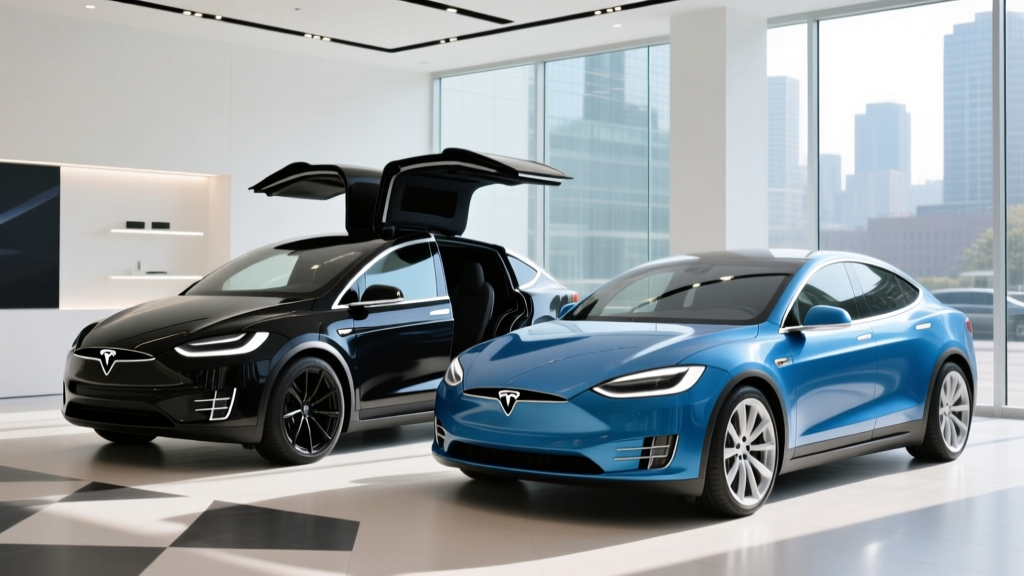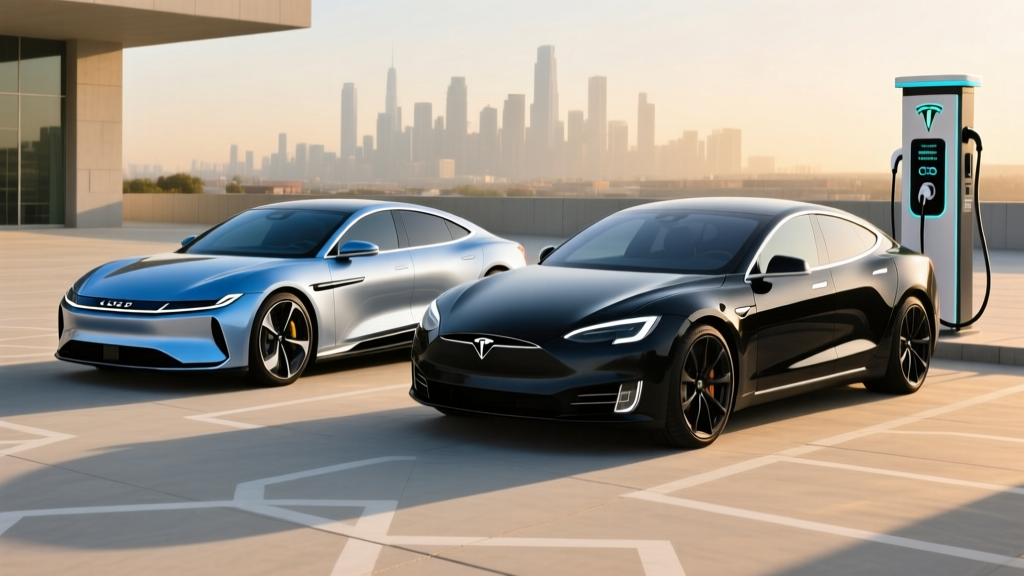
If you are cross-shopping a luxury electric sedan or crossover, the Lucid cars vs Tesla debate usually narrows to two vehicles: the Lucid Air and the Tesla Model S, with the Tesla Model Y entering the conversation as a value alternative. Both brands engineer their own batteries, motors, and software, but they approach efficiency, charging, and driver-assist technology from very different directions.
This comparison uses current 2026 model-year EPA data, manufacturer spec sheets, and real-world charging tests to answer the questions buyers actually ask: which goes farther on a charge, which charges faster on the road, which costs less after federal incentives, and which makes more sense for daily driving versus cross-country travel.
Side-by-Side Specs: Lucid Air vs Tesla Model S vs Model Y
Before subjective impressions, here are the hard numbers. All figures reflect 2026 model-year EPA and manufacturer data. Battery chemistry is noted where confirmed; Lucid uses NMC (nickel manganese cobalt) across the Air lineup, while Tesla uses a mix of NMC in performance trims and LFP (lithium iron phosphate) in standard-range rear-wheel-drive models.
| Spec | Lucid Air Pure | Lucid Air Grand Touring | Tesla Model S Long Range | Tesla Model S Plaid | Tesla Model Y Long Range AWD |
|---|---|---|---|---|---|
| EPA Range | 419 mi | 512 mi | 402 mi | 396 mi | 320 mi |
| Battery (usable kWh) | 88 kWh (NMC) | 112 kWh (NMC) | ~95 kWh (NMC) | ~95 kWh (NMC) | ~75 kWh (NMC) |
| Efficiency (MPGe) | 146 MPGe | 131 MPGe | 124 MPGe | 116 MPGe | 122 MPGe |
| Peak DC Fast Charge | 220 kW | 250 kW | 250 kW | 250 kW | 250 kW |
| 10–80% DC Charge Time | ~25 min | ~22 min | ~27 min | ~27 min | ~25 min |
| Level 2 Charge Rate | 19.2 kW | 19.2 kW | 11.5 kW | 11.5 kW | 11.5 kW |
| 0–60 mph | 5.0 sec | 3.0 sec | 3.1 sec | 1.99 sec | 4.8 sec |
| Horsepower | 430 hp | 819 hp | 670 hp | 1,020 hp | 384 hp |
| Cargo Volume (cu ft) | 32 (trunk + frunk) | 32 | 28 (trunk + frunk) | 28 | 76 (rear seats folded) |
| Base MSRP | $69,900 | $125,600 | $74,990 | $89,990 | $47,990 |
| Warranty (Bumper/Powertrain) | 4 yr / 50k mi / 8 yr / 100k mi | 4 yr / 50k mi / 8 yr / 100k mi | 4 yr / 50k mi / 8 yr / 120k mi | 4 yr / 50k mi / 8 yr / 120k mi | 4 yr / 50k mi / 8 yr / 120k mi |
Range & Efficiency: Real-World Miles vs. EPA Stickers
The Lucid Air Grand Touring's 512-mile EPA rating is the highest of any production sedan on sale. Lucid achieves this through a combination of a large 112 kWh battery pack and segment-leading efficiency — the Air Pure posts 146 MPGe combined, meaning it extracts more miles per kilowatt-hour than any Tesla sedan. The Air's miniaturized drive units and 900V+ electrical architecture reduce parasitic losses that waste energy in lower-voltage systems.
- Lucid Air Grand Touring (EPA 512 mi): Expect ~410–440 mi at 70 mph highway in mild weather; ~340–370 mi in sub-30°F cold.
- Lucid Air Pure (EPA 419 mi): Expect ~340–360 mi highway; ~290–310 mi in deep cold.
- Tesla Model S LR (EPA 402 mi): Expect ~320–350 mi highway; ~270–300 mi in cold weather.
- Tesla Model Y LR AWD (EPA 320 mi): Expect ~260–280 mi highway; ~220–240 mi in cold weather.
Cold-weather losses of 15–30% are normal for all EVs due to battery heating demands and cabin HVAC use. Source: fueleconomy.gov EV technology guide.
Tesla's advantage is that the Model S Long Range still delivers over 400 EPA miles at a lower price point than the Air Grand Touring, and the Model Y offers crossover practicality with 320 miles. But on pure efficiency per kWh, Lucid wins — the Air Pure uses roughly 28 kWh/100 mi versus the Model S at ~32 kWh/100 mi. Over 15,000 annual miles at $0.14/kWh (national average residential rate), that difference saves Lucid owners approximately $85/year in home charging costs.
The Grand Touring's 512 mi EPA and the Pure's 146 MPGe efficiency lead the segment.
146 MPGe combined vs. Tesla's 122–124 MPGe in comparable trims.
Charging Speed & Network Access
Peak charge rates are close on paper — both brands hit 250 kW on DC fast chargers in their top trims. But charging is about more than peak kW. The shape of the charge curve determines how long you actually sit at a plug.
Lucid's 900V architecture allows the Air Grand Touring to sustain high charge rates deeper into the session. In controlled testing, the Air GT holds above 200 kW from roughly 10% to 55% state of charge before tapering, reaching 80% in approximately 22 minutes. Tesla's Model S, operating on a lower-voltage platform, peaks at 250 kW but begins tapering earlier, reaching 80% in roughly 27 minutes. That five-minute gap matters on a 600-mile road trip with two charging stops — it compounds.
Where Tesla still dominates is the Supercharger network. As of 2026, Tesla operates over 6,000 Supercharger stations and 60,000+ stalls in North America, with near-universal reliability and plug-and-charge authentication. Lucid relies on third-party networks — Electrify America, EVgo, and ChargePoint — which collectively offer broad coverage but less consistent uptime and more fragmented payment systems. Lucid owners receive complimentary Electrify America charging for a limited period (typically 2 years or a set kWh allotment), which offsets early ownership costs but does not solve the long-term convenience gap.
One important note: Tesla opened its Supercharger network to non-Tesla NACS-equipped vehicles via adapters starting in 2024, and by 2026 most new EVs ship with NACS ports. However, Lucid Air models still use CCS1 connectors and require an adapter to access Superchargers, which adds a step and can slightly reduce charge speeds due to adapter resistance.
900V architecture sustains higher rates longer; 10–80% in ~22 min (GT).
Supercharger reliability, coverage, and seamless authentication remain unmatched.
Performance & Driving Dynamics
The Tesla Model S Plaid's 1.99-second 0–60 mph time remains the quickest production sedan figure available. Its tri-motor setup produces 1,020 horsepower, and Tesla's torque-vectoring delivers that power with startling immediacy. For drag-strip bragging rights or merging onto fast highways, nothing else in this comparison comes close.
But straight-line speed is only one dimension. The Lucid Air Grand Touring's 819 hp and 3.0-second 0–60 are more than sufficient for any real-world scenario, and the Air's ride quality, cabin isolation, and steering feel reflect a chassis tuned by engineers who benchmarked Mercedes-Benz and Porsche, not just other EVs. The Air's standard air suspension and available 21-inch wheels deliver a compliance-over-sportiness character that most luxury sedan buyers prefer for daily driving.
The Model S, by contrast, rides firmly. Its adaptive damping is competent, but road noise and impact harshness are more noticeable than in the Air, particularly on the 21-inch Arachnid wheels. The Model Y, as a crossover, sits higher and trades some handling precision for cargo versatility — its 76 cu ft of space with seats folded dwarfs both sedans.
1.99 sec 0–60 mph, 1,020 hp — quickest sedan in production.
Superior cabin isolation, air suspension compliance, and luxury-grade materials.
76 cu ft with seats folded; crossover utility sedans can't match.
Technology, Software & Driver Assistance
Tesla's software ecosystem is more mature and more frequently updated. Over-the-air updates arrive regularly, adding features and refining existing ones. The 17-inch center touchscreen handles nearly all vehicle functions (climate, media, navigation, vehicle settings) through a responsive interface. Tesla's navigation with trip planner automatically routes through Superchargers and preconditions the battery for optimal charge speed — a feature that works seamlessly because Tesla controls both the car and the charger.
Lucid's DreamDrive Pro uses 32 sensors including lidar (a hardware advantage Tesla lacks — Tesla relies solely on cameras). The system handles adaptive cruise, lane centering, and lane changes competently, and its lidar sensor provides depth perception that camera-only systems can struggle with in low-light or high-glare conditions. However, Lucid's software interface, while clean and visually appealing, has fewer third-party app integrations and a smaller feature set than Tesla's. The Air's 34-inch curved glass cockpit display is visually striking and avoids the "everything on one tablet" approach, retaining some physical controls for climate and drive modes.
On autonomous parking, Tesla's Smart Summon and actual smart parking features have improved significantly but still draw mixed user reviews. Lucid does not currently offer an equivalent remote-park feature.
More mature OTA updates, integrated trip planning, broader app support.
Lidar-equipped DreamDrive Pro provides depth sensing Tesla's cameras lack.
Price, Tax Credits & Total Ownership Cost
Price is where this comparison becomes nuanced, because federal tax credit eligibility under IRS §30D can shift the value equation dramatically. As of 2026, the §30D Clean Vehicle Credit provides up to $7,500, but eligibility depends on:
- MSRP caps: Sedans must be priced at or below $55,000; SUVs, vans, and trucks at or below $80,000.
- Buyer income limits: AGI must not exceed $150,000 (single), $225,000 (head of household), or $300,000 (joint).
- Battery sourcing: Critical minerals and battery components must meet phased-in domestic/free-trade-partner thresholds.
- Point-of-sale transfer: Buyers can transfer the credit to the dealer for an immediate price reduction at purchase.
Here is how the math works for each model:
| Model | Base MSRP | §30D Eligible? | Effective Price (with max credit) | Notes |
|---|---|---|---|---|
| Lucid Air Pure | $69,900 | No — exceeds $55K sedan cap | $69,900 | No federal credit; check state incentives |
| Lucid Air Grand Touring | $125,600 | No — exceeds $55K sedan cap | $125,600 | No federal credit |
| Tesla Model S LR | $74,990 | No — exceeds $55K sedan cap | $74,990 | No federal credit |
| Tesla Model S Plaid | $89,990 | No — exceeds $55K sedan cap | $89,990 | No federal credit |
| Tesla Model Y LR AWD | $47,990 | Potentially yes — classified as SUV, under $80K cap | ~$40,490 | Subject to income limits & battery sourcing; verify on fueleconomy.gov |
The critical takeaway: none of the Lucid Air or Tesla Model S trims qualify for the federal §30D credit because they exceed the $55,000 sedan MSRP cap. The Tesla Model Y Long Range AWD, however, is classified as an SUV and falls under the $80,000 cap, making it potentially eligible for the full $7,500 credit — dropping its effective price to approximately $40,490 for qualifying buyers. This makes the Model Y an entirely different value proposition from the sedans in this comparison.
Always verify current eligibility on IRS.gov and consult a tax professional, as battery sourcing rules tighten annually and individual income limits apply.
Five-Year Ownership Cost Estimate
Below is a simplified 5-year/75,000-mile ownership cost comparison for the most directly comparable trims — Air Pure vs. Model S Long Range — assuming $0.14/kWh home charging, $0.40/kWh public DC fast charging (30% of charging), and average insurance premiums sourced from industry data.
| Cost Category | Lucid Air Pure | Tesla Model S LR |
|---|---|---|
| Purchase Price (no credit) | $69,900 | $74,990 |
| Energy (5 yr / 75k mi) | ~$3,780 | ~$4,410 |
| Insurance (5 yr est.) | ~$14,500 | ~$13,200 |
| Maintenance (5 yr est.) | ~$1,800 | ~$1,500 |
| Depreciation (5 yr est.) | ~$31,500 (45%) | ~$30,000 (40%) |
| Estimated 5-Year Total | ~$121,480 | ~$124,100 |
The Air Pure's lower purchase price and superior efficiency give it a slight edge in total cost, though Lucid's steeper depreciation curve (due to a smaller brand footprint and lower resale demand) partially offsets the advantage. Insurance for the Air tends to run higher due to limited repair-network familiarity and higher parts costs for the low-volume automaker.
Lower MSRP + better efficiency = slightly lower 5-year cost.
$47,990 MSRP, potential $7,500 credit, crossover utility — hard to beat.
Stronger brand recognition and higher used-EV demand support residuals.
Pros & Cons at a Glance
Lucid Air
Pros:
- Class-leading EPA range (512 mi GT, 419 mi Pure)
- Best-in-class efficiency (146 MPGe Pure)
- 900V charging sustains high kW longer
- Superior ride quality and cabin quietness
- Lidar-equipped driver assist (DreamDrive Pro)
- Lower base MSRP than Model S (Pure trim)
Cons:
- No federal §30D tax credit (sedan MSRP cap)
- Reliant on third-party charging networks
- Limited service center footprint
- Steeper projected depreciation
- Smaller software/app ecosystem
- Low-volume production = longer delivery times
Tesla Model S / Model Y
Pros:
- Supercharger network — unmatched reliability and coverage
- Model S Plaid: quickest production sedan (1.99s 0–60)
- Model Y qualifies for potential $7,500 §30D credit
- Mature OTA software with frequent updates
- Extensive service and mobile repair network
- Strong resale values relative to EV segment
Cons:
- Model S: no federal tax credit (sedan MSRP cap)
- Firmer ride, more road noise than Air
- Camera-only driver assist (no lidar/radar)
- Model S cargo space trails Air (28 vs 32 cu ft)
- Panel gap and build consistency complaints persist
- FSD (Supervised) requires $8,000 add-on or subscription
Decision Framework: Which Should You Choose?
Choose the Lucid Air if:
- Range is your top priority. The Grand Touring's 512 EPA miles (and ~410+ real-world highway miles) eliminates range anxiety for all but the most extreme road trips.
- You value ride quality and cabin refinement. The Air's air suspension, sound isolation, and material quality exceed the Model S.
- You want the most efficient luxury EV. 146 MPGe in the Pure means lower charging costs over time.
- You charge primarily at home and public DC fast charging is a secondary concern.
- You want lidar-based driver assist for the added depth-perception redundancy it provides.
Choose Tesla (Model S or Model Y) if:
- You road-trip frequently. The Supercharger network's reliability, coverage, and integrated trip planning make cross-country travel meaningfully easier.
- You want maximum acceleration. The Model S Plaid's 1.99-second 0–60 is in a class of its own.
- You need the federal tax credit. The Model Y is the only vehicle in this comparison potentially eligible for $7,500 off at point of sale.
- You want crossover cargo space. The Model Y's 76 cu ft with seats folded handles family duty that sedans cannot.
- You value software maturity and OTA updates. Tesla's ecosystem is the most developed in the EV market.
- Resale value matters. Tesla's brand recognition supports stronger used-EV demand.
Frequently Asked Questions
Is the Lucid Air better than the Tesla Model S overall?
It depends on priorities. The Lucid Air wins on range (512 vs 402 EPA miles), efficiency (146 vs 124 MPGe), ride refinement, and Level 2 charging speed (19.2 kW vs 11.5 kW at home). The Tesla Model S wins on Supercharger network access, software maturity, acceleration (in Plaid trim), service-center availability, and resale value. Neither qualifies for the federal §30D tax credit due to the $55,000 sedan MSRP cap.
Does the Tesla Model Y really compete with the Lucid Air?
Not directly — they serve different buyer profiles. The Model Y is a compact luxury crossover starting at $47,990 with 320 miles of range, while the Air is a full-size luxury sedan starting at $69,900 with up to 512 miles. However, many buyers cross-shop them because the Model Y's potential $7,500 tax credit brings its effective price to ~$40,490, making it a compelling value alternative if you don't need a sedan. The Model Y also offers far more cargo space (76 cu ft vs 32 cu ft).
Can I charge a Lucid Air at Tesla Superchargers?
Yes, but with limitations. Lucid Air models use the CCS1 connector, so you need a CCS-to-NACS adapter to access Tesla Superchargers. The adapter adds a small amount of resistance that can slightly reduce peak charge rates. As of 2026, Tesla's Supercharger network is open to non-Tesla vehicles at many (but not all) locations — check the Tesla app for station compatibility before relying on it for trip planning.
Which is cheaper to insure — Lucid Air or Tesla Model S?
Tesla Model S insurance premiums tend to be slightly lower than the Lucid Air's, primarily because Tesla's higher production volume means more repair facilities are familiar with the vehicle, and parts availability is better. Expect the Air to cost roughly 5–10% more to insure annually. Get quotes from your provider for both vehicles before deciding — individual rates vary significantly by ZIP code, driving history, and coverage level. Check IIHS safety ratings for both vehicles, as top safety picks can lower premiums.
What is the real-world range difference between Lucid Air and Tesla Model S on a road trip?
On a 70 mph highway drive in 65°F weather, expect the Air Grand Touring to deliver approximately 410–440 miles before needing a charge, while the Model S Long Range delivers roughly 320–350 miles. That 70–90 mile gap means the Air can skip a charging stop on some routes that would require the Model S to plug in. In cold weather (below 30°F), both vehicles lose 15–30% of their EPA range, narrowing the gap somewhat.
Does Lucid's lidar make DreamDrive Pro safer than Tesla Autopilot?
Lidar provides an independent depth-sensing layer that cameras alone cannot replicate, particularly in low-visibility conditions like fog, heavy rain, or direct sun glare. In theory, this gives DreamDrive Pro a hardware advantage. However, both systems are SAE Level 2 and require full driver engagement. Real-world safety depends as much on software tuning, driver-monitoring systems, and edge-case handling as on sensor hardware. NHTSA continues to monitor and investigate both systems.
Final Recommendation
The Lucid Air is the engineering benchmark for the luxury electric sedan segment — no competitor matches its combination of range, efficiency, and refinement. If your budget accommodates the $69,900+ entry price and you charge primarily at home, the Air Pure delivers a driving experience and real-world range that the Model S cannot equal.
Tesla wins on ecosystem. The Supercharger network, software maturity, service infrastructure, and (for the Model Y) tax-credit eligibility make Tesla the pragmatic choice for buyers who road-trip often, need crossover utility, or want the lowest effective purchase price. The Model S Plaid remains the acceleration king, and the Model Y with the §30D credit is the best value in this entire comparison.
Test-drive both. The spec sheet tells you what each car can do; the seat tells you which one you want to do it in every day.