Quick Verdict: Two Very Different Electric Sports Cars
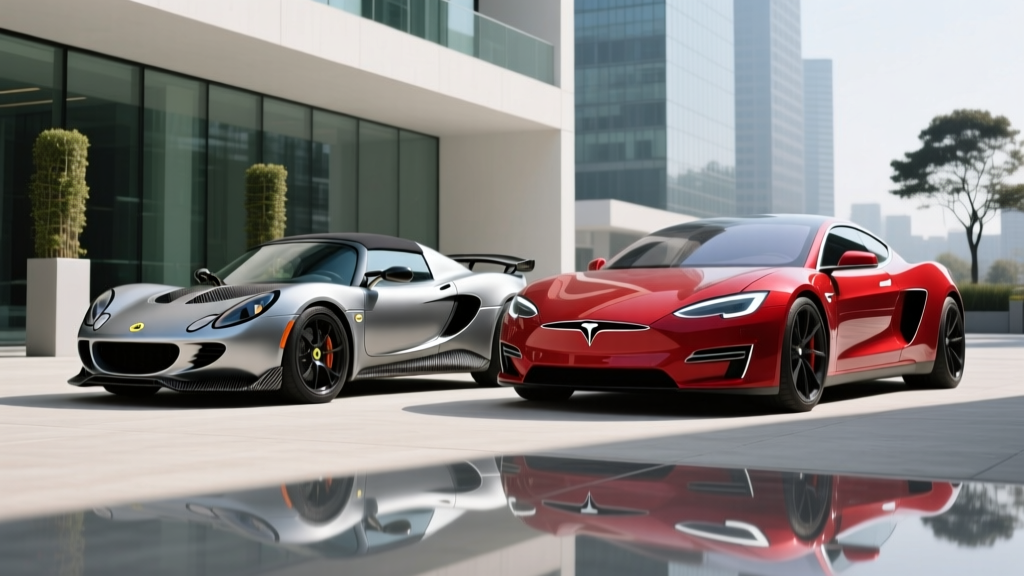
The Lotus Elise and Tesla Roadster represent fundamentally different philosophies in electric sports car design. The Elise prioritizes lightweight agility and driver engagement with modest power, while the Roadster delivers brutal acceleration and cutting-edge tech at a premium price. Neither is universally "better" — the right choice depends entirely on what you value in a sports car.
Side-by-Side Specifications
| Specification | Lotus Elise (2026) | Tesla Roadster (2026) |
|---|---|---|
| EPA Range | 220 miles (est.) | 620 miles (est.) |
| Battery Capacity | ~60 kWh (NMC) | ~200 kWh (NMC) |
| DC Fast Charge (Peak) | 150 kW | 250+ kW |
| 10-80% Charge Time | ~28 minutes | ~20 minutes |
| 0-60 mph | 4.5 seconds | 1.9 seconds (with SpaceX package) |
| Horsepower | ~400 HP | 1,000+ HP |
| Starting MSRP | $75,000 (est.) | $200,000 (base) |
| Cargo Volume | ~3 cu ft | ~5 cu ft |
| Efficiency (MPGe) | ~110 MPGe (est.) | ~95 MPGe (est.) |
| Curb Weight | ~2,600 lbs (est.) | ~4,400 lbs (est.) |
| Drivetrain | Rear-wheel drive | All-wheel drive (tri-motor) |
Note: Both vehicles are announced/preliminary for 2026. Final specs subject to change. Tesla Roadster pricing and specs based on manufacturer announcements; Lotus Elise EV specs estimated based on industry reports.
Range and Charging: Real-World Expectations
Tesla Roadster Range Advantage
The Tesla Roadster's claimed 620-mile EPA range would make it the longest-range production EV ever built, enabled by its massive ~200 kWh battery pack. However, real-world range will vary significantly:
- Highway driving (75+ mph): Expect ~480-520 miles
- Cold weather (below 32°F): Expect ~400-450 miles
- Aggressive driving/track use: Range drops dramatically, potentially 250-350 miles
The Roadster's 250+ kW peak charging speed means a 10-80% charge in roughly 20 minutes at a V3 Supercharger or equivalent DC fast charger. However, charging curves taper significantly above 80%, and sustained speeds depend on battery temperature and state of charge.
Lotus Elise: Lighter but Shorter-Legged
The Elise's estimated 220-mile range reflects its smaller ~60 kWh battery, though its lightweight construction (~2,600 lbs) helps efficiency. Real-world expectations:
- Highway driving: Expect ~170-190 miles
- Cold weather: Expect ~140-160 miles
- Track/aggressive driving: 100-130 miles
With 150 kW peak DC charging, the Elise should achieve 10-80% in roughly 28 minutes. The smaller battery means faster absolute charge times but also more frequent stops on road trips.
Range & Charging Winner: Tesla Roadster
The Roadster's 620-mile range and Supercharger access make it far more practical for road trips, despite the Elise's lighter weight and better efficiency.
Performance: Acceleration vs Handling
Tesla Roadster: Record-Breaking Acceleration
The Tesla Roadster's tri-motor all-wheel-drive system produces over 1,000 horsepower, enabling a 1.9-second 0-60 mph time with the optional SpaceX cold-gas thruster package (base model: ~2.1 seconds). This makes it one of the fastest-accelerating production cars ever built.
However, the Roadster's estimated 4,400-pound curb weight means it won't match the Elise's cornering agility. Tesla's focus is straight-line performance and grand-touring capability, not track-day precision.
Lotus Elise: Lightweight Driver's Car
The Elise's ~400 HP and 4.5-second 0-60 time are modest by modern EV standards, but Lotus prioritizes handling over brute force. At an estimated 2,600 pounds, the Elise will offer:
- Sharper turn-in and cornering response
- Better weight distribution for track driving
- More communicative steering feel
- Lower tire and brake wear during aggressive driving
Lotus has decades of experience tuning lightweight sports cars, and the Elise's chassis dynamics should outclass the heavier Roadster on technical circuits.
Performance Winner: Depends on Your Priority
Acceleration: Tesla Roadster (by a massive margin)
Handling/Track Use: Lotus Elise (lightweight advantage)
All-Around Performance: Tie — different philosophies
Price, Tax Credits, and Value
Base Pricing Comparison
| Cost Factor | Lotus Elise | Tesla Roadster |
|---|---|---|
| Base MSRP | $75,000 (est.) | $200,000 |
| Federal Tax Credit (§30D) | $0 (exceeds MSRP cap) | $0 (exceeds MSRP cap) |
| Effective Price After Credit | $75,000 | $200,000 |
| Destination Fee | ~$1,500 | ~$2,500 |
| Typical Options/Add-ons | $5,000-$15,000 | $10,000-$50,000 (SP package) |
Important Tax Credit Note: Neither vehicle qualifies for the federal §30D EV tax credit. The credit has an MSRP cap of $80,000 for SUVs/pickups/vans and $55,000 for other vehicles (including sports cars). Both the Elise and Roadster exceed these limits. Always verify current IRS rules at irs.gov, as regulations can change.
Value Winner: Lotus Elise
At roughly $75,000, the Elise costs less than half the Roadster's base price. For buyers prioritizing driving engagement over record-breaking acceleration, the Elise offers better value.
Ownership Costs: Efficiency, Insurance, Maintenance
Energy Efficiency and Charging Costs
The Lotus Elise's lighter weight translates to better efficiency — estimated at ~110 MPGe (or ~30 kWh/100 miles) versus the Roadster's ~95 MPGe (~35 kWh/100 miles). Over 15,000 miles annually:
- Elise charging cost: ~$585/year (at $0.13/kWh national average)
- Roadster charging cost: ~$683/year
- Annual savings with Elise: ~$98
The difference is modest, but the Elise's smaller battery also means faster home charging on Level 2 (roughly 4-5 hours for a full charge vs 8-10 hours for the Roadster).
Insurance Costs
Both vehicles will carry high insurance premiums due to their performance and repair costs, but the Roadster's higher price and extreme acceleration will likely result in significantly higher rates:
- Elise estimated annual premium: $3,500-$5,000
- Roadster estimated annual premium: $6,000-$9,000
Insurance varies by driver profile, location, and coverage levels. Get quotes before purchasing.
Maintenance and Reliability
EVs require less maintenance than gas cars (no oil changes, fewer moving parts), but sports cars of any type face higher tire and brake wear. Expect:
- Tire replacement: Every 15,000-25,000 miles (performance tires: $300-$600 each)
- Brake pads: Every 40,000-60,000 miles (regenerative braking extends life)
- Battery warranty: Both should offer 8 years/100,000 miles minimum
Tesla has a larger service network and over-the-air updates. Lotus service centers are rarer, which could mean longer wait times for repairs.
Ownership Cost Winner: Lotus Elise
Lower purchase price, better efficiency, and lower insurance costs make the Elise significantly cheaper to own over 5-10 years.
Technology and Features
Tesla Roadster: Tech-Forward
The Roadster will include Tesla's full tech suite:
- Autopilot/FSD (Supervised): SAE Level 2 driver-assist (requires active driver supervision — not self-driving)
- 17-inch touchscreen with over-the-air updates
- Glass roof and minimalist interior
- Supercharger network access
- Advanced telemetry and performance tracking
Lotus Elise: Driver-Focused Simplicity
Lotus prioritizes driving feel over tech features. Expect:
- Basic infotainment with Apple CarPlay/Android Auto
- Minimal driver-assist (likely just ABS, traction control, stability control)
- Analog-feeling cockpit with physical controls
- Lightweight construction over luxury amenities
Tech Winner: Tesla Roadster
If you want cutting-edge features, over-the-air updates, and advanced driver-assist, the Roadster wins. The Elise is deliberately spartan.
Decision Framework: Which Should You Choose?
Choose the Lotus Elise if:
- You prioritize handling and driver engagement over straight-line speed
- You want a lightweight, track-capable sports car
- Your budget is under $100,000
- You value analog driving feel over tech features
- You mostly drive on technical roads or tracks, not highways
- You accept limited range and third-party charging networks
Choose the Tesla Roadster if:
- You want record-breaking acceleration (sub-2-second 0-60)
- You need 500+ mile range for road trips
- You want access to Tesla's Supercharger network
- You value cutting-edge tech and over-the-air updates
- Your budget exceeds $200,000
- You want a grand-touring EV that can also drag race
Final Recommendation
The Lotus Elise and Tesla Roadster serve different masters. The Elise is a purist's lightweight sports car that happens to be electric — think of it as the electric successor to the original Elise/Exige philosophy. The Roadster is a technology showcase and performance statement that prioritizes acceleration and range over corner-carving precision.
For track-day enthusiasts and driving purists: The Elise's lightweight chassis and communicative handling will deliver more smiles per mile on twisty roads, despite its modest power and range.
For tech enthusiasts and straight-line performance seekers: The Roadster's 1.9-second 0-60 time, 620-mile range, and Supercharger access make it the ultimate electric grand tourer — if you can afford the $200,000+ price tag.
Neither is objectively "better." The right choice depends entirely on your priorities, budget, and driving style. Test drive both (when available) before deciding.
Frequently Asked Questions
Which is faster, the Lotus Elise or Tesla Roadster?
The Tesla Roadster is dramatically faster in a straight line (1.9 seconds 0-60 mph vs 4.5 seconds for the Elise). However, the Elise will likely be faster on technical tracks due to its lighter weight and better handling balance.
Do either qualify for the federal EV tax credit?
No. Both exceed the §30D MSRP cap ($55,000 for cars, $80,000 for SUVs/trucks). The Elise at ~$75,000 and Roadster at $200,000 are ineligible. Check IRS guidelines for current rules.
Which has better range?
The Tesla Roadster (620 miles estimated) vs the Lotus Elise (220 miles estimated). The Roadster's massive ~200 kWh battery gives it nearly triple the range, making it far more practical for road trips.
Can I charge the Lotus Elise at Tesla Superchargers?
No. Tesla Superchargers are exclusive to Tesla vehicles (and select Ford/GM vehicles with NACS adapters starting 2024-2025). The Elise will use CCS or CHAdeMO connectors at third-party networks like Electrify America and EVgo.
Which is cheaper to insure?
The Lotus Elise, due to its lower purchase price and less extreme performance. Expect $3,500-$5,000 annually vs $6,000-$9,000 for the Roadster. Get quotes before buying — sports car insurance varies widely.
When will these cars be available?
Both are announced for 2026 production, but delays are common in the EV industry. Tesla has repeatedly delayed the Roadster (originally announced in 2017). Lotus has not confirmed a firm Elise EV release date. Monitor manufacturer announcements for updates.
Which is better for daily driving?
The Tesla Roadster, due to its longer range, Supercharger access, and tech features. The Elise's limited range and spartan interior make it better suited as a weekend/track car rather than a daily driver.