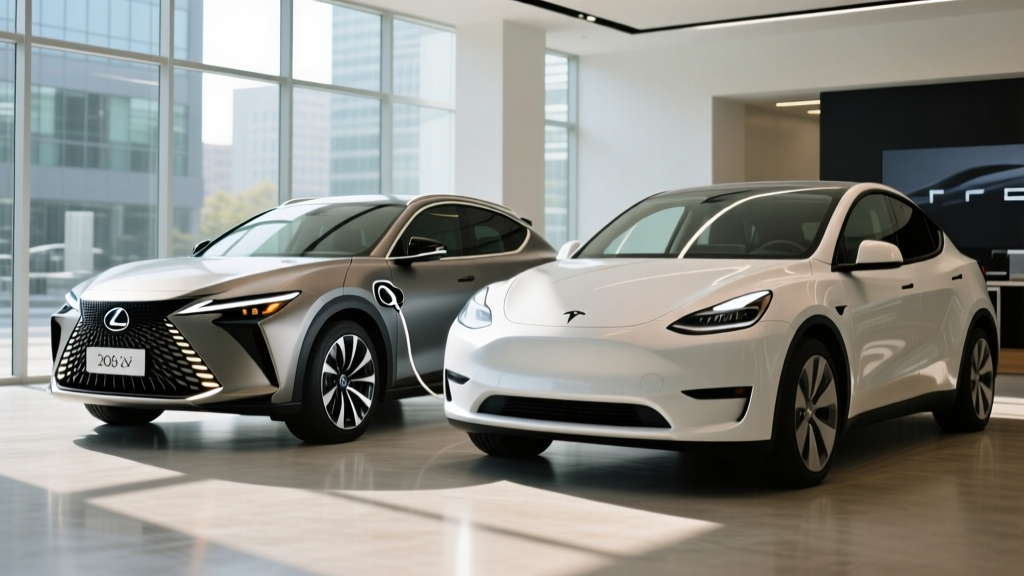
Shopping a premium electric crossover in 2026 almost always narrows down to two philosophies: the tech-forward efficiency of the Tesla Model Y, or the luxury-first comfort of the Lexus RZ 450e. Both seat five, both cost in the mid-$50,000s before incentives, and both target buyers migrating from gas-powered luxury SUVs. But underneath the similar sticker prices, these EVs diverge sharply on range, charging speed, software, and total cost of ownership.
This comparison uses current 2026 model-year specifications, EPA data, and IRS §30D tax-credit rules to help you decide which EV actually fits your driving pattern and budget.
Side-by-Side Specifications: Lexus RZ 450e vs Tesla Model Y
Before analyzing real-world behavior, here are the factory numbers that matter most. The RZ 450e is shown in its best-selling AWD configuration; the Model Y is the Long Range AWD variant, which remains the volume leader.
| Spec | Lexus RZ 450e AWD | Tesla Model Y Long Range AWD |
|---|---|---|
| EPA Range | 220 mi | 320 mi |
| Battery (usable) | 71.4 kWh (NMC) | ~78 kWh (NMC) |
| Peak DC Fast Charge | 150 kW | 250 kW |
| 10–80% DC Time | ~30 min | ~22 min |
| Level 2 AC Charge Rate | 7.2 kW | 11.5 kW |
| 0–60 mph | 5.0 sec | 4.8 sec |
| Horsepower | 308 hp | 384 hp |
| Efficiency (MPGe) | 102 MPGe combined | 122 MPGe combined |
| Cargo Volume | 34.9 cu ft (rear up) | 30.2 cu ft + 4.1 cu ft frunk |
| Base MSRP | $54,000 | $48,990 |
| Battery Warranty | 8 yr / 100,000 mi | 8 yr / 120,000 mi |
Sources: EPA fueleconomy.gov, Tesla specifications, Lexus RZ page.
Range and Efficiency: The 100-Mile Gap That Matters
The Tesla Model Y Long Range AWD holds a decisive 100-mile EPA advantage over the Lexus RZ 450e. On paper, that is 320 versus 220 miles. In practice, the gap widens or narrows depending on conditions.
Tesla Model Y LR AWD: EPA 320 mi. Expect ~270–290 mi at sustained 70 mph highway speeds; ~240 mi in freezing weather with cabin heat.
Lexus RZ 450e AWD: EPA 220 mi. Expect ~185–200 mi highway; ~160–170 mi in freezing weather. The RZ's smaller 71.4 kWh pack and lower efficiency compound in cold conditions.
The Model Y's superior MPGe rating (122 combined vs. 102) means it converts each kWh of battery into more miles. That efficiency advantage comes from Tesla's industry-leading powertrain thermal management, lower drag coefficient (0.23 vs. 0.29), and lighter curb weight despite a larger battery. For a driver covering 250+ miles between charges — road trips, rural commutes, or areas with sparse chargers — this gap is not academic. It's the difference between a nonstop drive and a mandatory 25-minute charge stop.
If your daily driving stays under 150 miles and you charge at home nightly, the RZ's range is adequate. But adequacy is not flexibility.
Charging Speed and Network Access
Charging is where the Model Y extends its lead beyond raw range. The Tesla peaks at 250 kW on V3 Superchargers, sustaining high rates through a wide state-of-charge window. The RZ 450e peaks at 150 kW, and its charge curve tapers noticeably above 60% SoC.
| Level | Lexus RZ 450e | Tesla Model Y LR |
|---|---|---|
| Level 1 (120V / 12A) | ~1.4 kW (~4 mi/hr) | ~1.4 kW (~5 mi/hr) |
| Level 2 (240V / 48A) | 7.2 kW (~22 mi/hr) | 11.5 kW (~37 mi/hr) |
| DC Fast Charge (peak) | 150 kW | 250 kW |
| DC 10–80% Time | ~30 min | ~22 min |
On a Level 2 home charger, the Model Y's 11.5 kW onboard charger refills roughly 37 miles of range per hour versus the RZ's 22 miles/hr. Over a 10-hour overnight session, that is 370 potential miles versus 220 — enough to fully replenish the Model Y's larger battery, while the RZ also fills completely but starts from a smaller total.
Charging network access is a critical 2026 factor. Tesla's Supercharger network exceeds 30,000 stalls in North America and remains the most reliable DC fast-charging ecosystem. The Model Y accesses it natively via NACS. Lexus has adopted the NACS connector for the RZ starting in the 2025 model year, so the 2026 RZ 450e can access Tesla Superchargers directly without an adapter. This eliminates a major historical disadvantage for non-Tesla EVs. However, the RZ's 150 kW peak charge rate means it will not fully utilize V3 Superchargers' 250 kW capacity — you will still charge slower than a Model Y at the same stall.
On third-party networks (Electrify America, EVgo, ChargePoint), both vehicles perform as their peak kW ratings allow. The Model Y consistently outperforms due to its higher ceiling and flatter charge curve.
Performance and Driving Dynamics
The Model Y Long Range AWD produces 384 hp and hits 60 mph in 4.8 seconds. The RZ 450e delivers 308 hp and a 5.0-second run. The 0.2-second difference is negligible in daily driving, but the 76-hp gap is felt during highway merging and passing.
Where the Lexus fights back is ride quality. The RZ uses a frequency-selective damper system and Lexus-tuned adaptive suspension that absorbs road imperfections noticeably better than the Model Y's firmer setup. Road noise is lower in the RZ as well. If you prioritize a quiet, plush commute over sporty acceleration, the RZ's driving refinement is a legitimate luxury-car advantage the Tesla cannot match.
The Model Y offers a Performance variant (not compared here) that drops 0–60 to 3.5 seconds for buyers prioritizing speed.
Interior, Technology, and Driver Assistance
This is the starkest philosophical divide between the two vehicles.
Tesla Model Y: Minimalist interior with a single 15-inch touchscreen controlling nearly all vehicle functions. No instrument cluster. No physical buttons for climate or volume. The 2026 Model Y refresh (codenamed Juniper) added ambient lighting, ventilated seats, a rear touchscreen, and improved sound deadening. Tesla's software ecosystem remains best-in-class: over-the-air updates, integrated navigation with real-time Supercharger routing, and the Tesla app for remote preconditioning and monitoring.
Lexus RZ 450e: Traditional luxury layout with a 14-inch touchscreen, physical climate controls, a heads-up display, and Lexus's 12.3-inch digital instrument cluster. Materials quality — open-pore wood, semi-aniline leather, Ultrasuede accents — is a tier above the Tesla. The RZ also offers the available DIRECT4 all-wheel-drive system, which can shift torque between axles in milliseconds for improved cornering stability.
Driver assistance: Both vehicles offer SAE Level 2 driver-assist systems. Tesla's Autopilot (and optional FSD Supervised) provides lane-centering, adaptive cruise, and automatic lane changes. Lexus Safety System+ 3.0 offers lane tracing assist, dynamic radar cruise control, and pre-collision systems. Neither system is "self-driving" — both require continuous driver attention and hands-on-wheel monitoring.
Both Tesla Autopilot/FSD Supervised and Lexus Safety System+ 3.0 are SAE Level 2 — partial automation. The driver must remain fully engaged, monitor the road, and be prepared to take over instantly. Neither vehicle is capable of unsupervised autonomous driving.
Price, Tax Credits, and Total Ownership Cost
Upfront pricing and federal incentives significantly alter the value equation.
| Factor | Lexus RZ 450e AWD | Tesla Model Y LR AWD |
|---|---|---|
| Base MSRP | $54,000 | $48,990 |
| Typical Destination Fee | $1,150 | $1,390 |
| Federal §30D Tax Credit (max) | Up to $3,750 | Up to $7,500 |
| Effective Starting Price (after max credit) | ~$51,400 | ~$42,880 |
| Estimated 5-Year Electricity Cost* | ~$4,100 | ~$3,400 |
| Estimated 5-Year Insurance** | ~$9,800 | ~$10,500 |
| Maintenance (5-Year Estimate) | ~$1,500 | ~$1,200 |
*Based on 15,000 mi/yr, $0.14/kWh average home charging, 20% DC fast charging at $0.40/kWh. **Insurance averages vary significantly by driver profile, state, and coverage level.
- MSRP Cap: SUVs must be under $80,000 — both qualify.
- Income Cap: AGI must not exceed $150K single / $300K joint.
- Battery Sourcing: Full $7,500 requires meeting both critical-minerals and battery-component sourcing thresholds set by the IRS. The Tesla Model Y, assembled in Fremont/Austin with a partially domestic supply chain, typically qualifies for the full $7,500. The Lexus RZ, assembled in Japan with a different battery supply chain, typically qualifies for $3,750 (meeting one of two sourcing requirements).
- Point-of-Sale Transfer: Both credits can be transferred to the dealer at purchase, reducing your out-of-pocket cost immediately.
Always verify current eligibility at irs.gov before purchasing — sourcing rules update annually.
Five-year total cost of ownership heavily favors the Model Y. The ~$8,500 lower effective purchase price, combined with ~$700 less in electricity costs over five years due to higher efficiency, gives the Tesla a roughly $9,200 advantage before factoring in depreciation. The RZ partially offsets this with slightly lower insurance premiums (~$700 savings over five years) and Lexus's strong resale value reputation, but the gap remains substantial.
Category Winners
320 vs. 220 EPA miles. Not close.
250 kW peak, 22 min 10–80%. RZ capped at 150 kW.
~$8,500 cheaper after tax credits.
122 MPGe combined vs. 102 MPGe.
Superior materials, quieter cabin, physical controls.
Better damping, lower road noise, refined suspension.
Best-in-class app, OTA updates, Supercharger routing.
1,300+ US dealers vs. ~400 Tesla service centers.
Decision Framework: Which One Fits You?
Choose the Tesla Model Y Long Range if:
- You regularly drive more than 200 miles between charges (road trips, rural areas, long commutes)
- You want the lowest total cost of ownership in the premium EV crossover segment
- You value the Supercharger network's reliability and coverage for DC fast charging
- You prefer a minimalist, software-forward interface with frequent OTA feature additions
- You want the maximum available federal tax credit ($7,500)
- Cargo capacity and a frunk matter for gear, groceries, or family logistics
Choose the Lexus RZ 450e if:
- You prioritize a quiet, plush ride with traditional luxury materials over maximum range
- Your daily driving stays under 150 miles and you charge reliably at home every night
- You prefer physical buttons, a heads-up display, and a conventional instrument cluster
- You want a Lexus dealer experience — no-haggle service, loaner cars, proximity to your home
- You are upgrading from an RX, NX, or UX and want brand continuity with electric power
- You value the available DIRECT4 torque-vectoring AWD system for all-weather confidence
Frequently Asked Questions
Can the Lexus RZ use Tesla Superchargers?
Yes. The 2026 Lexus RZ 450e is equipped with the NACS (North American Charging Standard) connector, which provides direct access to Tesla's Supercharger network without an adapter. However, the RZ's 150 kW peak charge rate means it will not charge as quickly as a Model Y at the same stall.
Is the Lexus RZ range enough for daily driving?
For most drivers, yes. The average American drives roughly 37 miles per day. The RZ's 220-mile EPA range covers a week of commuting on a single charge. The concern arises on road trips exceeding 180 miles one-way, in freezing weather (where range drops 20–30%), or in areas with limited public charging infrastructure.
Which is cheaper to insure?
The Lexus RZ 450e typically carries slightly lower insurance premiums than the Model Y, averaging $100–$200 less per year depending on your state and driving record. Tesla vehicles historically carry higher premiums due to repair-cost data from collision claims. Always get quotes from your insurer before purchasing.
Do both vehicles qualify for the full $7,500 federal tax credit?
As of 2026, the Tesla Model Y Long Range generally qualifies for the full $7,500 under IRS §30D, meeting both critical-mineral and battery-component sourcing requirements. The Lexus RZ, assembled in Japan, typically qualifies for $3,750 (meeting one of the two sourcing thresholds). Verify current eligibility at irs.gov before purchase, as sourcing rules are updated periodically.
Which has better resale value?
Lexus and Tesla both hold value well, but EV depreciation has been volatile. Historically, Tesla's massive sales volume and brand recognition supported strong resale. Lexus benefits from its decades-long reputation for reliability and a loyal buyer base. Third-party depreciation forecasts for 2026 EVs remain uncertain — neither should be purchased primarily as an investment.
What about the Lexus RZ 300e (FWD)?
Lexus offers a front-wheel-drive RZ 300e with an EPA range of up to 266 miles and a lower starting price (~$45,000). It trades the DIRECT4 AWD system and some power for extended range. If your priority is range on a budget and you do not need AWD, the 300e narrows the gap with the Model Y significantly on paper — though real-world highway and cold-weather range still trails the Tesla.
Final Verdict
There is no universal winner between the Lexus RZ 450e and Tesla Model Y — only the right answer for your priorities. The Model Y is the more capable electric vehicle by every measurable spec: range, efficiency, charging speed, cargo space, and post-credit price. If those numbers drive your decision, the Tesla is the clear pick.
The Lexus RZ wins where spreadsheets cannot measure: the feel of the steering wheel in your hands on a rough highway, the silence at 70 mph, the satisfaction of a dealer relationship you trust. If you can live with 220 miles of range and you charge at home every night, the RZ delivers a luxury experience the Model Y does not attempt to replicate.
Test-drive both. Pay attention to how each one feels on your actual commute route, not the dealer loop. The right EV is the one you enjoy plugging in every evening.