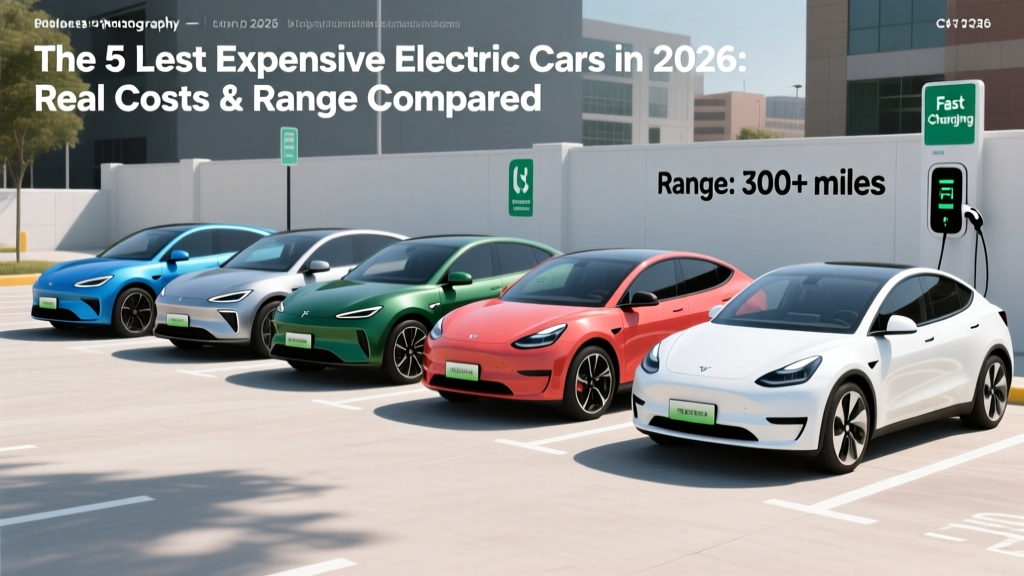
The Short Answer: What Are the Least Expensive Electric Cars in 2026?
As of early 2026, the least expensive new electric cars you can actually buy in the U.S. cluster between $28,000 and $36,000 MSRP before incentives. The current lineup, ranked by base price, is:
- Nissan LEAF S — ~$28,140 MSRP, 149-mile EPA range, CHAdeMO DC charging
- MINI Cooper SE — ~$30,900 MSRP, 114-mile EPA range, CCS DC charging
- Hyundai Kona Electric SE — ~$32,975 MSRP, 261-mile EPA range, CCS DC charging
- Chevrolet Equinox EV LT (FWD) — ~$33,600 MSRP, 319-mile EPA range, CCS/NACS
- Nissan ARIYA Engage — ~$39,590 MSRP, 289-mile EPA range, CCS DC charging
After the federal §30D tax credit (up to $7,500 for eligible buyers and vehicles) and typical state rebates, effective purchase prices can drop into the low-to-mid $20,000s for several of these models. But "least expensive" is only half the equation — total cost of ownership over five years, including charging, insurance, and maintenance, is what actually separates a smart buy from a budget trap. Below, we break down every number that matters.
Spec-By-Spec: How the Budget EVs Actually Stack Up
Price alone doesn't tell the story. A $28,000 car with 149 miles of range and slow DC charging behaves very differently on a road trip than a $33,600 car with 319 miles and 150+ kW peak charging. Here's the full matrix.
| Model | Base MSRP | EPA Range | Battery (usable kWh) | Chemistry | Peak DC kW | 10–80% Time | Level 2 kW | 0–60 mph | HP |
|---|---|---|---|---|---|---|---|---|---|
| Nissan LEAF S | $28,140 | 149 mi | 40 kWh | NMC | 50 kW (CHAdeMO) | ~40 min | 6.6 kW | 7.9 s | 147 |
| MINI Cooper SE | $30,900 | 114 mi | 28.9 kWh | NMC | 50 kW (CCS) | ~36 min | 7.4 kW | 7.3 s | 181 |
| Hyundai Kona Electric SE | $32,975 | 261 mi | 64.8 kWh | NMC | 100+ kW (CCS) | ~43 min | 10.9 kW | 7.9 s | 201 |
| Chevy Equinox EV LT FWD | $33,600 | 319 mi | 85 kWh (est.) | NMC (Ultium) | 150+ kW (CCS/NACS) | ~24 min | 11.5 kW | 8.4 s | 213 |
| Nissan ARIYA Engage | $39,590 | 289 mi | 63 kWh | NMC | 130 kW (CCS) | ~35 min | 7.2 kW | 7.5 s | 214 |
Real-world range note: EPA figures assume mixed driving at moderate temperatures. Expect roughly 15–25% range reduction in sustained highway driving at 70+ mph, and 20–40% loss in freezing weather depending on whether the vehicle uses a heat pump (Kona and Equinox EV have one; the base LEAF does not). A 149-mile LEAF in a Minnesota January may realistically deliver under 100 miles per charge.
Five-Year Cost of Ownership: Where Budget EVs Win (and Where They Don't)
A cheap purchase price only matters if the car stays cheap to run. We modeled five-year / 75,000-mile ownership using national averages for electricity ($0.17/kWh), gasoline ($3.45/gal), maintenance, and insurance. Source data from fueleconomy.gov and AAA's Your Driving Costs.
| Cost Category (5 yr / 75k mi) | Nissan LEAF S | Hyundai Kona Electric | Chevy Equinox EV LT | Comparable Gas Crossover (30 MPG) |
|---|---|---|---|---|
| Purchase (after $7,500 credit*) | $20,640 | $25,475 | $26,100 | $28,500 |
| Fuel / Electricity | $2,380 | $2,210 | $2,240 | $8,625 |
| Maintenance | $1,800 | $1,800 | $1,800 | $4,200 |
| Insurance (avg.) | $8,900 | $9,200 | $9,000 | $7,800 |
| 5-Year Total | $33,720 | $38,685 | $39,140 | $49,125 |
*Federal §30D credit eligibility depends on buyer income caps ($150k single / $300k joint), vehicle MSRP caps ($55k cars / $80k SUVs/trucks), and battery critical-mineral and component sourcing rules. Always verify current-year eligibility at IRS.gov and confirm with a tax professional. Point-of-sale transfer is available at participating dealers.
The takeaway: even the "expensive" budget EVs undercut a comparable gas crossover by roughly $10,000–$15,000 over five years, driven mostly by fuel and maintenance savings. The LEAF wins on pure purchase price but loses flexibility due to short range and CHAdeMO-only DC charging — a connector being phased out at most U.S. networks outside Nissan's own ecosystem.
EV vs Gas vs Hybrid: Which Powertrain Fits a Tight Budget?
First-time buyers often wonder whether a hybrid like the Toyota Prius (~$28,500, 57 MPG combined) makes more financial sense than a budget BEV. The answer depends almost entirely on one variable: whether you can charge at home.
| Factor | Budget BEV (e.g., Kona Electric) | HEV (e.g., Prius) | Gas Compact (e.g., Corolla, 33 MPG) |
|---|---|---|---|
| Upfront Price (after incentives) | ~$25,500 | ~$28,500 | ~$23,000 |
| Cost Per Mile (fuel/energy) | $0.04–$0.06 | $0.11 | $0.12 |
| Home Charging Needed? | Yes, strongly | No | No |
| Maintenance (5 yr) | ~$1,800 | ~$3,500 | ~$4,200 |
| Best For | Home-charging commuters | Apt dwellers, high-mileage | Lowest upfront, simple |
If you have access to Level 2 home charging (a 240V outlet or hardwired wallbox), the BEV wins on five-year cost in almost every scenario. If you live in an apartment without charging access and must rely on public DC fast chargers — where rates often hit $0.40–$0.60/kWh — the per-mile cost can actually exceed gasoline, and a hybrid becomes the more rational budget choice.
Charging at Home: The Hidden Cost Most Budget Guides Ignore
Every article about cheap EVs should lead with this: the car's price is not your only upfront cost. Home Level 2 charging installation typically runs $800–$2,500 if your electrical panel has capacity, and $3,000–$5,500+ if you need a panel upgrade from 100A to 200A service.
For a budget-focused buyer, here's a practical decision tree:
- IF you own a home with a 200A panel and a garage/driveway → Budget $1,200–$1,800 for a quality Level 2 charger (e.g., ChargePoint Home Flex, Emporia Vue) plus electrician labor. This unlocks the full economic advantage of any budget EV.
- IF you own a home with a 100A panel → Get an electrician quote for a panel upgrade before committing to the car. This can add $2,000–$4,000 and should be factored into total cost.
- IF you rent or live in an apartment without charging → Check workplace charging availability and public charger density near you (PlugShare or the DOE's Alternative Fuels Station Locator). If neither is reliable, a hybrid is likely the smarter budget move.
- IF you can install Level 1 (standard 120V) charging only → Expect roughly 3–5 miles of range per hour of charging. This works for a LEAF or MINI SE if your daily commute is under 30 miles round-trip, but will frustrate you with a larger-battery vehicle.
Common Myths About Cheap EVs — With the Actual Numbers
| Myth | Fact (with data) |
|---|---|
| "Budget EVs need a battery replacement soon." | All five models here carry a 8-year / 100,000-mile battery warranty (federally mandated minimum) against defects and excessive capacity loss (typically below 60–70% SoH). Real-world degradation data from Recurrent and owner forums shows most modern NMC packs retain 85–92% capacity at 100,000 miles. Out-of-warranty replacement for a 40–65 kWh pack currently runs $6,000–$12,000 — a real but distant risk. |
| "A cheap EV saves money no matter how you charge." | Public DC fast charging at $0.50/kWh costs roughly $0.14–$0.18 per mile in a Kona Electric — more than a 33 MPG gas car at $3.45/gal ($0.10/mi). The savings only materialize with home Level 2 or workplace charging at residential/utility rates ($0.12–$0.18/kWh, or $0.03–$0.05/mi). |
| "The $7,500 tax credit applies to everyone." | Under current IRS §30D rules, eligibility requires: (1) buyer AGI under $150k single / $300k joint, (2) vehicle MSRP under $55k (cars) or $80k (SUVs/pickups — note the Equinox EV is classified as an SUV), and (3) battery meets critical-mineral and North-American component sourcing thresholds, which change annually. Always confirm the specific VIN qualifies in the current tax year. |
| "149 miles of range is enough for everyone." | The LEAF's 149-mile EPA rating covers most commutes, but a single 80-mile round trip with HVAC use, highway speeds, and cold temps can drain it uncomfortably close to empty. Budget buyers who ever drive beyond their metro area should target 250+ miles of EPA range (Kona, Equinox EV, ARIYA). |
Decision Framework: Which Budget EV Is Actually Right for You?
- Choose the Nissan LEAF S IF your budget is absolutely firm under $30k, your daily driving is under 60 miles round-trip, you have home Level 2 charging, and you rarely take road trips. It's the lowest entry price but the CHAdeMO connector is a real long-term liability.
- Choose the MINI Cooper SE IF you want a fun, premium-feeling city car, commute under 50 miles daily, and value driving dynamics over range. The 114-mile EPA range is the shortest here — treat it as a dedicated commuter, not a one-car household solution.
- Choose the Hyundai Kona Electric SE IF you want the best balance of range (261 mi EPA), practicality (25.5 cu ft cargo), and price. It's the strongest all-around pick for a first-time EV buyer who wants one car to do everything without stretching past $35k.
- Choose the Chevrolet Equinox EV LT IF you need 300+ miles of range, SUV cargo space, and the fastest DC charging in this group (10–80% in ~24 min). It's the most "normal car" of the bunch — just happens to be electric.
- Choose the Nissan ARIYA Engage IF you want a larger, more refined crossover than the Kona and are willing to pay a ~$6k premium over it. Strong range, good tech, but slower Level 2 charging than rivals.
- Choose a hybrid instead IF you cannot install home charging, live in a charging desert, or regularly drive in extreme cold with no garage. A Prius or Corolla Hybrid removes the infrastructure variable entirely.
First-Time EV Buyer FAQ
Is a used budget EV a better deal than a new one?
Often yes. A 2–4 year old LEAF, Bolt EV, or Kona Electric can be had for $14,000–$22,000, and the federal used-EV credit (up to $4,000 or 30% of sale price, whichever is lower) applies to vehicles priced under $25,000 from a dealer. Request a battery State of Health (SoH) report before purchase — any pack above 85% SoH is generally a safe buy.
Will insurance really cost more on a budget EV?
Typically 10–18% more than an equivalent gas car, per IIHS and industry data, due to higher repair costs for battery-adjacent damage and specialized body-shop requirements. Shop quotes from EV-friendly carriers (Geico, Progressive, and Tesla Insurance where available) — the spread varies widely by ZIP code and driving record.
Do budget EVs handle cold weather well?
All EVs lose range in freezing temps, but models with a heat pump (Kona Electric, Equinox EV, ARIYA) lose noticeably less — roughly 15–25% versus 30–40% for resistive-heater vehicles like the base LEAF. Preconditioning the battery while plugged in (a feature on all five models here) reduces both range loss and charging slowdown in winter.
What happens if the charging network near me is unreliable?
This is the most under-discussed risk of budget EV ownership. Before buying, map your three most common drives on PlugShare and note charger uptime ratings. If you can't identify at least two reliable DC fast chargers within 10 miles of your daily routes — and you lack home charging — a hybrid is the lower-risk budget choice.
Are these prices and incentives current?
MSRP figures reflect 2025–2026 model-year pricing as of publication and can shift with mid-year updates. Federal §30D credit rules, especially battery sourcing requirements, are revised annually — verify eligibility on the specific VIN you intend to purchase at IRS.gov before signing.