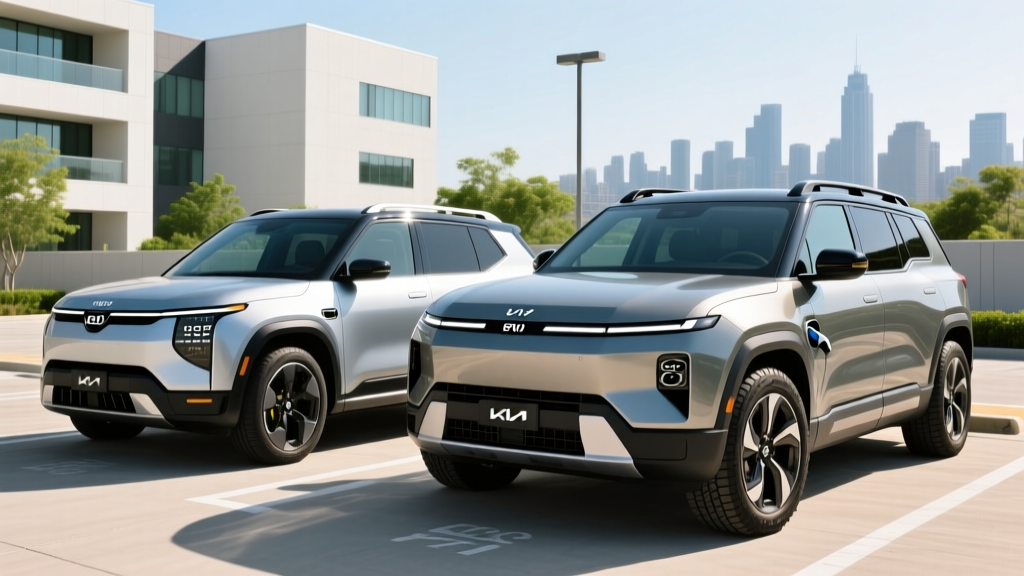
The three-row electric SUV market forces buyers into a stark choice: pay a premium for adventure-ready capability, or prioritize value and family practicality. The Kia EV9 vs Rivian R1S comparison distills this decision perfectly. The EV9 starts under $55,000, leverages an 800V architecture for blistering DC fast charging, and offers genuine three-row comfort. The R1S commands nearly $20,000 more but delivers up to 410 miles of EPA range, optional tri-motor performance, and genuine off-road chops. Neither is universally better — the right answer depends entirely on your budget, driving patterns, and whether you plan to tow or hit trails.
Side-by-Side: EV9 vs R1S Core Specs
Before we break down categories, here are the hard numbers. Specs reflect 2025–2026 model-year configurations as published by each manufacturer and the EPA. We've selected the EV9 Land AWD and R1S Dual-Motor Standard as the most cross-shopped trims, with Max Pack noted where relevant.
| Spec | Kia EV9 Land AWD | Rivian R1S Dual-Motor (Standard) | Rivian R1S Dual-Motor (Max Pack) |
|---|---|---|---|
| EPA Range | 282 mi | 270 mi | 410 mi |
| Battery (usable) | 100.0 kWh (NMC) | 92 kWh (NMC) | 141 kWh (NMC) |
| Peak DC Charge Rate | 236 kW | 200 kW | 200 kW |
| 10–80% DC Fast Charge | ~24 min | ~30 min | ~42 min |
| Level 2 Rate | 10.9 kW | 11.5 kW | |
| Horsepower | 379 hp | 533 hp | 533 hp |
| 0–60 mph | 5.0 sec | 4.5 sec | 4.5 sec |
| MPGe (combined) | 85 MPGe | 73 MPGe | 70 MPGe |
| Cargo (behind 3rd / max) | 20.2 / 81.7 cu ft | 10.6 / 104.7 cu ft | |
| Towing Capacity | 5,000 lb | 7,700 lb | |
| Base MSRP | $59,900 | $75,900 | $89,400 |
| Powertrain Warranty | 10 yr / 100,000 mi | 8 yr / 175,000 mi |
Range and Efficiency: Max Pack Changes Everything
Kia EV9 Land AWD: EPA 282 mi. Expect ~240 mi on sustained highway driving at 70 mph; ~195–215 mi in sub-freezing temperatures due to cabin heating and increased battery resistance.
Rivian R1S Standard Pack: EPA 270 mi. Highway reality is similar to the EV9 at ~230 mi, though the R1S's brick-like aerodynamics (higher drag coefficient) hurt it more above 75 mph.
Rivian R1S Max Pack: EPA 410 mi. Real-world highway ~340–360 mi; cold weather ~280–310 mi. This is the configuration that fundamentally separates the R1S from the EV9 on road trips.
Efficiency tells the other half of the story. The EV9's 85 MPGe combined translates to roughly 34 kWh per 100 miles — meaning you spend less per mile on electricity. The R1S Dual-Motor Standard sits at 73 MPGe (~40 kWh/100 mi), and the Max Pack drops further to 70 MPGe due to carrying 1,500+ pounds of additional battery. Over 15,000 annual miles, the EV9 will cost approximately $750–$850 to charge at home (at a national average of $0.16/kWh), while the R1S Standard will run $900–$1,000.
For context on real-world highway testing methodology, fueleconomy.gov provides the official EPA cycle data referenced here.
Category Winner — Efficiency: Kia EV9 (85 MPGe vs 70–73 MPGe)
Charging Speed and Network Realities
This is where the EV9's 800V electrical architecture earns its keep. Kia's peak 236 kW DC charge rate means a 10–80% session takes approximately 24 minutes on a capable 350 kW charger. The R1S, on a 400V architecture, peaks around 200 kW and requires about 30 minutes for the same 10–80% session on the Standard Pack. The Max Pack, with its 141 kWh battery, takes roughly 42 minutes to reach 80% — a meaningful penalty on road trips despite the extra range.
Charging-curve reality check: neither vehicle sustains peak kW for the entire session. The EV9 ramps hard from 10–55% SoC (holding near 230+ kW on a warm battery), then tapers to ~150 kW through 70%, and drops below 100 kW past 80%. The R1S curve is flatter but lower, holding ~180–200 kW through 60% before tapering. Preconditioning — warming the battery before arriving at a charger via the navigation system — is essential for both vehicles to hit published charge times, especially below 50°F.
| Level | Kia EV9 | Rivian R1S |
|---|---|---|
| Level 1 (120V / 1.4 kW) | ~4 mi/hr | ~4 mi/hr |
| Level 2 (240V / ~11 kW) | ~32 mi/hr | ~33 mi/hr |
| DC Fast (peak kW) | 236 kW (~85 mi/10 min) | 200 kW (~70 mi/10 min) |
Network considerations: Kia EV9s ship with a CCS1 connector. As of 2025–2026, Kia provides a NACS adapter for Tesla Supercharger access, expanding the public network considerably. Rivian switched to the NACS connector natively on 2025+ R1S models, granting direct Tesla Supercharger access without an adapter — a meaningful convenience advantage. Both vehicles can use Electrify America, EVgo, and ChargePoint networks. In our experience, Tesla Superchargers remain the most reliable public network by a wide margin, which gives the R1S a slight edge in plug-and-charge simplicity.
Category Winner — Network Access: Rivian R1S (native NACS, no adapter needed)
Performance, Ride, and Off-Road Capability
The R1S has a decisive power advantage. Its dual-motor setup produces 533 hp and delivers a 4.5-second 0–60 time — quick for a 6,800-pound SUV. The EV9's 379 hp and 5.0-second 0–60 is more than adequate for merging and passing but can't match the Rivian's shove. If you opt for the R1S Tri-Motor (850 hp, 3.0-sec 0–60), the gap becomes absurd, though at a price that approaches six figures.
Ride quality diverges by design. The EV9 uses a conventional steel-spring suspension tuned for comfort, with a composed highway demeanor and acceptable body control. The R1S features a standard adaptive air suspension that lowers at speed for efficiency, raises for ground clearance (up to 14.9 inches in Off-Road mode), and provides a genuinely plush ride. On broken pavement, the R1S isolates occupants noticeably better, though you feel the extra mass during aggressive direction changes.
Off-road capability isn't even a contest. The R1S offers approach/departure/breakover angles that rival dedicated off-roaders, plus a wade mode rated to over 40 inches. The EV9 is a pavement vehicle with 7.8 inches of ground clearance and no off-road pretensions. If you have a cabin, boat ramp with loose gravel, or ski-area access roads, the R1S handles them with ease.
Category Winner — Ride Comfort: Rivian R1S (air suspension)
Category Winner — Off-Road: Rivian R1S (not close)
Interior, Tech, and Family Practicality
Both vehicles seat seven (or six with captain's chairs), but the packaging differs. The EV9's boxy, upright design creates excellent headroom in all three rows, and the third row genuinely fits adults for short trips. The R1S third row is tighter — acceptable for children and shorter adults but cramped for six-footers on longer drives. Cargo behind the third row heavily favors the EV9: 20.2 cubic feet vs the R1S's 10.6 cu ft. Fold both rear rows and the R1S fights back with 104.7 cu ft vs the EV9's 81.7 cu ft, thanks to the Rivian's longer wheelbase and lower load floor.
Technology-wise, both run modern infotainment stacks with over-the-air updates. The EV9 uses Kia's dual 12.3-inch panoramic display with wireless Apple CarPlay/Android Auto and a straightforward interface. The R1S runs Rivian's proprietary software on a 15.6-inch landscape touchscreen — visually impressive and feature-rich, though some users find the reliance on touchscreen controls (no physical volume knob, minimal hard buttons) distracting while driving. The R1S includes a unique gear tunnel (an enclosed pass-through between the rear wheels) that adds ~11 cu ft of secure, weatherproof storage — ideal for muddy gear or charging cables.
The EV9's frunk is modest at 3.2 cu ft (enough for a charging cable bag). The R1S offers an 11 cu ft front trunk — substantially more usable for groceries or a carry-on.
Category Winner — Tech/Software: Rivian R1S (more polished, richer feature set)
Category Winner — Cargo Versatility: Tie (EV9 behind 3rd row; R1S with rows folded + gear tunnel)
Pricing, Tax Credits, and Total Cost of Ownership
The price gap is the single largest differentiator. Here's how it breaks down before and after the federal §30D EV tax credit, based on current IRS guidelines.
| Kia EV9 Land AWD | Rivian R1S Dual-Motor Std | |
|---|---|---|
| Base MSRP | $59,900 | $75,900 |
| Federal §30D Credit Eligibility | Up to $7,500 (subject to battery sourcing, income caps) | Up to $7,500 (subject to battery sourcing, income caps) |
| MSRP Cap (§30D SUV limit: $80,000) | ✅ Under cap | ✅ Under cap (Standard/Max dual-motor) |
| Buyer Income Cap (MFJ) | ≤$300,000 AGI | ≤$300,000 AGI |
| Estimated Price After Credit | ~$52,400 | ~$68,400 |
| Point-of-Sale Transfer | Available (reduces purchase price at dealer) | Available (Rivian supports POS transfer) |
Critical §30D caveat: The full $7,500 credit requires meeting both critical-mineral and battery-component sourcing thresholds that shift annually. For 2025–2026, many Kia and Rivian configurations qualify for the full amount, but eligibility can change as sourcing rules tighten. Always verify current eligibility on the IRS clean vehicle credit page or via the dealer at point of sale. The credit is also non-refundable unless transferred at point of sale, which both brands support — effectively converting it into an instant rebate regardless of tax liability.
Five-year ownership cost estimate (15,000 mi/yr, home charging at $0.16/kWh, national average insurance):
| Cost Category | Kia EV9 Land AWD | Rivian R1S Dual-Motor Std |
|---|---|---|
| Purchase (after credit) | ~$52,400 | ~$68,400 |
| Electricity (5 yr) | ~$4,000 | ~$4,700 |
| Insurance (5 yr est.) | ~$12,500 | ~$16,000 |
| Maintenance (5 yr) | ~$1,800 | ~$2,200 |
| Estimated Depreciation (5 yr) | ~$22,000 | ~$28,000 |
| Total 5-Year Cost | ~$92,700 | ~$119,300 |
The EV9 wins on nearly every ownership cost metric. Insurance premiums for the R1S run 20–30% higher, driven by the Rivian's higher repair costs, aluminum-intensive construction, and limited body-shop network. Depreciation data for the EV9 is still maturing, but Kia's 10-year/100,000-mile powertrain warranty provides strong residual support. Rivian's 8-year/175,000-mile battery warranty is among the best in the industry for mileage coverage.
Category Winner — Warranty Mileage: Rivian R1S (175,000 mi powertrain)
Safety and Driver Assistance
Both vehicles carry top safety credentials. The EV9 earned an IIHS Top Safety Pick+ rating and a 5-star NHTSA overall score. The R1S also holds a 5-star NHTSA rating across all categories. Both come standard with comprehensive ADAS suites — Kia's Highway Driving Assist 2 and Rivian's Driver+ — that include adaptive cruise, lane centering, automatic emergency braking, and blind-spot intervention.
Rivian's Driver+ is competent but does not yet offer hands-free highway driving on par with GM's Super Cruise or Ford's BlueCruise. Kia's HDA2 requires hands-on-wheel contact but is well-calibrated and predictable. Neither system is a reason to choose one vehicle over the other — they're functional aids, not differentiators.
Decision Framework: Which Should You Buy?
- Your budget is under $65,000 after incentives
- You prioritize third-row passenger comfort and behind-row cargo
- You want the fastest DC charging in its class for road trips
- Your driving is 90%+ on pavement
- You value a 10-year powertrain warranty and lower insurance costs
- You want a traditional dealer experience for sales and service
- You need 400+ miles of range (Max Pack) for long, remote road trips
- You tow a trailer, boat, or camper (7,700 lb vs 5,000 lb)
- You want genuine off-road capability and air suspension
- Performance matters (533 hp, 4.5-sec 0–60)
- You prefer native NACS / Tesla Supercharger access without adapters
- You want OTA software updates and a more tech-forward experience
Final Recommendation
The Kia EV9 is the rational family hauler — it delivers 85% of what most three-row EV buyers need at 65% of the Rivian's cost. If your life involves school runs, grocery trips, and occasional 300-mile road trips on well-served interstates, the EV9 is the financially smarter pick. The Rivian R1S justifies its premium for buyers who actually use its capabilities: towing, off-roading, remote-area travel where 410 miles of range matters, or simply wanting a vehicle that feels engineered without compromise. Neither is wrong — they're optimized for different buyers. Test-drive both loaded with your actual passengers and cargo before signing.
Frequently Asked Questions
Does the Kia EV9 qualify for the full $7,500 federal tax credit?
Most EV9 trims qualify for the full §30D credit as of 2025–2026, meeting both the MSRP cap ($80,000 for SUVs) and battery sourcing requirements. Buyer income must not exceed $300,000 (married filing jointly), $225,000 (head of household), or $150,000 (single). Verify current eligibility at irs.gov or through your dealer's point-of-sale transfer process.
Is the Rivian R1S worth the extra $16,000+ over the EV9?
It depends on utilization. If you tow regularly, drive off-pavement, need 400+ mile range for remote travel, or want the performance and air suspension, the R1S delivers capabilities the EV9 simply cannot match. If you primarily drive on pavement and value budget efficiency, the EV9 covers 90% of the use case for significantly less money.
Which charges faster on road trips?
The EV9 charges faster per session (~24 min vs ~30 min for 10–80%) thanks to its 800V architecture and 236 kW peak rate. However, the R1S Max Pack requires fewer charging stops overall due to its 410-mile range. On a 600-mile trip, the EV9 may stop twice with shorter sessions; the R1S Max Pack may stop once with a longer session. Total trip time is often comparable.
Can either vehicle tow a camper trailer?
Yes, but the R1S is substantially more capable. Its 7,700-lb rating handles most travel trailers, boat/trailer combos, and horse trailers. The EV9's 5,000-lb limit restricts you to lighter pop-up campers, small utility trailers, or a single jet ski. Note that towing cuts EV range by 30–50% in both vehicles — plan charging accordingly.
How does cold weather affect range in each?
Both vehicles lose 20–30% of EPA range in sustained sub-freezing temperatures, primarily due to cabin heating and increased battery internal resistance. The R1S uses a heat pump (standard) which partially mitigates cabin-heating losses. The EV9 also includes a heat pump on AWD trims. Expect the EV9 to deliver ~200 mi and the R1S Standard to deliver ~190 mi in 20°F highway driving; the R1S Max Pack still manages ~280–310 mi under the same conditions.