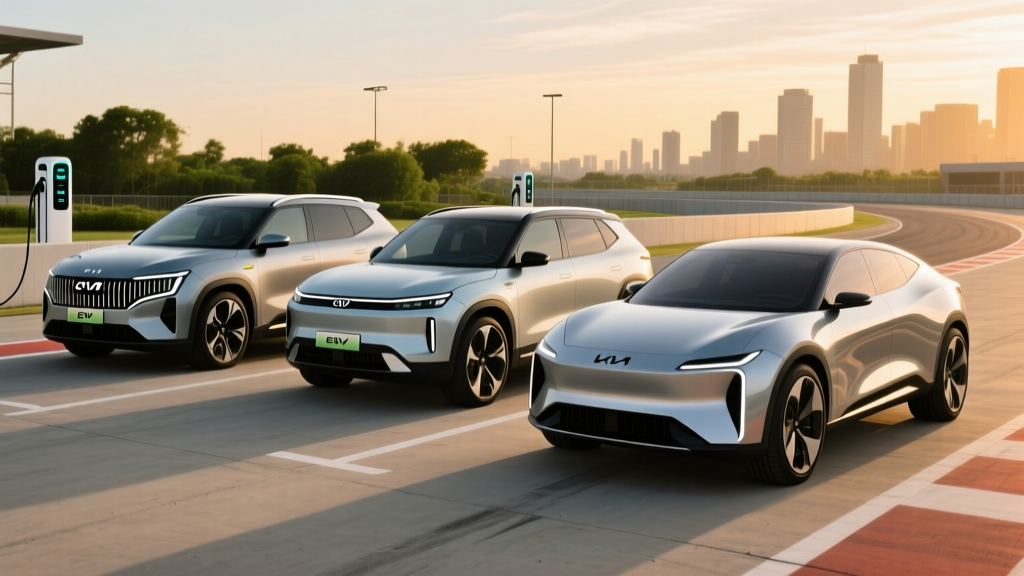
Quick Answer: Kia's 2026 electric SUV lineup spans three core models: the Niro EV (compact, 239 mi EPA range, ~$41,000), the EV6 (crossover, up to 310 mi, ~$44,000), and the three-row EV9 (up to 304 mi, ~$55,000). All use Kia's E-GMP architecture with 800V DC fast charging (10–80% in ~18 minutes on the EV6/EV9). For most buyers, the EV6 Wind AWD offers the best balance of range, charging speed, and price, while the EV9 is the only mainstream three-row electric SUV on the market. Tax-credit eligibility under IRS §30D varies by battery sourcing and buyer income — always verify before purchasing.
Kia's 2026 Electric SUV Lineup at a Glance
Kia has committed heavily to electrification, and by the 2026 model year, its electric SUV portfolio covers most family needs — from urban commuters to three-row haulers. Unlike some competitors still transitioning from ICE platforms, Kia's dedicated E-GMP (Electric-Global Modular Platform) underpins the EV6 and EV9, giving them flat floors, optimized weight distribution, and critically, 800V electrical architecture for ultra-fast DC charging.
| Model | Body Style | Battery (kWh) | EPA Range | Peak DC Charge | 10–80% Time | 0–60 mph | Base MSRP |
|---|---|---|---|---|---|---|---|
| Niro EV | Compact SUV | 64.8 (NMC) | 239 mi | ~85 kW | ~45 min | 7.2 sec | $40,900 |
| EV6 Light RWD | Crossover SUV | 58.0 (NMC) | 232 mi | ~180 kW | ~18 min | 7.2 sec | $43,900 |
| EV6 Wind AWD | Crossover SUV | 77.4 (NMC) | 282 mi | ~240 kW | ~18 min | 5.1 sec | $49,500 |
| EV6 GT-Line AWD | Crossover SUV | 77.4 (NMC) | 282 mi | ~240 kW | ~18 min | 5.1 sec | $53,200 |
| EV9 Light RWD | 3-Row SUV | 76.1 (NMC) | 230 mi | ~180 kW | ~20 min | 7.7 sec | $54,900 |
| EV9 Wind AWD | 3-Row SUV | 99.8 (NMC) | 280 mi | ~210 kW | ~24 min | 6.5 sec | $63,900 |
| EV9 Land AWD | 3-Row SUV | 99.8 (NMC) | 280 mi | ~210 kW | ~24 min | 6.5 sec | $69,900 |
Sources: EPA fueleconomy.gov, Kia America. Real-world highway range typically runs 10–15% below EPA estimates; cold-weather (below 32°F) can reduce range by 20–30% due to cabin heating demand and reduced battery efficiency.
Which Kia Electric SUV Fits Your Situation?
The right choice depends less on marketing and more on your actual driving patterns, household size, and charging access. Here's a practical breakdown:
The Urban Commuter: Niro EV
If you drive 40 miles or fewer round-trip, charge at home, and rarely road-trip, the Niro EV is the value play. Its 64.8 kWh battery delivers 239 EPA miles — plenty for daily use with a massive buffer. The trade-off is slower DC fast charging (~85 kW peak), which matters only if you take frequent long trips. Cargo space is 22.8 cu ft behind the rear seats, competitive for the segment.
The All-Rounder: EV6 Wind AWD
The EV6 Wind AWD with the 77.4 kWh pack is the sweet spot. You get 282 EPA miles, 320 hp from dual motors, and 800V fast charging that peaks near 240 kW. On a 350 kW Electrify America or Tesla Supercharger (with NACS adapter), you'll add roughly 150 miles in 15 minutes under ideal conditions. The charge curve does taper above 80% — expect the final 20% to take as long as the first 80%.
The Family Hauler: EV9
The EV9 is currently the only mainstream three-row electric SUV under $70,000. With the 99.8 kWh battery and AWD, the 280-mile EPA range is realistic for mixed driving, though expect closer to 240 miles on sustained highway runs at 75 mph. Third-row space fits adults for short trips; for long hauls, it's best for kids. Towing capacity reaches 5,000 lbs (AWD), though towing will cut range roughly in half.
Decision Framework:
- Choose the Niro EV if your budget is under $42K, you have home charging, and your longest regular trip is under 150 miles.
- Choose the EV6 if you want fast road-trip charging, need AWD for weather, and don't need a third row.
- Choose the EV9 if you need seating for six or seven, can budget $55K+, and accept slightly lower efficiency for the space.
- Consider a Kia Sorento PHEV instead if you lack reliable home charging or frequently drive 400+ miles between charging stops.
Real Costs: Kia EVs vs. Gas and Hybrid Alternatives
Sticker price tells only part of the story. Here's a five-year cost comparison for the EV6 Wind AWD against comparable gas and hybrid SUVs, assuming 15,000 miles/year, $0.14/kWh home electricity, and $3.50/gallon gas.
| Cost Category (5 yr) | Kia EV6 Wind AWD | Kia Sportage HEV | Toyota RAV4 Gas AWD |
|---|---|---|---|
| Purchase Price (MSRP) | $49,500 | $34,090 | $33,500 |
| Est. Federal Tax Credit | $0–$7,500* | $0 | $0 |
| Fuel / Energy | $3,150 | $6,560 | $9,450 |
| Maintenance | $1,200 | $2,800 | $3,200 |
| Insurance (avg) | $9,500 | $7,200 | $7,000 |
| 5-Year Total (pre-incentive) | $63,350 | $50,650 | $53,150 |
* Federal §30D tax credit eligibility depends on battery critical-mineral sourcing, buyer AGI ($150K single / $300K joint), and the vehicle's MSRP staying under the $80,000 SUV cap. Verify current rules at IRS.gov. Point-of-sale transfer is available through participating dealers.
The EV6 costs more upfront but saves $3,000–$6,000 in fuel and maintenance over five years. Insurance runs higher for EVs — typically 15–25% more than equivalent gas models, driven by higher repair costs and parts pricing. If you qualify for the full $7,500 credit, the effective purchase gap narrows to ~$8,000, and the TCO advantage becomes clearer by year four.
Charging at Home and on the Road: What You'll Actually Experience
Home Charging (Level 2)
All three models come with a J1772/NACS-compatible Level 2 inlet. With a 48-amp home charger on a 240V/60A circuit (like a ChargePoint Home Flex or Emporia Vue), the EV6 and EV9 charge at roughly 10.9 kW. That means:
- EV6 (77.4 kWh): 0–100% in about 7.5 hours — wake up full every morning.
- EV9 (99.8 kWh): 0–100% in about 9.5 hours — still achievable overnight.
- Niro EV (64.8 kWh): 0–100% in about 6.5 hours on a 32A charger (7.2 kW max acceptance).
Home charger installation typically costs $500–$2,000 depending on panel proximity and whether you need a 200A service upgrade ($1,500–$3,500 additional). Hire a licensed electrician — permits and code compliance matter for insurance and resale.
DC Fast Charging (Road Trips)
This is where 800V architecture separates the EV6/EV9 from most competitors. On a 350 kW charger with proper battery preconditioning (navigate to a charger in the Kia infotainment to trigger it):
| Metric | Kia EV6 (77.4 kWh) | Kia EV9 (99.8 kWh) | Niro EV (64.8 kWh) |
|---|---|---|---|
| Peak DC Rate | ~240 kW | ~210 kW | ~85 kW |
| 10–80% Time | ~18 min | ~24 min | ~45 min |
| Miles Added in 15 min | ~150 mi | ~130 mi | ~55 mi |
| Charging Port | NACS (2026) | NACS (2026) | CCS1 |
Critical context: Peak kW is not sustained kW. The EV6 hits 240 kW around 20–30% SoC, then tapers to ~150 kW by 60% and ~60 kW by 80%. The 18-minute figure assumes you arrive at low SoC with a preconditioned battery. Cold batteries charge significantly slower — preconditioning is non-negotiable in winter.
For 2026, Kia has transitioned the EV6 and EV9 to the NACS (Tesla-style) charging port, granting native access to Tesla Superchargers alongside Electrify America, EVgo, and other networks. The Niro EV retains CCS1; adapters are available but add cost and slight efficiency loss.
Federal Tax Credits and Incentives: What Actually Applies
The §30D Clean Vehicle Credit offers up to $7,500, but qualification is a moving target. Here's the 2026 eligibility checklist:
- MSRP cap: Vehicle must be under $80,000 (SUVs/trucks) — all Kia electric SUVs qualify on sticker price.
- Buyer income cap: AGI must not exceed $150,000 (single), $225,000 (head of household), or $300,000 (joint).
- Battery sourcing: Increasing percentages of critical minerals and battery components must be sourced from the U.S. or FTA partners — this threshold tightens annually and may disqualify some trims.
- Point-of-sale transfer: You can apply the credit as a down-payment reduction at purchase through a registered dealer, rather than waiting for tax filing.
- Assembly: Vehicle must undergo final assembly in North America — the EV6 and EV9 are built in Georgia (Kia's Metaplant), which satisfies this requirement. The Niro EV is assembled in South Korea and does not qualify for §30D as of current rules.
Many states layer additional rebates on top — California's CVRP, Colorado's innovative motor vehicle credit, and utility company rebates for charger installation can collectively offset $2,000–$5,000 more. Check your state energy office and utility provider for current programs.
Battery Longevity, Warranty, and Common Misconceptions
| Myth | Fact |
|---|---|
| "EV batteries need replacing every 5 years" | Kia covers the battery for 10 years/100,000 miles. Real-world degradation data from E-GMP vehicles shows ~8–10% capacity loss after 100K miles. Most packs will outlast the vehicle. |
| "You can't drive an EV in winter" | Range drops 20–30% in sub-freezing temps, but preconditioning (heating the battery while plugged in) recovers much of that. The EV6/EV9 heat pump is standard and significantly reduces cabin-heating energy draw. |
| "Charging takes too long for road trips" | At 240 kW, the EV6 adds 150 miles in 15 minutes. Combined with a rest stop, it's barely noticeable on a 4+ hour drive. |
| "EVs are worse for the environment" | Even on a coal-heavy grid, lifecycle emissions are lower than gas equivalents per EPA analysis. On cleaner grids, the advantage is substantial. |
| "I need to charge to 100% every day" | NMC batteries last longest between 20–80% SoC. Set your Kia's charge limit to 80% for daily driving and 100% only for long trips. |
Kia's battery warranty guarantees the pack retains at least 70% of original capacity for 10 years or 100,000 miles — whichever comes first. Industry data suggests most NMC packs retain 85–92% after 100K miles, well above the warranty floor. Battery replacement, if ever needed out of warranty, currently runs $12,000–$20,000 depending on the pack, but this is a rare scenario for vehicles under 150K miles.
Ownership Practicalities: Insurance, Depreciation, and Daily Life
Insurance: Expect premiums 15–25% above equivalent gas SUVs. The EV6 averages $1,800–$2,200/year depending on your state, age, and driving record. Shop quotes from EV-friendly insurers (Geico, Progressive, and some regional carriers have better EV actuarial data).
Depreciation: EVs have experienced steeper depreciation than gas vehicles in 2024–2025, partly due to Tesla price cuts resetting the market. The EV6 retains roughly 45–50% of value at 3 years/36K miles. Buying used (2–3 years old) lets someone else absorb that hit — and the §25E used-EV credit offers up to $4,000 on vehicles under $25,000.
Maintenance: No oil changes, no transmission fluid, no spark plugs. Brake pads last 100K+ miles thanks to regenerative braking. The main recurring costs are tires (EVs wear tires 20–30% faster due to weight and instant torque — budget $800–$1,200 for a set every 35–45K miles), cabin air filters, and wiper fluid.
Charging access reality check: If you can install a Level 2 charger at home, daily EV ownership is effortless — you start every morning with a "full tank." If you rely solely on public charging, factor in 20–40 minutes of DC fast charging per week and higher per-kWh costs ($0.35–$0.55 at public stations vs. $0.10–$0.18 at home). Apartment dwellers without charging access should seriously consider a PHEV like the Sorento PHEV instead.
Do Kia electric SUVs qualify for the $7,500 federal tax credit?
The EV6 and EV9 (assembled in Georgia) can qualify for up to $7,500 under §30D, but eligibility depends on your income, the battery's critical-mineral sourcing percentage for the specific model year, and MSRP limits. The Niro EV (built in South Korea) does not currently qualify. Always verify on fueleconomy.gov and with your tax professional before relying on the credit.
How does the EV9 compare to the Tesla Model X or Rivian R1S?
The EV9 starts ~$25,000 below the Model X and ~$15,000 below the R1S. It sacrifices some range (280 vs. 320+ mi) and raw performance but delivers comparable third-row usability and interior quality at a far more accessible price. It also uses NACS natively in 2026, so Supercharger access is equal.
What's the real-world highway range of the EV6?
The EV6 Wind AWD is EPA-rated at 282 miles. In real-world highway testing at 70–75 mph in moderate temperatures, expect 240–260 miles. In cold weather (below 32°F) at highway speeds, plan for 200–220 miles. Always leave a 10–15% buffer for unexpected detours or charger outages.
Is the Kia EV6 or EV9 better for towing?
The EV9 AWD tows up to 5,000 lbs; the EV6 AWD tows up to 2,700 lbs. However, towing a 4,000-lb trailer with the EV9 will cut range roughly in half — plan for 130–140 miles between charges. If you tow frequently and long distances, a PHEV or gas SUV may still be more practical.
Can I charge a Kia EV at a Tesla Supercharger?
Yes. For 2026, the EV6 and EV9 come with the native NACS port, meaning direct compatibility with Tesla Superchargers without an adapter. The Niro EV uses CCS1 and requires a NACS-to-CCS adapter (sold separately) for Supercharger access. Always check the Tesla app for station availability and NACS compatibility status.