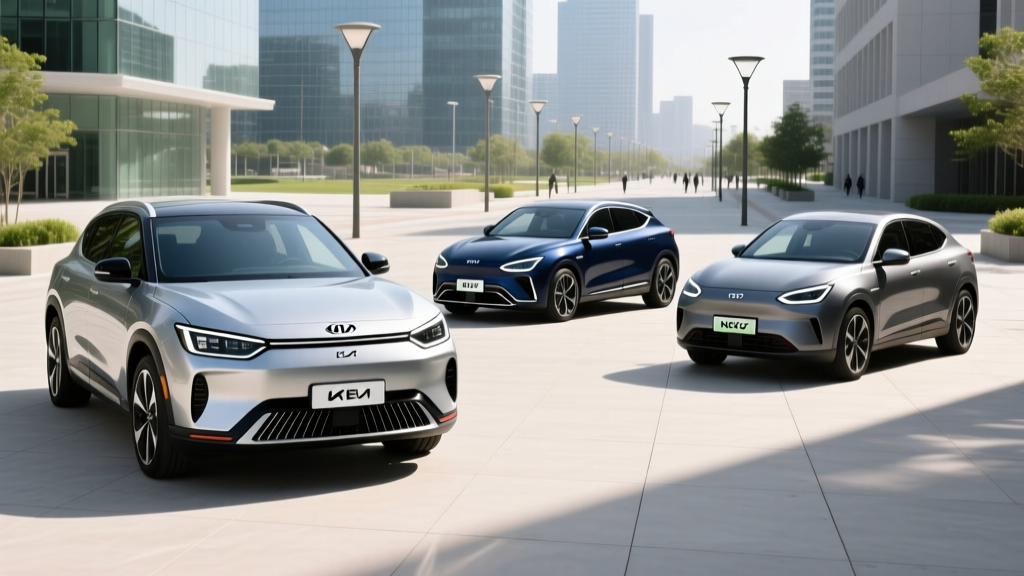
If you're searching for a Kia SUV electric option in 2026, you have three distinct battery-electric vehicles to choose from: the compact Kia Niro EV (239 miles EPA, starting ~$39,600), the midsize crossover Kia EV6 (up to 310 miles EPA, starting ~$42,900), and the three-row flagship Kia EV9 (up to 304 miles EPA, starting ~$54,900). The right pick depends on your passenger needs, charging access, and whether you qualify for the federal §30D tax credit — which, as of 2026, requires battery-sourcing compliance, buyer income caps, and MSRP limits that shift eligibility across trims.
Kia's 2026 Electric SUV Lineup at a Glance
Kia's BEV strategy spans three vehicle classes. Unlike some competitors that offer a single electric model, Kia covers compact, midsize, and large SUV segments — each built on different platforms with different battery chemistries and charging architectures.
| Spec | Niro EV | EV6 | EV9 |
|---|---|---|---|
| EPA Range | 239 mi | 274–310 mi (trim-dependent) | 230–304 mi (trim-dependent) |
| Battery (usable) | 64.8 kWh (NMC) | 58–77.4 kWh (NMC) | 76.1–100 kWh (NMC) |
| Peak DC Fast Charge | ~85 kW | ~240 kW (800V) | ~210 kW (800V) |
| 10–80% DCFC Time | ~45 min | ~18 min | ~24 min |
| 0–60 mph | 7.8 sec | 3.4–7.2 sec | 5.0–8.2 sec |
| Horsepower | 201 hp | 167–576 hp | 215–379 hp |
| Starting MSRP | ~$39,600 | ~$42,900 | ~$54,900 |
| Connector | CCS1 | NACS (2025+ models) | NACS (2025+ models) |
| Rows / Seats | 2 / 5 | 2 / 5 | 3 / 6–7 |
| Battery Warranty | 10 yr / 100,000 mi | 10 yr / 100,000 mi | 10 yr / 100,000 mi |
Sources: fueleconomy.gov, Kia America press specifications. Real-world range varies with temperature, speed, and terrain — see below.
Real-World Range: What the EPA Sticker Doesn't Tell You
EPA range estimates assume a mix of city and highway driving at moderate temperatures. In practice, your mileage will deviate based on three factors: sustained highway speed, ambient temperature, and elevation changes.
• Niro EV: EPA 239 mi → expect ~195–215 mi on a road trip
• EV6 (Long Range RWD, 310 mi EPA): expect ~255–275 mi highway
• EV9 (Light Long Range RWD, 304 mi EPA): expect ~245–265 mi highway
Cold-weather penalty (below 32°F): Subtract 20–30% from EPA figures across all three models. The EV9's larger 100 kWh battery partially offsets this because you start with more total energy. The Niro EV, with its smaller 64.8 kWh pack, feels the cold most acutely — plan for ~160–175 mi of usable range in sub-freezing highway driving.
The EV6 and EV9 both use Kia's E-GMP platform with standard heat pumps (on most trims), which recovers waste heat from the powertrain to warm the cabin — reducing the winter range penalty compared to resistive heating. The Niro EV, built on a shared platform with the hybrid Niro, uses a less sophisticated thermal system and will lose range faster in cold weather. If you live in Minnesota, Colorado, or New England, this matters for trip planning.
Charging Speed: The 800V Advantage Explained
This is where the EV6 and EV9 pull dramatically ahead of the Niro EV. Both larger models use an 800-volt electrical architecture, which allows them to accept much higher DC fast-charge power without overheating the battery.
| Level | Power (kW) | Niro EV (mi/hr added) | EV6 (mi/hr added) | EV9 (mi/hr added) |
|---|---|---|---|---|
| Level 1 (120V outlet) | ~1.4 kW | ~4 mi/hr | ~4 mi/hr | ~3 mi/hr |
| Level 2 (240V home) | 7.2–11 kW | ~22–32 mi/hr | ~26–35 mi/hr | ~22–32 mi/hr |
| DC Fast Charge | Peak 85–240 kW | ~180 mi/hr (peak) | ~650+ mi/hr (peak) | ~500+ mi/hr (peak) |
Critical note on charge curves: Peak kW is not sustained kW. The EV6 may hit 240 kW at 10% SoC, but it tapers progressively — typically dropping to ~150 kW by 50% and ~80 kW by 70%. That's why manufacturers quote 10–80% times rather than 0–100%. Above 80%, charging slows dramatically to protect battery longevity. If you're road-tripping, plan to charge to 80% and go — the last 20% can take as long as the first 70%.
The Niro EV's ~85 kW peak DC rate means it's best suited for drivers who charge at home overnight and only use DC fast charging occasionally. On a road trip, you'll spend roughly 45 minutes at a charger for a 10–80% session, versus ~18 minutes in the EV6. That's a meaningful difference on a 600-mile drive.
Federal Tax Credit: Which Kia EVs Qualify in 2026?
The §30D Clean Vehicle Credit offers up to $7,500 for qualifying new EVs — but eligibility hinges on three moving targets: battery critical-mineral sourcing, buyer income limits, and MSRP caps. As of 2026, Kia's situation is nuanced.
- MSRP cap: SUVs/vans/pickups ≤ $80,000; sedans/other ≤ $55,000
- Buyer income cap (AGI): $300K joint / $225K head of household / $150K individual
- Battery sourcing: Critical minerals and battery components must meet escalating percentage thresholds from US or FTA-partner countries
- Point-of-sale transfer: You can apply the credit as a down-payment reduction at the dealer (requires dealer registration with IRS)
- Final assembly: Must occur in North America
Source: IRS.gov — Clean Vehicle Credits. Consult a tax professional to confirm your personal eligibility. Rules are subject to change.
Current Kia status: The EV6 and EV9 are assembled in West Point, Georgia, satisfying the North American final-assembly requirement. However, the battery-sourcing requirements have tightened annually since 2023, and the specific credit amount ($3,750 for minerals alone, $3,750 for components, or the full $7,500 for both) varies by build date and supply-chain sourcing. The Niro EV is imported from South Korea, which disqualifies it from the new-vehicle §30D credit — though it may qualify for the used-EV credit (up to $4,000 or 30% of sale price) if purchased pre-owned from a dealer.
Always verify the specific VIN's credit eligibility on fueleconomy.gov before signing a purchase agreement. Dealers should be able to confirm point-of-sale transfer availability.
Total Cost of Ownership: EV vs Gas Kia Sorento
Sticker price alone doesn't tell the full story. Here's a 5-year / 75,000-mile cost comparison between the EV6 (Wind RWD, ~$47,500 MSRP) and a comparably equipped gas Kia Sorento (EX, ~$38,500 MSRP), assuming $0.14/kWh home charging and $3.40/gallon regular fuel.
| Category | EV6 Wind RWD | Sorento EX (Gas) |
|---|---|---|
| Purchase Price (MSRP) | $47,500 | $38,500 |
| Est. §30D Credit Applied | −$7,500 (if eligible) | $0 |
| Effective Purchase | $40,000 | $38,500 |
| Fuel/Energy (75K mi) | ~$3,150 (home L2) | ~$8,925 (26 MPG combined) |
| Maintenance (5 yr) | ~$1,200 | ~$3,500 |
| Insurance (est. avg) | ~$9,500 | ~$7,800 |
| Total 5-Year Cost | ~$53,850 | ~$58,725 |
Net savings for the EV6: approximately $4,875 over 5 years — but only if you qualify for the full §30D credit and charge primarily at home. If you rely on public DC fast charging at $0.40–$0.55/kWh, your energy cost jumps to ~$8,500–$11,700 over 75,000 miles, erasing most of the savings. Home charging access is the single biggest variable in EV economics.
Also note: EV insurance premiums run 15–25% higher than comparable gas vehicles, driven by higher repair costs for battery-adjacent damage and specialized parts. Get quotes before committing.
Myths vs Facts: Common Misconceptions About Kia Electric SUVs
| Myth | Fact |
|---|---|
| "The battery will need replacing in 5 years." | Kia warranties the battery for 10 years/100,000 miles with a 70% capacity-retention threshold. Industry data shows NMC packs losing ~10–15% capacity over 150,000 miles under normal use. Full replacement (rare) runs $12,000–$20,000 depending on model. |
| "You can't road-trip in an EV — charging takes too long." | The EV6 adds ~200 miles in 18 minutes at a 240 kW charger. With the growing NACS/Supercharger network opening to Kia (via adapter or native NACS on 2025+ models), DC fast-charging coverage is strong on interstate corridors. Plan stops around rest breaks and it's manageable. |
| "All Kia electric SUVs get the $7,500 tax credit." | The Niro EV is built in South Korea and does NOT qualify for the new-vehicle §30D credit. The EV6 and EV9 are assembled in Georgia but must still meet battery-sourcing thresholds. Always verify per VIN. |
| "EVs don't work in cold climates." | Range drops 20–30% in sub-freezing temps — that's real. But the EV9's 100 kWh pack still delivers ~200+ real-world winter miles. Preconditioning the battery while plugged in recovers significant range and protects charging speed. |
| "I need a special electrical panel to charge at home." | Most homes with a 200-amp panel can support a 40-amp Level 2 circuit (9.6 kW). If you have a 100-amp panel or heavy existing loads, a panel upgrade ($1,500–$3,000) may be needed. A licensed electrician should assess this — never DIY high-voltage work. |
Decision Framework: Which Kia Electric SUV Should You Buy?
- Your daily commute is under 60 miles round-trip
- You have reliable Level 2 home charging
- You want the lowest entry price and rarely road-trip more than 200 miles
- You're buying used and can capture the $4,000 used-EV credit
- You want the best range-to-price ratio in Kia's lineup
- You road-trip regularly and need 18-minute DC fast stops
- You want access to the Tesla Supercharger network (native NACS on 2025+ models)
- You want performance options (GT trim: 576 hp, 3.4-sec 0–60)
- You need three rows for family or carpool duty
- You can budget $55,000–$75,000+ depending on trim
- You want V2L (vehicle-to-load) capability to power devices or tailgate
- You value ride comfort and cabin space over maximum efficiency
- You lack home charging access and can't install Level 2
- You regularly drive 400+ miles in rural areas with sparse DC charging
- You need maximum cargo flexibility without range trade-offs
- You want a lower purchase price and aren't eligible for the §30D credit
First-Time EV Buyer Essentials
If this is your first electric vehicle, here's what actually matters beyond the spec sheet:
1. Home charging is non-negotiable for most owners. Over 80% of EV charging happens at home. Budget $500–$1,500 for a quality Level 2 charger (Emporia, ChargePoint, or Wallbox) plus $500–$2,000 for electrician installation, depending on panel proximity and conduit runs. A NEMA 14-50 outlet install is often cheaper than a hardwired unit and gives you portability.
2. Learn to read the charge curve. A "240 kW" peak doesn't mean you charge at 240 kW the whole session. The EV6's curve peaks early and tapers. On a road trip, it's faster to charge 10–80% and drive on than to wait for 100%. Plan your stops around the 80% mark.
3. Download charging apps before you buy. PlugShare, A Better Routeplanner (ABRP), and the Kia Access app will become part of your routine. ABRP in particular accounts for elevation, temperature, and charge-curve taper when estimating trip times — far more accurate than the dash range estimator alone.
4. Precondition your battery. When you set a navigation destination to a DC fast charger in the EV6 or EV9, the car warms or cools the battery to the optimal temperature for charging. This can shave 5–10 minutes off your session in cold weather. Always navigate to the charger rather than just driving there.
5. Verify insurance costs early. Call your insurer for an EV6 or EV9 quote before signing. Some carriers surcharge EVs significantly; others (like Geico and Progressive in many states) have narrowed the gap. This $100–$200/month variable can change your cost-of-ownership math.
Frequently Asked Questions
Is the Kia EV6 or EV9 better for road trips?
The EV6 is more efficient and charges faster (18 min vs 24 min, 10–80%), making it the better road-tripper for two rows of passengers. The EV9's larger battery gives it comparable highway range, but its higher weight and drag reduce efficiency — expect ~3.0–3.3 mi/kWh vs the EV6's ~3.8–4.0 mi/kWh. If you need three rows, the EV9 is the only Kia BEV option.
Can I use Tesla Superchargers with a Kia electric SUV?
Yes. Starting with 2025 model-year production, the EV6 and EV9 ship with a native NACS (Tesla-style) charge port, giving direct access to Tesla's Supercharger network without an adapter. The Niro EV retains CCS1 — you'll need a NACS-to-CCS adapter (available from Kia and third parties) to use Superchargers, and not all adapters support full charging speeds. Verify adapter compatibility before relying on it for a trip.
How much does it cost to charge a Kia EV at home?
At the US average residential rate of ~$0.16/kWh (EIA, 2025), fully charging an EV6 (77.4 kWh) costs about $12.40 for ~290 miles of range — roughly $0.043 per mile. A gas Sorento at 26 MPG and $3.40/gallon costs ~$0.131 per mile. That's a per-mile fuel savings of ~67%. Your actual rate depends on your utility; some offer off-peak EV rates as low as $0.08–$0.10/kWh.
Will the Kia EV battery last 200,000 miles?
Based on current NMC degradation data from fleets and long-term owners, yes — with ~10–18% capacity loss at that mileage. Kia's 10-year/100,000-mile warranty covers you if degradation exceeds 30% within the warranty window. To maximize longevity: avoid routinely charging to 100% (set a daily limit of 80%), minimize repeated DC fast-charging in extreme heat, and use preconditioning when possible.
Should I wait for the next-generation Kia EVs?
Kia has announced an expanded EV lineup through 2027, including smaller and more affordable models. However, the EV6 and EV9 are current-generation products with proven reliability data, available inventory, and established §30D credit eligibility. Waiting always means potentially better tech — but also potentially shifting credit rules, higher MSRPs, and delayed delivery. If a current model fits your needs and budget, there's no strong reason to wait.