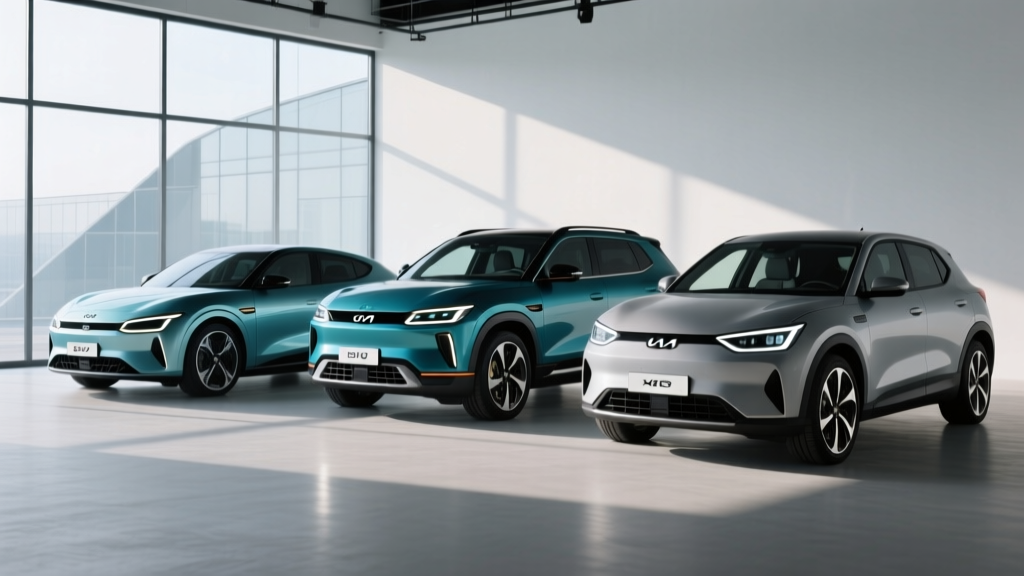
Bottom line: Kia's 2026 electric lineup covers three distinct buyer needs. The Niro EV (~$39,600, 239 mi EPA) is the budget-friendly commuter. The EV6 (~$42,900, up to 310 mi EPA, 240 kW DC fast charging) is the performance-and-road-trip crossover. The EV9 (~$54,900, up to 304 mi EPA) is the only mainstream three-row electric SUV. All three use Hyundai Motor Group's proven E-GMP platform (EV6/EV9) or dedicated BEV architecture (Niro EV), feature 10-year/100,000-mile battery warranties, and support NACS charging via adapter or native port on newer builds. Federal §30D tax credit eligibility varies by model, trim, battery sourcing, and your income — check current IRS rules before purchasing.
Kia's 2026 Electric Lineup at a Glance
Kia offers three battery-electric vehicles in the US market for 2026, each targeting a different use case. Rather than a one-size-fits-all approach, Kia segments its EVs by price, size, and capability. Here is how the numbers stack up:
| Spec | 2026 Kia Niro EV | 2026 Kia EV6 | 2026 Kia EV9 |
|---|---|---|---|
| Base MSRP | $39,600 | $42,900 | $54,900 |
| EPA Range (max) | 239 mi | 310 mi (LR RWD) | 304 mi (LR RWD) |
| Battery (usable) | 64.8 kWh (NMC) | 77.4 kWh (NMC) | 100.0 kWh (NMC) |
| Peak DC Charge Rate | ~85 kW | ~240 kW | ~210 kW |
| 10–80% DC Fast Charge | ~45 min | ~18 min | ~24 min |
| Level 2 (240V) Rate | ~11 kW | ~10.9 kW | ~11 kW |
| 0–60 mph | 7.8 sec | 3.4 sec (GT AWD) | 5.0 sec (GT-Line AWD) |
| Horsepower | 201 hp | 225–576 hp | 215–379 hp |
| MPGe (combined) | 113 MPGe | 117–134 MPGe | 88–92 MPGe |
| Cargo (behind 2nd row) | 22.8 cu ft | 24.4 cu ft | 43.5 cu ft |
| Battery Warranty | 10 yr / 100,000 mi | 10 yr / 100,000 mi | 10 yr / 100,000 mi |
Source: fueleconomy.gov and Kia America specifications.
Real-World Range: What the EPA Sticker Doesn't Tell You
EPA range estimates assume a mix of city and highway driving at moderate temperatures. Your actual mileage will vary — sometimes significantly — based on speed, climate, and terrain. Here is what to expect from Kia's electric cars in real-world conditions:
EPA vs. Real-World Range Estimates (Kia EV Lineup)
- EV6 Long Range RWD (310 mi EPA): Expect ~260–280 mi at sustained 75 mph highway speeds in mild weather. In sub-30°F winter conditions without preconditioning, range can drop to ~210–240 mi. The EV6's heat pump (standard on most trims) helps mitigate cold-weather loss.
- EV9 Long Range RWD (304 mi EPA): The larger, boxier SUV loses efficiency at highway speed. Expect ~245–270 mi on road trips, and ~200–230 mi in freezing temperatures. AWD trims drop the EPA figure to ~270–280 mi, with real-world highway closer to ~225–250 mi.
- Niro EV (239 mi EPA): Adequate for commuting but tighter on road trips. Expect ~195–215 mi at highway speeds, and ~165–185 mi in deep cold. This is a commuter-first vehicle — plan road trips around charging stops.
The EV6 and EV9 benefit from the E-GMP platform's sophisticated thermal management system, which includes battery preconditioning for DC fast charging. When you navigate to a fast charger using the built-in navigation, the car warms or cools the battery to optimal temperature before you arrive, enabling those peak charge rates. Skip preconditioning and your 10–80% charge time could stretch from 18 minutes to 35+ minutes on the EV6.
Charging Speeds and Infrastructure: The NACS Advantage
Kia's charging story in 2026 is defined by the industry's shift to the North American Charging Standard (NACS). Here is how each model connects:
- EV6 and EV9 (newer builds): Kia has transitioned to native NACS charge ports on vehicles built from late 2024 onward, granting direct access to Tesla's Supercharger network (17,000+ stalls in North America) without an adapter. Earlier 2024–2025 builds shipped with CCS1 ports; Kia provides a NACS adapter.
- Niro EV: Remains on CCS1. A NACS adapter is required for Supercharger access. The Niro's ~85 kW peak DC charge rate means it won't bottleneck on any charger type, but it won't take advantage of 250+ kW stalls.
| Charging Level | Power (kW) | EV6 Miles/Hour | EV9 Miles/Hour | Niro EV Miles/Hour |
|---|---|---|---|---|
| Level 1 (120V) | ~1.4 kW | ~4–5 mi/hr | ~4–5 mi/hr | ~4–5 mi/hr |
| Level 2 (240V, 48A) | ~11 kW | ~35–38 mi/hr | ~32–35 mi/hr | ~32–35 mi/hr |
| DC Fast (peak) | 85–240 kW | ~700+ mi/hr (peak) | ~550+ mi/hr (peak) | ~250 mi/hr (peak) |
Home charging reality check: A Level 2 home charger is essential for convenient EV ownership. Expect to pay $500–$800 for a quality Level 2 EVSE (ChargePoint Home Flex, Emporia Level 2, or Kia's own wallbox) plus $800–$2,500 for professional electrician installation, depending on whether your electrical panel needs a 240V/50A circuit upgrade. If you need a panel upgrade from 100A to 200A service, add $1,500–$3,500. Total home charging setup typically runs $1,500–$4,000.
Cost Breakdown: Kia EVs vs. Gas Equivalents
Let's compare the 5-year ownership cost of the Kia EV6 Long Range RWD against a comparably priced gas crossover (Kia Sportage EX AWD, ~$35,000 MSRP). This analysis uses 15,000 miles/year, $0.14/kWh home electricity (national average), $3.40/gallon gas, and accounts for maintenance differences.
| Cost Category (5 Years) | Kia EV6 LR RWD | Kia Sportage EX AWD (Gas) |
|---|---|---|
| Purchase Price (MSRP) | $42,900 | $35,000 |
| Est. Federal Tax Credit (§30D) | $0–$7,500* | $0 |
| Effective Purchase Price | $35,400–$42,900 | $35,000 |
| Fuel/Energy (75,000 mi) | $3,675 (home charging) | $9,563 (28 MPG combined) |
| Maintenance | ~$1,200 | ~$3,500 |
| Insurance (est. average) | ~$10,500 | ~$8,500 |
| 5-Year Total (pre-depreciation) | $50,775–$58,275 | $56,563 |
*§30D tax credit eligibility depends on MSRP caps ($80,000 for SUVs like EV9; $55,000 for sedans/wagons — EV6 classification varies by model year), buyer income limits ($150K single / $300K joint AGI), and battery critical-mineral and component sourcing requirements that change annually. Consult the IRS Clean Vehicle Credit page and a tax professional. Point-of-sale transfer is available at participating dealers.
Key takeaways: The EV6 breaks even or saves money over 5 years when the tax credit applies, primarily through fuel and maintenance savings. Without the credit, the EV6 costs slightly more upfront but still narrows the gap through dramatically lower per-mile energy costs ($0.049/mi electric vs. $0.128/mi gas). EV insurance premiums remain 15–25% higher on average due to repair costs and battery replacement risk.
Energy Cost Per Mile — Kia Electric Cars vs. Gas Equivalents
| Vehicle | Energy Source | Cost/Mile |
|---|---|---|
| EV6 (home, $0.14/kWh) | Electricity | $0.049 |
| EV6 (DC fast, $0.35/kWh avg) | Electricity | $0.12 |
| Niro EV (home) | Electricity | $0.053 |
| Sportage AWD (gas, $3.40/gal) | Gasoline | $0.121 |
| Sorento V6 AWD (gas, $3.40/gal) | Gasoline | $0.155 |
Federal Tax Credit: What Kia Buyers Actually Qualify For
The §30D Clean Vehicle Credit is the single most confusing aspect of buying a Kia EV. Here is a practical eligibility checklist:
- MSRP cap: $55,000 for sedans/wagons (EV6 may fall here); $80,000 for SUVs and trucks (EV9 and Niro EV qualify as SUVs). Vehicles above the cap are ineligible.
- Income cap: Modified AGI must not exceed $150,000 (single), $225,000 (head of household), or $300,000 (joint). Check your prior-year or current-year AGI, whichever is lower.
- Battery sourcing: The credit splits into two halves — $3,750 for critical minerals and $3,750 for battery components. Each has escalating domestic/free-trade-partner sourcing thresholds that tighten yearly. As of 2026, vehicles with battery cells or minerals sourced from "foreign entities of concern" (primarily China) may lose part or all of the credit.
- Point-of-sale transfer: You can transfer the credit to the dealer at purchase, reducing your out-of-pocket cost immediately rather than waiting for tax filing. The dealer must be IRS-registered.
- Final assembly: Must occur in North America. Kia's EV9 is assembled in West Point, Georgia. EV6 is assembled in South Korea — this may affect eligibility depending on current-year rules.
Critical nuance: The EV6's South Korean assembly has made its §30D eligibility inconsistent since 2023. Check the DOE's qualifying vehicle list on fueleconomy.gov before assuming credit availability. The EV9, assembled in Georgia, has more stable credit eligibility. The Niro EV (also assembled in Korea) faces the same sourcing and assembly challenges as the EV6.
Common Misconceptions About Kia Electric Cars
| Myth | Fact |
|---|---|
| "The battery will need replacing in 5 years." | Kia warrants the battery for 10 years/100,000 miles with a 70% capacity retention threshold. Real-world degradation data from E-GMP vehicles shows ~5–8% loss over the first 100,000 miles — well within warranty. NMC batteries in Kia's thermal-managed packs degrade slowly when not routinely charged to 100%. |
| "You can't road-trip an EV." | The EV6 adds ~210 miles of range in 18 minutes at a 240 kW DC fast charger. On a 600-mile trip, plan two 20-minute stops — comparable to rest breaks you'd take anyway. The NACS port unlocks Tesla Superchargers, the most reliable US network. |
| "EVs are worse in winter." | Range drops 15–30% in sub-freezing temps, but the EV6 and EV9 use heat pumps that reclaim waste heat for cabin warming, reducing the penalty vs. resistive heaters. Preconditioning while plugged in preserves range. Traction and AWD performance are excellent — EVs have a low center of gravity and instant torque control. |
| "Kia EVs don't hold value." | EV depreciation has been volatile industry-wide, but Kia's 10-year powertrain warranty (transferable) supports resale. The EV9, as one of few three-row electric SUVs, holds strong demand in the used market. |
Decision Framework: Which Kia EV Fits Your Life?
Choose the Niro EV if:
- Your daily commute is under 60 miles round-trip
- You rarely drive more than 150 miles without stopping
- Budget is the top priority (lowest MSRP in the lineup)
- You have reliable home Level 2 charging
- You don't need AWD or towing capability
Choose the EV6 if:
- You take regular road trips and need fast DC charging (18-min 10–80%)
- You want performance (GT trim: 576 hp, 3.4 sec 0–60)
- You need 310 miles of EPA range for peace of mind
- You value the widest Supercharger access via native NACS
- Two rows of seating are sufficient
Choose the EV9 if:
- You need three rows and 7-passenger seating
- You want an electric family hauler with 43.5 cu ft of cargo space
- You're eligible for the §30D credit (US-assembled, within MSRP cap)
- You can accept ~245–270 real-world highway miles between charges
- You occasionally tow (up to 5,000 lbs on AWD trims)
Consider a Kia hybrid (Sorento HEV or Niro HEV) instead if:
- You lack access to home or workplace charging
- You regularly drive in remote areas with sparse charging infrastructure
- Your budget is under $30,000
- You frequently tow heavy loads in cold weather
First-Time Kia EV Buyer Checklist
If you are buying your first electric vehicle from Kia, work through these steps before signing:
- Audit your charging access. Can you install a 240V Level 2 charger at home? Get an electrician quote before buying. If you live in an apartment without charging, map your nearest public Level 2 and DC fast chargers using PlugShare or the Kia Access app.
- Verify tax credit eligibility. Check irs.gov for current §30D rules, then confirm the specific VIN's eligibility with the dealer. Do not assume the credit applies.
- Test the charge curve, not just peak kW. On your test drive, ask to stop at a DC fast charger. Watch how the EV6 sustains high charge rates from 10–55% SoC before tapering. This real-world behavior matters more than the headline number.
- Understand your warranty. Kia covers the battery at 10 years/100,000 miles (70% capacity). The basic vehicle warranty is 5 years/60,000 miles. Both are fully transferable to second owners, which helps resale.
- Get an insurance quote first. EV insurance premiums are 15–25% higher on average. The EV6 GT's performance classification can push premiums further. Shop quotes from GEICO, Progressive, and State Farm before committing.
- Set charging habits for longevity. For daily driving, set your charge limit to 80%. Reserve 100% charges for road trips. The Kia infotainment system lets you schedule charging and set limits. For NMC batteries (all three models), avoiding prolonged 100% or near-0% states extends long-term health.
Frequently Asked Questions
Do Kia electric cars qualify for the $7,500 federal tax credit?
It depends on the model, your income, and battery sourcing. The EV9 (assembled in Georgia) has the strongest eligibility as of 2026. The EV6 and Niro EV (assembled in South Korea) face assembly and sourcing limitations that may reduce or eliminate the credit. Always verify via fueleconomy.gov and the IRS before purchasing. The credit can be transferred to the dealer at point of sale to reduce your purchase price immediately.
How long does it take to charge a Kia EV at home?
On a Level 2 (240V, ~11 kW) home charger, the EV6 (77.4 kWh) charges from 0–100% in approximately 7.5 hours. The EV9 (100 kWh) takes about 9.5 hours. The Niro EV (64.8 kWh) takes roughly 6.5 hours. Most owners plug in overnight and wake up to a full battery. On a standard 120V outlet (Level 1), expect 3–5 miles of range per hour of charging — only practical for low-mileage days or topping off.
Is the Kia EV6 or EV9 better for road trips?
The EV6 is the stronger road-trip vehicle. Its 310-mile EPA range, 240 kW peak DC charging (10–80% in ~18 min), and lower energy consumption mean fewer and shorter stops. The EV9 has comparable range (304 mi) but charges slightly slower (~24 min 10–80%) and consumes more energy per mile due to its larger size and weight. Both use NACS on newer builds, granting Supercharger access.
What happens if the battery degrades significantly?
Kia's battery warranty guarantees at least 70% capacity retention for 10 years or 100,000 miles. If your battery falls below that threshold, Kia will repair or replace it at no cost. Out-of-warranty battery replacement for the EV6/EV9 currently runs $12,000–$20,000 depending on the pack, though prices are declining as the supply chain matures. Real-world data from early E-GMP owners (2022–2023 EV6) shows ~3–5% degradation at 40,000–60,000 miles — well above the warranty threshold.
Can I charge a Kia EV at Tesla Superchargers?
Yes. Kia EVs built from late 2024 onward feature a native NACS charge port and can plug directly into Tesla Superchargers. Earlier models with CCS1 ports can use a Kia-provided NACS adapter. The Kia Access app and in-car navigation integrate Supercharger locations into route planning, including preconditioning the battery for optimal charge speed upon arrival.
Kia EV vs. Kia hybrid: which saves more money?
If you can charge at home, a Kia EV saves $4,000–$6,000 in fuel costs over 5 years compared to a Kia hybrid like the Sorento HEV (37 MPG combined). However, hybrids have a lower purchase price, no range limitations, and lower insurance costs. The break-even point typically occurs at 3–5 years of ownership with home charging. If you lack home charging and rely on public DC fast chargers ($0.30–$0.48/kWh), the cost advantage narrows significantly, and a hybrid may be the smarter financial choice.