The short answer: Jeep-branded electric bikes (e-bikes) are fun, off-road-capable pedal-assist machines priced between $1,500 and $3,500, but they are not electric vehicles (EVs). They do not qualify for the federal §30D tax credit, cannot be driven on highways, and offer 20-40 miles of range per charge. If your goal is commuting, road trips, or replacing a gas car, a used EV like a 2024 Chevy Bolt EV (259 miles EPA, ~$18,000 used) delivers far more utility per dollar. If you want a rugged recreational e-bike for trails and short neighborhood rides, the Jeep e-bike lineup delivers genuine off-road capability — just don't confuse it with an EV purchase.
What Are Jeep Electric Bikes?
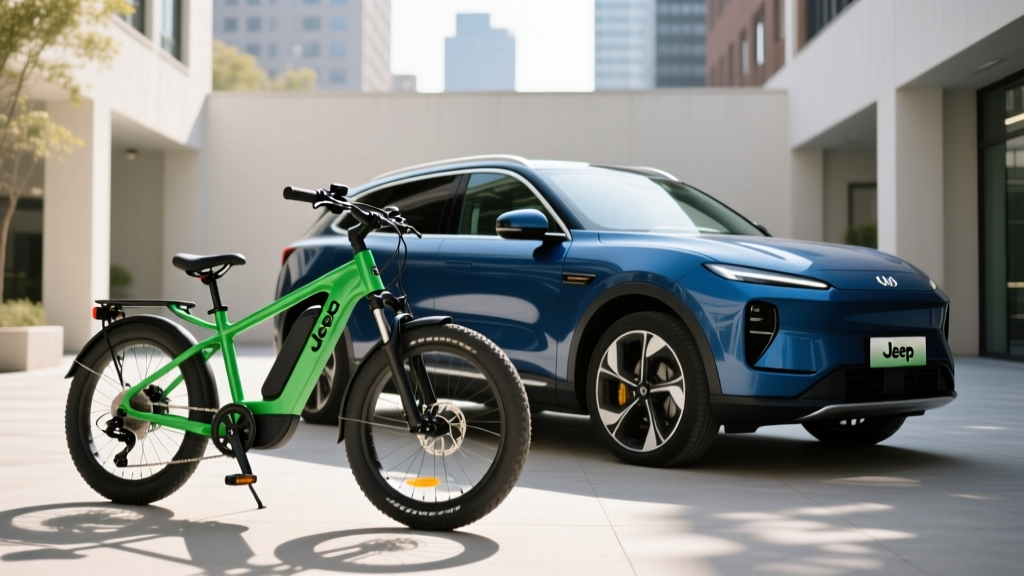
Jeep licenses its brand to several e-bike manufacturers, most notably QuietKat, which produces a line of fat-tire, off-road electric bikes under the Jeep nameplate. These are Class 2 or Class 3 pedal-assist e-bikes — meaning they have a motor that assists your pedaling up to 20 mph (Class 2, throttle-equipped) or 28 mph (Class 3, pedal-assist only at higher speed). They are not motorcycles, not electric cars, and not plug-in vehicles of any kind.
The Jeep e-bike lineup as of 2026 includes models like the Jeep Rubicon e-Bike (fat-tire, full-suspension, ~$3,200), the Jeep Wrangler e-Bike (hardtail, ~$2,200), and the Jeep Compass e-Bike (commuter-oriented, ~$1,700). All use hub-drive or mid-drive electric motors rated between 500W and 750W, powered by removable lithium-ion battery packs in the 480Wh to 720Wh range.
Specs That Matter: Range, Power, and Charging
Here's where e-bike buyers often get tripped up: Wh (watt-hours) on an e-bike is not the same as kWh (kilowatt-hours) on an EV. A 720Wh e-bike battery holds 0.72 kWh of energy — roughly 1/100th the capacity of a Tesla Model Y's 75 kWh pack. That small battery is why e-bike range is measured in tens of miles, not hundreds.
| Model | Motor | Battery | EPA-Est. Range | Top Assist Speed | Charge Time (0-100%) | MSRP |
|---|---|---|---|---|---|---|
| Jeep Rubicon e-Bike | 750W mid-drive | 720Wh (48V) | 25-40 mi | 28 mph (Class 3) | ~4.5 hours | $3,199 |
| Jeep Wrangler e-Bike | 500W hub-drive | 540Wh (48V) | 20-35 mi | 20 mph (Class 2) | ~4 hours | $2,199 |
| Jeep Compass e-Bike | 500W hub-drive | 480Wh (48V) | 20-30 mi | 20 mph (Class 2) | ~3.5 hours | $1,699 |
Real-world range caveat: Those range estimates assume moderate pedal assist on flat terrain. If you're riding off-road, climbing hills, using full throttle (Class 2), or riding in cold weather below 40°F, expect range to drop 30-50%. A Rubicon e-Bike rated at 40 miles may deliver only 20-25 miles on a rugged trail ride in November.
Charging is simple: plug the removable battery into a standard 120V household outlet. There's no Level 2 home charger to install, no DC fast charging, and no charging network to navigate. You will never experience "range anxiety" at a public charger — because there are no public e-bike chargers. You charge at home, period.
Jeep E-Bike vs Used EV: The Ownership Cost Comparison
This is where the decision gets interesting. A Jeep Rubicon e-Bike at $3,199 sounds affordable — and it is, compared to a new EV. But compared to a used EV, the value proposition shifts. Let's compare the Rubicon e-Bike against a 2024 Chevrolet Bolt EV (259 miles EPA, widely available on the used market for $16,000-$19,000).
| Cost Category | Jeep Rubicon E-Bike | 2024 Chevy Bolt EV (Used, $17,500) |
|---|---|---|
| Purchase Price | $3,199 | $17,500 |
| Federal Tax Credit (§30D) | $0 (not eligible) | Up to $4,000 (used EV credit, income-limited) |
| Effective Purchase | $3,199 | ~$13,500 (with credit) |
| Annual "Fuel" Cost | ~$30/yr (electricity) | ~$550/yr (electricity, 12,000 mi/yr) |
| 5-Year Fuel Total | $150 | $2,750 |
| Insurance (Annual Avg) | $0-$150 (homeowners rider) | ~$1,400/yr |
| 5-Year Insurance | $0-$750 | $7,000 |
| Maintenance (5-Year) | $300-$600 (tires, brakes, chain) | ~$800 (cabin filter, tires, wipers) |
| Battery Replacement Risk | $400-$700 (after 3-5 yrs) | Covered by 8-yr/100k-mi warranty |
| 5-Year Total Cost | $4,049-$5,299 | $24,050-$26,800 |
| Utility: Commuting, Road Trips, Weather | Fair-weather, <40 mi, 1 rider | All-weather, 259 mi, 5 passengers, cargo |
The e-bike wins on pure dollar cost by a wide margin. But the Bolt EV can carry five people, drive 259 miles in freezing rain at 75 mph, and replace your gas car entirely. The e-bike replaces a bicycle — or, at best, a second car for very short solo trips in good weather.
Tax Credit Reality: What Jeep E-Bike Buyers Get Wrong
The most common misconception I encounter: "Does the Jeep electric bike qualify for the $7,500 EV tax credit?"
No. The federal §30D Clean Vehicle Credit applies only to four-wheeled plug-in electric vehicles with a gross vehicle weight rating under 14,000 lbs, purchased for use on public roads. E-bikes have two wheels, are not registered with a DMV, and are not "motor vehicles" under IRS rules. You cannot claim any federal EV tax credit for an e-bike purchase.
There is a separate, smaller incentive: the §30D-used credit (up to $4,000 or 30% of sale price, whichever is less) applies only to used EVs, not e-bikes. Some states and municipalities offer e-bike rebates — Colorado, for example, has offered e-bike tax credits — but these are state-level programs that vary widely. Check your local jurisdiction; do not assume federal incentives apply.
| Myth | Fact |
|---|---|
| "It's a Jeep product, so it qualifies for EV tax credits." | Jeep licenses the brand to QuietKat. E-bikes are not eligible for §30D credits. Only 4-wheeled plug-in vehicles qualify. |
| "I can ride it on the road instead of buying a car." | Class 2/3 e-bikes are legal on roads and bike lanes in most states, but they offer no crash protection, no weather protection, and limited cargo/passenger capacity. |
| "The battery will last forever." | E-bike lithium-ion batteries degrade like any lithium cell. Expect 500-800 full charge cycles before capacity drops below 80%. For a daily rider, that's 2-4 years before noticeable range loss. |
| "It charges at a public EV station." | E-bikes charge from a standard 120V outlet using a proprietary charger. Public EV chargers (CCS, NACS, CHAdeMO) are physically and electrically incompatible. |
| "750W motor means it's as fast as a moped." | 750W is the motor's nominal assist rating. Top speed is electronically limited to 20 or 28 mph by federal e-bike classification. It will not outpace car traffic. |
Who Should Buy a Jeep E-Bike (and Who Shouldn't)
The Jeep e-bike lineup fills a specific niche: off-road-capable, recreational pedal-assist for riders who want fat-tire stability and trail-riding fun. It is not a car replacement, not a commuter solution for most people, and not an EV in any regulatory or practical sense.
Choose a Jeep e-bike if:
- You want a recreational off-road e-bike for trails, beach paths, or campground exploration
- You already own a car and want to reduce short solo trips under 15 miles
- You live in a mild climate with year-round riding weather
- You have secure storage (garage or shed) — e-bike theft is rampant and often uninsured
- Your budget is $1,500-$3,500 and you don't need passenger or cargo capacity
Choose an EV (new or used) if:
- You need to commute more than 20 miles each way, in all weather
- You carry passengers, groceries, or cargo regularly
- You take road trips longer than 40 miles
- You want federal tax credits (§30D: up to $7,500 new, $4,000 used — per IRS rules, subject to income and MSRP caps)
- You need crash safety, airbags, and all-weather traction control
Real-World Ownership: What No One Tells You
Having tested several fat-tire e-bikes alongside EVs, here are the ownership realities that spec sheets don't reveal:
Storage and security: A Jeep Rubicon e-Bike weighs 70+ lbs. You cannot carry it up apartment stairs easily. If you don't have a garage, you need a heavy-duty lock and ideally a GPS tracker. E-bike theft rates have surged — IIHS and urban police departments have flagged e-bike theft as a growing problem, and most standard homeowners policies require a specific rider for e-bikes over $1,000.
Battery degradation: Unlike EVs, which are federally mandated to carry 8-year/100,000-mile battery warranties, e-bike batteries typically carry 1-year warranties. After 2-3 years of regular use, expect 20-30% capacity loss. A replacement battery for a Jeep Rubicon e-Bike costs $400-$700 — a significant percentage of the bike's original price.
Maintenance: E-bikes need bicycle maintenance: chain lubrication, brake pad replacement, tire changes (fat tires run $50-$80 each), and occasional motor or controller service. Budget $100-$200 per year in routine maintenance, more if you ride off-road frequently.
Winter riding: Lithium-ion batteries lose 20-40% capacity below 32°F. If you live in a cold climate, your 40-mile summer range becomes 20-25 miles in January — and that's if you're willing to ride in freezing wind at 20 mph on a bicycle.
The Bottom Line: E-Bike vs EV Is Not Either/Or
For most households, the smart play is both: a used or new EV as the primary vehicle, and an e-bike (Jeep or otherwise) as a short-trip supplement that reduces wear on the car and adds recreational value. A household with a Bolt EV and a Jeep Wrangler e-Bike covers 95% of daily trips on electricity, reserving the car for longer commutes and bad weather, while the e-bike handles farmers' market runs, neighborhood loops, and trail rides.
Just don't mistake the e-bike for an EV. The specs, the economics, the tax treatment, and the utility are entirely different categories. Know what you're buying.
Are Jeep electric bikes made by Jeep?
No. Jeep (Stellantis) licenses its brand to QuietKat, a Colorado-based e-bike manufacturer. QuietKat designs, manufactures, and warrants the bikes. Jeep provides brand oversight and design input but does not produce the bikes directly.
Can I claim a tax credit for a Jeep electric bike?
Not the federal §30D EV credit — that applies only to four-wheeled plug-in vehicles. Some states offer e-bike rebates or tax credits (Colorado, for example). Check your state's energy or transportation department for current programs.
How far can a Jeep e-bike really go on one charge?
Real-world range depends heavily on terrain, assist level, rider weight, and temperature. The Rubicon e-Bike's 40-mile maximum assumes flat ground, moderate assist, and mild weather. Off-road riding, hills, full throttle, or cold weather can cut range to 20-25 miles.
Is a Jeep e-bike street legal?
Yes, in most US jurisdictions. Class 2 e-bikes (20 mph throttle) and Class 3 e-bikes (28 mph pedal-assist) are legal on roads and bike lanes in most states, though some municipalities restrict Class 3 bikes from certain paths. Check your local regulations — helmet laws and age restrictions vary by state.
Should I buy a Jeep e-bike instead of a used EV?
They serve different purposes. If you need a primary vehicle for commuting, road trips, and all-weather driving, buy a used EV. If you want a recreational off-road bike for short trips and trail riding, the Jeep e-bike is a solid choice. Many households benefit from owning both.