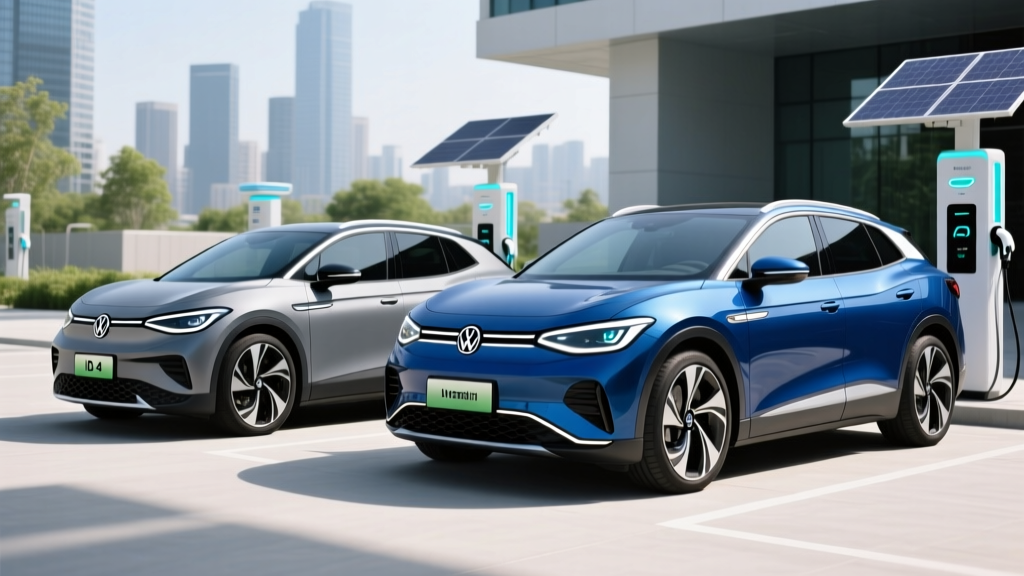
The Volkswagen ID.4 and Hyundai Ioniq 5 are two of the most popular electric crossovers in the U.S. market, but they solve the EV equation very differently. One prioritizes interior space and family practicality; the other chases charging speed and retro-futuristic design. For 2026, both have received meaningful updates that shift the calculus. This comparison breaks down every number that matters — EPA range, battery chemistry, sustained charge rates, cargo volume, and total ownership cost — so you can match the right EV to your actual driving life.
Side-by-Side Spec Table: 2026 ID.4 vs 2026 Ioniq 5
Before we get into subjective impressions, here are the hard numbers. All figures reflect the most popular long-range, rear-wheel-drive trims unless noted. AWD variants are called out where relevant.
| Spec | 2026 VW ID.4 Pro S (RWD) | 2026 Hyundai Ioniq 5 SEL (RWD) |
|---|---|---|
| EPA Range | 291 mi | 303 mi |
| Battery (usable / chemistry) | 82 kWh / NMC | 84 kWh / NMC |
| Efficiency (MPGe combined) | 107 MPGe | 117 MPGe |
| Peak DC Fast Charge | 175 kW | 238 kW |
| 10–80% DC Charge Time | ~28 min | ~18 min |
| Level 2 (240V) Charge Rate | 11 kW | 10.9 kW |
| 0–60 mph | 7.7 sec (RWD) / 5.4 sec (AWD) | 7.2 sec (RWD) / 5.0 sec (AWD) |
| Horsepower | 282 hp (RWD) / 335 hp (AWD) | 225 hp (RWD) / 320 hp (AWD) |
| Cargo (behind rear seats) | 30.3 cu ft | 27.2 cu ft |
| Frunk | 0.4 cu ft (cable storage) | 2.1 cu ft |
| Towing Capacity | 2,700 lb | 2,300 lb |
| Base MSRP (RWD, before dest.) | $44,495 | $46,700 |
| Battery Warranty | 8 yr / 100,000 mi | 10 yr / 100,000 mi |
| Vehicle Warranty | 4 yr / 50,000 mi | 5 yr / 60,000 mi |
Sources: fueleconomy.gov (EPA), VW spec sheet, Hyundai spec sheet. Specs reflect 2026 model year as published; confirm with dealer for late-year changes.
Range and Efficiency: Real-World Expectations
On paper, the Ioniq 5 holds a 12-mile EPA advantage (303 vs. 291). But EPA testing is conducted under controlled conditions that don't fully capture highway cruising or cold-weather losses — the two scenarios EV buyers care about most.
- VW ID.4 (EPA 291 mi): Expect ~235–260 mi at sustained 70–75 mph highway speeds in moderate temps (50–80°F). In sub-30°F winter conditions, plan for ~190–220 mi without preconditioning.
- Hyundai Ioniq 5 (EPA 303 mi): Expect ~245–275 mi highway in moderate temps. Winter drops it to ~200–230 mi. The Ioniq 5's standard heat pump (on most trims) helps limit cold-weather degradation compared to EVs without one.
The Ioniq 5's efficiency edge — 117 MPGe combined vs. 107 MPGe — means it extracts more miles per kWh. This matters if you mostly charge at home on a Level 2 circuit: the Hyundai will cost slightly less per mile to "fuel." Over 15,000 annual miles at the U.S. average electricity rate of ~$0.16/kWh, the Ioniq 5 saves roughly $80–$120 per year in energy costs versus the ID.4. Not dramatic, but it compounds.
Both vehicles use NMC (nickel-manganese-cobalt) lithium-ion chemistry, which offers higher energy density than LFP (lithium iron phosphate) at the cost of slightly faster long-term degradation. Neither offers an LFP variant in the U.S. for 2026.
Charging Speed and Network Access
This is where the gap widens considerably. The Ioniq 5's 800-volt architecture allows it to accept up to 238 kW at a DC fast charger, while the ID.4's 400-volt system peaks at 175 kW.
| Charging Level | VW ID.4 | Hyundai Ioniq 5 |
|---|---|---|
| Level 1 (120V, 12A) | ~1.4 kW / ~4 mi/hr | ~1.4 kW / ~4 mi/hr |
| Level 2 (240V, 48A) | 11 kW / ~33 mi/hr | 10.9 kW / ~35 mi/hr |
| DC Fast Charge (peak) | 175 kW | 238 kW |
| 10–80% DCFC Time | ~28 min | ~18 min |
| Sustained Rate (10–50%) | ~150–170 kW avg | ~200–230 kW avg |
The 10-minute gap on a 10–80% charge is significant for road trips. On a 600-mile drive with two charge stops, the Ioniq 5 saves you roughly 20 minutes of plug-in time — enough to matter when you're managing kids, pets, or a tight schedule.
Charging curve caveat: Both vehicles taper charge rate substantially above 80% SoC to protect battery health. The Ioniq 5's curve is aggressive: it holds near-peak speed to about 55–60%, then steps down. The ID.4's curve is flatter but lower overall. Neither sustains peak kW for the entire session — "peak 238 kW" is a momentary maximum, not an average.
Network access: Both VW and Hyundai have adopted the NACS (Tesla North American Charging Standard) port for new vehicles starting with the 2025 model year in North America. For 2026 models, you'll find native NACS ports on both, granting access to Tesla Superchargers (V3 and V4) with no adapter. This dramatically expands the reliable fast-charging footprint for both vehicles, particularly in rural corridors where Electrify America and EVgo coverage is thinner.
Price, Tax Credits, and Ownership Cost
Sticker price alone doesn't tell the story. Federal tax credit eligibility under IRS §30D can shift the value equation by up to $7,500, but the rules are layered.
2026 Pricing & Federal Tax Credit Snapshot
| VW ID.4 Pro S (RWD) | Hyundai Ioniq 5 SEL (RWD) | |
|---|---|---|
| Base MSRP | $44,495 | $46,700 |
| Destination Charge | $1,395 | $1,395 |
| Total Before Incentives | $45,890 | $48,095 |
| Potential §30D Credit | Up to $7,500 | Up to $7,500 |
| Effective Price (max credit) | ~$38,390 | ~$40,595 |
Tax credit caveats (2026 rules): The §30D credit has multiple eligibility gates — buyer income caps ($150K single / $300K joint AGI), MSRP caps ($80,000 for SUVs), critical-mineral sourcing requirements, and battery-component manufacturing rules. Both vehicles are classified as SUVs and fall under the MSRP cap. However, the exact credit amount depends on the battery's critical-mineral and component sourcing, which can shift mid-year. As of early 2026, both the ID.4 (built in Chattanooga, TN) and Ioniq 5 (built in Ellabell, GA at Hyundai's Metaplant America) qualify for the full $7,500 for eligible buyers — but always verify current eligibility via the fueleconomy.gov tax credit lookup or consult a tax professional. The point-of-sale transfer option allows you to apply the credit as a down payment reduction at the dealer rather than waiting for a tax refund.
5-Year Total Cost of Ownership Estimate
| Cost Category (5 yr / 75K mi) | VW ID.4 | Hyundai Ioniq 5 |
|---|---|---|
| Depreciation (est.) | ~$16,500 | ~$15,200 |
| Electricity (home charging avg.) | ~$4,700 | ~$4,300 |
| Insurance (national avg.) | ~$9,200 | ~$9,800 |
| Maintenance | ~$1,800 | ~$1,600 |
| Tax Credit Savings | -$7,500 | -$7,500 |
| Est. 5-Year Net Cost | ~$24,700 | ~$23,400 |
The Ioniq 5 edges ahead on TCO thanks to better efficiency, slightly lower maintenance (fewer scheduled dealer visits under Hyundai's complimentary maintenance plan), and marginally stronger resale value. The ID.4 costs less to insure on average, partially offsetting the gap. Your actual numbers will vary based on local electricity rates, driving mix, and insurance profile.
Performance, Interior, and Daily Usability
Performance
The ID.4 RWD makes 282 hp to the Ioniq 5's 225 hp, yet the Hyundai hits 60 mph slightly quicker (7.2 vs. 7.7 sec) thanks to a lighter curb weight and more aggressive torque delivery off the line. Neither is a performance EV — both are tuned for comfortable, composed cruising rather than sport-sedan aggression. The AWD variants are the real performers: the ID.4 Pro S AWD (335 hp, 5.4 sec) and Ioniq 5 AWD (320 hp, 5.0 sec) both deliver genuine hot-hatch thrust.
Regenerative braking is adjustable in both via steering-wheel paddles. The Ioniq 5's i-PEDAL mode offers true one-pedal driving to a full stop, while the ID.4's B-mode slows to ~3 mph but requires a brake tap for a complete stop — a minor annoyance in stop-and-go traffic.
Interior and Cargo
The ID.4 wins on interior volume, period. Its 30.3 cu ft of rear cargo space and flat load floor make it the better choice for families hauling strollers, groceries, or camping gear. Rear seat legroom is generous (37.6 in.), and the cabin materials have improved for 2026 with softer-touch surfaces on the Pro S trim.
The Ioniq 5 sacrifices some cargo space (27.2 cu ft) to its sloping roofline and shorter wheelbase overhang, but its interior design is more distinctive. The dual 12.3-inch displays, sliding center console, and available Vehicle-to-Load (V2L) adapter (powers 120V devices up to 3.6 kW) give it a tech-forward personality the ID.4 can't match. The frunk is also more useful at 2.1 cu ft — enough for charging cables and a small bag.
Tech and Driver Assistance
Both come well-equipped: wireless Apple CarPlay/Android Auto, over-the-air updates, and comprehensive ADAS suites. VW's IQ.DRIVE and Hyundai's Highway Driving Assist 2 (HDA2) are both SAE Level 2 systems — they handle lane centering and adaptive cruise but require full driver attention at all times. Neither is "self-driving."
The Ioniq 5's infotainment system is faster and more intuitive in our experience, with physical shortcut buttons below the touchscreen. The ID.4's latest software (v4.0) has improved responsiveness over earlier models, but its capacitive-touch steering wheel controls remain a frustration point — easy to trigger accidentally.
Category-by-Category Verdict
Winner: Hyundai Ioniq 5
303 mi EPA and 117 MPGe combined beat the ID.4's 291 mi / 107 MPGe. The gap matters more for apartment dwellers relying on public charging.
Winner: Hyundai Ioniq 5
238 kW peak and ~18 min 10–80% crushes the ID.4's 175 kW / ~28 min. The 800V architecture is a genuine road-trip advantage.
Winner: VW ID.4
30.3 cu ft cargo, 2,700-lb towing, and a more spacious rear seat make it the family hauler.
Winner: VW ID.4
~$2,200 lower MSRP before incentives, and cheaper insurance partially offsets the efficiency gap.
Winner: Hyundai Ioniq 5
10 yr/100,000 mi battery and 5 yr/60,000 mi bumper-to-bumper beats VW's 8 yr/100K and 4 yr/50K.
Winner: Hyundai Ioniq 5
V2L capability, faster infotainment, more usable frunk, and HDA2 with lane-change assist edge out VW's IQ.DRIVE.
Decision Framework: Which Should You Buy?
Choose the VW ID.4 if…
- You need maximum cargo space for family gear, bikes, or camping equipment
- You tow a small trailer (2,700 lb vs. 2,300 lb capacity)
- You want the lowest entry price and prefer VW's dealer network in your area
- Most of your charging is at home, where the DC fast-charge speed gap is irrelevant
- You prefer a more conventional, understated crossover design
Choose the Hyundai Ioniq 5 if…
- You take regular road trips and value 10-minute-faster DC charging sessions
- Efficiency matters (you pay for electricity at higher rates or charge on expensive public networks)
- You want V2L capability for camping, tailgating, or emergency backup power
- Long-term warranty coverage is a priority (10-year battery, 5-year bumper-to-bumper)
- You value distinctive design and a more responsive infotainment system
Pros and Cons at a Glance
VW ID.4 — Pros
- Lower starting price (~$44,495)
- More cargo space (30.3 cu ft)
- Higher towing capacity (2,700 lb)
- Comfortable ride quality, well-tuned suspension
- Strong RWD horsepower (282 hp)
- Built in USA (Chattanooga, TN)
VW ID.4 — Cons
- Slower DC fast charging (175 kW peak)
- Lower efficiency (107 MPGe)
- Capacitive steering wheel controls are frustrating
- Shorter basic warranty (4 yr / 50K mi)
- One-pedal driving doesn't fully stop the car
Hyundai Ioniq 5 — Pros
- Faster DC charging (238 kW, ~18 min 10–80%)
- Better efficiency (117 MPGe)
- Standard heat pump on most trims
- V2L capability (3.6 kW, 120V)
- Superior warranty (10 yr battery, 5 yr basic)
- Distinctive, head-turning design
Hyundai Ioniq 5 — Cons
- Higher starting price (~$46,700)
- Less cargo space (27.2 cu ft)
- Lower towing capacity (2,300 lb)
- Insurance costs slightly higher on average
- Rear visibility limited by thick C-pillars
Final Recommendation
There's no universal winner — the right choice depends on how you'll actually use the vehicle. If your life involves frequent road trips, apartment living with reliance on public DC fast chargers, or you simply want the most efficient and tech-rich EV crossover in this price range, the Hyundai Ioniq 5 earns the edge. Its 800V charging architecture is a genuine daily-life advantage, not just a spec-sheet flex.
If you're a family buyer who charges at home most nights, needs the cargo room for weekend adventures, and wants to keep the purchase price as low as possible, the VW ID.4 is the more pragmatic pick. It's quieter about its virtues, but the extra 3 cu ft of cargo and $2,200 savings add up in real ownership.
Either way, test-drive both back-to-back, confirm §30D tax credit eligibility for your specific situation with a tax professional, and check current dealer inventory — trim availability and pricing incentives vary by region and month.
Frequently Asked Questions
Which is cheaper to own over 5 years, the ID.4 or Ioniq 5?
The Ioniq 5 edges ahead on estimated 5-year total cost of ownership (~$23,400 vs. ~$24,700 for the ID.4), primarily due to better efficiency, stronger resale value, and Hyundai's complimentary maintenance program. However, the ID.4's lower insurance premiums narrow the gap. Actual costs depend on your local electricity rates, driving habits, and insurance profile.
Do both the ID.4 and Ioniq 5 qualify for the full $7,500 federal tax credit in 2026?
As of early 2026, both vehicles are expected to qualify for the full $7,500 §30D credit for eligible buyers, since both are now manufactured in U.S. plants (VW in Tennessee, Hyundai in Georgia). However, eligibility depends on your income (AGI caps apply), the vehicle's MSRP (both clear the $80K SUV cap), and battery-sourcing requirements that can shift. Always verify at fueleconomy.gov or with a tax professional before purchasing.
Can I charge either vehicle at Tesla Superchargers?
Yes. Both the 2026 ID.4 and 2026 Ioniq 5 come with native NACS (Tesla) charge ports in North America, granting direct access to the Tesla Supercharger network without an adapter. This is a significant advantage over 2023 and earlier models that required CCS-to-NACS adapters.
Which has better cold-weather range?
The Ioniq 5 holds a slight edge thanks to its standard heat pump (on SEL and above), which uses less energy to warm the cabin compared to resistive heating. Expect both vehicles to lose 20–30% of their EPA range in sustained sub-30°F temperatures, but the Ioniq 5's heat pump can limit that loss to closer to 15–25%.
Is the Ioniq 5's faster charging noticeable in real life?
Absolutely — on road trips. A 10-minute difference per charge stop adds up to 20–30 minutes saved on a 600+ mile drive. For daily home charging, the difference is irrelevant since both charge fully overnight on Level 2. The Ioniq 5's advantage is specifically for DC fast charging during travel.
Which is better for towing?
The VW ID.4, with a 2,700-lb towing capacity vs. the Ioniq 5's 2,300 lb. Neither is a heavy-duty tow vehicle, but the ID.4 can handle a small boat trailer, bike rack with e-bikes, or a light utility trailer more comfortably. Note that towing will reduce range by 30–50% in either vehicle.