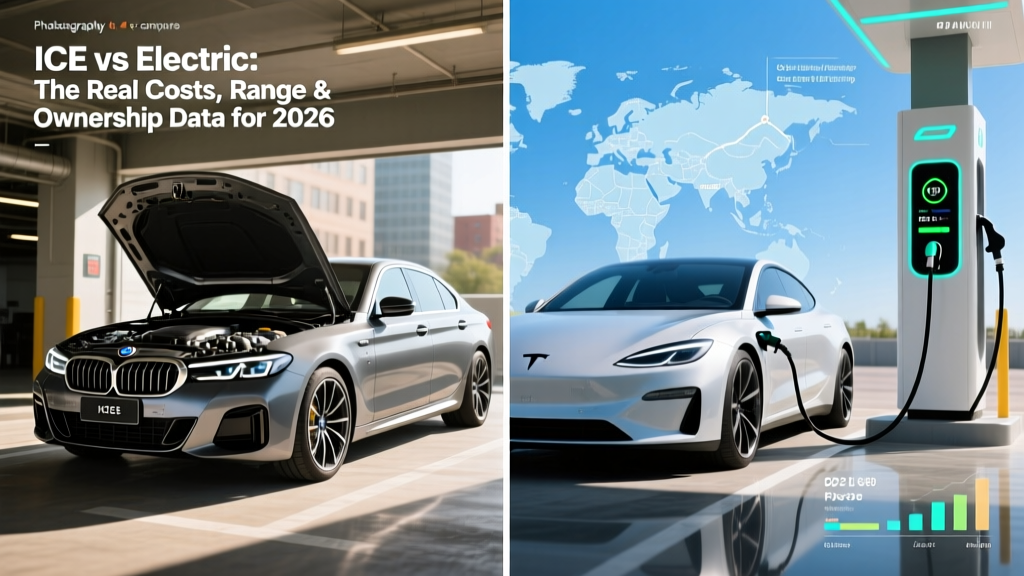
You're weighing an ICE (internal combustion engine) vehicle against an electric car, and the answer isn't a simple "EVs are cheaper." Here's the practical truth: an EV saves most drivers $4,000–$9,000 over five years in fuel and maintenance, but only if you have access to home charging, drive under ~250 miles daily, and qualify for some portion of the federal tax credit. If you live in an apartment without charging, regularly tow heavy loads in sub-freezing weather, or drive 400+ miles between stops, a hybrid or efficient ICE vehicle may still be your smarter buy. Below, we break down the exact numbers — purchase price, energy cost per mile, maintenance intervals, insurance premiums, and depreciation — so you can run the math on your own situation.
Quick Answer: ICE vs Electric in 2026
EVs win on: per-mile energy cost ($0.04–$0.06/mi vs $0.12–$0.16/mi for gas), maintenance (no oil changes, fewer brake replacements), and qualifying models, up to $7,500 in federal tax credits.
ICE vehicles win on: lower upfront purchase price (typically $5,000–$10,000 less before incentives), refueling speed (3 minutes vs 18–40 minutes for DC fast charging), and zero range loss in extreme cold.
The deciding factor: whether you can install a Level 2 home charger. Without home charging, EV ownership costs and convenience drop significantly.
What "ICE vs Electric" Actually Means for Your Wallet
When shoppers search "ICE electric," they're usually asking one question: will switching from a gas car to an EV save me money, and how much? The answer requires separating upfront cost from total cost of ownership (TCO).
The average new ICE vehicle transaction price in early 2026 sits around $42,000, while the average new EV lands near $48,500 before incentives, according to Kelley Blue Book data. That $6,500 gap narrows or disappears depending on three variables:
- Federal §30D tax credit: Up to $7,500 for qualifying new EVs, subject to MSRP caps ($80,000 for SUVs/trucks/vans, $55,000 for sedans), buyer income limits ($300K joint / $150K single), and battery component/critical mineral sourcing requirements. The credit can now be transferred to the dealer at point of sale, reducing your out-of-pocket cost on day one. Check current eligibility at IRS.gov.
- State and utility incentives: Vary widely — some states offer $2,000–$5,000 rebates, and utilities may cover $500–$1,500 of home charger installation. Consult your state's energy office for current programs.
- Home charging access: If you own a home with a 200-amp electrical panel, a Level 2 charger install runs $800–$2,500 total. If you need a panel upgrade, add $2,000–$4,000.
Fuel vs Charging: The Per-Mile Cost Breakdown
This is where EVs deliver their most consistent advantage — but the exact savings depend on your local electricity rate and driving patterns.
| Vehicle Type | Energy Source | Rate | Efficiency | Cost/Mile | Annual Cost |
|---|---|---|---|---|---|
| Midsize ICE sedan (e.g., Honda Accord 2.0T) | Gasoline | $3.40/gal | 30 MPG combined | $0.113 | $1,700 |
| Midsize EV (e.g., Hyundai Ioniq 6 SE) | Home L2 (national avg) | $0.16/kWh | 3.6 mi/kWh (138 MPGe) | $0.044 | $667 |
| Midsize EV (public DCFC only) | DC fast charging | $0.40/kWh | 3.6 mi/kWh | $0.111 | $1,667 |
| Compact ICE (e.g., Toyota Corolla) | Gasoline | $3.40/gal | 35 MPG combined | $0.097 | $1,457 |
| Midsize PHEV (e.g., Toyota RAV4 Prime) | Gas + Electric | Mixed | 94 MPGe / 38 MPG | $0.06–$0.10 | $900–$1,500 |
The critical insight: if you charge exclusively on public DC fast chargers at $0.35–$0.48/kWh, your per-mile cost nearly matches gasoline. The EV savings story depends on home charging at residential rates. A driver in Louisiana paying $0.10/kWh spends roughly $417/year to drive 15,000 miles. A driver in California paying $0.30/kWh on a time-of-use plan (charging overnight at $0.15/kWh) spends about $625/year. Both beat gas — but the gap varies by 50%.
For current EV efficiency ratings by model, the EPA's fueleconomy.gov database provides MPGe and kWh/100mi figures for every EPA-certified EV sold in the US.
Real-World Range: EPA Sticker vs What You'll Actually Get
One of the most common reasons buyers hesitate on the ICE-to-electric switch is range uncertainty. Here's how EPA estimates translate to real driving:
| Factor | ICE Vehicle | Battery Electric Vehicle |
|---|---|---|
| EPA-rated range / tank | 350–500 miles | 220–400 miles (model dependent) |
| Real-world highway range (75 mph) | ~90–95% of sticker | ~80–85% of EPA estimate |
| Cold-weather range (20°F) | ~95–98% of sticker | ~60–75% of EPA estimate (chemistry dependent) |
| Refueling / recharge time | 3–5 minutes | 18–40 min (10–80% DCFC); 8–12 hrs (Level 2 home) |
| Refueling infrastructure | 145,000+ gas stations | ~75,000 public charging ports (growing) |
| Home refueling convenience | Not practical | Wake up "full" every morning (with L2 install) |
The cold-weather row deserves emphasis. An EV with an EPA range of 300 miles may deliver only 200–225 miles in sustained 20°F driving, because the battery must expend energy heating itself and the cabin. Models equipped with a heat pump (standard on most Hyundai/Kia EVs, Tesla Model Y, and many 2025+ models) reduce this loss to roughly 20–25% instead of 30–40%. LFP (lithium iron phosphate) batteries tend to suffer slightly more cold-weather range loss than NMC chemistry, though they offer longer cycle life and lower cost.
For context, a 2026 Tesla Model 3 Long Range (75 kWh usable, NMC) carries an EPA rating of 341 miles. In real-world highway testing at 70–75 mph in moderate temperatures, expect approximately 275–295 miles. In 20°F winter conditions with cabin heat, plan for 220–250 miles between charges.
5-Year Total Cost of Ownership: ICE vs Electric
Let's run a concrete scenario: a midsize sedan, 15,000 miles/year, 5-year ownership, comparing a well-equipped ICE vehicle against a comparable EV.
| Cost Category | 2026 Camry SE (ICE) | 2026 Ioniq 6 SEL (EV) | Notes |
|---|---|---|---|
| MSRP (base) | $31,500 | $42,500 | EV starts ~$11K higher |
| Federal tax credit | $0 | –$7,500 (if eligible) | Subject to §30D sourcing & income rules |
| Effective purchase price | $31,500 | $35,000 | $3,500 gap after credit |
| Fuel / energy (5 yrs) | $8,500 | $3,335 (home charging) | EV saves ~$5,165 |
| Maintenance (5 yrs) | $3,200 | $1,400 | No oil, fewer brake pads, no transmission fluid |
| Insurance (5 yrs) | $7,500 | $8,750 | EV insurance averages 10–20% higher |
| Home charger install | $0 | $1,200 | One-time Level 2 installation |
| Estimated depreciation | –$12,600 (40%) | –$17,500 (50%) | EV depreciation has been steeper, narrowing |
| Total 5-year cost | $38,100 | $39,685 | Near parity; EV pulls ahead at year 6+ |
Key takeaways from this comparison:
- Years 1–4: The ICE vehicle often costs less overall due to the higher EV purchase price and steeper early depreciation.
- Year 5 and beyond: Cumulative fuel and maintenance savings begin overtaking the purchase premium, especially if you keep the EV past the warranty period.
- Insurance premium gap: EVs cost more to insure because repair costs after collision are higher (battery pack replacement can total a vehicle that would be repairable if it were ICE). Get quotes before buying.
- Depreciation wildcard: EV resale values have been volatile. Tesla price cuts in 2023–2024 hammered used EV values broadly. This may stabilize as the market matures, but budget for higher depreciation risk.
Maintenance Differences: What You'll Actually Pay For
EVs eliminate several recurring ICE maintenance items, but they're not maintenance-free:
What you'll never pay for on an EV:
- Oil changes ($40–$90 each, 2x/year on ICE)
- Spark plugs ($200–$600 at 60K–100K miles)
- Transmission fluid service ($150–$300)
- Timing belt/chain replacement ($500–$2,000 at 80K–120K miles)
- Emissions system repairs (catalytic converter: $1,000–$3,000)
What EVs still require:
- Cabin air filter ($20–$50, DIY-friendly)
- Tire rotation and replacement (EVs wear tires 15–25% faster due to instant torque and heavier curb weight — budget $800–$1,400 for a set of EV-rated tires)
- Brake fluid flush every 2–3 years ($80–$150)
- Windshield washer fluid, wiper blades
- 12V auxiliary battery replacement every 4–6 years ($200–$400)
- Coolant service on battery thermal management system (interval varies by manufacturer)
The net result: average EV maintenance costs run $0.06–$0.09 per mile vs $0.10–$0.14 per mile for ICE vehicles, a savings of roughly $400–$700 per year at 15,000 miles. Regenerative braking extends brake pad life dramatically — many EV owners report original brake pads at 80,000+ miles.
Common ICE vs Electric Myths — Corrected With Data
| Myth | Fact |
|---|---|
| "EV batteries need replacing every 5 years and cost $20,000." | Federal law mandates battery warranties of at least 8 years / 100,000 miles. Real-world degradation data shows most EV batteries retain 85–92% capacity at 100K miles. Full replacements are rare and typically covered under warranty within the coverage period. |
| "EVs are worse for the environment because of battery manufacturing." | Lifecycle analyses from Argonne National Laboratory show that even on coal-heavy grids, an EV's lifetime CO₂ emissions fall below an equivalent ICE vehicle within 1–2 years of driving. On cleaner grids, the breakeven is under 1 year. |
| "Public charging is unreliable and always broken." | Reliability varies by network. Tesla Superchargers consistently report 95%+ uptime. Electrify America and EVgo have improved but still average 80–88% session success rates. J.D. Power's 2025 EV Experience Index scores public charging at 654/1000 — improving but a legitimate pain point. |
| "You can't take road trips in an EV." | A 300-mile EPA-range EV with access to 150+ kW DC fast chargers can cover 500 miles in a day with two 25-minute stops. It's slower than gas, but entirely practical with route planning via A Better Routeplanner or the vehicle's native navigation. |
| "EVs are slow in cold weather and won't start." | EVs don't have cold-start problems like ICE engines. However, range drops 20–40% in sub-freezing temps, and charging speeds slow unless the battery is preconditioned. Plug in and use scheduled departure preconditioning to mitigate this. |
Decision Framework: Should You Go ICE, Electric, or Hybrid?
Choose a Battery EV If:
- You can install a Level 2 charger at home (garage or driveway with 240V access)
- Your daily driving is under 200 miles round-trip
- You qualify for the §30D federal tax credit (check income and vehicle sourcing at IRS.gov)
- You want the lowest per-mile operating cost and minimal scheduled maintenance
- You have a second vehicle or don't regularly drive 400+ miles in a single day
Choose a Plug-In Hybrid (PHEV) If:
- You want 25–45 miles of electric-only commuting but need gas flexibility for road trips
- You can charge at home but also take frequent long trips where charging infrastructure is sparse
- You tow a trailer regularly (PHEVs handle towing without the range penalty of a pure EV)
- Models like the Toyota RAV4 Prime (42 mi EV range, 38 MPG gas) or Jeep Wrangler 4xe (22 mi EV, 20 MPG gas) fit your lifestyle
Choose an ICE Vehicle If:
- You have no access to home or workplace charging and your area has sparse public infrastructure
- You regularly drive 400+ miles in remote areas with limited DC fast chargers
- Your budget is strictly under $30,000 and you need a new vehicle (the used EV market is an alternative)
- You tow heavy loads (8,000+ lbs) in extreme cold, where EV range loss compounds severely
What First-Time EV Buyers Must Know Before Signing
If you're leaning electric after reviewing the data above, here are the ownership realities no brochure will tell you:
1. kW vs kWh — know the difference. kWh (kilowatt-hours) measures battery capacity — the size of your "fuel tank." A 75 kWh battery holds 75 kWh of energy. kW (kilowatts) measures charging power — how fast you can refill. A 150 kW DC fast charger delivers energy at 150 kW, but only at peak; the actual charge curve tapers significantly above 80% State of Charge, which is why manufacturers quote 10–80% times rather than 0–100%.
2. Precondition your battery before fast charging. If you navigate to a DC fast charger using your EV's built-in navigation, most modern vehicles will begin warming the battery to optimal temperature (roughly 95–105°F) en route. This can cut your 10–80% charge time by 30–50% in cool weather. Arriving at a charger with a cold battery can mean the difference between 18 minutes and 45 minutes.
3. Don't obsess over peak kW — look at the charge curve. A vehicle that peaks at 250 kW but sustains 180 kW from 10–60% will outperform a vehicle that peaks at 270 kW but drops to 100 kW within 5 minutes. Hyundai/Kia's E-GMP platform (Ioniq 5, EV6) sustains high rates impressively; always check real-world charge curve tests, not just the peak number.
4. Your electrical panel may need an upgrade. A Level 2 home charger draws 32–48 amps on a 240V circuit. If your home has a 100-amp panel (common in older homes), you'll likely need a $2,000–$4,000 upgrade to 200 amps. Get an electrician's assessment before committing to an EV purchase. A licensed electrician should specify your final installation requirements.
5. The §30D tax credit has moving parts. As of 2026, the credit requires that a growing percentage of battery components be manufactured in North America and that critical minerals are sourced from the US or free-trade-agreement partners. Vehicles that qualified in 2024 may not qualify in 2026 as sourcing thresholds tighten. Always verify current eligibility on the fueleconomy.gov tax credit page before purchasing.
Frequently Asked Questions
Is an EV really cheaper than a gas car over 5 years?
It depends on your purchase price, tax credit eligibility, and charging setup. With the full $7,500 federal credit and home charging, many EVs reach cost parity with comparable ICE vehicles by year 4–5. Without the credit or without home charging, the EV typically costs more over five years due to the higher purchase price and steeper depreciation.
How much does it cost to charge an EV at home vs. buying gas?
At the US average residential electricity rate of ~$0.16/kWh, driving an efficient EV (3.5 mi/kWh) costs about $0.046 per mile. A 30 MPG gas car at $3.40/gallon costs $0.113 per mile. Over 15,000 miles, that's roughly $690 for electricity vs $1,700 for gas — a $1,000 annual savings. Your exact rate varies by state and utility.
Do EV batteries degrade quickly, and what does replacement cost?
Modern EV batteries (both NMC and LFP chemistries) typically lose 8–15% of capacity over the first 100,000 miles, with degradation slowing significantly after the initial break-in period. Federal warranty mandates require at least 8 years / 100,000 miles of coverage with a minimum 70% capacity retention threshold. Out-of-warranty replacement costs range from $8,000–$20,000 depending on the vehicle, but full replacements remain uncommon within the first 150,000 miles.
Can I buy an EV if I live in an apartment without a charger?
It's possible but significantly less convenient and more expensive. You'll rely on public DC fast charging (at $0.35–$0.48/kWh, nearly matching gas costs) and workplace charging if available. Before buying, map your daily routine against nearby charger locations using apps like PlugShare. If reliable daily charging access isn't feasible, a PHEV or efficient ICE vehicle may be a better fit.
What happens to EV range in winter?
Expect a 20–40% range reduction in sustained sub-freezing temperatures (below 32°F), with the worst losses occurring below 20°F. A 300-mile EPA-rated EV may deliver 190–240 miles in cold weather. Vehicles with heat pumps lose less range than those using resistive cabin heating. Preconditioning while plugged in and using seat/steering wheel heaters instead of cabin air heating can recover 10–15% of lost range.