Quick Answer: Which Hyundai SUV EV Fits You?
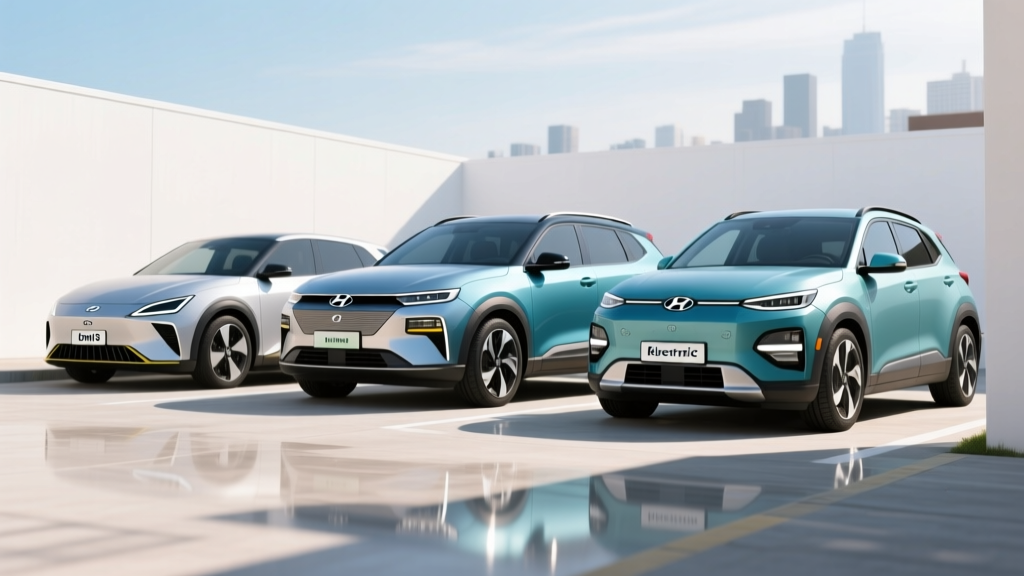
Hyundai's 2026 SUV EV lineup covers three distinct needs. The Kona Electric (starting ~$32,975) delivers 261 miles of EPA range for budget-conscious urban commuters. The Ioniq 5 (~$42,600 base) offers up to 318 miles and ultra-fast 800V charging (10–80% in ~18 minutes) for versatile family use. The Ioniq 9 (~$53,000 base) is a three-row flagship with up to 335 miles for larger households. All three qualify for varying levels of the federal §30D tax credit depending on your income, the vehicle's MSRP cap compliance, and battery-sourcing requirements. Your best choice depends on passenger needs, daily commute length, and whether you can install a Level 2 home charger.
The 2026 Hyundai SUV EV Lineup at a Glance
Hyundai now fields three fully electric SUVs in the US market, each built on different platforms and targeting different buyer profiles. Here's how the spec sheets stack up side by side.
| Spec | Kona Electric | Ioniq 5 | Ioniq 9 |
|---|---|---|---|
| EPA Range (max config) | 261 mi | 318 mi | 335 mi |
| Battery (usable, chemistry) | 64.8 kWh, NMC | 84.0 kWh, NMC | 110.3 kWh, NMC |
| Peak DC Fast Charge | ~100 kW | ~240 kW (800V) | ~240 kW (800V) |
| 10–80% DC Fast Charge | ~43 min | ~18 min | ~24 min |
| Level 2 Charge Rate | 10.9 kW | 10.9 kW | 10.9 kW |
| Horsepower | 201 hp (FWD) | 168–320 hp | 215–376 hp |
| 0–60 mph | 7.4 sec | 7.4–5.1 sec | 8.1–4.9 sec |
| Starting MSRP | ~$32,975 | ~$42,600 | ~$53,000 |
| Battery Warranty | 10 yr / 100,000 mi | 10 yr / 100,000 mi | 10 yr / 100,000 mi |
Sources: fueleconomy.gov, Hyundai USA spec sheets. Ranges reflect best available trim/configuration for the 2026 model year.
Real-World Range vs. EPA Stickers
The EPA numbers above represent controlled-cycle testing. On actual highways, in cold weather, or with aggressive acceleration, expect different results.
What You'll Actually Get
- Kona Electric (EPA 261 mi): Expect ~210–230 mi on a 70-mph highway run in moderate temps. In sub-freezing weather, plan for 170–195 mi.
- Ioniq 5 (EPA 318 mi): Highway real-world is typically ~260–285 mi. Cold-weather highway drops to ~210–240 mi. The heat pump on AWD trims helps mitigate winter losses.
- Ioniq 9 (EPA 335 mi): Large battery and heavy curb weight mean ~270–300 mi highway. Cold weather cuts this to ~220–260 mi. Towing (up to 4,400 lb on AWD) can halve range.
The Ioniq 5 and Ioniq 9 benefit from Hyundai's 800V E-GMP platform, which enables preconditioning of the battery for optimal DC fast-charging speeds. Use the route planner in the infotainment system to trigger preconditioning before arriving at a charger — skipping this step in cold weather can double your 10–80% charge time.
Charging Speed: Where the Ioniq 5 and 9 Pull Ahead
This is where Hyundai's platform split matters most. The Kona Electric uses a 400V architecture, while the Ioniq 5 and Ioniq 9 use an 800V system capable of dramatically faster DC charging.
| Charging Level | Power | Kona Electric | Ioniq 5 / Ioniq 9 |
|---|---|---|---|
| Level 1 (120V household) | ~1.4 kW | ~3 mi/hr | ~3 mi/hr |
| Level 2 (240V home/public) | 10.9 kW | ~26 mi/hr | ~28–30 mi/hr |
| DC Fast Charge | Peak 100–240 kW | ~100 kW peak, ~43 min 10–80% | ~240 kW peak, 18–24 min 10–80% |
Charging-curve reality check: The Ioniq 5's 240 kW peak is not sustained across the entire session. It holds roughly 200+ kW up to ~55% state of charge, then tapers progressively. By 80%, you're down to roughly 90–110 kW. The 18-minute claim is accurate for a 10–80% session at a capable 350 kW charger (such as Electrify America's latest stalls). At a 150 kW charger, expect 10–80% in roughly 25–30 minutes.
The Kona Electric's ~100 kW peak is adequate for overnight stops but becomes a bottleneck on road trips where you're making multiple DC fast-charge stops. If you drive more than 300 miles in a day regularly, the Ioniq 5's charging advantage translates to saving 40–60 minutes per trip.
Cost Breakdown: Purchase, Charging, and Ownership
Let's put concrete numbers on what owning a Hyundai SUV EV actually costs over five years compared to a comparable gas SUV.
| Cost Factor | Ioniq 5 SEL AWD | Hyundai Tucson Gas (AWD) |
|---|---|---|
| Base MSRP | ~$46,500 | ~$33,750 |
| Est. Federal Tax Credit (§30D) | Up to $7,500* | $0 |
| Effective Purchase Price | ~$39,000 | ~$33,750 |
| Fuel/Energy (5 yr, 60K mi) | ~$3,400 (home L2 @ $0.14/kWh) | ~$7,500 (28 mpg @ $3.50/gal) |
| Maintenance (5 yr, 60K mi) | ~$600 | ~$2,800 |
| Insurance (5 yr avg) | ~$9,500 | ~$7,800 |
| 5-Year Total Cost | ~$52,500 | ~$51,850 |
*§30D credit eligibility depends on your modified adjusted gross income, the vehicle's MSRP cap compliance (SUVs: $80,000), battery critical-mineral and component sourcing requirements, and point-of-sale transfer rules. Check current rules at irs.gov. State incentives may further reduce cost.
The Ioniq 5 reaches near cost-parity with a gas Tucson over five years despite the higher sticker price, primarily through fuel and maintenance savings. The Kona Electric, starting ~$10,000 lower, will beat any comparable gas subcompact SUV on total cost. The Ioniq 9 is a premium play — compare it against three-row gas SUVs like the Hyundai Santa Fe or Kia Telluride for a fair analysis.
Insurance note: EVs typically cost 15–25% more to insure than gas equivalents due to higher repair costs and battery replacement risk. Get quotes before purchasing — your rate varies significantly by carrier and ZIP code.
Federal Tax Credit Eligibility: What Applies to Hyundai EVs
The §30D Clean Vehicle Credit has become increasingly complex. Here's what matters for Hyundai SUV EV buyers in 2026:
- Income caps: MAGI must not exceed $150,000 (single), $225,000 (head of household), or $300,000 (joint filers).
- MSRP caps: SUVs (all three Hyundai models qualify as SUVs per IRS classification) must be under $80,000 MSRP.
- Battery sourcing: The credit splits into two halves — $3,750 for critical-minerals sourcing and $3,750 for battery-component manufacturing. Sourcing requirements tighten annually. Hyundai has been working to shift battery supply chains to qualify, but the exact credit amount varies by model and production batch.
- Point-of-sale transfer: You can transfer the credit to the dealer at purchase, reducing your out-of-pocket cost immediately rather than waiting for a tax refund.
- Foreign Entity of Concern (FEOC) restrictions: Vehicles with battery components from FEOC entities lose part or all of the credit. This rule has tightened each year since 2024.
Always verify current eligibility on fueleconomy.gov before committing to a purchase, as sourcing compliance can change between model-year production runs.
EV vs. Gas vs. Hybrid: Which Hyundai SUV Powertrain Makes Sense?
Hyundai sells the Tucson as a gas model, a conventional hybrid (HEV), a plug-in hybrid (PHEV), and the fully electric Ioniq 5. Here's how the efficiency numbers compare:
| Model | Powertrain | Efficiency | Electric-Only Range | Starting MSRP |
|---|---|---|---|---|
| Tucson | Gas (2.5L I4) | 28 mpg combined | N/A | ~$31,000 |
| Tucson Hybrid | HEV (1.6T) | 38 mpg combined | N/A | ~$34,500 |
| Tucson PHEV | PHEV (1.6T) | 80 MPGe / 35 mpg gas | 33 mi | ~$39,500 |
| Ioniq 5 | BEV | 114 MPGe (29 kWh/100mi) | 318 mi (full) | ~$42,600 |
The Tucson PHEV is a compelling middle ground if you lack reliable home charging. You get 33 miles of electric commuting (covering most daily trips) and a gas engine for road trips. But if you can charge at home, the Ioniq 5's per-mile energy cost (roughly $0.04–0.06/mi on residential electricity) crushes even the hybrid's $0.10–0.13/mi fuel cost.
Decision Framework: Which Hyundai SUV EV Should You Buy?
Choose the Kona Electric if:
- Your budget is under $38,000 (before incentives)
- Your daily commute is under 80 miles round-trip
- You rarely take road trips over 250 miles in a day
- You want the lowest total cost of ownership in Hyundai's EV lineup
Choose the Ioniq 5 if:
- You need more interior space (106.5 cu ft passenger volume vs. Kona's 99.4)
- You road-trip regularly and need 18-minute DC fast charging
- You want AWD availability for snow-belt climates
- You value the latest ADAS tech (Highway Driving Assist 2 with lane-change assist)
Choose the Ioniq 9 if:
- You need three rows and seat up to seven passengers
- You tow (up to 4,400 lb with AWD)
- Budget is flexible above $55,000
- You want flagship comfort: ventilated second-row seats, premium audio, air suspension on upper trims
Choose a Tucson PHEV instead if:
- You cannot install a Level 2 home charger and public charging is sparse in your area
- You regularly drive 400+ miles in a day and don't want to plan around chargers
- You want electric commuting with zero range anxiety for longer trips
Real-World Ownership Considerations
Home Charging Access Is the Make-or-Break Factor
All three Hyundai SUV EVs are excellent daily drivers — if you can charge at home. A Level 2 (240V) home charger adds roughly 26–30 miles of range per hour of charging, meaning an overnight session easily replenishes any daily commute. Expect to pay $500–$1,200 for a quality Level 2 unit (such as the ChargePoint Home Flex or Emporia Vue) and $800–$2,500 for professional electrical installation, depending on whether your panel needs an upgrade to support a 40–48A circuit.
If you rely entirely on public charging, your cost per mile roughly doubles (DC fast charging averages $0.30–$0.48/kWh nationally), and your convenience drops significantly. The Ioniq 5 and Ioniq 9's fast charging helps, but public-charging-only ownership remains a compromise.
Cold-Weather Realities
If you live where winters regularly dip below 30°F, plan for 20–30% range reduction. The Ioniq 5 and Ioniq 9 offer a heat pump (standard on AWD trims, optional on some RWD configs), which recovers waste heat from the powertrain to warm the cabin more efficiently than resistive heating. The Kona Electric uses a conventional heating system that draws more from the battery. Preconditioning the cabin while still plugged in at home is the single most effective cold-weather range hack.
Driving Assistance: Level 2, Not Self-Driving
SAE Automation Level: 2
Hyundai's Highway Driving Assist 2 (HDA2) and Highway Driving Assist with Lane Change (available on Ioniq 5 and Ioniq 9 upper trims) are Level 2 driver-assistance systems. They combine adaptive cruise control and lane-centering but require continuous driver supervision — hands on or near the wheel, eyes on the road. These are not autonomous or "self-driving" systems. You remain fully responsible for the vehicle at all times.
Common Misconceptions About Hyundai SUV EVs
| Myth | Fact |
|---|---|
| "The battery will need expensive replacement in a few years." | Hyundai's battery warranty covers 10 years/100,000 miles with a 70% capacity retention threshold. Industry data shows modern NMC batteries typically lose 10–15% capacity over 150,000–200,000 miles with normal use. Full replacement (if ever needed out of warranty) runs $8,000–$15,000 depending on model. |
| "EVs are worse in the cold." | Range drops 20–30% in freezing weather — real and worth planning for. But EVs start instantly in cold weather (no engine cranking), and preconditioning while plugged in means you leave home with a warm cabin and full range. AWD Ioniq 5 and Ioniq 9 models use a heat pump to mitigate losses. |
| "Charging takes too long for road trips." | At a 350 kW DC fast charger, the Ioniq 5 adds ~200 miles in 18 minutes. Plan meal and restroom stops around charging, and the downtime largely disappears. The Kona Electric's slower charging is a legitimate road-trip limitation — choose accordingly. |
| "The tax credit is guaranteed." | §30D eligibility depends on your income, the vehicle's battery sourcing compliance, and MSRP caps. The credit amount can vary even between production batches. Always confirm before signing. |
| "EVs cost more to insure and always will." | EV insurance premiums run 15–25% higher on average today, but the gap is narrowing as repair networks expand and claims data matures. Shop multiple carriers — some now offer EV-specific discounts. |
Frequently Asked Questions
Does the Hyundai Ioniq 5 qualify for the full $7,500 federal tax credit?
The Ioniq 5 is eligible for up to $7,500 under §30D, but the actual amount depends on battery critical-mineral and component sourcing for the specific production batch, your income level, and the MSRP cap (SUVs: $80,000 — the Ioniq 5 clears this). Hyundai's US-built Ioniq 5 (produced at the Metaplant in Georgia) has improved its sourcing compliance. Verify the exact credit on the IRS's clean vehicle credit page or fueleconomy.gov before purchasing.
Can I use Tesla Superchargers with a Hyundai SUV EV?
The Ioniq 5 and Ioniq 9 (2025+ model years) come equipped with the NACS (North American Charging Standard) port, granting native access to Tesla's Supercharger network without an adapter. Earlier model-year Ioniq 5 vehicles with CCS ports can use Tesla Superchargers via a Tesla-approved CCS-to-NACS adapter. The Kona Electric uses a CCS1 port; check adapter compatibility before relying on Supercharger access.
What is the real-world highway range of the Ioniq 5?
The EPA rates the Ioniq 5 Long Range RWD at 318 miles. In real-world 70-mph highway driving at moderate temperatures, expect approximately 260–285 miles. In sub-freezing conditions, that drops to roughly 210–240 miles. Engaging the battery preconditioning feature before DC fast-charging stops and using the heat pump (AWD trims) helps maximize usable range.
How much does it cost to charge a Hyundai SUV EV at home?
At the US average residential electricity rate of ~$0.16/kWh, fully charging the Ioniq 5's 84 kWh battery costs roughly $13.44, yielding a cost of about $0.042/mile. For the Kona Electric (64.8 kWh), a full charge is ~$10.37, or ~$0.040/mile. Compare this to a gas Tucson at 28 mpg and $3.50/gallon: $0.125/mile. Home charging saves roughly $0.08–0.09 per mile.
Is the Ioniq 9 worth the premium over the Ioniq 5?
The Ioniq 9 commands roughly $10,000–$15,000 more than a comparably equipped Ioniq 5. You gain a third row (seating for up to seven), a larger 110.3 kWh battery (335 vs. 318 mi EPA), higher towing capacity (4,400 vs. 2,300 lb), and premium features like available air suspension and Executive Lounge seating. If you need three rows or tow regularly, the premium is justified. For five-passenger duty, the Ioniq 5 is the better value.