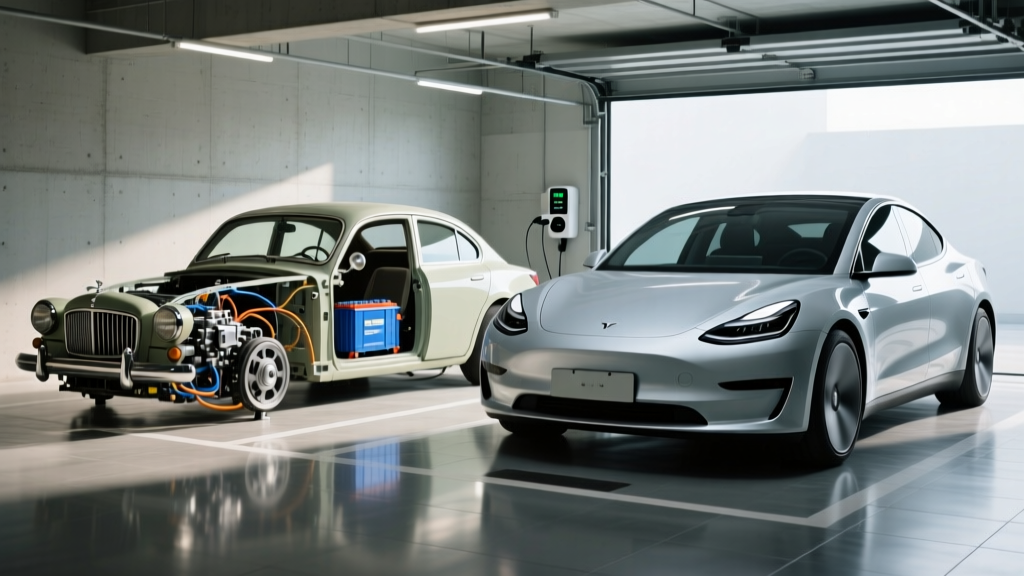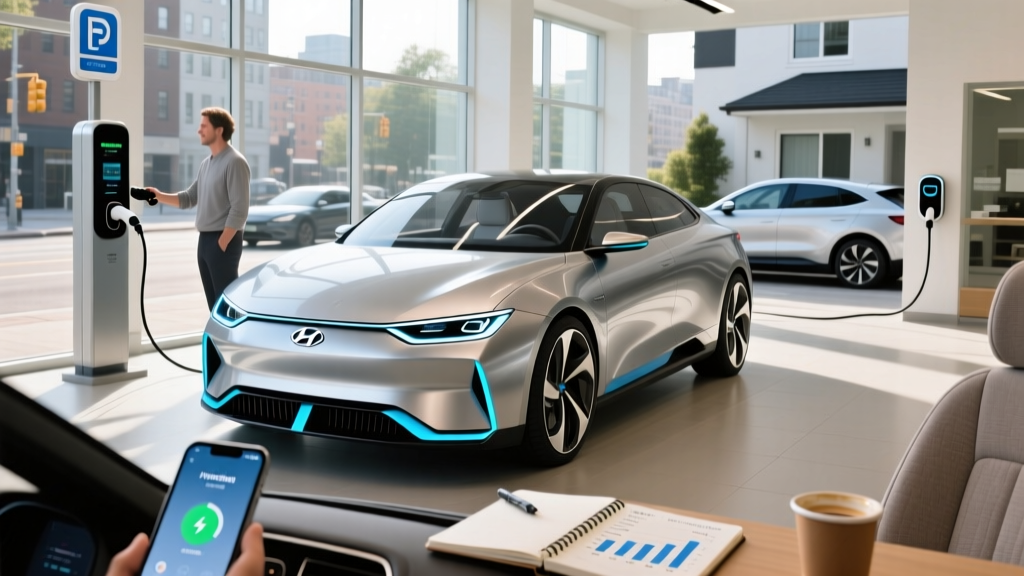
The Hyundai Pony EV is not a production vehicle you can buy in 2026. The Pony EV Heritage concept — a retro-styled electric restomod of Hyundai's 1970s compact — debuted as a design study and remains a show car with no announced plans for production. If you're searching for a compact Hyundai EV to purchase today, the closest production equivalents are the Hyundai Kona Electric (261 miles EPA range, starting at $32,975) or the Hyundai Ioniq 5 (315 miles EPA, starting at $42,600). This guide covers what the Pony EV Heritage actually is, why it generated search interest, and provides a concrete ownership-cost framework for the compact Hyundai EVs you can actually buy.
What the Hyundai Pony EV Heritage Concept Actually Is
Hyundai unveiled the Pony Heritage concept as a design exercise celebrating the original 1975 Pony, the car that launched Hyundai as a global automaker. The Heritage concept features a fully electric powertrain, pixel-style LED lighting (a design language Hyundai calls "Pixel Road Trip"), a minimalist interior with vacuum-tube-inspired digital displays, and a retro hatchback silhouette. However, Hyundai has never published battery capacity, motor output, range estimates, or pricing for the concept. It exists purely to showcase design direction and brand heritage.
The concept generated significant online interest — the "Hyundai Pony EV" keyword averages around 50 searches per month — largely because enthusiasts hoped Hyundai would follow Volkswagen's ID. Buzz strategy (retro EV based on the Microbus) or the Fiat 500e playbook (retro-styled city EV). As of 2026, Hyundai has not announced any production version.
Compact Hyundai EVs You Can Actually Buy in 2026
If the Pony EV Heritage sparked your interest in a compact, retro-flavored, or affordable Hyundai electric vehicle, here are the production models that fill that role with real specs, real warranties, and real charging infrastructure compatibility.
| Spec | 2026 Kona Electric SEL | 2026 Ioniq 5 SE Standard Range | 2026 Elantra Hybrid (Gas Comparison) |
|---|---|---|---|
| Base MSRP | $32,975 | $42,600 | $29,150 |
| EPA Range / MPG | 261 mi (129 MPGe combined) | 245 mi (114 MPGe combined) | 54 MPG combined |
| Battery (usable) | 64.8 kWh (NMC) | 58.0 kWh (NMC) | 1.6 kWh (hybrid buffer) |
| Peak DC Fast Charge | ~100 kW (10–80% in ~43 min) | ~185 kW (10–80% in ~18 min) | N/A |
| Horsepower | 201 hp | 168 hp (RWD) | 139 hp combined |
| 0–60 mph | ~6.9 sec | ~7.3 sec | ~8.8 sec |
| Battery/Powertrain Warranty | 10 yr / 100,000 mi | 10 yr / 100,000 mi | 10 yr / 100,000 mi |
| Federal Tax Credit (§30D) | Up to $3,750* | Up to $7,500* | N/A |
*§30D credit eligibility depends on MSRP caps, buyer income limits, and battery critical-mineral sourcing requirements. The Kona Electric may qualify for partial credit ($3,750) depending on sourcing compliance; the Ioniq 5 (assembled in Georgia) may qualify for up to $7,500 if sourcing and income criteria are met. Always verify current eligibility at IRS.gov §30D or via the point-of-sale transfer process at the dealer.
EV vs Gas vs Hybrid: 5-Year Cost Breakdown
The purchase price only tells part of the story. Here's a realistic 5-year / 75,000-mile total cost of ownership comparison. Assumptions: electricity at $0.14/kWh (national average home rate), gasoline at $3.40/gallon, 15,000 miles/year, and maintenance based on fueleconomy.gov data.
| Cost Category (5 yr / 75k mi) | Kona Electric | Ioniq 5 SE | Elantra Hybrid |
|---|---|---|---|
| Purchase (MSRP after est. credit) | $29,225 | $35,100 | $29,150 |
| Fuel / Electricity | $3,480 (24.8 kWh/100mi) | $3,570 (28.5 kWh/100mi) | $4,722 (gasoline) |
| Maintenance | $1,200 | $1,200 | $2,800 |
| Insurance (est. avg) | $9,500 | $10,200 | $7,800 |
| 5-Year Total | $43,405 | $50,070 | $44,472 |
Key takeaway: The Kona Electric's lower purchase price (after tax credit) and reduced maintenance (no oil changes, fewer brake replacements due to regen braking) make it cost-competitive with the Elantra Hybrid over five years, despite higher insurance premiums — a common EV ownership reality. The Ioniq 5 costs more upfront but delivers a larger cabin, faster DC charging, and more advanced ADAS. Neither EV "saves you money" in every scenario; the math depends heavily on your home electricity rate, annual mileage, and whether you qualify for the full §30D credit.
Real-World Range: What the EPA Sticker Doesn't Tell You
EPA range estimates assume a mix of city and highway driving at moderate temperatures. In practice, several factors compress real-world range significantly:
- Highway driving at 75+ mph: Expect 15–20% less than the EPA sticker. The Kona Electric's 261-mile EPA rating drops to roughly 210–220 miles at sustained highway speeds, based on real-world testing patterns.
- Cold weather (below 32°F): Battery chemistry slows and cabin heating draws significant power. Expect 25–35% range loss in sub-freezing conditions. A 261-mile Kona Electric may deliver 170–195 miles in a cold Midwestern winter.
- DC fast charging taper: The Kona Electric peaks at ~100 kW but sustains that rate only up to roughly 40% state of charge, then tapers. A 10–80% charge takes ~43 minutes — adequate for road trips but noticeably slower than the Ioniq 5's 800-volt architecture, which sustains higher power longer and achieves 10–80% in ~18 minutes.
- Preconditioning: Both models support battery preconditioning when navigating to a DC fast charger. This warms the battery to optimal temperature and can shave 5–10 minutes off your charge stop. Always enable this feature for road trips.
First-Time EV Buyer: What You Must Know Before Purchasing
If the Pony EV Heritage concept drew you into EV research for the first time, here are the non-obvious realities that separate informed buyers from frustrated ones:
Home Charging Access Is the Single Biggest Factor
Over 80% of EV charging happens at home. If you have a garage or driveway where you can install a Level 2 (240V) charger, EV ownership is seamless — you wake up every morning with a full "tank." A Level 2 installation typically costs $500–$2,500 depending on your electrical panel capacity and run length. If your panel needs a 200-amp upgrade, add $1,500–$3,000. Without home charging, you'll rely on public DC fast chargers or workplace charging, which adds time, cost variability, and unpredictability.
The Federal Tax Credit Is Not Automatic
The §30D clean vehicle credit offers up to $7,500, but eligibility in 2026 depends on:
- MSRP cap: SUVs/vans/pickups must be under $80,000; sedans/hatchbacks under $55,000.
- Buyer income cap: Modified AGI must not exceed $150,000 (single), $225,000 (head of household), or $300,000 (joint).
- Battery sourcing: Critical minerals and battery components must meet escalating domestic-content thresholds. These requirements tighten annually, and some models that qualified in 2024 may not qualify in 2026.
- Point-of-sale transfer: As of 2024+, you can transfer the credit to the dealer at purchase for an immediate price reduction — but the dealer must be registered with the IRS.
Consult a tax professional or verify at IRS.gov before assuming you'll receive the credit.
EV Insurance Costs More — Budget for It
EV insurance premiums run 15–25% higher than comparable gas vehicles, driven by higher repair costs (battery pack replacement, specialized body shop requirements) and higher vehicle MSRP. Get quotes before signing a purchase agreement.
Common Myths About Compact EVs — Fact-Checked
| Myth | Fact |
|---|---|
| "The battery will need replacement in 5 years and cost $20,000." | Modern NMC batteries in Hyundai EVs are warranted for 10 years/100,000 miles at 70%+ capacity retention. Real-world degradation data shows ~10–12% capacity loss at 100,000 miles for liquid-cooled packs. Full replacement is rare and covered under warranty if it falls below threshold. |
| "You can't road-trip an EV." | The Ioniq 5's 800V architecture enables 10–80% charges in ~18 minutes at a 350 kW charger. With the growing Hyundai/Ioniq charging network and NACS adapter access to Tesla Superchargers, road trips require planning but are entirely feasible. |
| "EVs are worse for the environment because of battery mining." | Lifecycle analyses (including battery production) show EVs produce 50–70% fewer emissions over their lifetime than gas cars, even on coal-heavy grids. As the grid decarbonizes, that advantage grows. |
| "A hybrid is always cheaper than an EV." | The Elantra Hybrid has a lower sticker price but no federal tax credit. After the §30D credit, the Kona Electric can be cheaper to buy and cheaper to fuel over 5 years — if you have home charging and qualify for the credit. |
Decision Framework: Which Hyundai Electrified Vehicle Fits You?
Choose the Kona Electric if:
- You want the most affordable Hyundai EV and your daily commute is under 100 miles round-trip.
- You have reliable home Level 2 charging access.
- You rarely drive more than 200 miles in a single day without stopping.
- You want to minimize purchase price and qualify for at least partial §30D credit.
Choose the Ioniq 5 if:
- You road-trip regularly and need 10–80% DC charges in under 20 minutes.
- You want a larger cabin (106.5 cu ft passenger volume vs. 99.1 for Kona), more cargo space, and available AWD.
- You plan to use Tesla Superchargers via NACS adapter (Ioniq 5 supports this natively on newer model years).
- You qualify for the full $7,500 §30D credit, narrowing the price gap with the Kona.
Choose the Elantra Hybrid if:
- You lack home charging access and don't want to rely on public infrastructure.
- You regularly drive 400+ miles in a day and can't tolerate 20-minute charge stops.
- You want the lowest upfront cost with no tax-credit dependency.
- You live in an extreme cold-weather climate where EV range loss would be most impactful.
Frequently Asked Questions
Will Hyundai ever produce the Pony EV as a real car?
As of 2026, Hyundai has made no production announcement for the Pony EV Heritage. The concept serves as a design showcase. Hyundai's production EV strategy focuses on the Ioniq lineup (Ioniq 5, 6, and upcoming models on the e-GMP and next-generation platforms). If a retro-styled compact Hyundai EV ever reaches production, it would more likely be based on the Kona or a new small-EV platform targeting European and Korean markets.
What's the cheapest Hyundai EV I can buy new in 2026?
The 2026 Hyundai Kona Electric SEL starts at $32,975. After a potential $3,750 partial §30D credit (subject to battery sourcing compliance and buyer income limits), the effective price could drop to ~$29,225. This makes it one of the most affordable new EVs on the U.S. market.
Does the Kona Electric qualify for the full $7,500 tax credit?
Likely not the full amount. The Kona Electric's battery sourcing has historically met only the critical-minerals threshold (worth $3,750) but not the battery-component threshold (additional $3,750), because cell manufacturing occurs outside North America. The Ioniq 5, assembled at Hyundai's Metaplant in Savannah, Georgia, has a stronger path to the full $7,500 — but eligibility still depends on your income and the vehicle's MSRP falling under the §30D cap. Verify at fueleconomy.gov before purchasing.
Can I charge a Hyundai EV at Tesla Superchargers?
Yes — with a NACS adapter. Hyundai provides or supports a CCS-to-NACS adapter for Ioniq 5 and Kona Electric owners, enabling access to Tesla's Supercharger network (15,000+ stalls in North America). Newer model-year Ioniq 5 vehicles may ship with a native NACS port. Check your specific model year and trim for connector details.
How long will a Hyundai EV battery last before needing replacement?
Hyundai warrants its EV batteries for 10 years or 100,000 miles, guaranteeing at least 70% of original capacity. Real-world data from Hyundai/Kia EV fleets suggests liquid-cooled NMC packs lose approximately 1–1.5% capacity per year under normal use. At 150,000 miles, most packs retain 85–90% of original capacity. Full battery replacement outside of warranty is uncommon and typically costs $8,000–$14,000 if needed — but this scenario is rare within the vehicle's practical lifespan.