Hyundai Ioniq 5 vs Kia EV6 Charging Speed: Which EV Charges Faster?
When it comes to electric vehicles, charging speed is often the single most important factor for buyers who plan to take road trips or rely on public charging infrastructure. Two of the most talked-about electric crossovers on the market — the Hyundai Ioniq 5 and the Kia EV6 — share a common platform yet deliver subtly different charging experiences. In this in-depth comparison, we break down every aspect of the Hyundai Ioniq 5 vs Kia EV6 charging speed battle, along with range, performance, interior space, technology, pricing, and warranty coverage, so you can decide which EV earns a spot in your garage.
Both vehicles are built on the Hyundai Motor Group's Electric Global Modular Platform (E-GMP), which means they share a great deal of engineering DNA. However, differences in battery tuning, thermal management, and software calibration give each model its own personality at the charger. If you are also considering other options, check out our best electric SUVs rankings for a broader look at the segment.
Overview: Hyundai Ioniq 5 vs Kia EV6
The Hyundai Ioniq 5 debuted as a retro-futuristic crossover with pixel-inspired LED lighting, a flat floor, and a spacious cabin made possible by its dedicated EV architecture. Its design pays homage to the Hyundai Pony while pushing the brand firmly into the electric era. Available in both rear-wheel-drive and all-wheel-drive configurations, the Ioniq 5 targets buyers who value comfort, unique styling, and practical everyday usability.
The Kia EV6, meanwhile, takes a sportier approach. With its sleek fastback silhouette, aggressive stance, and available GT performance variant, the EV6 appeals to driving enthusiasts who still need the practicality of a crossover. Like the Ioniq 5, it offers rear-wheel-drive and all-wheel-drive layouts, but Kia has tuned the EV6's suspension and powertrain calibration for a slightly more dynamic feel.
Both vehicles offer a standard-range and long-range battery pack, 800-volt electrical architecture, and vehicle-to-load (V2L) capability. For a deeper dive into each model individually, read our full Hyundai Ioniq 5 review and complete Kia EV6 review.
Side-by-Side Specification Comparison
| Specification | Hyundai Ioniq 5 (Long Range AWD) | Kia EV6 (Long Range AWD) |
|---|---|---|
| Battery Capacity (usable) | 77.4 kWh | 77.4 kWh |
| EPA-Estimated Range | 256–290 miles | 252–282 miles |
| DC Fast Charging (10–80%) | ~18 minutes | ~18 minutes |
| Peak DC Charging Rate | ~240 kW | ~240 kW |
| AC Level 2 Charging (10–100%) | ~7 hours 20 minutes | ~7 hours 20 minutes |
| Electrical Architecture | 800V / 400V compatible | 800V / 400V compatible |
| Horsepower (AWD) | 320 hp | 320 hp |
| Torque (AWD) | 446 lb-ft | 446 lb-ft |
| 0–60 mph (AWD) | ~5.0 seconds | ~4.6 seconds |
| Vehicle-to-Load (V2L) | Yes (interior & exterior) | Yes (interior & exterior) |
| Starting MSRP (approx.) | ~$45,000 | ~$43,000 |
Note: Specifications may vary by trim level and model year. Always consult the manufacturer's latest data and EPA Fuel Economy ratings for the most current figures.
Charging Speed: The Head-to-Head Showdown
This is the category that brought you here, and for good reason. Charging speed determines how long you will wait at a highway rest stop, how quickly you can top up during a busy day, and how convenient life with an EV truly is.
800-Volt Architecture: The Great Equalizer
Both the Ioniq 5 and EV6 utilize an 800-volt electrical architecture, which is still relatively rare in the mainstream EV market. Most competitors, including many offerings from legacy automakers, still rely on 400-volt systems. The higher voltage allows both Hyundai and Kia models to accept significantly more power at compatible DC fast chargers without requiring excessively high current, which reduces heat and improves efficiency.
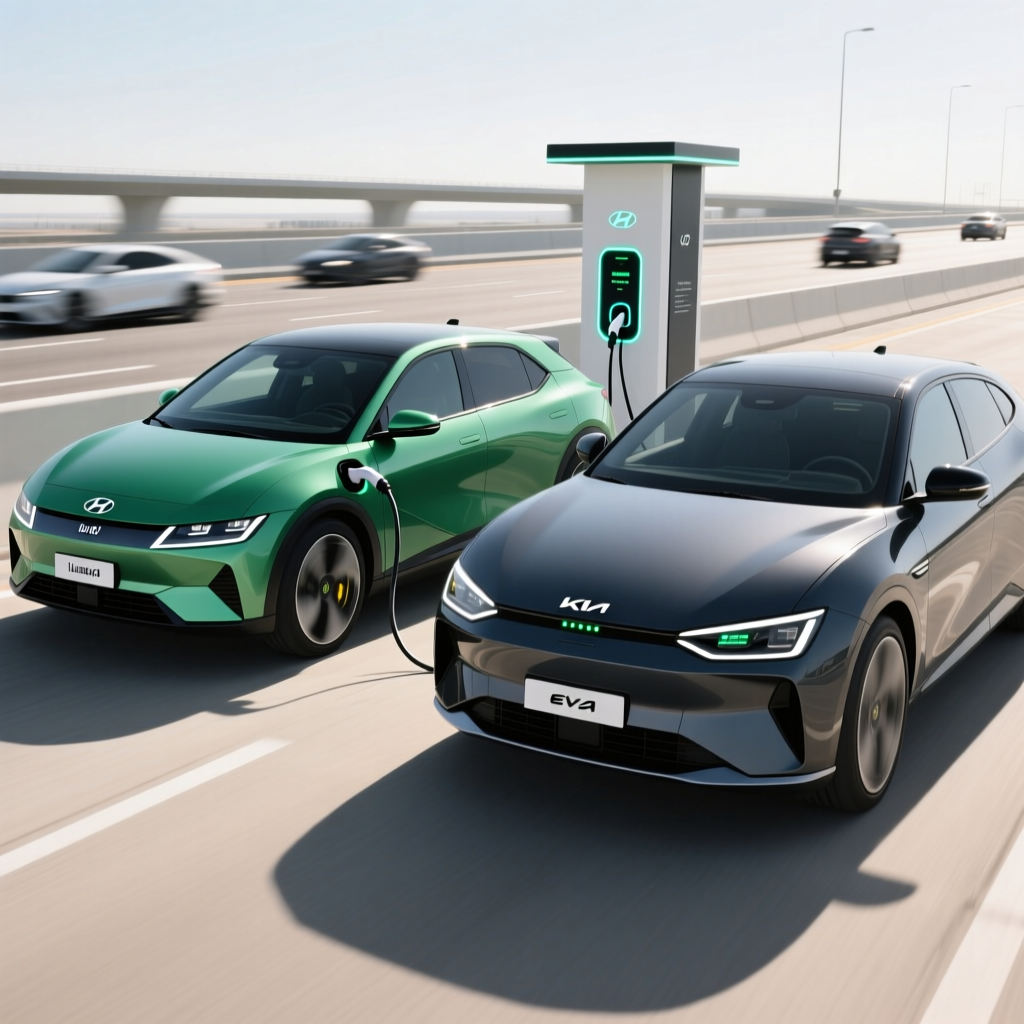
When connected to a 350 kW DC fast charger — such as those found on the Electrify America or Ionity networks — both vehicles can accept a peak charge rate of approximately 240 kW. Under ideal conditions (warm battery, low state of charge, high-power charger), both the Ioniq 5 and EV6 can charge from 10% to 80% in roughly 18 minutes. This is among the fastest charging speeds available in any production electric vehicle at any price point.
Real-World Charging Tests
Independent testing by outlets such as MotorTrend and various EV-focused YouTube channels has confirmed that both vehicles deliver on their charging promises. In controlled tests on 350 kW chargers, the Ioniq 5 and EV6 consistently reach peak rates above 230 kW within the first few minutes of a session. The charging curve remains strong through approximately 50–55% state of charge before tapering off to protect battery longevity.
One subtle difference emerges in thermal management. The Ioniq 5 has been observed to precondition its battery slightly more aggressively when a navigation waypoint is set to a charging station. This means that in cold weather, the Ioniq 5 may arrive at a charger with its battery at a more optimal temperature, potentially shaving a minute or two off charging time. The EV6 also supports battery preconditioning, but early software versions required manual activation. Kia has since improved this through over-the-air updates, narrowing the gap considerably.
Level 2 AC Charging
On a Level 2 home charger or public AC station, both vehicles accept up to 10.9 kW of power. A full charge from 10% to 100% takes approximately 7 hours and 20 minutes for both models. This means overnight charging at home is equally convenient regardless of which vehicle you choose. Both vehicles come with a portable charging cable that can plug into a standard 120-volt outlet for emergency trickle charging, though this is best reserved for occasional use.
400-Volt Charger Compatibility
Not every public charger operates at 800 volts. When connected to a more common 400-volt DC fast charger (typically rated at 50–150 kW), both vehicles automatically step down and accept charge at the maximum rate the station can provide. At a 150 kW charger, expect a 10–80% charge in approximately 25–30 minutes. At a 50 kW charger, the same session takes closer to 60–70 minutes. Again, performance is virtually identical between the two.
Charging Speed Verdict: It is essentially a tie. Both the Hyundai Ioniq 5 and Kia EV6 offer class-leading DC fast charging capability thanks to their shared 800V platform. Any real-world differences are measured in seconds, not minutes, and are heavily dependent on ambient temperature, charger availability, and battery preconditioning habits.
Range & Efficiency
While charging speed determines how quickly you can replenish your battery, total range dictates how often you need to charge in the first place. Here, the Ioniq 5 holds a slight advantage.
The Hyundai Ioniq 5 in its Long Range RWD configuration achieves an EPA-estimated 303 miles of range (with 19-inch wheels). The AWD version drops to approximately 256–290 miles depending on wheel size and trim. The Ioniq 5's slightly boxier shape does create more aerodynamic drag, but Hyundai has optimized the powertrain efficiency and regenerative braking to compensate.
The Kia EV6 Long Range RWD delivers an EPA-estimated 310 miles of range, while the AWD variant achieves approximately 252–282 miles. The EV6's sleeker, more aerodynamic fastback profile gives it a marginal efficiency edge on the highway, but real-world results tend to be very close between the two.
Both vehicles feature multiple regenerative braking levels, adjustable via steering wheel paddles. The Ioniq 5 and EV6 each offer a one-pedal driving mode (i-Pedal on the Kia, i-Pedal on the Hyundai as well) that allows you to come to a complete stop without touching the brake pedal, maximizing energy recapture in city driving.
For more on maximizing your electric vehicle's range, see our guide to best long-range electric vehicles.
Performance & Driving Dynamics
On paper, the standard AWD versions of the Ioniq 5 and EV6 produce identical power outputs: 320 horsepower and 446 lb-ft of torque. However, Kia has given the EV6 a slightly sportier tune, and it typically hits 60 mph a few tenths of a second quicker — approximately 4.6 seconds versus the Ioniq 5's 5.0 seconds.
The difference is even more dramatic if you step up to the performance variants. The Kia EV6 GT produces a staggering 576 horsepower and rockets to 60 mph in approximately 3.4 seconds, making it one of the quickest production crossovers available. Hyundai offers the Ioniq 5 N, which takes a different approach to performance with simulated gear shifts, aggressive sound design, and track-focused engineering that prioritizes driver engagement over raw straight-line speed.
In everyday driving, the EV6 feels slightly more connected and responsive through corners, thanks to firmer suspension tuning and quicker steering. The Ioniq 5 prioritizes ride comfort, with a softer suspension setup that absorbs bumps and imperfections more effectively. Neither approach is objectively better — it depends on whether you prefer a sporty or comfort-oriented driving experience.
Both vehicles offer multiple drive modes (Eco, Normal, Sport) and adjustable regenerative braking. The AWD models provide confident traction in rain and light snow, though neither is designed for serious off-road use.
Interior Space, Comfort & Cargo
The E-GMP platform's flat floor and long wheelbase give both vehicles remarkably spacious interiors. However, there are meaningful differences in how that space is utilized.
The Hyundai Ioniq 5 offers a more open, lounge-like cabin. Its universal center console (called the "Universal Island") slides forward and backward by up to 140 mm, creating flexible storage options and making it easier to exit through the passenger side in tight parking spots. Rear legroom is generous at approximately 39.4 inches, and the rear seats recline for added comfort on long trips. Cargo capacity behind the rear seats is approximately 27.2 cubic feet, expanding to around 59.3 cubic feet with the rear seats folded.
The Kia EV6 has a slightly more driver-focused cockpit with a curved panoramic display and sportier seating position. Rear legroom measures approximately 39.0 inches — close to the Ioniq 5 but fractionally less due to the sloping roofline. Cargo capacity is slightly lower at approximately 24.4 cubic feet behind the rear seats, expanding to around 50.2 cubic feet with seats folded. The EV6's fastback design sacrifices a bit of cargo height, which can make loading taller items more challenging.
Both vehicles offer a front trunk (frunk), though it is relatively small — suitable for storing charging cables and small bags rather than significant cargo. Both also feature heated and ventilated front seats on higher trims, a heated steering wheel, and available premium audio systems from brands like Bose (Ioniq 5) and Meridian (EV6).
Technology & Features
Both the Ioniq 5 and EV6 come loaded with technology, but there are some differences in presentation and functionality.
Infotainment & Displays
The Hyundai Ioniq 5 features dual 12.3-inch screens — one for the instrument cluster and one for infotainment — housed under a single curved glass panel. The system supports wireless Apple CarPlay and Android Auto (on certain trims), built-in navigation, and over-the-air software updates. Hyundai's Bluelink connected services allow remote climate control, charging management, and vehicle status monitoring via smartphone.
The Kia EV6 also uses dual 12.3-inch screens in a curved layout, but the interface design and menu structure differ slightly. Kia Connect services mirror the functionality of Bluelink. One notable advantage for the EV6 is its augmented reality head-up display (available on higher trims), which projects navigation directions and speed information onto the windshield in a format that appears to float over the road ahead.
Driver Assistance & Safety
Both vehicles come standard with a comprehensive suite of advanced driver assistance systems (ADAS), including:
- Forward collision-avoidance assist with pedestrian & cyclist detection
- Lane keeping assist & lane following assist
- Blind-spot collision-avoidance assist
- Rear cross-traffic collision-avoidance assist
- Adaptive cruise control with stop-and-go
- Highway driving assist (semi-autonomous lane centering & speed management)
Higher trims on both vehicles add features like remote smart parking assist (which allows the vehicle to park itself while you stand outside), a 360-degree surround-view camera, and enhanced highway driving assist with lane change assist.
Vehicle-to-Load (V2L)
One of the standout features shared by both vehicles is Vehicle-to-Load (V2L) capability. Using a special adapter, you can plug standard household appliances, power tools, camping equipment, or even another electric vehicle into your car and draw up to 3.6 kW of power. This turns either vehicle into a mobile power station, which is invaluable for camping, tailgating, or emergency backup power during outages.
Both vehicles also support digital key functionality, allowing you to use your smartphone as a key fob, and both offer over-the-air update capability that can add new features and improve existing ones without a dealership visit.
Warranty & Ownership Costs
Hyundai and Kia are sister companies, and their warranty coverage reflects a shared commitment to long-term ownership confidence.
Both the Hyundai Ioniq 5 and Kia EV6 come with:
- Basic Warranty: 5 years / 60,000 miles
- Powertrain Warranty: 10 years / 100,000 miles
- Battery Warranty: 10 years / 100,000 miles
- Roadside Assistance: 5 years / unlimited miles
- Complimentary Maintenance: 3 years / 36,000 miles (varies by region)
This warranty coverage is among the best in the entire automotive industry, regardless of fuel type. The 10-year battery warranty provides significant peace of mind for EV buyers concerned about long-term battery degradation.
In terms of running costs, both vehicles benefit from lower electricity costs compared to gasoline, reduced maintenance (no oil changes, fewer moving parts), and potential federal & state tax incentives. Consult the U.S. Department of Energy's alternative fuels tax credit page for the latest eligibility information.
Verdict: Which One Should You Buy?
The Hyundai Ioniq 5 and Kia EV6 are remarkably similar vehicles built on the same platform, sharing the same battery, powertrain options, and class-leading 800V charging architecture. The differences come down to personality, packaging, and priorities.
Choose the Hyundai Ioniq 5 if:
- You prioritize interior space and cargo versatility over sporty styling
- You prefer a comfort-oriented ride for daily commuting and long road trips
- You love the retro-futuristic design language that stands out in a parking lot
- You value the sliding Universal Island console for flexible cabin storage
- You want slightly more rear-seat headroom for taller passengers
Choose the Kia EV6 if:
- You want a sportier driving experience with sharper handling and quicker acceleration
- You prefer a sleek, coupe-like design with aggressive styling cues
- You are interested in the EV6 GT for supercar-rivaling performance
- You want an augmented reality head-up display for enhanced navigation
- You prefer a driver-focused cockpit with a sportier seating position
When it comes specifically to charging speed, there is no meaningful difference between the two. Both deliver best-in-class DC fast charging thanks to their shared 800V architecture, and both will get you from 10% to 80% in approximately 18 minutes under ideal conditions. Your decision should be based on design preference, driving dynamics, and interior layout rather than charging performance.
For more comparisons and recommendations, explore our best electric crossovers roundup and our best EVs for road trips guide.
Frequently Asked Questions
How fast can the Hyundai Ioniq 5 and Kia EV6 charge on a DC fast charger?
Both the Hyundai Ioniq 5 and Kia EV6 can charge from 10% to 80% in approximately 18 minutes when connected to a 350 kW DC fast charger. Their shared 800-volt architecture allows them to accept a peak charging rate of around 240 kW, which is among the fastest in the EV market. On a 150 kW charger, expect a 10–80% session to take approximately 25–30 minutes. Always check the charger's maximum output before plugging in, as not all public stations support the speeds these vehicles are capable of.
Do the Ioniq 5 and EV6 charge at the same speed at home on Level 2?
Yes. Both vehicles accept up to 10.9 kW on a Level 2 AC charger, and a full charge from 10% to 100% takes approximately 7 hours and 20 minutes for both models. For most owners, this means plugging in at home in the evening and waking up to a fully charged vehicle every morning. Installing a dedicated Level 2 home charger (240V, 48-amp circuit) is highly recommended to take full advantage of the onboard charger's capability.
Which has better real-world range: the Ioniq 5 or EV6?
The difference is minimal. The Kia EV6 Long Range RWD has a slightly higher EPA-estimated range at 310 miles compared to the Ioniq 5 Long Range RWD at 303 miles. However, in real-world driving, factors like ambient temperature, driving style, tire choice, and terrain have a far greater impact on range than the small difference between these two vehicles. In cold weather, both vehicles lose approximately 20–30% of their rated range, which is typical for lithium-ion battery packs. Using the heat pump (standard on many trims) can help mitigate cold-weather range loss.
Is the 800V charging system on the Ioniq 5 and EV6 worth it?
Absolutely. The 800-volt architecture is one of the most significant advantages these vehicles have over competitors using 400V systems. It enables faster charging, reduced heat generation during charging, and greater efficiency. While you need a 350 kW charger to take full advantage, the number of high-power charging stations continues to grow rapidly across major highway corridors. Even when using 400V chargers, both vehicles automatically adapt and still deliver competitive charging speeds. As charging infrastructure continues to upgrade, the 800V advantage will only become more pronounced over time.