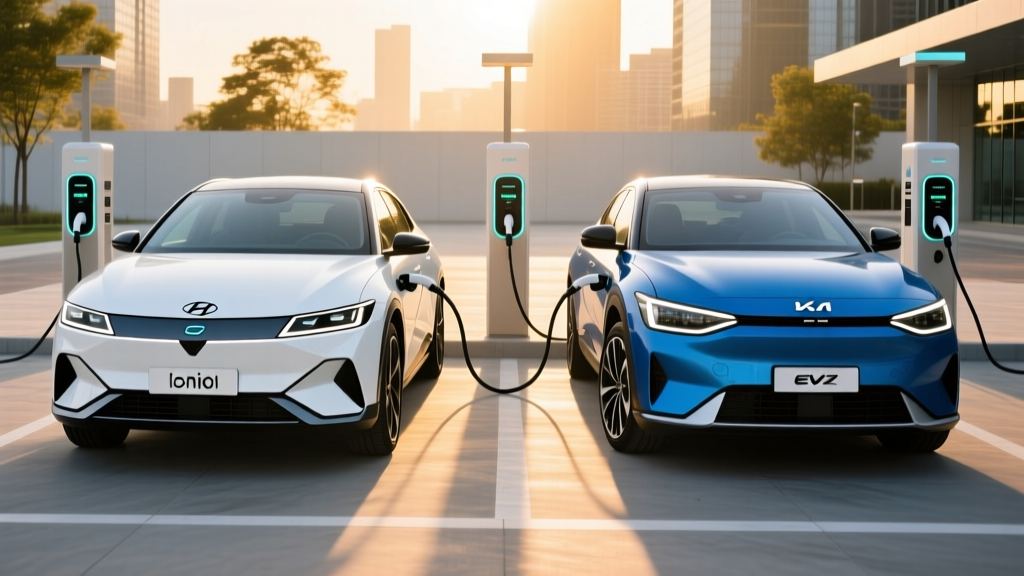
If you've narrowed your next EV purchase to the Hyundai Ioniq 5 and the Kia EV6, you've already made one smart decision: both ride on the Hyundai Motor Group's E-GMP platform with 800V architecture, meaning DC fast charging that outpaces nearly everything outside the Porsche Taycan and Lucid Air. But sharing bones doesn't make these twins identical. The 2026 Ioniq 5 leans retro-futuristic utility with a refreshed battery and NACS port from the factory, while the EV6 doubles down on sportback styling and a slightly more driver-focused cockpit. Below, we break down every number that matters — range, charging curves, pricing after the federal tax credit, and real-world ownership costs — so you can pick the one that actually fits your driving life.
Side-by-Side Specs: 2026 Ioniq 5 vs 2026 EV6 at a Glance
Both vehicles offer standard-range and long-range battery packs, rear-wheel drive and all-wheel drive configurations, and high-performance variants. The table below focuses on the most popular long-range AWD trims, which represent the bulk of U.S. sales, with notes on the performance models where specs diverge significantly.
| Specification | 2026 Hyundai Ioniq 5 (Long Range AWD) | 2026 Kia EV6 (Long Range AWD) |
|---|---|---|
| EPA Range | 290 miles | 282 miles |
| Usable Battery Capacity | 84.0 kWh (NMC) | 84.0 kWh (NMC) |
| Battery Chemistry | NMC (Nickel Manganese Cobalt) | NMC (Nickel Manganese Cobalt) |
| Peak DC Fast Charge Rate | ~240 kW | ~240 kW |
| 10–80% DC Fast Charge Time | ~18 minutes | ~18 minutes |
| Level 2 AC Charging (Max) | 10.9 kW | 10.9 kW |
| Charge Port (2026 U.S.) | NACS (native) | CCS1 (NACS adapter included) |
| Combined Efficiency (MPGe) | 98 MPGe | 97 MPGe |
| Horsepower (AWD) | 320 hp | 320 hp |
| 0–60 mph | 4.5 seconds | 4.5 seconds |
| Cargo Volume (rear seats up) | 27.2 cu ft | 24.4 cu ft |
| Cargo Volume (rear seats folded) | 59.3 cu ft | 50.2 cu ft |
| Frunk Volume | 0.85 cu ft | 0.74 cu ft |
| Towing Capacity | 2,300 lbs (braked) | 2,300 lbs (braked) |
| Base MSRP (Long Range AWD) | ~$50,200 | ~$51,200 |
| Battery/Powertrain Warranty | 10 years / 100,000 miles | 10 years / 100,000 miles |
Sources: fueleconomy.gov (EPA), Hyundai News, Kia USA. Specs reflect 2026 model year long-range AWD trims; performance variants (Ioniq 5 N, EV6 GT) differ significantly.
Range and Efficiency: Real-World Miles vs. the EPA Sticker
The Ioniq 5 holds a slight EPA advantage at 290 miles versus the EV6's 282 miles in long-range AWD configuration. That 8-mile gap is small on paper, and in practice, both vehicles will behave similarly because they share the same 84 kWh battery pack and powertrain hardware. The Ioniq 5's marginally higher MPGe rating (98 vs. 97) comes down to minor aerodynamic and weight differences — the EV6's sportback roofline creates slightly more drag at highway speeds despite its sleeker appearance.
Both vehicles feature a heat pump as standard equipment on long-range trims, which mitigates cold-weather range loss compared to resistive heating. Hyundai and Kia also use an active thermal management system that preconditions the battery when a DC fast charger is set as your navigation destination — critical for achieving peak charge rates in cold or hot weather.
🏆 Range Winner: Hyundai Ioniq 5
A narrow victory. The 8-mile EPA edge and 1 MPGe advantage translate to a few extra miles per charge, which could matter on road trips where you're stretching between chargers.
Charging Speed and Network Access
This is where the E-GMP platform's 800V architecture earns its reputation. Both the Ioniq 5 and EV6 can accept up to ~240 kW at a DC fast charger, sustaining high charge rates through the critical 10–80% window in roughly 18 minutes under ideal conditions. That charge curve is remarkably flat compared to 400V competitors — where many EVs peak at a high kW figure for 2–3 minutes then taper aggressively, the Ioniq 5 and EV6 hold above 180 kW for much of the session before tapering above 70% SoC.
What this means in practice: At a 350 kW Electrify America or Tesla Supercharger stall, you'll add roughly 180–200 miles of range in 15 minutes. The key caveat is that you must precondition the battery (automatic when navigating to a charger) and arrive at a low state of charge (below 15%) to see peak rates. Show up at 40% SoC and your peak will be closer to 120–140 kW.
Connector Differences: NACS vs. CCS1
For 2026, the Hyundai Ioniq 5 ships with a native NACS (North American Charging Standard) port, meaning direct access to Tesla's Supercharger network — over 25,000 stalls in North America — without an adapter. The Kia EV6 retains the CCS1 connector but includes a NACS adapter in the box, granting Supercharger access through the adapter.
| Network | Ioniq 5 (Native NACS) | EV6 (CCS1 + NACS Adapter) |
|---|---|---|
| Tesla Supercharger | Direct plug-in | Requires included adapter |
| Electrify America | NACS-to-CCS adapter needed | Direct plug-in (CCS1) |
| EVgo | Adapter or NACS stalls | Direct plug-in (CCS1) |
| ChargePoint (DC) | Adapter or NACS stalls | Direct plug-in (CCS1) |
The adapter situation is transitional. As networks add NACS cables through 2026 and 2027, the Ioniq 5's native port becomes increasingly convenient. Today, however, Electrify America and most non-Tesla networks still primarily use CCS1 connectors, making the EV6's native CCS1 port slightly more convenient at those stations. Neither vehicle is disadvantaged — both can access every major network with at most an adapter swap.
🏆 Charging Winner: Tie (with nuance)
Identical 800V hardware and charge curves. The Ioniq 5 wins on future-proofing with native NACS; the EV6 wins on present-day convenience at non-Tesla CCS1 stations. Pick based on which network dominates your routes.
Performance and Driving Dynamics
In their mainstream long-range AWD trims, the Ioniq 5 and EV6 are mechanically identical: 320 hp, 446 lb-ft of torque, and a 4.5-second 0–60 mph time. Both deliver confident highway merging and satisfying off-the-line acceleration. The difference emerges in character.
The EV6's slightly lower seating position, tighter steering ratio, and sportback weight distribution give it a marginally more engaged feel on back roads. The Ioniq 5 counters with a softer ride tuning that absorbs highway expansion joints and potholes more gracefully. On long interstate drives, most testers and owners report the Ioniq 5 as the more comfortable cruiser; on canyon roads, the EV6 feels more willing.
If you want serious performance, both offer halo models: the Ioniq 5 N (641 hp, 0–60 in 3.4 seconds, simulated gear shifts, N e-Shift) and the EV6 GT (576 hp, 0–60 in 3.4 seconds). The Ioniq 5 N is the more track-capable and enthusiast-focused machine with its dedicated N tuning, but both sacrifice range significantly — expect roughly 200–220 miles EPA in the performance variants.
🏆 Performance Winner: Kia EV6
By a hair. The EV6's chassis tuning gives it a sportier demeanor in everyday driving, even though the spec sheet is identical. Enthusiasts who plan track days should look at the Ioniq 5 N instead.
Interior, Cargo, and Daily Practicality
This is where the two vehicles diverge most visibly. The Ioniq 5's boxy, retro-inspired design (think 1980s Hyundai Pony meets a concept car) translates into genuinely superior interior volume. The flat floor, sliding center console, and upright roofline create an airy cabin that feels larger than its compact-crossover dimensions suggest. Rear-seat legroom is generous at 39.4 inches, and the 27.2 cu ft cargo area behind the second row swallows more groceries, luggage, or dog crates than the EV6's 24.4 cu ft.
The EV6's sportback silhouette looks dramatic but costs you headroom for tall rear passengers and cuts into cargo height. If you regularly haul bulky items — think large boxes, a full-size dog crate, or camping gear with the seats folded — the Ioniq 5's 59.3 cu ft maximum cargo volume versus the EV6's 50.2 cu ft is a meaningful gap of over 9 cubic feet.
Both vehicles feature dual 12.3-inch curved displays, wireless Apple CarPlay and Android Auto, and Hyundai/Kia's latest infotainment software. The Ioniq 5 uses a column-mounted shifter that frees up console space; the EV6 uses a rotary dial on the center console that some drivers find more intuitive. Build quality and materials are comparable — soft-touch surfaces on the dash and doors, with some harder plastics on lower panels in both.
🏆 Practicality Winner: Hyundai Ioniq 5
More cargo space, more rear headroom, and a more versatile interior layout. If you have a family or regularly carry cargo, the Ioniq 5's packaging advantage is substantial.
Pricing and Federal Tax Credit Eligibility
Base MSRPs for the long-range AWD trims are close: approximately $50,200 for the Ioniq 5 SEL AWD and $51,200 for the EV6 GT-Line AWD. Fully loaded, both can climb past $58,000 with premium packages, advanced driver assistance upgrades, and larger wheels.
§30D Federal Tax Credit Considerations
Under current IRS rules for the §30D Clean Vehicle Credit, both vehicles must meet several criteria for the buyer to claim up to $7,500:
- MSRP Cap: SUVs/crossovers must be below $80,000 — both qualify on all trims.
- Buyer Income Cap: Modified adjusted gross income must not exceed $150,000 (single), $225,000 (head of household), or $300,000 (joint). Check your specific situation with a tax professional.
- Battery Sourcing: Critical minerals and battery components must meet phased-in percentage thresholds from U.S. or free-trade-agreement countries. As of 2026, the sourcing requirements are stringent, and eligibility can shift mid-year based on supply-chain changes.
- Point-of-Sale Transfer: Eligible buyers can transfer the credit to the dealer at purchase, reducing the purchase price directly rather than waiting to claim it on their tax return.
🏆 Value Winner: Hyundai Ioniq 5
A ~$1,000 lower starting price for the equivalent trim, combined with more cargo space and the same range/charging hardware. If both qualify for the same tax credit amount, the Ioniq 5 delivers more vehicle per dollar.
Ownership Costs: Efficiency, Insurance, and Long-Term Value
Beyond the purchase price, the ongoing cost of ownership is nearly identical between the two. Both consume roughly 34–35 kWh per 100 miles of mixed driving, translating to approximately $0.045–$0.06 per mile when charging at home on a national average electricity rate of $0.16/kWh. Public DC fast charging at $0.35–$0.50/kWh pushes that to $0.12–$0.18 per mile — still below the average gasoline cost for a comparable 25 MPG crossover at current fuel prices.
Insurance: Both vehicles carry slightly higher insurance premiums than equivalent gas crossovers, typically 10–18% more, due to higher repair costs for battery-adjacent damage and specialized parts. Expect annual premiums in the $1,800–$2,400 range depending on your state, driving record, and coverage level. Quotes for the two are usually within $50–$100 of each other.
Maintenance: Minimal for both. No oil changes, no spark plugs, no transmission fluid. Budget for cabin air filter replacement ($30–$50 annually), tire rotation every 7,500 miles, and brake fluid checks. Regenerative braking significantly extends pad and rotor life — many EV owners don't need brake service for 80,000+ miles.
Battery Warranty: Both Hyundai and Kia back the high-voltage battery and powertrain for 10 years or 100,000 miles, whichever comes first. The warranty covers defects and capacity loss below approximately 70% of original capacity. This is among the best in the industry and provides long-term peace of mind.
Depreciation: Historically, the Ioniq 5 has held value slightly better than the EV6 in the used market, likely due to its more universally appealing design and higher cargo practicality. Expect 3-year residual values in the 48–55% range for both, though EV depreciation trends remain volatile as the market matures.
🏆 Ownership Cost Winner: Tie
Identical efficiency, comparable insurance, and the same warranty. The Ioniq 5's slightly stronger residual value is a minor edge that may or may not hold by the time you sell.
Driver Assistance and Technology
Both vehicles come equipped with comprehensive Level 2 driver-assistance suites. Hyundai's Highway Driving Assist 2 (HDA2) and Kia's Highway Driving Assist 2 are functionally similar: adaptive cruise control with stop-and-go, lane-centering steering, lane-change assist, and navigation-based speed adjustment. Neither system is "self-driving" — both require continuous driver supervision and hands-on or eyes-on engagement per SAE Level 2 standards.
In practice, Hyundai/Kia's HDA2 is smooth and predictable on well-marked highways, though it lacks the hands-free capability of GM's Super Cruise or Ford's BlueCruise on approved roads. The Ioniq 5 and EV6 both offer remote smart parking assist, digital key (phone-as-key), and over-the-air software updates that continue to improve vehicle function post-purchase.
🏆 Tech Winner: Tie
Shared platform, shared software, shared ADAS hardware. The infotainment and driver-assist experience is effectively identical between the two.
The Decision Framework: Which One Should You Buy?
Choose the Hyundai Ioniq 5 if:
- You prioritize cargo space and interior versatility (family hauling, road trips, bulky gear)
- You want native NACS charging for the simplest Supercharger experience as networks transition
- You prefer a softer, more comfort-oriented ride on long highway drives
- You value the slightly higher EPA range (290 vs. 282 miles) for marginal road-trip flexibility
- You want to spend ~$1,000 less at the equivalent trim level
Choose the Kia EV6 if:
- You prefer sportback styling and a more athletic, driver-focused cockpit
- You drive on routes where Electrify America or other CCS1 networks dominate and want native plug-in without an adapter
- You want a slightly firmer, more responsive chassis for spirited back-road driving
- You're drawn to the EV6 GT-Line's more aggressive exterior design language
- You find a better dealer deal or inventory availability in your area
Final Recommendation
There is no wrong choice here — the Ioniq 5 and EV6 are two of the best-rounded EVs in the $45,000–$60,000 segment, and their shared E-GMP platform ensures excellent charging speed, competitive range, and strong warranty coverage regardless of which badge you pick.
For most buyers, the Hyundai Ioniq 5 edges ahead on practical grounds: more cargo room, a lower starting price, native NACS, and a more comfortable daily-driver ride. It's the vehicle that works for the widest range of lifestyles, from solo commuters to families with gear.
The Kia EV6 is the driver's pick — marginally sportier, visually more dramatic, and perfectly capable in every measurable metric. If its styling speaks to you and you find the right deal, it's every bit as good as the Ioniq 5.
Before signing, test-drive both back-to-back on the same route, verify current federal tax credit eligibility for your specific build date, and confirm which DC fast charging networks are most accessible along your regular routes. The right answer depends on your priorities — and now you have the numbers to make that call.
Frequently Asked Questions
Is the Ioniq 5 or EV6 better for road trips?
The Ioniq 5 has a slight edge due to its 8-mile higher EPA range, significantly larger cargo area (27.2 vs. 24.4 cu ft), and more comfortable ride tuning. Both charge at the same speed, so your stops will be identical in length — but you'll pack more and ride more comfortably in the Ioniq 5.
Can I use Tesla Superchargers with either vehicle?
Yes. The 2026 Ioniq 5 has a native NACS port and plugs directly into Superchargers. The 2026 EV6 uses CCS1 but includes a NACS adapter for Supercharger access. Both can also use Electrify America, EVgo, and other networks (the Ioniq 5 may need a CCS adapter at legacy CCS-only stations during the network transition).
Which holds its value better?
Early data suggests the Ioniq 5 retains value slightly better, likely due to broader design appeal and higher practicality. However, EV depreciation is influenced by rapidly changing incentives, new model introductions, and market conditions — residual values for both remain less predictable than established gas vehicles.
Do both qualify for the $7,500 federal tax credit?
Both vehicles are potentially eligible for up to $7,500 under §30D, but eligibility depends on your income, the vehicle's battery sourcing compliance at the time of purchase, and MSRP caps. Always check fueleconomy.gov and consult a tax professional before relying on the credit in your purchase decision.
How long will the battery last?
Both use NMC chemistry with active thermal management, which typically retains 85–92% capacity after 100,000 miles based on industry-wide degradation data for similar packs. Hyundai and Kia warrant the battery for 10 years/100,000 miles against defects and capacity loss below ~70%. Many E-GMP owners report minimal degradation in the first 2–3 years of ownership.
Which is better in snow and winter?
Both offer AWD with similar traction control tuning and identical ground clearance (~6.1 inches). Cold-weather range loss will be comparable (20–30% reduction in extreme cold). The Ioniq 5's heat pump and battery preconditioning are standard, as on the EV6. Neither has a clear winter advantage — choose based on tire selection (winter tires make a far bigger difference than AWD tuning).