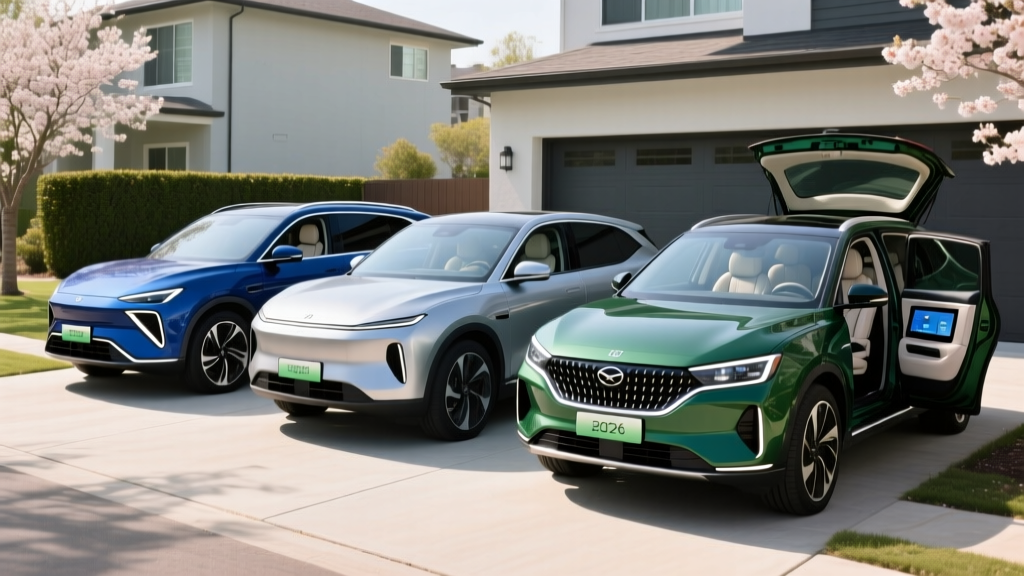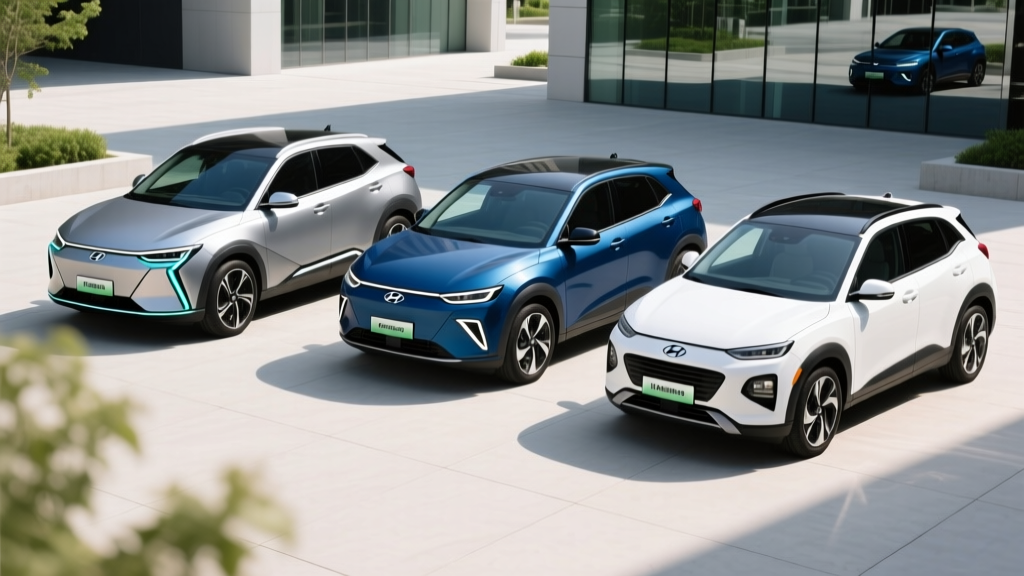
Quick Answer: Which Hyundai EV SUV Fits You?
If you're shopping for a Hyundai EV SUV in 2026, the lineup breaks into three clear tiers: the Kona Electric (~$33,000, 261 mi EPA) is the budget-friendly compact; the Ioniq 5 (~$42,000, up to 318 mi EPA) is the midsize sweet-spot with 800V ultra-fast charging; and the Ioniq 9 (~$57,000+, up to 335 mi EPA) is the new three-row family hauler. Your pick depends on budget, passenger count, and whether you need 10–80% DC fast charging in under 20 minutes.
The 2026 Hyundai EV SUV Lineup at a Glance
Hyundai now fields one of the broadest all-electric SUV portfolios of any mainstream automaker. Unlike competitors still leaning on a single EV nameplate, Hyundai offers three distinct battery-electric SUVs targeting different buyer segments — from urban commuters to three-row families. Here's how they stack up on the numbers that matter.
| Spec | Kona Electric | Ioniq 5 | Ioniq 9 |
|---|---|---|---|
| Base MSRP | $32,975 | $42,600 | $56,900 |
| EPA Range (max trim) | 261 mi | 318 mi (Long Range RWD) | 335 mi (Long Range RWD) |
| Battery (usable) | 64.8 kWh (NMC) | 84.0 kWh (NMC) | 110.3 kWh (NMC) |
| Peak DC Fast Charge | 100 kW | 240 kW (800V) | 250+ kW (800V) |
| 10–80% DC Charge Time | ~43 min | ~18 min | ~20 min |
| Level 2 Charge Rate | 11 kW | 11 kW | 11 kW |
| 0–60 mph | ~7.4 sec (FWD) | ~5.0 sec (AWD) | ~5.5 sec (AWD) |
| Horsepower | 201 hp | 320 hp (AWD) | 379 hp (AWD) |
| Seating | 5 | 5 | 6–7 |
| Cargo (behind 2nd row) | 25.5 cu ft | 27.2 cu ft | ~35 cu ft |
| Drivetrain Options | FWD only | RWD / AWD | RWD / AWD |
| Battery/Powertrain Warranty | 10 yr / 100,000 mi | 10 yr / 100,000 mi | 10 yr / 100,000 mi |
Sources: EPA / fueleconomy.gov, Hyundai USA spec sheets. Real-world highway range typically runs 10–15% below EPA; cold-weather (below 25°F) can reduce range 20–30%.
Real-World Range vs. EPA Sticker: What You'll Actually Get
Hyundai's EPA range figures are competitive, but EPA testing cycles don't reflect sustained 75 mph highway driving or winter commutes. Based on independent testing and owner data, here's what to expect in practice:
Ioniq 5 Long Range RWD (EPA 318 mi)
Highway (70–75 mph, 75°F): ~270–285 mi
Cold weather (20°F, mixed driving): ~225–250 mi
City / suburban (moderate speeds, regen-heavy): ~300–315 mi
The Ioniq 5's heat pump (standard on most trims) helps limit cold-weather losses compared to EVs without active thermal management, but physics still applies — expect a meaningful dip below freezing.
Kona Electric (EPA 261 mi)
Highway (70–75 mph, 75°F): ~220–235 mi
Cold weather (20°F, mixed): ~185–205 mi
City / suburban: ~250–260 mi
The Kona Electric's smaller 64.8 kWh pack means less buffer for highway or cold-weather use. If your commute exceeds 80 miles round-trip in winter, you'll want daily Level 2 charging access.
Ioniq 9 Long Range RWD (EPA 335 mi)
Highway (70–75 mph, 75°F): ~285–300 mi
Cold weather (20°F, mixed): ~240–265 mi
City / suburban: ~315–330 mi
The Ioniq 9's massive 110.3 kWh pack gives it the most range cushion in the lineup, but its larger mass and frontal area keep highway efficiency lower than the Ioniq 5's.
Charging Speed: Where Hyundai's 800V Architecture Pays Off
This is where the Ioniq 5 and Ioniq 9 separate sharply from the Kona Electric — and from most competitors in their price brackets.
The Ioniq 5 and Ioniq 9 both use Hyundai's E-GMP 800-volt platform, enabling peak DC fast-charge rates of 240–250+ kW at compatible 350 kW chargers (like Electrify America or Tesla Superchargers with NACS adapters). The charge curve is aggressive: both vehicles sustain above 180 kW through roughly 55% SoC before tapering. A 10–80% session takes approximately 18–20 minutes.
The Kona Electric, by contrast, tops out at 100 kW on DC fast charging — adequate for overnight road trips but noticeably slower. Expect 10–80% in roughly 43 minutes.
Why Peak kW Isn't the Whole Story
A vehicle that peaks at 240 kW but tapers hard after 50% SoC may deliver less total energy in 30 minutes than one sustaining 180 kW longer. Hyundai's E-GMP charge curve is one of the flattest in the industry through the critical 10–60% window — that's why real-world 10–80% times match marketing claims closely. Always precondition the battery (via the car's nav-routed preconditioning) before arriving at a DC fast charger for optimal speeds.
| Charge Level | Power | Kona Electric | Ioniq 5 | Ioniq 9 |
|---|---|---|---|---|
| Level 1 (120V household) | ~1.4 kW | ~4 mi/hr | ~5 mi/hr | ~4 mi/hr |
| Level 2 (240V home/public) | ~11 kW | ~28 mi/hr | ~35 mi/hr | ~30 mi/hr |
| DC Fast Charge | 100–250 kW | ~140 mi in 30 min | ~200+ mi in 18 min | ~210+ mi in 20 min |
EV vs. Gas: The True Cost of Owning a Hyundai EV SUV
The sticker price of an EV is only half the equation. Let's compare the Ioniq 5 SEL AWD (~$47,000 MSRP) against a comparably equipped Hyundai Tucson Gas AWD (~$35,000 MSRP) over five years and 75,000 miles.
| Cost Category | Ioniq 5 SEL AWD | Tucson Gas AWD |
|---|---|---|
| Purchase Price (MSRP) | $47,000 | $35,000 |
| Est. Federal Tax Credit (§30D) | –$3,750 to $7,500* | $0 |
| Effective Purchase Price | ~$39,500–$43,250 | $35,000 |
| Fuel / Electricity (75k mi) | ~$2,400 (home L2, $0.14/kWh) | ~$8,100 (26 MPG avg, $3.50/gal) |
| Maintenance (5 yr) | ~$1,200 | ~$3,500 |
| Insurance (5 yr est.) | ~$9,500 | ~$7,800 |
| Estimated Depreciation | ~$18,000 | ~$14,000 |
| 5-Year Total Cost | ~$60,600–$64,350 | ~$68,400 |
*Federal §30D credit eligibility depends on MSRP caps ($80,000 for SUVs), buyer income limits ($300k MFJ / $150k single), and battery critical-mineral/content sourcing requirements. Check IRS §30D guidelines and consult a tax professional. Credit may be transferred to the dealer as a point-of-sale discount.
The takeaway: The Ioniq 5 closes the price gap within 1–2 years through fuel and maintenance savings — especially if you can charge at home on a standard Level 2 setup. Public-only charging at $0.35–$0.50/kWh narrows the advantage significantly.
Federal Tax Credit & Incentives: What Applies in 2026
Hyundai now manufactures the Ioniq 5 at its Metaplant in Georgia, and the Ioniq 9 production is also US-based. This addresses the North American assembly requirement under §30D. However, the credit is not automatic — you must satisfy multiple conditions:
- MSRP cap: Vehicle MSRP must not exceed $80,000 (SUVs/vans/pickups) — all current Hyundai EV SUVs qualify.
- Buyer income cap: Modified AGI ≤ $300,000 (married filing jointly), $225,000 (head of household), $150,000 (single).
- Battery sourcing: Increasing percentages of critical minerals and battery components must be sourced from the US or FTA partners. This threshold rises annually — verify current-year compliance on fueleconomy.gov.
- Point-of-sale transfer: You may transfer the credit to the dealer at purchase for an upfront price reduction, even if your tax liability is lower than the credit amount.
- One credit per VIN: The vehicle must be new, and you must not have claimed the credit for the same VIN previously.
State incentives vary widely. States like California, Colorado, and Massachusetts offer additional rebates ($1,000–$5,000+), often stacked with the federal credit. Check your state energy office or AFDC state incentive database for current programs.
Common Misconceptions About Hyundai EV SUVs
| Myth | Fact |
|---|---|
| "The battery will need replacing in 5 years and cost $20,000." | Hyundai's battery warranty covers 10 years / 100,000 miles against degradation below 70% capacity. Real-world data from E-GMP vehicles shows ~5–8% degradation at 100k miles. Full pack replacement (rare) runs $12,000–$18,000 out of warranty. |
| "I can't road-trip an EV — charging takes too long." | The Ioniq 5 adds ~200 miles in 18 minutes at a 350 kW charger. With route planning via the car's built-in preconditioning, highway road trips add 20–30 minutes per 3-hour drive segment. |
| "EVs are worse in winter." | Range drops 20–30% in sub-25°F weather (true for all EVs), but the Ioniq 5 and Ioniq 9 include a heat pump that reduces cabin-heating energy draw. Preconditioning while plugged in preserves range. |
| "I need a $3,000 electrical panel upgrade to charge at home." | Most homes with a 200A panel can add a 40A/48A Level 2 circuit for $500–$1,500. Panel upgrades ($2,000–$4,000) are only needed on older 100A services with high existing loads. |
| "The Kona Electric charges just as fast as the Ioniq 5." | The Kona Electric peaks at 100 kW (400V architecture); the Ioniq 5 peaks at 240 kW (800V). That's a 25-minute difference per 10–80% session on a road trip. |
Decision Framework: Which Hyundai EV SUV Should You Buy?
Choose the Kona Electric if:
- Your budget is under $38,000 (after incentives)
- Your daily commute is under 60 miles round-trip
- You have reliable home Level 2 charging
- You rarely take road trips over 200 miles
- You don't need AWD (FWD only)
Choose the Ioniq 5 if:
- You want the best balance of range, charging speed, and price
- You take road trips and value 10–80% in ~18 minutes
- You want AWD availability and 320 hp
- You need NACS compatibility for Tesla Supercharger access
- You're cross-shopping the Tesla Model Y, Ford Mustang Mach-E, or VW ID.4
Choose the Ioniq 9 if:
- You need three rows / 6–7 seats in an EV
- You're replacing a gas SUV like the Palisade or Telluride
- You want 335 mi EPA range with 800V fast charging
- Your budget accommodates $57,000+ (before incentives)
- You cross-shop the Kia EV9, Rivian R1S, or Tesla Model X
First-Time EV Buyer Essentials
If this is your first electric vehicle, a few ownership realities differ from gas cars:
Home charging is the foundation. Over 80% of EV charging happens at home. Budget $500–$1,500 for a licensed electrician to install a 240V NEMA 14-50 outlet or hardwired Level 2 charger (e.g., ChargePoint Home Flex, Emporia Level 2). This adds 25–35 miles of range per hour of charging — enough to replenish any Hyundai EV SUV overnight.
Public charging is for road trips and top-ups. Networks like Electrify America, EVgo, and Tesla Superchargers (now accessible to Hyundai via NACS adapter on 2025+ models) cover most US highway corridors. Use apps like PlugShare or A Better Routeplanner to verify charger availability along your route.
Maintenance is minimal but not zero. Expect cabin air filter changes, tire rotations (EVs wear tires faster due to instant torque and heavier weight), brake fluid checks, and wiper fluid. You'll never pay for an oil change, spark plugs, or a transmission service.
Insurance costs ~15–25% more. EV repair costs and parts pricing drive higher premiums. Get quotes from 2–3 insurers before purchasing — some (like Progressive and State Farm) have EV-specific rate adjustments.
Frequently Asked Questions
Is the Hyundai Ioniq 5 eligible for the full $7,500 federal tax credit in 2026?
The Ioniq 5 qualifies for up to $7,500 under §30D, split into two halves: $3,750 for battery component sourcing and $3,750 for critical minerals. Because sourcing thresholds increase annually, the exact amount varies by model year and build date. Check the latest eligibility on fueleconomy.gov and verify with your tax professional. Hyundai's US-built Ioniq 5 satisfies the North American assembly requirement.
Does the Hyundai Kona Electric support NACS / Tesla Supercharger charging?
Starting with the 2025 model year refresh, Hyundai began equipping new EVs with the NACS charge port (or providing a CCS-to-NACS adapter). For the 2026 Kona Electric, check the specific trim — some may still use CCS1 with an included adapter for Supercharger access. The Ioniq 5 and Ioniq 9 have transitioned to NACS natively on 2025+ model years.
How long does a Hyundai EV battery last before replacement?
Hyundai warranties its EV batteries for 10 years / 100,000 miles, guaranteeing they'll retain at least 70% of original capacity. Industry data from similar NMC packs suggests most EV batteries retain 85–92% capacity at 100,000 miles. Catastrophic failure requiring full replacement is rare and typically covered under warranty.
Can I tow with a Hyundai EV SUV?
The Ioniq 5 AWD is rated for up to 2,300 lbs of towing capacity (braked trailer). The Ioniq 9 is expected to match or exceed the Kia EV9's ~5,000-lb rating. The Kona Electric is not recommended for towing. Note that towing reduces EV range by 30–50% depending on trailer weight and speed.
Which Hyundai EV SUV has the lowest total cost of ownership?
The Ioniq 5 SEL RWD typically offers the lowest 5-year TCO in the lineup when the federal tax credit applies — its combination of ~$42k pricing, 318 mi range, low electricity cost, and minimal maintenance produces a 5-year cost competitive with a gas Tucson despite the higher sticker.