Hyundai's EV Lineup in 2026: What You're Actually Leasing
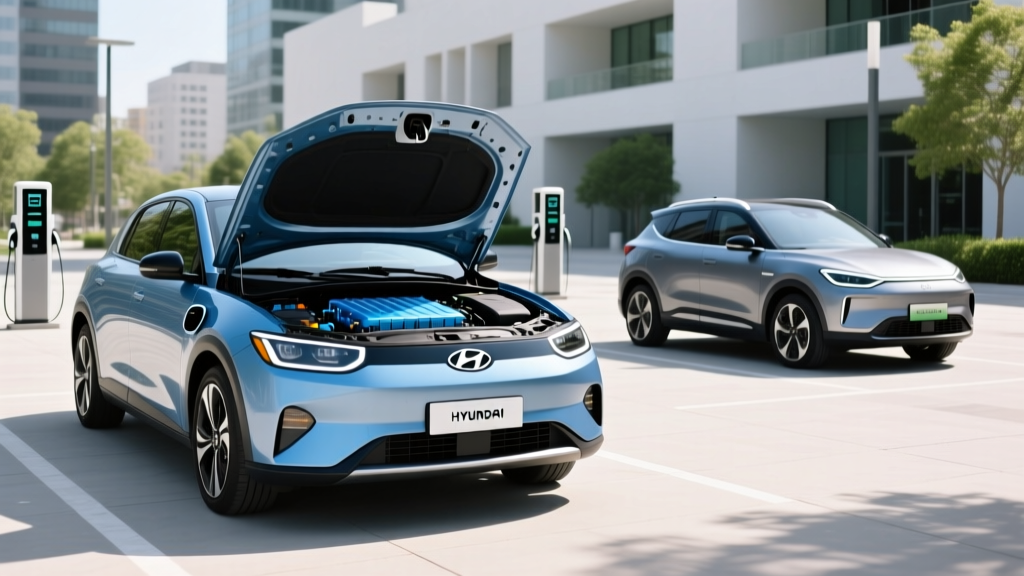
Hyundai currently offers three battery-electric models in the US market: the Ioniq 5 (midsize crossover), the Ioniq 6 (aerodynamic sedan), and the Kona Electric (subcompact crossover). Each occupies a different price and range bracket, and your choice between leasing and buying significantly affects your total cost, tax-credit eligibility, and long-term financial outcome.
Here's the spec snapshot for the current lineup:
| Model | EPA Range | Battery (kWh) | Chemistry | Peak DC Charge | 10–80% Time | 0–60 mph | Base MSRP |
|---|---|---|---|---|---|---|---|
| Kona Electric SEL | 261 mi | 64.8 kWh usable | NMC | 100 kW | ~43 min | 7.8 sec | $32,975 |
| Ioniq 5 SEL (RWD) | 303 mi | 77.4 kWh usable | NMC | 240 kW | ~18 min | 7.1 sec | $42,600 |
| Ioniq 6 SEL (RWD) | 361 mi | 77.4 kWh usable | NMC | 240 kW | ~18 min | 6.9 sec | $38,650 |
Lease vs. Purchase: The Federal Tax Credit Difference
The single biggest financial variable in a Hyundai electric vehicle lease decision is how the federal EV tax credit applies. Under current IRS §30D rules, the landscape is nuanced — and leasing introduces a critical workaround that buyers should understand.
Buying: The §30D New Clean Vehicle Credit
If you purchase a qualifying Hyundai EV, you may be eligible for up to $7,500 in federal tax credits, now available as a point-of-sale transfer (meaning the dealer applies it as a down-payment reduction at purchase). But eligibility depends on meeting all of the following requirements simultaneously:
- Income caps: Modified AGI ≤ $150,000 (single), ≤ $225,000 (head of household), ≤ $300,000 (joint filers)
- MSRP caps: Vehicle MSRP must not exceed $55,000 for sedans (Ioniq 6) or $80,000 for SUVs/trucks (Ioniq 5, Kona Electric)
- Battery sourcing: A percentage of critical minerals must be sourced from the US or free-trade-agreement partners, and battery components must be manufactured or assembled in North America — these percentages increase annually
- Assembly: Vehicle must undergo final assembly in North America
- Transfer option: You can transfer the credit to the dealer at point of sale for an immediate price reduction, even if you owe less than $7,500 in taxes
Source: IRS.gov — New Clean Vehicle Credits. Rules are subject to legislative change. Consult a tax professional for your specific situation.
The critical catch for Hyundai buyers: The Ioniq 5 is assembled at Hyundai's Metaplant in Ellabell, Georgia, making it eligible for §30D (assuming you meet income and sourcing requirements). The Ioniq 6 and Kona Electric have had varying assembly locations — some imported from South Korea — which can disqualify them from the purchase credit depending on the model year and VIN. Always verify assembly location via the fueleconomy.gov VIN lookup before signing.
Leasing: The §45W Commercial Clean Vehicle Credit Loophole
Here's where leasing gets interesting. When you lease a Hyundai EV, the vehicle is technically purchased by the leasing company (Hyundai Motor Finance or a partner). That entity can claim the §45W Commercial Clean Vehicle Credit — up to $7,500 — and may pass those savings to you as a lease cash incentive or capitalized-cost reduction.
The §45W credit has no MSRP cap and no buyer income cap. This means high-income earners who are locked out of §30D can still benefit from a Hyundai electric vehicle lease. However, the leasing company is not legally required to pass the credit through to you — it's a business decision. Hyundai has historically been competitive with lease cash offers, often advertising $5,000–$7,500 in lease bonuses on EV models, but these incentives fluctuate monthly.
5-Year Total Cost of Ownership: The Full Picture
To evaluate whether a Hyundai electric vehicle lease or purchase makes financial sense, you need to look beyond the monthly payment. Here's a 5-year / 60,000-mile total cost of ownership (TCO) comparison using the Ioniq 5 SEL (RWD) as the baseline, compared against a similarly priced gas crossover (approximately 28 MPG combined):
| Cost Category | Ioniq 5 SEL (Buy w/ Credit) | Ioniq 5 SEL (Lease, 36 mo × 2) | Gas Crossover Baseline |
|---|---|---|---|
| Purchase/Lease Payments (5 yr) | $35,100 (after $7,500 credit) | $33,600 ($560/mo × 60 mo) | $33,000 |
| Fuel / Charging | $4,320 | $4,320 | $8,570 |
| Maintenance | $1,800 | $1,800 | $4,500 |
| Insurance (5 yr) | $10,500 | $10,500 | $8,250 |
| Depreciation / Residual | -$14,000 (est. resale) | $0 (returned at lease-end) | -$12,000 (est. resale) |
| Net 5-Year Cost | $37,720 | $50,220 | $42,320 |
Assumptions: Home charging at $0.14/kWh average, gas at $3.50/gal, 15,000 mi/yr, 3.5 mi/kWh efficiency for Ioniq 5 (per EPA data). Insurance based on national EV averages. Depreciation estimates based on current EV resale trends.
Charging vs. Gas: The Per-Mile Math
Fuel savings are the most consistent advantage of going electric, but the actual dollar amount depends heavily on how and where you charge.
| Charging Scenario | Cost per kWh | Cost per Mile (Ioniq 5) | Annual Cost (15k mi) |
|---|---|---|---|
| Home Level 2 (national avg electricity) | $0.14 | $0.040 | $600 |
| Home Level 2 (high-cost state, e.g., CA) | $0.28 | $0.080 | $1,200 |
| Public DC Fast Charging (avg network rate) | $0.40 | $0.114 | $1,710 |
| Gas Crossover (28 MPG, $3.50/gal) | — | $0.125 | $1,875 |
The Ioniq 5 achieves roughly 3.5 miles per kWh (114 MPGe combined, per fueleconomy.gov). At the national average residential electricity rate of ~$0.14/kWh, you're paying about 4 cents per mile — roughly one-third the cost of a 28 MPG gas vehicle at $3.50/gallon.
However, if you rely exclusively on public DC fast charging at $0.40/kWh or more (common on Electrify America and EVgo networks without subscription plans), your per-mile cost nearly matches gasoline. Home charging access is the single biggest determinant of EV fuel savings.
Maintenance Savings: Fewer Parts, Less Wear
EVs eliminate several routine maintenance items entirely and reduce wear on others:
| Maintenance Item | Gas Vehicle | Hyundai EV |
|---|---|---|
| Oil changes | Every 5,000–7,500 mi ($40–$80 each) | None |
| Transmission fluid | Every 30,000–60,000 mi | None (single-speed reduction gear) |
| Spark plugs | Every 30,000–100,000 mi | None |
| Brake pads | Every 30,000–70,000 mi | 80,000–120,000+ mi (regen braking) |
| Cabin air filter | Every 15,000–20,000 mi | Every 15,000–20,000 mi |
| Coolant | Every 30,000–50,000 mi | Every 60,000+ mi (battery thermal loop) |
| Tire rotation | Every 5,000–7,500 mi | Every 5,000–7,500 mi (EVs wear tires faster due to torque + weight) |
Hyundai's scheduled maintenance for the Ioniq 5 over 5 years / 60,000 miles typically runs $1,200–$1,800 — primarily tire rotations, cabin filter replacements, and periodic brake-fluid checks. A comparable gas crossover averages $3,500–$4,500 over the same period, driven by oil changes, transmission service, and earlier brake-pad replacement.
One caveat: EV tires. The Ioniq 5's instant torque and ~4,400-lb curb weight accelerate tire wear. Budget for a tire replacement around 35,000–45,000 miles, and consider EV-optimized tires (like the Michelin Pilot Sport EV or Hankook iON evo) which are designed for lower rolling resistance and noise but cost $200–$300 per tire.
Insurance Costs: The EV Premium Reality
EVs cost more to insure than comparable gas vehicles — typically 15–25% higher premiums. The reasons are straightforward:
- Higher repair costs: Battery packs are expensive to replace if damaged; even minor collision damage near the battery enclosure can trigger full-pack replacement claims
- Specialized labor: Fewer body shops are certified for high-voltage EV repair, driving up labor rates
- Higher vehicle MSRP: Insurers price premiums partly on replacement cost
- Total-loss thresholds: Battery damage can push repair costs past the total-loss threshold more quickly than with gas vehicles
For the Ioniq 5 SEL, expect annual premiums in the range of $1,800–$2,400 depending on your state, driving record, and coverage levels (national average for EVs is approximately $2,100/year vs. $1,650/year for comparable gas crossovers). Some insurers — notably GEICO, Progressive, and Tesla Insurance (where available) — offer EV-specific policies that can narrow the gap.
Lease consideration: Leasing companies typically require higher coverage minimums (often $100,000/$300,000 bodily injury and $50,000 property damage), which can add $200–$400/year over state-minimum policies. Factor this into your lease-vs-buy math.
Depreciation and Resale Value: The EV Wildcard
EV depreciation has been volatile. From 2022–2024, aggressive price cuts by Tesla and rapid battery-technology improvement compressed used EV values broadly. By 2025–2026, the market has partially stabilized, but EVs still depreciate faster than many gas vehicles in the first three years:
- Average 3-year EV retention: ~48–55% of original MSRP (vs. ~55–62% for gas vehicles)
- Hyundai Ioniq 5 3-year retention: Approximately 52–57%, aided by strong reviews and competitive specs
- Key depreciation drivers: Battery health uncertainty in used market, rapid new-model improvements, and federal-credit effects on effective new pricing
This is where leasing has a structural advantage: you transfer the depreciation risk to the leasing company. If EV resale values continue to soften, you walk away at lease-end with no exposure. If they recover, you miss the upside — but you've had predictable monthly costs throughout.
Lease residual values for Hyundai EVs are typically set at 50–58% for a 36-month lease. If the actual market value at lease-end is lower, you simply return the car. If it's higher, you have the option to purchase at the residual price and capture the equity.
State, Local, and Utility Incentives: The Regional Variable
- California: Up to $7,000 via the Clean Fuel Rebate and CVRP (income-dependent)
- Colorado: State tax credit up to $5,000 for EVs under $80,000 MSRP
- New York: Drive Clean Rebate up to $2,000 (point-of-sale)
- Utility rebates: Many utilities (e.g., PG&E, ConEdison, Xcel Energy) offer $500–$1,500 for home Level 2 charger installation, and some provide discounted EV-specific electricity rates (time-of-use plans)
Check afdc.energy.gov for a state-by-state incentive database, and contact your local utility for charger-installation rebates before signing a lease or purchase agreement.
When a Hyundai Electric Vehicle Lease Makes the Most Sense
- Your modified AGI exceeds §30D income limits ($150K single / $300K joint) but you want to benefit from the lessor's commercial credit pass-through
- You want to avoid depreciation risk in a volatile EV resale market
- You prefer a new vehicle every 3 years and want the latest battery/charging technology
- You're unsure about long-term battery health and want warranty coverage throughout ownership
- The model you want is imported and doesn't qualify for §30D purchase credits (but the lessor can claim §45W)
- You qualify for the full §30D credit and can apply it at point of sale
- You plan to keep the vehicle 5+ years (amortizing the higher upfront cost)
- You drive 15,000+ miles/year (lease mileage penalties at $0.15–$0.25/mile add up fast)
- You want to build equity and capture potential resale value
- You qualify for your state's purchase incentives that don't apply to leases
Frequently Asked Questions
How much does it really cost to own a Hyundai EV over 5 years?
For an Ioniq 5 SEL purchased with the $7,500 federal credit applied, expect approximately $37,000–$40,000 in net 5-year cost (payments + charging + insurance + maintenance − resale value). Leasing for the same period typically costs $48,000–$52,000 net, but with lower upfront cash and no depreciation risk. The gas-vehicle alternative runs about $40,000–$44,000 net over the same period.
Do I qualify for the federal tax credit on a Hyundai EV?
For a purchase: you must meet income caps ($150K/$225K/$300K by filing status), the vehicle MSRP must be under $55K (sedans) or $80K (SUVs), the vehicle must be assembled in North America, and battery components/critical minerals must meet escalating domestic-sourcing thresholds. For a lease: income and MSRP caps don't apply to you directly — the leasing company claims the commercial credit and may pass savings as lease cash. Always verify current rules at IRS.gov.
How much do I save on fuel and maintenance?
Charging at home at the national average rate ($0.14/kWh), the Ioniq 5 costs about $600/year to "fuel" vs. ~$1,875/year for a 28 MPG gas crossover — saving roughly $1,275/year. Maintenance savings add another $500–$700/year (no oil changes, less brake wear). Combined, expect $1,800–$2,000/year in operating-cost savings with home charging access.
Are Hyundai EVs more expensive to insure?
Yes, typically 15–25% more than comparable gas vehicles. For an Ioniq 5, budget $1,800–$2,400/year depending on your profile. The higher cost reflects expensive battery-repair scenarios, specialized shop requirements, and higher vehicle MSRP. Shop multiple insurers — some now offer EV-specific discounts that partially close the gap.
How well do Hyundai EVs hold their value?
The Ioniq 5 retains approximately 52–57% of MSRP after 3 years, which is competitive within the EV segment but trails top gas crossovers. Battery-health uncertainty and rapid technology iteration remain headwinds for EV resale. Leasing eliminates this risk entirely — you return the car at term with no resale exposure.
What happens if I exceed the lease mileage limit?
Most Hyundai EV leases offer 10,000, 12,000, or 15,000 miles/year. Excess mileage charges typically run $0.15–$0.25 per mile. If you drive 18,000 miles/year, a 12,000-mile lease would cost you an extra $1,800–$3,000 at turn-in. High-mileage drivers should either negotiate a higher-mileage lease upfront or consider purchasing.
Does Hyundai's warranty cover the battery?
Yes. Hyundai provides a 10-year/100,000-mile warranty on the high-voltage battery pack and electric powertrain components, and a 5-year/60,000-mile new-vehicle limited warranty. The battery warranty covers capacity loss below 70% of original capacity. This warranty is transferable to subsequent owners, which supports resale value.