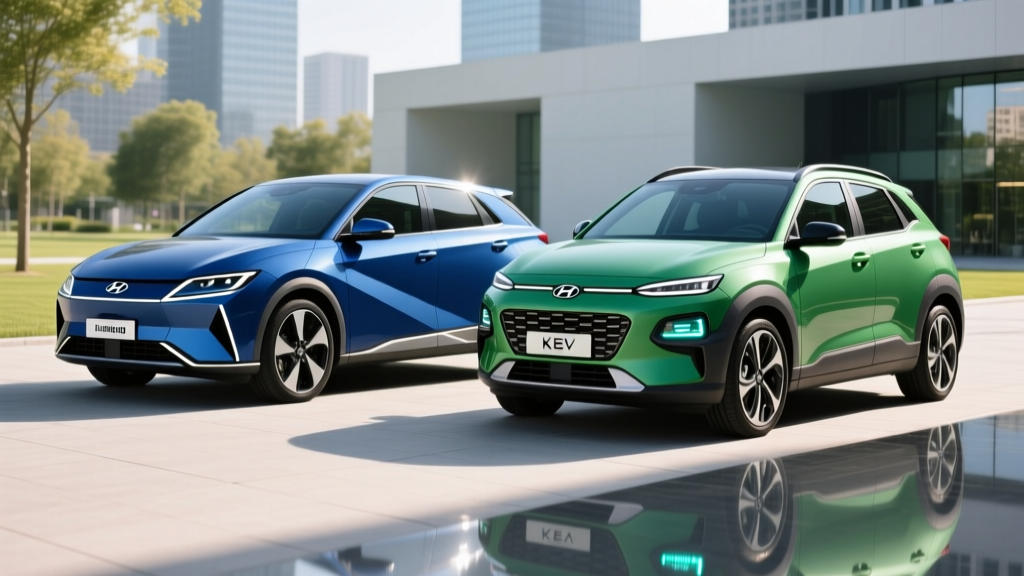
Which Hyundai electric SUV should you buy? The 2026 Hyundai Ioniq 5 (EPA range up to 318 miles, 240 kW DC fast charging, starting ~$44,500) is the better long-distance and family hauler. The 2026 Hyundai Kona Electric (EPA range up to 261 miles, 100 kW DC fast charging, starting ~$33,500) is the budget-friendly commuter pick. Both qualify for partial or full §30D federal tax credits depending on battery sourcing, your income, and point-of-sale transfer eligibility.
Hyundai's 2026 Electric SUV Lineup at a Glance
Hyundai sells two fully electric SUVs in the US market for the 2026 model year. The Ioniq 5 rides on the dedicated E-GMP platform with an 800-volt architecture, enabling some of the fastest DC charging speeds in its class. The Kona Electric uses a modified 400-volt architecture shared with its gasoline sibling, keeping costs lower but limiting peak charge rates.
| Spec | 2026 Ioniq 5 (SEL AWD) | 2026 Kona Electric (SEL) |
|---|---|---|
| EPA Range | 290 mi (AWD) / 318 mi (RWD Long Range) | 261 mi |
| Battery (usable) | 77.4 kWh, NMC | 65.4 kWh, NMC |
| Peak DC Fast Charge | 240 kW (10–80% in ~18 min) | 100 kW (10–80% in ~43 min) |
| Level 2 Charge Rate | 10.9 kW | 7.2 kW |
| Connector | NACS (Tesla Supercharger compatible) | CCS1 |
| Horsepower | 320 hp (AWD) / 168 hp (RWD Std) | 201 hp |
| 0–60 mph | 4.5 sec (AWD) | 7.4 sec |
| Combined MPGe | 110 MPGe (AWD) | 105 MPGe |
| Base MSRP | $44,500 (SEL AWD) | $33,550 (SEL) |
| Battery/Powertrain Warranty | 10 yr / 100,000 mi | 10 yr / 100,000 mi |
Sources: EPA / fueleconomy.gov, Hyundai USA spec sheets.
Real-World Range: What the EPA Sticker Doesn't Tell You
EPA range estimates assume a mix of city and highway driving at moderate temperatures. In practice, your mileage varies based on speed, climate, and terrain.
Ioniq 5 AWD (EPA 290 mi): Expect roughly 250–270 miles on a flat highway at 70 mph in mild weather. In sub-freezing temperatures, range drops 15–25%, yielding approximately 215–245 miles per charge. The heat pump (standard on most trims) mitigates some cold-weather loss.
Kona Electric (EPA 261 mi): Real-world highway driving nets about 225–240 miles in summer, falling to 190–215 miles in winter cold. The Kona lacks a heat pump on base trims, so resistive cabin heating draws more from the traction battery.
For buyers in northern climates, preconditioning the battery while plugged in (using Hyundai's BlueLink app) preserves range by warming the cabin and battery pack on grid power rather than battery power. Both models support scheduled departure preconditioning.
Charging Speed and Infrastructure
The Ioniq 5's 800V architecture is its biggest practical advantage for road-trippers. At a 350 kW-capable Electrify America or Tesla Supercharger stall (via NACS adapter or native NACS port on 2026 models), the Ioniq 5 sustains above 180 kW through roughly 60% state of charge, tapering gradually to protect the NMC cells above 80%. A 10–80% session takes approximately 18 minutes.
The Kona Electric, limited to ~100 kW peak, follows a flatter but slower charge curve. A 10–80% session takes roughly 43 minutes at a DC fast charger — fine for grocery-stop top-ups but noticeably slower on longer trips.
| Charging Level | Power | Ioniq 5 (miles/hr) | Kona EV (miles/hr) |
|---|---|---|---|
| Level 1 (120V outlet) | ~1.4 kW | ~5 mi/hr | ~4 mi/hr |
| Level 2 (240V home) | 7.2–10.9 kW | ~36 mi/hr | ~24 mi/hr |
| DC Fast Charge | 100–240 kW peak | ~200+ mi in 18 min (10–80%) | ~130 mi in 30 min (10–80%) |
Home Level 2 charging requires a 240V circuit — typically a NEMA 14-50 outlet on a 50-amp breaker or a hardwired wall connector. Installation costs range from $500 (simple outlet near the panel) to $2,500+ if your panel needs an upgrade or the run is long. Always get a quote from a licensed electrician before purchasing.
Total Cost of Ownership: Hyundai Electric SUVs vs. Gas Equivalents
Purchase price is only part of the equation. Below is a 5-year cost comparison assuming 15,000 miles/year, $0.14/kWh home electricity, $3.50/gallon gas, and typical maintenance schedules.
| Cost Factor (5 yr / 75k mi) | Ioniq 5 SEL AWD | Tucson Gas AWD (2.5L) | Kona Electric SEL | Kona Gas (1.6T) |
|---|---|---|---|---|
| Purchase Price (MSRP) | $44,500 | $33,000 | $33,550 | $29,500 |
| Est. §30D Federal Credit | Up to $7,500* | $0 | Up to $7,500* | $0 |
| Effective Purchase | ~$37,000 | $33,000 | ~$26,050 | $29,500 |
| Fuel / Electricity | $3,940 | $9,375 | $3,580 | $8,250 |
| Maintenance | $1,200 | $3,500 | $1,200 | $3,200 |
| Insurance (avg) | $9,500 | $7,800 | $8,200 | $7,500 |
| 5-Year Total | $51,640 | $53,675 | $39,030 | $48,450 |
*§30D credit eligibility depends on MSRP caps ($80,000 for SUVs), buyer income limits ($150K single / $300K joint), and battery component/critical mineral sourcing requirements per IRS rules. Point-of-sale transfer is available at participating dealers. Verify current-year eligibility with a tax professional.
Key takeaways: The Ioniq 5 breaks even with the Tucson gas model within 5 years despite its higher MSRP, thanks to fuel and maintenance savings plus the tax credit. The Kona Electric is substantially cheaper to own than the gas Kona over the same period, making it one of the most affordable EVs on the market when incentives apply.
Hyundai Electric SUVs vs. Hybrid: Which Saves More?
If you can't install a home charger or frequently drive in rural areas with sparse DC fast-charging coverage, Hyundai's hybrid SUVs (Tucson Hybrid, 38 MPG combined; Tucson PHEV, 35 mi electric + 35 MPG) may fit better. A Tucson Hybrid costs roughly $5,400 in fuel over 5 years/75k miles at $3.50/gallon — more than either EV on home charging, but less than a gas-only Tucson and without range or charging-infrastructure concerns.
The PHEV splits the difference: 35 miles of electric-only range covers most commutes, and the gas engine handles longer trips. However, PHEVs carry higher maintenance costs than BEVs (oil changes, spark plugs, transmission fluid) and lack the §30D credit structure that favors full EVs with compliant battery sourcing.
First-Time EV Buyer: What You Must Know Before Purchasing
Home Charging Is Non-Negotiable for Most Owners
Over 80% of EV charging happens at home. If you live in an apartment without charging access or lack a dedicated parking spot with electrical access, public charging costs ($0.30–$0.55/kWh at DC fast chargers) erode the fuel savings significantly. Budget $500–$2,500 for Level 2 home installation before you buy.
Insurance Costs More for EVs
EV insurance premiums run 10–25% higher than gas equivalents due to higher repair costs and battery replacement risk. Get quotes from your insurer before committing — the $5,435 fuel savings on the Ioniq 5 over 5 years can shrink if your insurance jumps by $2,000+.
Cold Weather Cuts Range — Plan Accordingly
If your daily round-trip commute is 200 miles and you live where winters drop below 25°F, the Kona Electric's ~200-mile winter range will feel tight. The Ioniq 5's larger battery and heat pump provide more buffer.
Battery Degradation Is Slow and Warrantied
Hyundai's NMC batteries in both models are warrantied for 10 years/100,000 miles against capacity loss below 70%. Independent data from sources like Recurrent shows modern NMC packs losing roughly 5–8% capacity over the first 100,000 miles with normal use. Avoid routinely charging to 100% and use preconditioning to extend longevity.
Common Misconceptions About Hyundai Electric SUVs
| Myth | Fact |
|---|---|
| "The battery will need replacing in 5 years." | NMC batteries in Hyundai E-GMP vehicles show <10% degradation at 100k miles. The 10-year warranty covers defects and abnormal capacity loss. |
| "EVs don't work in cold climates." | Range drops 15–25% in freezing temps, but preconditioning and heat pumps (Ioniq 5) mitigate this. Thousands of EV owners in Minnesota, Norway, and Canada drive daily in winter. |
| "The Ioniq 5 can charge at 240 kW everywhere." | Peak 240 kW requires a 350 kW-capable DC charger and optimal battery temperature. Many public chargers cap at 50–150 kW, and the charge curve tapers above 60–70% SoC. |
| "The Kona Electric charges as fast as the Ioniq 5." | The Kona's 400V architecture limits it to ~100 kW peak — roughly half the Ioniq 5's rate. A 10–80% session takes ~43 min vs. ~18 min. |
| "All Hyundai EVs get the full $7,500 tax credit." | §30D credit depends on battery sourcing (critical minerals + components), your AGI, and MSRP caps. Credits can be $0, $3,750, or $7,500. Verify on the IRS clean vehicle credit list for the current model year. |
Decision Framework: Which Hyundai Electric SUV Is Right for You?
Choose the Ioniq 5 if:
- You take road trips of 200+ miles more than a few times per year
- You need AWD for snow or rain
- You want the fastest public charging to minimize stop time
- You need 27.2 cu ft of cargo space (53.3 cu ft with seats folded)
- Your budget accommodates $44,500+ before incentives
Choose the Kona Electric if:
- Your daily commute is under 100 miles round-trip
- You primarily charge at home and rarely road-trip
- You want the lowest possible purchase price in an electric SUV
- You don't need AWD (Kona EV is FWD only)
- You live in a mild climate where winter range loss is less severe
Consider a Tucson Hybrid or PHEV instead if:
- You cannot install a home Level 2 charger
- You regularly tow (Tucson Hybrid: 2,000 lb capacity; neither EV is rated for towing)
- You drive in rural areas with limited DC fast-charging infrastructure
Frequently Asked Questions
Does the 2026 Ioniq 5 have a NACS port for Tesla Superchargers?
Yes. Starting with the 2025 model year, Hyundai transitioned the Ioniq 5 to the NACS (North American Charging Standard) connector, providing native access to Tesla's Supercharger network — over 20,000 stalls in North America. The 2026 model continues with NACS. The Kona Electric retains CCS1 but can access Superchargers via adapter where supported.
What is the real cost to charge a Hyundai electric SUV at home?
At the US average of $0.14/kWh, fully charging the Ioniq 5's 77.4 kWh battery costs approximately $10.84, yielding about $0.034 per mile. The Kona Electric's 65.4 kWh pack costs ~$9.16 for a full charge, or ~$0.035 per mile. Compare this to $0.12–$0.15 per mile for a 28 MPG gas SUV at $3.50/gallon.
How does Hyundai's battery warranty compare to competitors?
Hyundai's 10-year/100,000-mile battery and powertrain warranty is among the best in the industry. Tesla offers 8 years/120,000 miles (Model Y), Ford offers 8 years/100,000 miles, and most legacy automakers match at 8/100k. Hyundai's extra 2 years of coverage is a meaningful advantage for long-term ownership peace of mind.
Is the Ioniq 5's Level 2 ADAS actually self-driving?
No. Hyundai's Highway Driving Assist 2 (HDA2) and the available Highway Driving Assist with Lane Change Assist are SAE Level 2 driver-assistance systems. You must keep your hands on the wheel and eyes on the road at all times. These systems handle adaptive cruise, lane centering, and highway navigation well, but they do not replace the driver. Only Level 4 robotaxi services like Waymo operate without human supervision in geofenced areas.
Can I tow with a Hyundai electric SUV?
The 2026 Ioniq 5 is not officially rated for towing by Hyundai in the US market. The Kona Electric is also not rated for towing. If towing is a priority, consider the Hyundai Tucson Hybrid (2,000 lb rating) or look at EVs from Ford (F-150 Lightning), Rivian (R1S), or Tesla (Model Y, 3,500 lb) that offer tow ratings.