The Hyundai Electric SUV You Should Buy
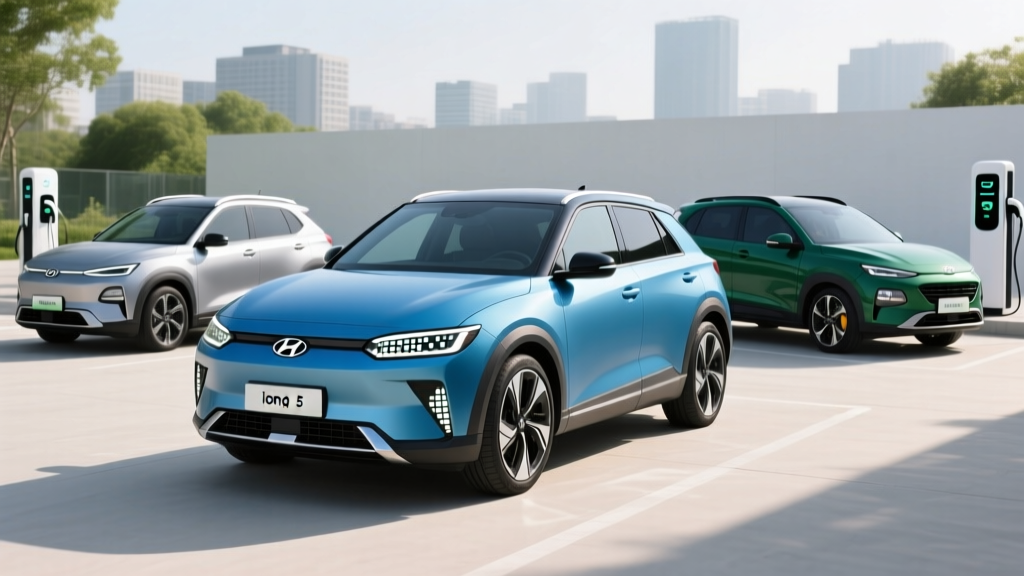
If you're searching for a Hyundai electric SUV in 2026, the answer depends on your budget and needs: the Ioniq 5 ($42,600 base) is the best all-around pick with 311 miles of EPA range and 800V ultra-fast charging, the Kona Electric ($32,975) is the most affordable entry point at 261 miles, and the new three-row Ioniq 9 ($52,000 est.) targets families needing space for six or seven. All three qualify for partial or full federal tax credits depending on trim, battery sourcing, and your income. Below, we break down real-world range, charging costs, and how each stacks up against gas and hybrid alternatives.
2026 Hyundai Electric SUV Lineup at a Glance
| Model | Body Style | EPA Range | Battery (kWh) | Peak DC Charge | 10–80% Time | 0–60 mph | Starting MSRP |
|---|---|---|---|---|---|---|---|
| Kona Electric | Subcompact SUV | 261 mi | 64.8 (NMC) | 100+ kW | ~43 min | 7.8 sec | $32,975 |
| Ioniq 5 (RWD) | Compact Crossover | 311 mi | 77.4 (NMC) | 238 kW (800V) | ~18 min | 7.2 sec | $42,600 |
| Ioniq 5 (AWD) | Compact Crossover | 290 mi | 77.4 (NMC) | 238 kW (800V) | ~18 min | 4.5 sec | $46,100 |
| Ioniq 9 (est.) | Midsize 3-Row SUV | ~330 mi (est.) | 110.3 (NMC) | 350 kW (800V) | ~20 min (est.) | ~5.5 sec (AWD) | $52,000 (est.) |
All figures reflect 2026 model-year data from fueleconomy.gov and Hyundai's official specifications. The Ioniq 9 is newly introduced; specs marked "est." are manufacturer-announced targets subject to final EPA certification.
Real-World Range vs. EPA Stickers
EPA range estimates are useful baseline numbers, but every EV owner learns quickly that real-world results depend heavily on speed, temperature, and terrain. Here's what to actually expect from a Hyundai electric SUV on the road:
Real-World Range Expectations
- Kona Electric (EPA 261 mi): Expect ~210–230 mi on highway road trips at 70 mph; ~170–190 mi in freezing weather with cabin heat running.
- Ioniq 5 RWD (EPA 311 mi): Expect ~250–275 mi sustained highway driving; ~210–240 mi in sub-30°F conditions.
- Ioniq 5 AWD (EPA 290 mi): Expect ~235–255 mi highway; ~195–220 mi in deep cold.
The Ioniq 5's standard heat pump (on most trims) helps mitigate cold-weather losses compared to EVs without one, but 25–35% range reduction in freezing temperatures is physics, not a defect. Plan charging stops accordingly.
For context, the average American drives 37 miles per day according to FHWA data. Even the Kona Electric's reduced winter range covers most daily commutes with a substantial buffer — provided you can charge at home.
Charging: Speed, Cost, and Home Setup
The biggest differentiator in Hyundai's EV lineup is charging architecture. The Ioniq 5 and Ioniq 9 use Hyundai's E-GMP platform with 800-volt capability, enabling dramatically faster DC fast charging than the Kona Electric's 400V system.
| Charging Level | Power (kW) | Kona Electric (mi/hr) | Ioniq 5 (mi/hr) | Typical Use Case |
|---|---|---|---|---|
| Level 1 (120V) | ~1.4 kW | ~4 mi/hr | ~4 mi/hr | Emergency/overnight trickle |
| Level 2 (240V, 48A) | ~10.9 kW | ~35 mi/hr | ~40 mi/hr | Home/workplace daily charging |
| DC Fast (Kona) | ~100 kW peak | — | — | Road trips; 10–80% in ~43 min |
| DC Fast (Ioniq 5/9, 800V) | 238–350 kW peak | — | — | Road trips; 10–80% in ~18–20 min |
What kW vs. kWh Actually Means
This is the single most common EV confusion. kWh (kilowatt-hours) measures battery capacity — think of it as the "tank size." The Ioniq 5 has a 77.4 kWh battery. kW (kilowatts) measures power flow — the rate at which energy moves into or out of the battery. A 238 kW DC fast charger fills the battery quickly, but only at peak; the charge curve tapers significantly above 80% State of Charge to protect battery longevity.
Home Charging Installation Costs
| Item | Typical Cost Range | Notes |
|---|---|---|
| Level 2 Charger (hardware) | $300–$700 | Emporia, ChargePoint, Wallbox |
| Electrician (240V/50A circuit) | $500–$2,000 | Depends on panel proximity |
| Electrical panel upgrade (if needed) | $1,500–$3,500 | Older homes with 100A service |
| Permits | $50–$200 | Varies by jurisdiction |
| Total (typical install) | $850–$2,900 | Without panel upgrade |
Have a licensed electrician assess your panel before purchasing. Homes built after 2000 with 200A service rarely need upgrades; pre-1980 homes often do. Hyundai includes a complimentary home charging partnership with Electrify America for some model years — check current dealer offers.
EV vs. Gas vs. Hybrid: The Cost Comparison
How does a Hyundai electric SUV compare to its gas and hybrid siblings? Let's run the numbers for a compact SUV buyer cross-shopping the Ioniq 5, the Hyundai Tucson Hybrid, and the gas-only Tucson.
| Metric | Ioniq 5 RWD | Tucson Hybrid (HEV) | Tucson Gas (AWD) |
|---|---|---|---|
| MSRP (base) | $42,600 | $33,265 | $30,550 |
| Federal Tax Credit (§30D) | Up to $7,500* | None | None |
| Effective Price After Credit | ~$35,100* | $33,265 | $30,550 |
| EPA Efficiency | 114 MPGe (30 kWh/100mi) | 38 MPG combined | 28 MPG combined |
| Fuel/Energy Cost per Year | ~$550 (home charging)** | ~$1,500 | ~$2,050 |
| Annual Maintenance | ~$150 | ~$450 | ~$550 |
| 5-Year Fuel + Maintenance | ~$3,500 | ~$9,750 | ~$13,000 |
*Tax credit eligibility depends on income caps ($150K single / $300K joint AGI), MSRP caps ($55K for SUVs), and battery critical-mineral sourcing requirements. Verify at irs.gov. Point-of-sale transfer is available for 2026.
**Based on $0.16/kWh national average and 12,000 mi/yr. Public DC fast charging costs significantly more ($0.35–$0.55/kWh).
The Ioniq 5's effective price after the tax credit lands close to the Tucson Hybrid, but the EV saves roughly $6,000–$9,500 over five years in fuel and maintenance. The break-even point versus the gas Tucson is roughly 2–3 years for most drivers who charge at home.
When a Hybrid Makes More Sense
If you lack access to home or workplace Level 2 charging, live in an apartment without charging infrastructure, or regularly drive 400+ mile routes through charging deserts (rural stretches of I-70, I-10, or I-80), the Tucson Hybrid offers strong efficiency without any charging dependency. Be honest about your access before committing to a BEV.
Federal Tax Credit: What You Actually Qualify For
The §30D federal EV tax credit is not a blanket $7,500 for every buyer. Here's the 2026 eligibility checklist:
- Income caps: Modified AGI must not exceed $150,000 (single), $225,000 (head of household), or $300,000 (married filing jointly).
- MSRP cap: Vehicle MSRP must not exceed $55,000 for SUVs (all Hyundai electric SUVs currently qualify on base/mid trims).
- Battery sourcing: Increasing percentages of critical minerals and battery components must be sourced from US or FTA-partner countries. This determines whether you receive the full $7,500, a partial $3,750, or $0.
- Point-of-sale transfer: You can transfer the credit to the dealer at purchase, reducing your out-of-pocket cost immediately rather than waiting for tax filing.
- One credit per VIN, one per taxpayer per year.
Always confirm the specific trim's credit status at the time of purchase — sourcing requirements tighten annually and credit amounts can shift mid-year. Consult a tax professional for your personal situation.
Common EV Misconceptions, Corrected
| Myth | Fact |
|---|---|
| "EV batteries need replacing every few years." | Hyundai's EV battery warranty covers 10 years / 100,000 miles with a minimum 70% capacity retention threshold. Real-world degradation for NMC packs averages 10–15% over 150,000 miles based on fleet data. |
| "Charging takes too long for road trips." | The Ioniq 5 adds ~150 miles in 18 minutes at a 250+ kW charger. That's a rest-stop bathroom break and a coffee. The Kona Electric is slower (~43 min 10–80%), so plan accordingly. |
| "EVs don't work in cold weather." | They work, but range drops 25–35% in sub-freezing temps. A 311-mile Ioniq 5 becomes ~220 miles in deep cold. Preconditioning the battery while plugged in mitigates this and preserves fast-charging speed. |
| "EVs are worse for the environment because of electricity generation." | Even on the dirtiest US grids, EVs produce fewer lifetime emissions than gas equivalents per EPA analysis. On cleaner grids, the advantage is dramatic. |
| "I'll save on insurance." | EV insurance premiums average 15–25% higher than gas equivalents due to repair costs and battery replacement risk. Get quotes before purchasing. |
Decision Framework: Which Hyundai Electric SUV Is Right for You?
Choose Based on Your Situation
- Choose the Kona Electric if: Your budget is under $35K, your daily commute is under 60 miles, you rarely road-trip more than 200 miles one-way, and you want the lowest entry price into a Hyundai electric SUV.
- Choose the Ioniq 5 (RWD) if: You want the best balance of range (311 mi), charging speed (18-min 10–80%), interior space, and tech. This is the default recommendation for most buyers.
- Choose the Ioniq 5 (AWD) if: You live in a snowy climate, need the 4.5-second 0–60 performance, or tow occasionally (up to 2,300 lbs with the tow package).
- Choose the Ioniq 9 if: You need three rows for family hauling, want 330+ miles of range, and have a budget above $50K. Best for households outgrowing the Ioniq 5's two-row layout.
- Choose a Tucson Hybrid instead if: You cannot install home charging, regularly drive routes with sparse DC fast-charging infrastructure, or want a lower purchase price without tax-credit dependency.
What First-Time EV Buyers Must Know
Home Charging Is Non-Negotiable for Most Owners
Over 80% of EV charging happens at home. If you can install a Level 2 (240V) charger in your garage or driveway, EV ownership is seamless — wake up every morning with a "full tank." If you rely solely on public charging, costs rise to $0.35–$0.55/kWh at DC fast chargers, and convenience drops significantly. Confirm your charging situation before buying.
The Charge Curve Matters More Than Peak kW
Hyundai advertises 238 kW peak charging on the Ioniq 5 — but that rate only holds between roughly 10–55% State of Charge. Above 80%, charging slows dramatically to protect battery health (often below 50 kW). For road trips, plan stops around the 15–80% window for maximum efficiency rather than charging to 100%.
Battery Longevity: What to Expect
Hyundai covers its EV batteries with a 10-year / 100,000-mile warranty guaranteeing at least 70% capacity retention. Independent fleet data from sources like Recurrent shows most modern NMC packs retain 85–90% capacity at 100,000 miles. The biggest longevity enemies are sustained 100% State of Charge, frequent DC fast charging in extreme heat, and letting the battery sit at 0% for extended periods. For daily driving, charging to 80% and keeping the battery between 20–80% optimizes lifespan.
Safety Ratings
The Ioniq 5 earned an IIHS Top Safety Pick+ rating and a 5-star NHTSA overall score. The Kona Electric holds a 5-star NHTSA rating as well. Check current results at iihs.org and nhtsa.gov for the latest test data.
Frequently Asked Questions
Does the Hyundai Ioniq 5 qualify for the full $7,500 federal tax credit?
Eligibility depends on your income, the specific trim's MSRP (must be under $55K for SUVs), and the battery's critical-mineral and component sourcing for the model year. Many Ioniq 5 trims have qualified for the full or partial credit, but sourcing rules tighten annually. Confirm with your dealer and check irs.gov for the current list.
Can I use a Tesla Supercharger with a Hyundai electric SUV?
Starting with the 2025 model year, Hyundai adopted the NACS (North American Charging Standard) port on new vehicles, granting direct access to Tesla's Supercharger network. For 2024 and earlier models with CCS ports, Hyundai provides a NACS adapter. Confirm with your dealer which port your specific model year carries.
How much does it cost to charge a Hyundai electric SUV at home?
At the national average of $0.16/kWh, fully charging the Ioniq 5's 77.4 kWh battery costs roughly $12.40 for 311 miles of range — about $0.04 per mile. Compare that to the gas Tucson at roughly $0.14–$0.17 per mile at $3.50/gallon. Annual savings for a 12,000-mile driver: approximately $1,200–$1,500.
What's the maintenance schedule for a Hyundai electric SUV?
EVs have no oil changes, spark plugs, timing belts, or exhaust systems. Maintenance is limited to cabin air filters (~$30–$50 every 15,000 mi), tire rotations (EVs wear tires faster due to weight and instant torque), brake fluid checks, and coolant top-offs for the battery thermal management system. Budget ~$150/year vs. ~$500+ for a gas equivalent.
Is the Hyundai Ioniq 5 considered self-driving?
No. The Ioniq 5 offers Hyundai's Highway Driving Assist 2 (HDA2), which is an SAE Level 2 driver-assistance system. It provides adaptive cruise control and lane-centering on highways, but the driver must remain fully engaged with hands on the wheel and eyes on the road at all times. It is not autonomous driving.
How does cold weather affect the Hyundai Kona Electric?
Expect 25–35% range reduction in sustained sub-freezing temperatures. The Kona Electric's 261-mile EPA range may drop to roughly 170–190 miles in deep cold. Unlike the Ioniq 5, some Kona Electric trims lack a heat pump (a battery-warming efficiency feature), so cabin heating draws more directly from the traction battery. Preconditioning while plugged in helps significantly.