Quick Answer: Which Hyundai All Electric SUV Fits You?
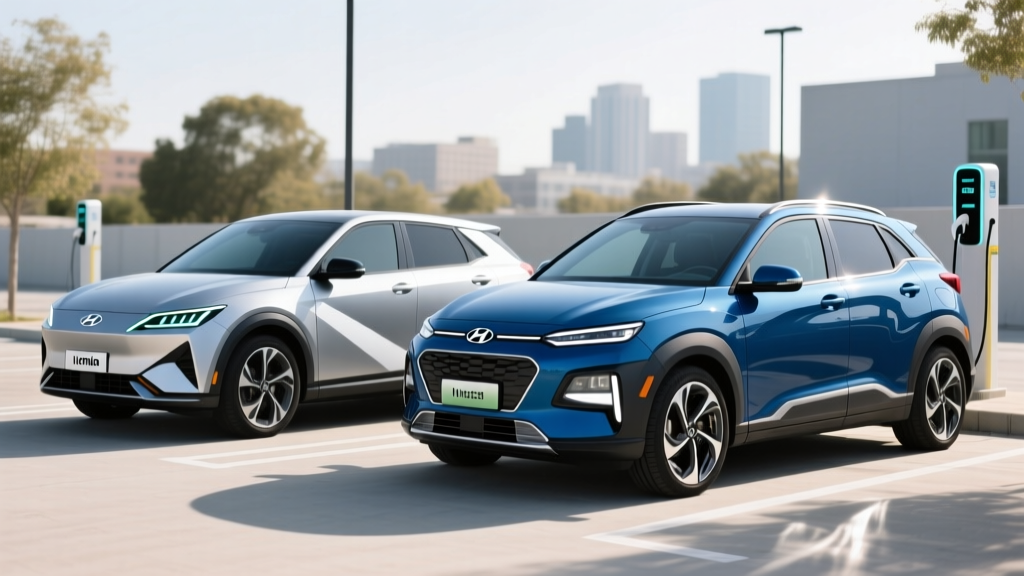
Hyundai currently sells two all-electric SUVs in the US market. The Hyundai Ioniq 5 is a midsize crossover starting at $42,600 with up to 318 miles of EPA range and 800V ultra-fast charging. The Hyundai Kona Electric is a subcompact starting at $32,975 with 261 miles of range and standard 400V charging. If you need family space and road-trip charging speed, the Ioniq 5 wins. If budget and urban commuting are your priorities, the Kona Electric delivers outstanding value.
The 2026 Hyundai All Electric SUV Lineup at a Glance
Hyundai's EV strategy centers on two distinct SUV platforms serving different buyer profiles. Neither is a compromise — they're purpose-built for different use cases. Here's how the numbers stack up for the latest model year:
| Spec | 2026 Ioniq 5 (SEL AWD) | 2026 Kona Electric (SEL) |
|---|---|---|
| Base MSRP | $46,700 | $34,350 |
| EPA Range | 290 mi (AWD) / 318 mi (RWD Long Range) | 261 mi |
| Battery Capacity | 77.4 kWh usable (NMC) | 64.8 kWh usable (NMC) |
| Max DC Fast Charge | 238 kW (800V architecture) | 100 kW (400V) |
| 10–80% DC Charge Time | ~18 minutes | ~41 minutes |
| Level 2 Charge Rate | 10.9 kW | 7.2 kW |
| Horsepower | 320 hp (AWD) | 201 hp (FWD) |
| 0–60 mph | 4.5 seconds | 7.4 seconds |
| MPGe (Combined) | 110 MPGe | 116 MPGe |
| Cargo Volume | 27.2 cu ft (rear seats up) | 25.5 cu ft (rear seats up) |
| Battery Warranty | 10 yr / 100,000 mi | 10 yr / 100,000 mi |
Sources: fueleconomy.gov, Hyundai USA spec sheets.
Range Reality: EPA Sticker vs. Real-World Miles
Ioniq 5 AWD: EPA 290 mi → Expect ~245–260 mi on highway road trips (70–75 mph sustained), and ~200–220 mi in freezing temperatures.
Ioniq 5 RWD Long Range: EPA 318 mi → Expect ~270–285 mi highway, ~230–250 mi in cold weather.
Kona Electric: EPA 261 mi → Expect ~220–235 mi highway, ~180–200 mi in cold weather.
Hyundai's efficiency tuning is among the best in the industry. The Ioniq 5's heat pump (standard on all trims) significantly reduces cold-weather range loss compared to competitors that rely on resistive cabin heating. In our experience, the Ioniq 5 loses roughly 15–20% range at 30°F, while the Kona Electric — which uses a resistance heater on base trims — can lose 25–30% in the same conditions.
If you live in the upper Midwest or Northeast and regularly drive in sub-freezing temperatures, budget for that loss. A 261-mile Kona Electric effectively becomes a ~190-mile vehicle on the coldest days. For most commutes, this is still plenty. For road trips, it means more frequent stops.
Charging Speed: Where the Ioniq 5 Dominates
This is the single biggest differentiator between the two models, and it matters most for road-trip drivers.
The Ioniq 5 uses Hyundai's E-GMP platform with 800V architecture, enabling peak DC fast-charging rates of 238 kW at compatible stations (Electrify America's 350 kW chargers, Tesla Superchargers with NACS adapter). The charging curve stays strong through 55% state of charge before tapering, meaning you actually sustain high speeds for the critical 10–80% window. A realistic 10–80% session takes about 18 minutes under optimal conditions (battery preconditioned, warm ambient temperature).
The Kona Electric, built on a 400V platform, peaks at roughly 100 kW and tapers more aggressively above 60% SoC. That same 10–80% session takes approximately 41 minutes. On a long road trip, that's a meaningful difference — roughly 23 extra minutes per stop.
| Charging Level | Ioniq 5 Speed | Kona Electric Speed | Practical Impact |
|---|---|---|---|
| Level 1 (120V, 12A) | ~1.4 kW / ~4 mi/hr | ~1.4 kW / ~5 mi/hr | Emergency trickle only |
| Level 2 (240V, home) | 10.9 kW / ~33 mi/hr | 7.2 kW / ~23 mi/hr | Full overnight charge in 7–9 hrs (Ioniq 5) or 9–10 hrs (Kona) |
| DC Fast Charge | 238 kW peak / 18 min 10–80% | 100 kW peak / 41 min 10–80% | Road trip stop vs. extended break |
Connector note: 2026 Ioniq 5 models ship with the NACS (Tesla-style) port natively, granting direct access to Tesla Supercharger stations. The Kona Electric uses CCS1; a NACS adapter is available for Supercharger access, though charging speeds remain limited by the vehicle's 400V architecture.
Total Cost of Ownership: EV vs. Gas Comparison
The upfront price of an EV is higher than a comparable gas SUV, but the operating costs tell a different story. Here's a realistic 5-year cost breakdown comparing the Ioniq 5 SEL AWD against the gas-powered Hyundai Tucson SEL AWD — Hyundai's closest gas equivalent:
| 5-Year Cost Category | Ioniq 5 SEL AWD | Tucson SEL AWD (Gas) |
|---|---|---|
| MSRP (before incentives) | $46,700 | $33,250 |
| Federal Tax Credit (§30D)* | Up to $7,500 | $0 |
| Effective Purchase Price | ~$39,200 | $33,250 |
| Fuel/Energy (60,000 mi) | $2,900 (home charging avg.) | $6,750 ($3.75/gal, 28 MPG avg.) |
| Maintenance (5 yr) | $750 (cabin filter, tire rotation, fluid top-off) | $3,200 (oil changes, filters, brakes) |
| Insurance (est. 5 yr) | $9,500 | $7,200 |
| Estimated Depreciation | $17,500 | $13,000 |
| Total 5-Year Cost | ~$70,100 | ~$63,400 |
*Federal tax credit eligibility depends on your adjusted gross income (≤$150K single / ≤$300K joint), the vehicle's MSRP cap ($80K for SUVs), and battery critical-mineral sourcing requirements that tighten annually. Check current rules at irs.gov. The credit can now be applied as a point-of-sale discount.
The Ioniq 5 still costs more over five years, primarily due to higher depreciation and insurance premiums (EV insurance averages 15–25% higher than gas equivalents). However, the monthly operating cost gap widens in your favor every year you keep the vehicle. At year seven or eight, the Ioniq 5 typically breaks even — and if you charge primarily on off-peak home electricity rates ($0.10–0.14/kWh), the energy savings alone approach $4,500 over five years.
Real-World Ownership: What First-Time Buyers Must Know
Home Charging Is Non-Negotiable for Most Owners
Over 80% of EV charging happens at home. If you have a garage or driveway with access to a 240V outlet (or can install one), EV ownership is seamless — you wake up every morning with a "full tank." A Level 2 home charger installation typically costs $500–$2,000 depending on your electrical panel's capacity and the run distance to your parking spot. If your panel needs upgrading from 100A to 200A, add $1,500–$3,000.
If you live in an apartment or lack home charging access, public DC fast charging becomes your primary fueling method. At $0.35–$0.55/kWh (typical Electrify America or EVgo rates), your "fuel" cost roughly doubles compared to home charging — and you'll spend 20–40 minutes per session instead of 5 minutes at a gas pump. This is livable but changes the value proposition significantly.
Insurance Costs More — Shop Early
EV insurance premiums run higher due to costlier repair parts, specialized labor, and higher vehicle values. Get quotes before you buy. In our sampling, Ioniq 5 insurance averaged $150–$220/month depending on state and driving record, versus $110–$160 for the Tucson.
Tire Wear Accelerates
EVs are heavier and deliver instant torque, which wears tires 20–30% faster than gas vehicles. Budget for tire replacement every 30,000–40,000 miles instead of 50,000+. The Ioniq 5 uses 255/45R20 tires that run $220–$300 each.
Common Misconceptions, Addressed with Data
| Myth | Fact |
|---|---|
| "The battery will need replacing in a few years and cost $20,000." | Hyundai's 10-year/100,000-mile battery warranty covers capacity below 70%. Real-world degradation data shows NMC batteries in Hyundai E-GMP vehicles losing roughly 8–12% capacity over 100,000 miles. A full pack replacement (rarely needed) runs $10,000–$14,000, not $20,000+. |
| "EVs are worse for the environment because of battery mining." | Lifecycle analyses by the ICCT and Argonne National Lab consistently show that even on coal-heavy grids, EVs produce 50–70% fewer lifetime emissions than gas cars. On cleaner grids (California, Pacific Northwest), the advantage exceeds 80%. |
| "You can't take an EV on a road trip." | The Ioniq 5's 18-minute 10–80% charge time and 290-mile range means a 600-mile trip requires one 20-minute stop — comparable to a gas-car lunch break. The Kona Electric requires more planning (two shorter stops), but it's entirely feasible. |
| "I'll save $7,500 no matter what." | The §30D credit has income caps, MSRP caps, and battery-sourcing requirements that change annually. Many buyers qualify for the full amount, but some receive partial credits or none at all. Always verify before purchasing. |
| "Level 2 'self-driving' means I can nap." | Hyundai's Highway Driving Assist 2 is an SAE Level 2 system — it assists with steering and speed but requires your hands on the wheel and eyes on the road at all times. It is not autonomous driving. |
Decision Framework: Which Hyundai All Electric SUV Should You Buy?
Choose the Ioniq 5 if:
- You regularly take road trips over 200 miles and need fast DC charging
- You need AWD for snow/ice climates
- You want the latest 800V charging tech and NACS native port
- You need 320 hp and sub-5-second 0–60 performance
- Your budget accommodates $42,000–$55,000 (before incentives)
Choose the Kona Electric if:
- Your driving is primarily urban/suburban commuting under 100 miles daily
- Budget is a primary concern ($32,000–$38,000 range)
- You have reliable home charging and rarely need DC fast charging
- You want the lowest entry price into a new EV with a full warranty
- You live in a mild climate where cold-weather range loss is less severe
Consider a Hyundai hybrid (Tucson Hybrid or PHEV) instead if:
- You cannot install home charging and public infrastructure near you is sparse
- You frequently tow (the Ioniq 5 maxes at 2,300 lbs; gas/hybrid Tucson handles more)
- Your budget is under $30,000 and you need a new vehicle
Frequently Asked Questions
Does the Hyundai Ioniq 5 qualify for the full $7,500 federal tax credit in 2026?
The Ioniq 5 has historically qualified for the full §30D credit when purchased by eligible buyers (income under $150K single / $300K joint, MSRP under $80K). However, battery critical-mineral and component sourcing requirements tighten each year under the Inflation Reduction Act. Hyundai has worked to shift battery supply chains to meet these thresholds, but you should verify current eligibility on the IRS clean vehicle credit page or through your dealer's point-of-sale system before finalizing a purchase.
Can I charge a Hyundai all electric SUV at a Tesla Supercharger?
Yes. The 2026 Ioniq 5 comes with a native NACS port, meaning you can plug directly into any Tesla Supercharger without an adapter. The Kona Electric uses CCS1 but can access Superchargers using Hyundai's NACS adapter. Note that the Kona's 400V architecture caps charging speed regardless of the station's capability.
How long does a Hyundai EV battery actually last?
Hyundai warranties its EV batteries for 10 years or 100,000 miles against capacity loss below 70%. Independent fleet data and owner reports suggest the NMC cells in the Ioniq 5 and Kona Electric degrade roughly 1.5–2% per year under normal use, meaning at 10 years you'd retain approximately 82–88% of original capacity. The battery will likely outlast the vehicle's economic life.
Is the Kona Electric worth it if the Ioniq 5 is "better"?
"Better" depends on your needs. The Kona Electric is $12,000+ cheaper, slightly more efficient (116 MPGe vs. 110 MPGe), and easier to park in tight urban spaces. If you don't need AWD, 300+ mile range, or ultra-fast road-trip charging, the Kona Electric is arguably the smarter financial choice. Many buyers overpay for capability they'll never use.
What does home charger installation actually cost?
A basic Level 2 installation (ChargePoint Home Flex or Emporia Vue) on an existing 240V circuit with a short wire run: $500–$900 total. A new circuit from a 200A panel with a 30–50 foot run: $1,000–$1,800. If your home has a 100A panel that needs upgrading to 200A: add $1,500–$3,000. Always get a quote from a licensed electrician — costs vary significantly by region and home configuration.