Quick Answer: Should You Buy a Hydrogen Electric Truck?
As of early 2026, the only consumer-available hydrogen fuel-cell electric vehicle (FCEV) in the U.S. light-duty market remains the Toyota Mirai sedan — there is no hydrogen electric truck available for retail purchase. Hyundai's XCIENT Fuel Cell is a Class 8 semi, not a consumer pickup. The Nikola hydrogen truck program has not materialized as a production consumer product. If you need an electric pickup today, battery-electric (BEV) options like the Ford F-150 Lightning, Rivian R1T, Chevrolet Silverado EV, and GMC Sierra EV are on sale with EPA ranges of 230–440 miles. Hydrogen fueling infrastructure remains severely limited outside of California, with fewer than 60 retail hydrogen stations nationwide — compared to over 70,000 public EV charging ports. For virtually all U.S. truck buyers, a BEV pickup or a plug-in hybrid is the practical electrified choice.
What Is a Hydrogen Electric Truck (FCEV) Exactly?
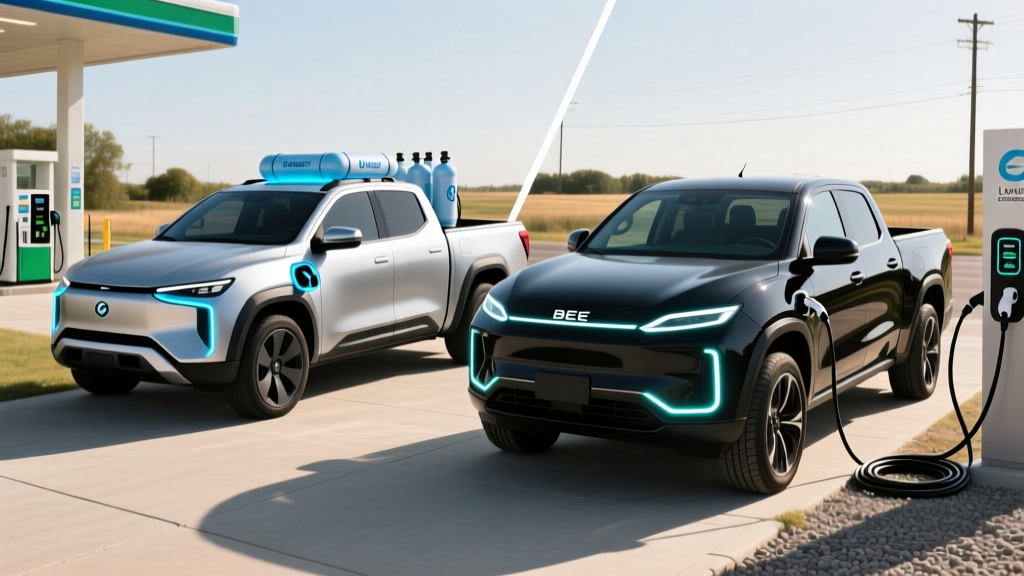
A hydrogen fuel-cell electric vehicle uses compressed hydrogen gas (stored at 700 bar / 10,000 psi) fed through a fuel-cell stack to generate electricity onboard. That electricity powers an electric motor — just like a battery-electric vehicle. The only tailpipe emission is water vapor. The key difference: instead of plugging in to recharge a battery, you fill a hydrogen tank at a station, similar to pumping gas, in roughly 3–5 minutes.
The appeal is clear for commercial trucking: fast refueling and long range without massive, heavy battery packs. For the Class 8 semi-truck segment, companies like Hyundai (XCIENT Fuel Cell), Toyota (Project Portal), and the now-restructured Nikola have pursued hydrogen. But for consumer pickups — the trucks most readers here are shopping for — the technology simply hasn't arrived at retail scale.
Here's why, and what you should buy instead.
FCEV vs BEV Pickup: The Numbers That Matter
Let's compare what hydrogen-electric technology offers versus the battery-electric pickups you can actually order today. The data below reflects current 2026 model-year specifications and real-world infrastructure counts.
| Factor | Hydrogen FCEV (Consumer Truck) | BEV Pickup (e.g., F-150 Lightning) | Diesel/Gas Pickup (Baseline) |
|---|---|---|---|
| Available models (U.S. retail) | 0 consumer pickups | 6+ models (F-150 Lightning, R1T, Silverado EV, Sierra EV, Cybertruck, Gladiator 4xe upcoming) | Dozens |
| Refueling/recharge time | ~5 minutes (where stations exist) | 10–80% in ~20–41 min (DC fast); 8–10 hrs (Level 2 home) | ~5 minutes |
| EPA range | N/A (no consumer truck) | 230–440 miles depending on model/battery | 400–700+ miles |
| Fuel/energy cost per mile | $0.25–$0.40/mi (hydrogen at $30–$36/kg) | $0.04–$0.08/mi (home charging at $0.13/kWh) | $0.15–$0.22/mi (gas/diesel at $3.50–$4.50/gal) |
| Fueling stations (U.S.) | ~60 retail (nearly all in CA) | 70,000+ public charging ports | 150,000+ gas stations |
| Home refueling possible? | No (residential H2 dispensing doesn't exist) | Yes — Level 1 (120V) or Level 2 (240V) | No |
| Federal tax credit (§30D) | Up to $7,500 (if eligible) | Up to $7,500 (if eligible, subject to MSRP/income/sourcing rules) | $0 |
| Maintenance cost (annual est.) | Moderate (fuel-cell stack, H2 tank inspections) | Low (~$0.061/mi per AAA) | Higher (oil, filters, transmission, emissions) |
Sources: fueleconomy.gov, DOE Alternative Fuels Data Center, manufacturer specifications.
The Hydrogen Cost Problem: Why FCEV Trucks Are Expensive to Run
The single biggest obstacle for any hydrogen electric truck — consumer or commercial — is the cost and availability of hydrogen fuel. In California, where virtually all U.S. retail hydrogen stations are clustered, the price of hydrogen has surged since 2022. As of late 2025 and into 2026, retail hydrogen prices hover between $30 and $36 per kilogram.
One kilogram of hydrogen contains roughly the same energy as one gallon of gasoline. A Toyota Mirai (the closest analog to a consumer FCEV) holds about 5.6 kg and achieves an EPA-estimated 402 miles of range. That's a fill-up cost of $168–$202, or roughly $0.42–$0.50 per mile at current prices.
Compare that to charging a Ford F-150 Lightning Extended Range (131 kWh usable battery) at home:
| Scenario | Energy Cost | Cost Per Mile | Annual Cost (15,000 mi) |
|---|---|---|---|
| FCEV (hydrogen at $33/kg, ~60 mi/kg) | $33.00 per "gallon equivalent" | $0.55/mi | $8,250 |
| BEV pickup (home charging, $0.13/kWh, 2.0 mi/kWh) | $0.065/mi | $0.065/mi | $975 |
| BEV pickup (public DC fast, $0.40/kWh) | $0.20/mi | $0.20/mi | $3,000 |
| Gas pickup (18 MPG combined, $3.80/gal) | $0.21/mi | $0.21/mi | $3,167 |
The math is brutal for hydrogen. Even at public DC fast-charging rates — the most expensive way to charge a BEV — battery-electric fueling costs less than half what hydrogen costs per mile. And home charging makes BEVs roughly 8x cheaper per mile to fuel than an FCEV.
Where Are the Hydrogen Stations? Infrastructure Reality
This is where the hydrogen electric truck concept collapses for most buyers. According to the U.S. Department of Energy's Alternative Fuels Data Center, there are approximately 60 retail hydrogen fueling stations in the entire United States as of early 2026. Roughly 55 of them are in California. A handful exist in Hawaii and the Northeast, with sporadic plans for expansion.
If you live in Sacramento, the Bay Area, or greater Los Angeles, you might have a station within 10–15 miles. Everywhere else in the country? You're looking at drives of 100+ miles to the nearest hydrogen pump — making a hydrogen electric truck effectively useless as a daily driver.
Contrast this with EV charging infrastructure: over 70,000 public Level 2 and DC fast-charging ports nationwide, growing rapidly thanks to NEVI (National Electric Vehicle Infrastructure) funding and private network expansion from Tesla's Supercharger network opening to NACS, Electrify America, EVgo, and ChargePoint.
Common Hydrogen Truck Misconceptions — Fact-Checked
| Myth | Fact |
|---|---|
| "Hydrogen trucks are zero-emission." | At the tailpipe, yes — only water vapor. But ~95% of U.S. hydrogen is produced from natural gas ("gray hydrogen"), which generates significant upstream CO₂. "Green hydrogen" from renewable-powered electrolysis exists but costs 2–3x more and accounts for less than 1% of production. |
| "Hydrogen refueling is just as fast as gas." | The fill itself takes 3–5 minutes, comparable to gas. But stations frequently experience downtime, pressure issues, or run out of fuel. Toyota Mirai owners in California report station outages as a recurring frustration. |
| "Hydrogen is the future of trucking." | For Class 8 long-haul semis, hydrogen has a plausible use case. For consumer pickups, battery-electric technology has already won the market — six BEV pickups are on sale, with ranges up to 440 EPA miles and rapidly improving charging speeds (up to 350 kW peak on the Silverado EV). |
| "You can't tow with an electric truck." | The F-150 Lightning tows up to 10,000 lbs; the Silverado EV up to 12,500 lbs. Towing does cut range significantly (expect 40–50% reduction), but this is true for gas trucks too — MPG drops sharply under load. |
| "Hydrogen is safer than batteries." | Both technologies meet stringent federal safety standards. Hydrogen tanks are built to withstand 10,000+ psi and undergo ballistic and crash testing. Battery packs have robust thermal management. Neither is categorically "safer" — they have different risk profiles. |
The BEV Pickups You Can Actually Buy in 2026
Since no hydrogen electric truck is available to consumers, here are the battery-electric pickups on the market with key specifications:
| Model | Battery (kWh usable) | EPA Range | Peak DC Charge (kW) | 10–80% Time | Max Tow (lbs) | Starting MSRP |
|---|---|---|---|---|---|---|
| Ford F-150 Lightning (Std Range) | 98 kWh (LFP/NMC) | ~240 mi | 120 kW | ~38 min | 7,700 | $54,995 |
| Ford F-150 Lightning (Ext Range) | 131 kWh (NMC) | ~320 mi | 150 kW | ~41 min | 10,000 | $69,995 |
| Rivian R1T (Dual-Motor, Large) | 128.9 kWh (NMC) | ~352 mi | 200 kW | ~30 min | 11,000 | $69,900 |
| Chevrolet Silverado EV (4WT) | 200 kWh (NMC) | ~440 mi | 350 kW | ~20 min | 12,500 | $74,800 |
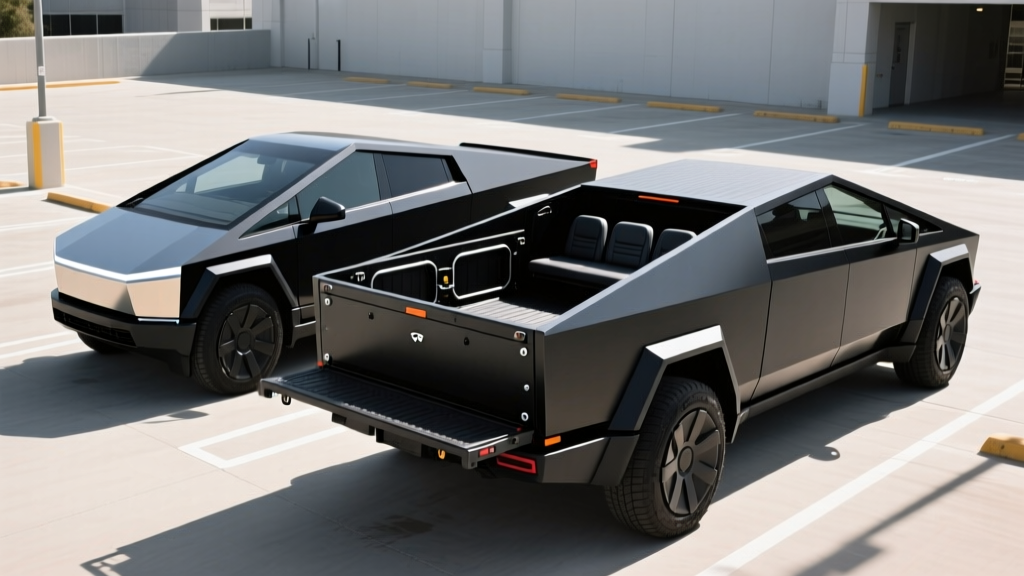
| Tesla Cybertruck (AWD) | 123 kWh (NMC) | ~340 mi | 250 kW | ~28 min | 11,000 | $79,990 |
| GMC Sierra EV (Denali Edition 1) | 200 kWh (NMC) | ~440 mi | 350 kW | ~20 min | 12,500 | $99,495 |
Note: EPA ranges are estimates based on manufacturer filings and fueleconomy.gov data. Real-world range will be 15–30% lower at sustained highway speeds (70+ mph), and cold weather (below 32°F) can reduce range by 20–40%. DC fast-charge times assume optimal battery preconditioning and non-congested chargers.
Real-World Ownership: What a First-Time EV Truck Buyer Must Know
Home Charging Is Non-Negotiable for Most Owners
Over 80% of EV charging happens at home. If you have a garage or driveway where you can install a Level 2 (240V) charger, a BEV pickup becomes extraordinarily convenient — you wake up every morning with a "full tank." A typical Level 2 installation (40-amp circuit, hardwired) costs $800–$2,500 including the charger unit ($300–$700), electrician labor, and permits. If your electrical panel needs an upgrade from 100A to 200A service, add $1,500–$3,500.
Without home charging, BEV ownership is still viable but requires discipline: planning around public chargers, relying on workplace charging, or using DC fast-charging networks 2–3 times per week. This is where hydrogen's 5-minute fill sounds appealing — but only if a station is nearby and operational.
Cold-Weather Range Loss Is Real
Battery-electric trucks lose range in freezing temperatures — typically 20–30% at 20°F and up to 40% at 0°F, based on Recurrent Auto's fleet data. An F-150 Lightning Extended Range rated at 320 EPA miles might deliver 200–240 miles in a Minnesota January. Hydrogen FCEVs also experience cold-weather efficiency loss, though generally less severe (roughly 10–15%) since the fuel cell generates waste heat that can warm the cabin.
Federal Tax Credit Eligibility
The IRS §30D Clean Vehicle Credit offers up to $7,500 for qualifying new EVs and FCEVs. However, eligibility depends on:
- MSRP caps: Vans, SUVs, and pickups must be under $80,000 MSRP.
- Buyer income limits: AGI must not exceed $150,000 (single), $225,000 (head of household), or $300,000 (joint).
- Battery sourcing: Critical minerals and battery components must meet escalating domestic/free-trade-partner sourcing thresholds.
- Point-of-sale transfer: As of 2024+, you can transfer the credit to the dealer for an immediate price reduction at purchase.
Always verify current-year eligibility on the IRS website and consult a tax professional — rules change and vary by model and build date.
Decision Framework: Which Electric Truck Is Right for You?
If X, Then Y — Your Electric Truck Decision
- If you need a truck NOW and want zero tailpipe emissions: Buy a BEV pickup (F-150 Lightning, R1T, Silverado EV). They're available, proven, and supported by a growing charging network.
- If you tow heavy loads long distances frequently: Consider a PHEV or diesel for now. BEV towing range drops to 150–200 miles under heavy load, and DC fast-charging stops add significant trip time. The upcoming Ram 1500 REV and Ramcharger (EREV) may bridge this gap.
- If you live in California and are intrigued by hydrogen: The Toyota Mirai sedan is your only consumer FCEV option — but it's a sedan, not a truck. Wait for Hyundai or Toyota to announce a consumer FCEV pickup, which is not expected before 2028–2030.
- If you can't charge at home: A BEV is still feasible if you have reliable workplace or public charging nearby. But honestly evaluate your weekly mileage and local charger density. A hybrid (HEV or PHEV) truck like the Ford Maverick Hybrid may be a more practical bridge.
- If you want the lowest cost per mile: BEV with home Level 2 charging wins decisively — $0.04–$0.08/mi versus $0.21/mi for gas and $0.50+/mi for hydrogen.
- If you're a commercial fleet operator running long-haul routes: Hydrogen FCEV semis (Hyundai XCIENT) deserve evaluation, especially in California with corridor-specific hydrogen infrastructure. But for last-mile and regional delivery, BEV vans and box trucks are more mature.
FAQ: Hydrogen Electric Truck Questions Answered
Will there ever be a consumer hydrogen pickup truck?
It's possible but not imminent. Toyota and Hyundai have demonstrated FCEV pickup concepts, and both companies continue investing in hydrogen for commercial applications. However, the rapid advancement of BEV truck technology — 440-mile ranges, 350 kW charging, and falling battery costs — has largely eliminated the business case for a consumer hydrogen pickup in the near term. If one arrives, 2029–2031 is a realistic earliest window.
Is hydrogen more dangerous than a battery-electric truck?
Neither technology is categorically more dangerous. Hydrogen is highly flammable but disperses rapidly in open air (it's 14x lighter than air). FCEV tanks are tested to withstand extreme impacts, fire, and pressure. Battery packs carry thermal runaway risk but have sophisticated cooling and monitoring systems. Both meet FMVSS safety standards. Real-world incident data for both is limited due to low volumes.
Can I install a hydrogen fueling station at home?
No. Residential hydrogen generation and dispensing equipment does not exist at consumer scale or price points. This is a fundamental disadvantage versus BEVs, where a $500–$700 Level 2 home charger provides the equivalent of a personal gas station.
What about hydrogen for heavy-duty and commercial trucking?
This is hydrogen's strongest use case. Long-haul Class 8 trucks need 500+ mile range and fast refueling to meet driver hours-of-service regulations. Battery packs large enough for that range add thousands of pounds of weight, reducing payload. Hydrogen FCEV semis from Hyundai (XCIENT) are operating in fleets in California, and companies like Daimler Truck are developing hydrogen platforms. But this is commercial — not consumer — territory.
What's the cheapest electric truck I can buy today?
The Ford F-150 Lightning standard-range starts at approximately $54,995 MSRP. After a potential $7,500 federal tax credit (if eligible), the effective price drops to around $47,495 — competitive with well-equipped gas F-150s. The Chevrolet Silverado EV Work Truck (4WT) is also positioned for fleet and value-oriented buyers, though retail trims start higher. Check IRS §30D eligibility before assuming credit availability.
How does regenerative braking work in an electric truck?
When you lift off the accelerator or brake, the electric motor reverses direction and acts as a generator, converting kinetic energy back into electricity to recharge the battery. In a heavy pickup like the F-150 Lightning (6,500+ lbs), regen braking is substantial — enough to enable one-pedal driving in many scenarios and significantly reduce wear on friction brakes. This is one reason EV maintenance costs are so much lower: brake pads can last 100,000+ miles.