Hybrid vs Electric Car Comparison: Which Powertrain Is Right for You?
Choosing between a hybrid and a fully electric car is one of the most consequential decisions modern car buyers face. Both powertrains promise lower fuel costs and reduced emissions, but they deliver on those promises in fundamentally different ways. This comprehensive hybrid vs electric car comparison breaks down every critical factor — from range and pricing to charging speed and long-term ownership costs — so you can drive away confident in your choice.
Whether you are a daily commuter, a road-trip enthusiast, or someone simply looking to reduce your carbon footprint, understanding the real-world differences between hybrids and battery-electric vehicles (BEVs) is essential. Below, we put these two powertrain technologies head-to-head across six major categories, backed by EPA ratings and independent test data.
Before diving into the details, be sure to explore our best electric vehicles rankings and best hybrid vehicles rankings for our top picks in each category.
Overview: How Hybrids & Electric Cars Differ
A hybrid vehicle pairs a conventional internal combustion engine with a small electric motor and battery pack. The electric system assists during acceleration, captures energy during braking (regenerative braking), and in some cases allows short bursts of electric-only driving. Hybrids never need to be plugged in — the gasoline engine and regenerative braking keep the battery charged. Popular examples include the Toyota Prius, Honda Accord Hybrid, and Hyundai Sonata Hybrid.
A plug-in hybrid (PHEV) bridges the gap between traditional hybrids and full electric vehicles. PHEVs feature a larger battery that can be charged from an external source, typically offering 20–50 miles of electric-only range before the gasoline engine kicks in. Models like the Toyota RAV4 Prime and Jeep Wrangler 4xe fall into this category.
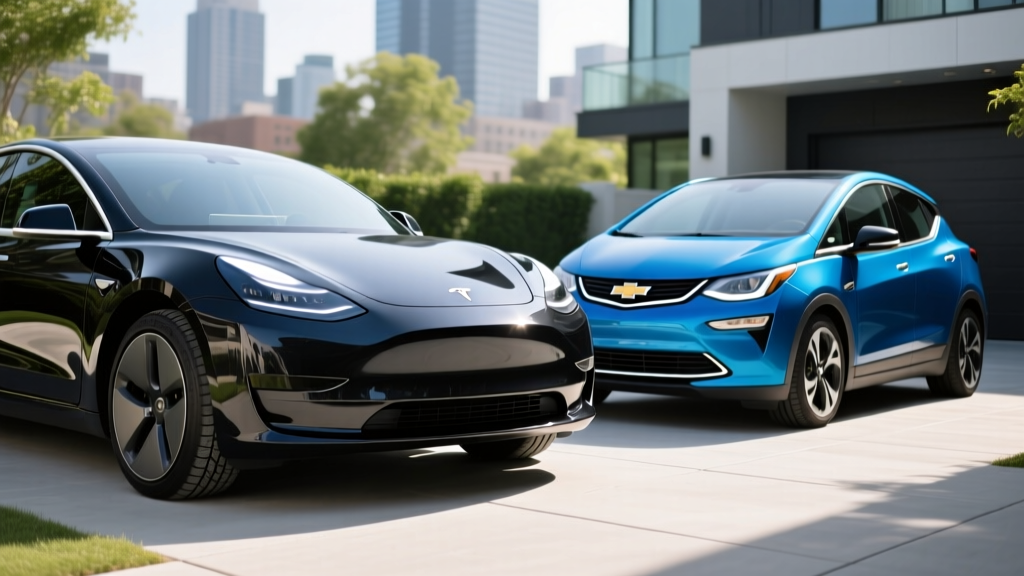
A fully electric vehicle (BEV) relies exclusively on a large battery pack and one or more electric motors. There is no gasoline engine, no tailpipe, and no oil changes. BEVs must be plugged in to recharge, and their range varies widely — from roughly 150 miles on budget models to over 400 miles on premium offerings. The Tesla Model 3, Hyundai Ioniq 5, Ford Mustang Mach-E, and Chevrolet Equinox EV are among the most popular choices on the market.
Each powertrain serves a distinct purpose. Hybrids maximize convenience and eliminate range anxiety. Plug-in hybrids offer a taste of electric driving with a gasoline safety net. Full EVs deliver the lowest running costs and the smoothest driving experience — provided you have reliable access to charging.
Side-by-Side Spec Comparison
The table below provides a general comparison across typical hybrid, plug-in hybrid, and fully electric vehicles. Individual models will vary, so always consult our individual vehicle reviews for model-specific data.
| Specification | Hybrid (HEV) | Plug-In Hybrid (PHEV) | Battery Electric (BEV) |
|---|---|---|---|
| Powertrain | Gas engine + small electric motor | Gas engine + larger electric motor & battery | Electric motor(s) + large battery pack |
| Electric-Only Range | 1–2 miles (low-speed assist) | 20–50 miles | 150–400+ miles |
| Total Range | 500–650+ miles | 400–600+ miles (combined EV + gas) | 150–400+ miles |
| Fuel Economy (EPA) | 40–60 MPG combined | 70–100 MPGe (electric), 30–40 MPG (gas) | 100–140 MPGe |
| Starting Price (Typical) | $28,000–$40,000 | $35,000–$55,000 | $30,000–$70,000+ |
| Charging Required | No (self-charging) | Optional but recommended | Yes (mandatory) |
| Home Charging Speed | N/A | 2–5 hours (Level 2) | 6–12 hours (Level 2) |
| DC Fast Charging | N/A | Limited or unavailable | 15–45 min (10–80%) |
| 0–60 MPH (Typical) | 7.0–10.0 seconds | 5.5–8.0 seconds | 3.0–7.5 seconds |
| Maintenance Needs | Standard (oil changes, filters) | Standard (reduced engine wear) | Minimal (no oil, fewer moving parts) |
| Federal Tax Credit | Generally not eligible | Up to $7,500 (varies) | Up to $7,500 (varies) |
Range & Driving Distance
Range is often the single biggest concern for buyers comparing hybrids and electric cars. If you regularly drive long distances or live in a rural area with sparse charging infrastructure, this category deserves your closest attention.
Hybrid Range
Hybrids are the undisputed champions of total driving range. Because they combine a gasoline engine with electric assistance, many hybrids can travel 500 to 650 miles on a single tank of gas. The Toyota Prius, for instance, achieves an EPA-estimated 57 MPG combined, which translates to roughly 580 miles of range from its 11.3-gallon fuel tank. You refuel at any gas station in under five minutes and continue on your way.
There is zero range anxiety with a hybrid. You never need to plan your route around charging stations, and cold weather has a negligible impact on total range compared to electric vehicles.
Plug-In Hybrid Range
PHEVs offer the best of both worlds — typically 20 to 50 miles of electric-only driving for daily commutes, plus a full gasoline tank for longer trips. The Toyota RAV4 Prime delivers an EPA-rated 42 miles of electric range and a combined total range exceeding 600 miles. This makes PHEVs an excellent choice for drivers who want electric commuting but occasional long-distance flexibility.
Electric Vehicle Range
Modern EVs have made tremendous strides in range. The EPA rates vehicles like the Tesla Model 3 Long Range at over 340 miles per charge, while the Hyundai Ioniq 6 achieves roughly 360 miles. However, real-world range can vary significantly based on driving style, terrain, temperature, and highway speeds. Independent testing by outlets such as Edmunds has shown that some EVs fall 10–20% short of their EPA estimates in cold-weather highway driving.
For most daily commutes — which the U.S. Census Bureau reports average roughly 26 miles one way — even a modest-range EV is more than sufficient. The challenge arises on road trips, where careful route planning around DC fast chargers becomes necessary.
Winner: Hybrids for total range and convenience. EVs for daily commuting efficiency. For a deeper dive, see our EV range comparison guide.
Price & Total Cost of Ownership
Upfront price tells only part of the story. To truly compare hybrids and electric cars, you must consider fuel savings, maintenance costs, tax incentives, depreciation, and insurance over the life of the vehicle.
Upfront Purchase Price
Hybrids typically carry a modest premium over their gasoline-only counterparts — often $1,500 to $4,000 more. The Honda Accord Hybrid, for example, starts only slightly above the gasoline Accord, making the upgrade easy to justify.
Fully electric vehicles tend to have higher sticker prices, largely due to the cost of their large battery packs. However, prices have been falling steadily as battery technology improves and production scales up. Budget-friendly EVs like the Chevrolet Equinox EV and Nissan LEAF now start in the low $30,000 range, narrowing the gap with hybrids.
Fuel & Energy Costs
This is where EVs shine. Electricity is significantly cheaper per mile than gasoline in most regions. According to EPA data, charging an EV at home at an average electricity rate of $0.16 per kWh translates to a fuel cost of roughly $0.04–$0.06 per mile. A hybrid achieving 50 MPG at $3.50 per gallon costs about $0.07 per mile. While the difference seems small per mile, it adds up to hundreds of dollars in annual savings for higher-mileage drivers.
PHEVs offer a middle ground: if you charge regularly and stay within the electric range, your fuel costs can approach those of a full EV. If you rarely charge, you will essentially be driving a slightly heavier (and slightly less efficient) conventional hybrid.
Maintenance Costs
Electric vehicles have far fewer moving parts than any vehicle with an internal combustion engine. There are no oil changes, no spark plugs, no timing belts, and no exhaust systems to replace. Brake wear is also significantly reduced thanks to regenerative braking. Studies by Consumer Reports and the U.S. Department of Energy estimate that EV maintenance costs are roughly 40–50% lower than those of gasoline vehicles over the life of the car.
Hybrids still require standard engine maintenance, though the electric assist system reduces wear on the engine and brakes somewhat. Overall maintenance costs for hybrids fall between those of conventional gasoline cars and full EVs.
Tax Credits & Incentives
Federal, state, and local incentives can dramatically alter the cost equation. Qualifying new EVs may be eligible for up to $7,500 in federal tax credits, depending on battery sourcing requirements and manufacturer caps. Many states and utilities offer additional rebates ranging from $1,000 to $5,000. Some PHEVs also qualify for partial credits. Traditional hybrids (HEVs) generally do not qualify for federal tax credits.
Check our EV tax credits and incentives guide for the latest eligibility details.
Depreciation
Historically, EVs depreciated faster than hybrids due to concerns about battery longevity and rapid technology obsolescence. However, as the EV market matures and battery warranties prove reliable, depreciation rates are converging. Hybrids, particularly from Toyota and Honda, have historically held their value exceptionally well. Always check current resale value data before making a final decision.
Winner: EVs for lowest long-term running costs. Hybrids for lowest upfront cost and strongest resale value. The total cost of ownership gap continues to narrow each year.
Charging Speed & Infrastructure
Charging is the most significant lifestyle adjustment when switching from a hybrid to a fully electric vehicle. Understanding the realities of charging — at home, at work, and on the road — is crucial to determining whether an EV fits your routine.
Home Charging
For EV owners, home charging is the backbone of the ownership experience. A standard 120-volt outlet (Level 1) adds roughly 3–5 miles of range per hour of charging — adequate for low-mileage drivers but painfully slow for others. Most EV owners install a 240-volt Level 2 charger, which can fully recharge a typical EV battery in 6 to 12 hours, depending on battery size and charger amperage.
Hybrids require no charging infrastructure whatsoever. Plug-in hybrids benefit from Level 2 home charging but can operate perfectly well without it — you simply lose the electric-only range advantage.
Public Charging & DC Fast Charging
The public charging network has expanded rapidly, with networks like Electrify America, EVgo, and Tesla's Supercharger network offering thousands of DC fast-charging stations nationwide. A modern EV with 800-volt architecture, such as the Hyundai Ioniq 5 or Kia EV6, can charge from 10% to 80% in approximately 18 minutes at a 350 kW charger. Most other EVs achieve 10–80% charges in 25 to 45 minutes.
However, charging infrastructure remains uneven. Urban and suburban areas along major highways tend to be well-served, while rural regions can present significant gaps. Apps like PlugShare and ChargePoint help EV drivers plan routes around available chargers.
For a detailed breakdown of what to expect, read our complete EV charging guide.
The Convenience Factor
Hybrids win this category by default — you simply fill up at a gas station in minutes, anywhere in the country. EVs require a shift in habits: plugging in at home overnight, planning road trips around charging stops, and occasionally dealing with out-of-service chargers. For homeowners with a garage and Level 2 charger, daily EV charging is arguably more convenient than visiting a gas station. For apartment dwellers or street-parkers, the calculus changes dramatically.
Winner: Hybrids for hassle-free refueling. EVs for those with reliable home charging access.
Performance & Driving Experience
Electric vehicles have fundamentally changed expectations around acceleration, smoothness, and driving dynamics. Hybrids, while less thrilling, have their own set of advantages.
Acceleration & Power Delivery
Electric motors deliver instant torque from zero RPM, which gives EVs a decisive advantage in off-the-line acceleration. Even mainstream EVs like the Volkswagen ID.4 and Ford Mustang Mach-E deliver 0–60 MPH times in the 5–6 second range, while performance variants from Tesla, Porsche, and Hyundai can dip below 3 seconds.
Hybrids use their electric motors primarily to supplement the gasoline engine, smoothing out acceleration and filling in torque gaps at low RPMs. The result is adequate but rarely exciting performance. Most hybrids reach 60 MPH in 7 to 10 seconds. Performance-oriented hybrids like the Toyota Prius Prime have narrowed this gap somewhat, but they still cannot match the visceral punch of a full EV.
Ride Quality & Noise
EVs are remarkably quiet. Without a combustion engine, the cabin is free from engine drone, vibration, and exhaust noise. At highway speeds, wind and tire noise become the dominant sounds — and many EVs are engineered with extensive sound deadening to minimize both.
Hybrids operate in electric-only mode at low speeds, providing a taste of EV silence. However, the gasoline engine engages under harder acceleration and at higher speeds, introducing familiar engine noise. The transition between electric and gas power is seamless in well-engineered hybrids but can feel less refined in others.
Handling & Weight
EV batteries are heavy and mounted low in the chassis, giving electric vehicles a low center of gravity that enhances cornering stability. However, the added weight — often 1,000 to 2,000 pounds more than a comparable gasoline car — can be felt during braking and direction changes. Tire wear is also accelerated on heavier EVs.
Hybrids carry smaller batteries and are generally lighter than EVs, which can translate to more agile handling in some models. However, the added weight of the hybrid system compared to a pure gasoline car still slightly affects dynamics.
Winner: EVs for acceleration, smoothness, and refinement. Hybrids for lighter weight and predictable dynamics. Explore our best performance EVs for the fastest options available.
Interior Space, Cargo & Practicality
Interior packaging varies significantly between hybrid and electric platforms, largely because of where and how the battery is stored.
Cabin Space
Electric vehicles built on dedicated EV platforms (such as Hyundai's E-GMP or Volkswagen's MEB) benefit from a flat floor and the absence of a transmission tunnel. This allows designers to maximize interior volume, often creating cabin space that rivals or exceeds vehicles in a larger class. The Hyundai Ioniq 5, for example, offers midsize-SUV interior room despite its compact crossover footprint.
Hybrids, which are typically adapted from existing gasoline platforms, may sacrifice some trunk space to accommodate the battery pack. In some models, the battery sits behind the rear seats, reducing cargo capacity or eliminating the option for a spare tire. Newer hybrid designs have mitigated this issue by relocating batteries under the rear seat or floor, but it remains a consideration for some models.
Cargo Capacity
Many EVs offer a front trunk (frunk) in addition to the rear cargo area, since there is no engine occupying the front compartment. This extra storage space — ranging from a small compartment for charging cables to a sizable area that can fit a carry-on bag — is a practical advantage unique to electric vehicles.
SUVs and crossovers are available in both hybrid and electric form factors. Compare specific models in our best electric SUVs and best hybrid SUVs rankings to see how cargo volumes stack up.
Winner: EVs on dedicated platforms for cabin space and frunk storage. Hybrids for models where battery packaging has been well-integrated without sacrificing cargo room.
Technology, Safety & Warranty
Both hybrids and EVs are packed with modern technology, but EVs tend to push the envelope further in terms of software, connectivity, and over-the-air updates.
Infotainment & Software
EVs from Tesla, Rivian, Hyundai, and others treat software as a core part of the ownership experience. Over-the-air (OTA) updates can add new features, improve range estimates, enhance autopilot capabilities, and even adjust suspension settings — all without a visit to the dealership. Large touchscreen interfaces, smartphone-style app ecosystems, and integrated navigation with real-time charger routing have become standard in the EV segment.
Hybrids increasingly feature modern infotainment systems, digital instrument clusters, and smartphone integration (Apple CarPlay and Android Auto). However, they rarely receive the same level of OTA enhancement as full EVs, and their software ecosystems tend to be more traditional.
Driver Assistance & Safety
Advanced driver assistance systems (ADAS) — including adaptive cruise control, lane-keeping assist, automatic emergency braking, and blind-spot monitoring — are widely available across both hybrid and electric vehicles. The Insurance Institute for Highway Safety (IIHS) and the National Highway Traffic Safety Administration (NHTSA) rate vehicles from both categories highly for safety.
Some EVs offer more advanced semi-autonomous driving features. Tesla's Autopilot and Full Self-Driving capability, General Motors' Super Cruise, and Ford's BlueCruise represent the cutting edge of hands-free highway driving — features that are currently exclusive to electric platforms.
Warranty Coverage
EV battery warranties are a major consideration. Federal regulations require that EV batteries be covered for at least 8 years or 100,000 miles (10 years/150,000 miles in states that follow California Air Resources Board standards). Many manufacturers exceed these minimums. Hyundai and Kia, for example, offer 10-year/100,000-mile powertrain warranties on both their hybrid and electric models.
Hybrid battery warranties are similarly robust, typically covering 8–10 years and 100,000–150,000 miles. Real-world data shows that modern hybrid and EV batteries rarely need replacement within the warranty period, and many last well beyond 200,000 miles with minimal degradation.
Winner: EVs for cutting-edge technology and software innovation. Hybrids and EVs are closely matched on safety and warranty coverage.
The Verdict: Which Should You Buy?
There is no universally "better" choice between a hybrid and an electric car — the right answer depends entirely on your lifestyle, driving habits, and priorities. Here is our recommendation based on buyer type:
Choose a Hybrid If:
- You frequently drive long distances or road-trip often and do not want to plan around charging stops.
- You live in an apartment or lack access to home or workplace charging.
- You want the lowest upfront purchase price and do not want to invest in home charging equipment.
- You live in a rural area with limited public charging infrastructure.
- You want a proven, low-risk technology with excellent resale value.
Browse our best hybrid vehicles to find the top-rated options.
Choose a Plug-In Hybrid If:
- Your daily commute falls within 20–50 miles and you can charge at home or work.
- You want electric driving for errands and commuting but need gasoline flexibility for weekend trips.
- You are not yet ready to commit to a fully electric vehicle but want to reduce your fuel consumption and emissions.
Choose a Fully Electric Vehicle If:
- You have reliable access to home charging (garage or dedicated parking spot with a 240V outlet).
- Your daily driving is under 200 miles and you are willing to plan charging stops on road trips.
- You want the lowest possible fuel and maintenance costs over the life of the vehicle.
- You prioritize instant torque, a quiet cabin, and cutting-edge technology.
- You want to minimize your environmental impact with zero tailpipe emissions.
Explore our best electric vehicles to find the EV that best fits your needs and budget.
Ultimately, the hybrid vs electric car decision is deeply personal. Test-driving vehicles from both categories, evaluating your charging situation honestly, and running the numbers on total cost of ownership will lead you to the right answer. Whichever path you choose, you will be driving a more efficient, more modern vehicle than a conventional gasoline car — and that is a win no matter how you measure it.
Frequently Asked Questions
Are hybrids cheaper to own than electric cars?
It depends on your driving habits and charging access. Hybrids generally have a lower purchase price and do not require home charging equipment, making them cheaper upfront. However, EVs typically cost less to fuel and maintain over time. When federal and state tax incentives are factored in, the total cost of ownership for an EV can equal or undercut a hybrid over a 5–10 year ownership period. High-mileage drivers who charge at home tend to see the greatest savings with an EV.
How long do hybrid and EV batteries last?
Modern hybrid and EV batteries are designed to last the life of the vehicle. Most manufacturers warranty their batteries for 8–10 years and 100,000–150,000 miles. Real-world data from Consumer Reports and fleet operators shows that many EV batteries retain 85–95% of their original capacity after 150,000 miles. Hybrid batteries, being smaller and subjected to less demanding charge cycles, often last even longer. Complete battery failure within the warranty period is rare.
Can I switch from a hybrid to an electric car later?
Absolutely. Many drivers use a hybrid or plug-in hybrid as a stepping stone toward full electric ownership. Starting with a hybrid lets you experience electric-assisted driving, regenerative braking, and improved efficiency without the lifestyle adjustment of charging. When your circumstances change — perhaps you buy a home with a garage, or the charging network in your area improves — transitioning to a full EV becomes much easier. Our EV buying guide can help you navigate the transition when you are ready.
Is a plug-in hybrid the best of both worlds?
For many drivers, a PHEV represents an excellent compromise. You get 20–50 miles of electric range for daily commuting — enough to cover most round-trip commutes without using a drop of gasoline — plus a full gasoline tank for road trips and emergencies. The trade-off is that PHEVs carry both an engine and a battery, making them heavier and more mechanically complex than either a pure hybrid or a pure EV. They also tend to be more expensive upfront than conventional hybrids. If you can charge at home and your daily driving stays within the electric range, a PHEV can deliver an EV-like experience for most trips while eliminating range anxiety entirely.