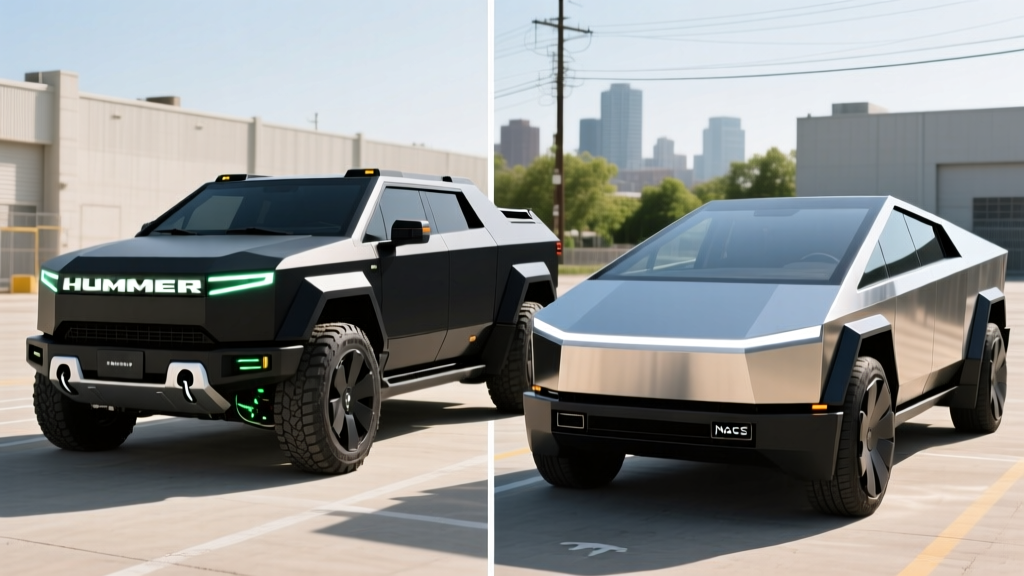
Two Electric Giants, Two Very Different Philosophies
The GMC Hummer EV and Tesla Cybertruck represent the extreme ends of the electric pickup truck market in 2026. One is a 9,000-pound luxury land yacht built on GM's Ultium platform with trick four-wheel steering and extractable roof panels. The other is a stainless-steel wedge that prioritizes efficiency, software integration, and access to the most reliable DC fast-charging network in North America. Neither is a conventional truck, and neither appeals to the same buyer — which makes this comparison less about declaring a universal winner and more about matching engineering philosophy to your actual use case.
We've driven both, charged both on public and home infrastructure, and pored over EPA data at fueleconomy.gov to build the most spec-accurate, real-world-honest comparison available. Here's what the numbers actually say.
Side-by-Side Spec Comparison
| Specification | 2025 GMC Hummer EV Pickup (3X) | 2025 Tesla Cybertruck (AWD) |
|---|---|---|
| EPA Range | 381 miles | 340 miles |
| Battery (Usable) | ~212 kWh, NMC (Ultium) | ~123 kWh, NMC (4680 cells) |
| Efficiency | 47 MPGe (2.1 kWh/mi) | 70 MPGe (1.4 kWh/mi) |
| Peak DC Fast Charge | ~350 kW (800V capable) | ~250 kW (V3 Supercharger) |
| 10–80% DC Charge Time | ~34 min | ~30 min |
| Level 2 AC Charge Rate | 11.5 kW | 11.5 kW |
| 0–60 mph | 3.0 sec (Watts to Freedom mode) | 4.1 sec (AWD) / 2.6 sec (Cyberbeast) |
| Horsepower | 830 hp (3-motor) | 600 hp (AWD) / 845 hp (Cyberbeast) |
| Towing Capacity | 11,500 lbs | 11,000 lbs |
| Payload | 1,300 lbs | 2,500 lbs |
| Cargo Bed Length | 5 ft | 6 ft |
| Cargo Volume (bed + frunk) | Bed + 8.9 cu ft eTrunk | Bed + 7.0 cu ft frunk |
| Base MSRP | ~$106,395 (3X Pickup) | ~$79,990 (AWD) |
| Battery/Powertrain Warranty | 8 yr / 100,000 mi | 8 yr / 120,000 mi |
Sources: fueleconomy.gov, GMC official specs, Tesla Cybertruck page. Specs reflect latest available model-year data. Confirm with dealer before purchase.
Range and Efficiency: The Physics of 9,000 Pounds
Hummer EV 3X: EPA 381 mi — expect ~300–320 mi in mixed highway driving at 70 mph, dropping to ~250–270 mi in cold weather (below 32°F) or when towing even a modest 5,000-lb trailer.
Cybertruck AWD: EPA 340 mi — expect ~275–295 mi highway, ~230–250 mi in cold conditions. The tonneau cover helps highway aero slightly, but the angular shape still creates more drag than a sleek sedan.
The Hummer EV carries a massive ~212 kWh usable battery — the largest pack ever put in a production passenger vehicle. That brute-force approach gives it a higher EPA range number, but the efficiency penalty is severe: 47 MPGe means it burns through roughly 2.1 kWh for every mile driven. The Cybertruck, by contrast, achieves 70 MPGe on a pack nearly half the size. That efficiency gap matters enormously for long-term electricity costs and charging frequency on road trips.
On a 500-mile road trip, the Hummer EV will need at least two DC fast-charging stops while the Cybertruck might squeeze by with one longer stop plus a brief top-off — but only if you're driving conservatively. Push either truck to 80+ mph and both see range crater.
Charging Speed and Network Access
Here's where the comparison gets nuanced. The Hummer EV supports peak charging rates around 350 kW on compatible 800V DC fast chargers, which sounds impressive. However, its enormous battery means even at peak rate, a 10–80% session takes roughly 34 minutes because there's simply more energy to push into the pack. The charge curve also tapers significantly above 80% SoC — expect 80–100% to add another 25+ minutes.
The Cybertruck peaks around 250 kW at Tesla V3 Superchargers and completes a 10–80% session in approximately 30 minutes. The smaller battery fills proportionally faster even at a lower peak rate.
The network advantage is decisive. Tesla's Supercharger network remains the most reliable, best-maintained DC fast-charging infrastructure in North America. With over 25,000 Supercharger stalls across the US and near-universal uptime, Cybertruck owners face far fewer broken-stall frustrations than Hummer EV owners relying on Electrify America, EVgo, or Ionity. The Hummer EV uses the CCS1 connector (with NACS adapters increasingly available), but third-party network reliability remains a real-world pain point as of 2026.
Performance and Driving Dynamics
Both trucks are absurdly quick, but they deliver speed differently. The Hummer EV 3X hits 0–60 mph in 3.0 seconds using its "Watts to Freedom" launch mode — a theatrical experience complete with haptic seat vibrations, sound effects, and a countdown animation. It's a party trick, but one that never quite gets old. The three-motor setup (one front, two rear) delivers 830 hp and enables torque vectoring that makes the truck feel surprisingly agile for its 9,000-lb curb weight.
The Cybertruck AWD manages 4.1 seconds to 60 mph, while the Cyberbeast trim (tri-motor, 845 hp) drops that to 2.6 seconds — making it the quickest production pickup ever built. But the Cybertruck's real party trick is CrabWalk — wait, no, that's the Hummer EV. The Hummer's four-wheel steering system allows diagonal movement at low speeds, a genuine off-road and tight-parking advantage that the Cybertruck lacks.
The Cybertruck counters with a steer-by-wire system that eliminates the mechanical connection between steering wheel and wheels. It's precise and quick, but some drivers find the lack of road feedback disconcerting at highway speeds. Rear-wheel steering on the Cybertruck (up to 10 degrees) does give it a surprisingly tight turning radius for a full-size truck.
Pricing, Tax Credits, and Total Cost of Ownership
- MSRP Cap: Pickup trucks must have an MSRP at or below $80,000 to qualify for the up-to-$7,500 federal credit (source: IRS §30D).
- Hummer EV 3X (~$106,395): Exceeds the $80,000 MSRP cap. Does NOT qualify for the federal tax credit at any trim currently offered.
- Cybertruck AWD (~$79,990): Sits right at the cap line. May qualify for partial or full $7,500 credit depending on battery-sourcing and critical-mineral requirements. Verify current eligibility on fueleconomy.gov before purchase, as sourcing rules tighten annually.
- Income Caps: AGI must not exceed $150K single / $300K joint filers.
- Point-of-Sale Transfer: Eligible buyers can apply the credit as an instant rebate at the dealer, reducing out-of-pocket cost.
Tax rules change frequently. Consult a tax professional and verify eligibility at the time of purchase.
| Cost Factor | Hummer EV 3X | Cybertruck AWD |
|---|---|---|
| Base MSRP | $106,395 | $79,990 |
| Est. Federal Tax Credit | $0 (over MSRP cap) | Up to $7,500 (verify sourcing eligibility) |
| Effective Starting Price | ~$106,395 | ~$72,490 (if full credit applies) |
| Annual Electricity Cost (12K mi/yr, $0.16/kWh) | ~$4,032 | ~$2,688 |
| Estimated Annual Insurance | $3,200–$4,500 | $2,800–$3,800 |
| 5-Year Electricity Cost | ~$20,160 | ~$13,440 |
| 5-Year Estimated Insurance | ~$19,250 | ~$16,500 |
| 5-Year Total Operating Cost | ~$39,410 | ~$29,940 |
The price gap is staggering. Even before tax credits, the Cybertruck AWD undercuts the Hummer EV 3X by over $26,000. After the potential $7,500 credit, the gap widens to roughly $34,000. Over five years of ownership, the Hummer EV's poor efficiency adds another ~$6,700 in electricity costs alone. Factor in higher insurance premiums (the Hummer's MSRP drives up comprehensive/collision coverage), and the five-year total cost of ownership difference approaches $43,000.
Tech, Interior, and Daily Usability
Hummer EV Interior: Traditional luxury truck layout with a 13.4-inch infotainment screen, 12.3-inch driver display, physical buttons for climate and off-road modes, and premium materials throughout. The removable roof panels (Infinity Roof) store in the frunk and give open-air driving capability. The UltraVision camera system with underbody cameras is genuinely useful for off-roading. Super Cruise — GM's hands-free Level 2 highway driving system — works on over 750,000 miles of mapped roads and is one of the best Level 2 systems available, though it remains a driver-assist feature requiring attention.
Cybertruck Interior: Minimalist to the extreme. A single 18.5-inch center touchscreen controls everything — no instrument cluster, no physical buttons, no traditional stalks (turn signals are on the steering wheel rim). The stainless-steel dash and sparse design won't appeal to luxury-truck buyers. Tesla's Autopilot and available FSD (Supervised) offer broad coverage but remain SAE Level 2 — the driver must remain engaged at all times. Build quality has improved since the Cybertruck's 2023 launch, but panel-gap variability and early-production issues are worth inspecting on any used example.
Category Verdicts
🏆 EPA Range
Winner: Hummer EV
381 vs 340 mi EPA. The brute-force battery approach wins on paper, though efficiency is abysmal.
🏆 Efficiency
Winner: Cybertruck
70 MPGe vs 47 MPGe. Costs ~$1,344 less per year to charge. Smaller battery, smarter packaging.
🏆 Charging Network
Winner: Cybertruck
Native Supercharger access remains the gold standard for reliability and coverage in 2026.
🏆 Peak Charging Speed
Winner: Hummer EV
~350 kW peak on 800V chargers vs Cybertruck's ~250 kW. But larger battery offsets the advantage in actual session time.
🏆 Acceleration (Base Trims)
Winner: Hummer EV
3.0 sec 0–60 (3X) vs 4.1 sec (Cybertruck AWD). Cyberbeast flips this at 2.6 sec — but at a much higher price.
🏆 Value / Price
Winner: Cybertruck
~$26K–$34K cheaper depending on credit eligibility. Far lower operating costs. Not even close.
🏆 Off-Road Capability
Winner: Hummer EV
CrabWalk, 4-wheel steer, Extract Mode (adaptive air suspension lifts 15.9 in), underbody armor, UltraVision cameras. Built for trails.
🏆 Payload & Utility
Winner: Cybertruck
2,500 lbs payload vs 1,300 lbs. 6-ft bed vs 5-ft. The Cybertruck is the more practical work truck.
🏆 Interior Comfort
Winner: Hummer EV
Conventional luxury layout, physical controls, premium materials, quiet cabin. The Cybertruck's spartan interior is polarizing.
🏆 Software / OTA Updates
Winner: Cybertruck
Tesla's software ecosystem, OTA update cadence, and mobile app remain industry-leading. GM's Ultifi platform is improving but trails.
Decision Framework: Which Should You Buy?
Choose the Hummer EV if:
- You need a serious off-road rig with CrabWalk, Extract Mode, and underbody armor — and you'll actually use these features
- Maximum EPA range (381 mi) is a priority and you accept the efficiency trade-off
- You prefer a traditional luxury truck interior with physical controls and premium materials
- Budget is secondary — you're comfortable spending $100K+ with no federal tax credit
- You want hands-free Super Cruise on mapped highways and value GM's ADAS approach
- You need the removable Infinity Roof for open-air driving
Choose the Cybertruck if:
- Value matters — you want an electric pickup starting ~$80K with potential $7,500 tax credit eligibility
- You prioritize charging-network reliability and want native Supercharger access
- Efficiency is important — 70 MPGe saves ~$1,300+/yr in electricity vs the Hummer
- You need practical payload capacity (2,500 lbs) and a longer 6-foot bed
- You embrace minimalist tech-forward design and are comfortable with steer-by-wire and touchscreen-only controls
- You want the best software/OTA ecosystem and frequent feature updates
- You're drawn to the Cyberbeast's 2.6-sec 0–60 time (at ~$99,990 MSRP — no tax credit at that price)
Final Recommendation
For the majority of electric pickup buyers in 2026, the Tesla Cybertruck AWD is the more rational purchase. It costs roughly $34,000 less (after credit), runs cheaper per mile, charges on the most reliable network, and offers genuine utility with its payload and bed length. The efficiency advantage alone saves thousands over a five-year ownership period.
But the Hummer EV isn't trying to be rational. It's an engineering showcase — a 9,000-pound statement that electric powertrains can deliver capabilities no gas truck ever could (CrabWalk, instantaneous 830-hp torque, silent off-roading). If your budget accommodates the premium and your lifestyle involves real off-road use or you simply want the most capable, most outrageous electric vehicle on the road, the Hummer EV delivers an experience the Cybertruck doesn't attempt to match.
Neither is wrong. They're just solving different problems. Test-drive both, check current IRS §30D eligibility before signing, and buy the one that fits your life — not just your spreadsheet.
Frequently Asked Questions
Does the Hummer EV qualify for the federal EV tax credit?
No. The Hummer EV's MSRP (~$106,395 for the 3X pickup) exceeds the $80,000 MSRP cap for pickup trucks under IRS §30D rules. No Hummer EV trim currently qualifies for the up-to-$7,500 federal credit. State-level incentives may still apply — check your state's energy office for details.
Does the Tesla Cybertruck qualify for the $7,500 tax credit?
The Cybertruck AWD at ~$79,990 sits at the MSRP cap threshold and may qualify, but eligibility depends on battery-component sourcing and critical-mineral requirements that tighten each year. Always verify current eligibility on fueleconomy.gov and consult a tax professional before relying on the credit. The Cyberbeast trim (~$99,990) exceeds the cap and does not qualify.
Which truck is better for towing?
The Hummer EV has a slightly higher max tow rating (11,500 lbs vs 11,000 lbs), but towing crushes range in both trucks. Expect range to drop by 40–50% when towing a 7,000+ lb trailer in either vehicle. Plan for charging stops every 120–150 miles while towing.
Is the Cybertruck's steer-by-wire safe?
Tesla's steer-by-wire system has redundant electronic backups and has been on the road since late 2023. NHTSA has not issued recalls specific to the system as of early 2026. However, it does take getting used to — the variable ratio means small steering inputs at low speed produce large wheel movements, while highway inputs are more muted. Budget at least a week of daily driving to build muscle memory.
Can I charge the Hummer EV at Tesla Superchargers?
GM has been adding NACS (Tesla connector) compatibility to its EVs. As of 2026, Hummer EV owners can access Superchargers using a GM-approved NACS adapter. However, charging speed may be limited by adapter throughput, and the experience is less seamless than native Supercharger integration in the Cybertruck.
Which truck handles cold weather better?
Both use NMC chemistry and both have heat pumps for cabin and battery thermal management. Expect 20–30% range loss in sustained sub-freezing temperatures for either truck. The Hummer EV's larger battery means it retains more absolute range in cold weather (~250–270 mi vs ~230–250 mi for the Cybertruck), but preconditioning is essential for both to maintain fast-charging speeds in winter.