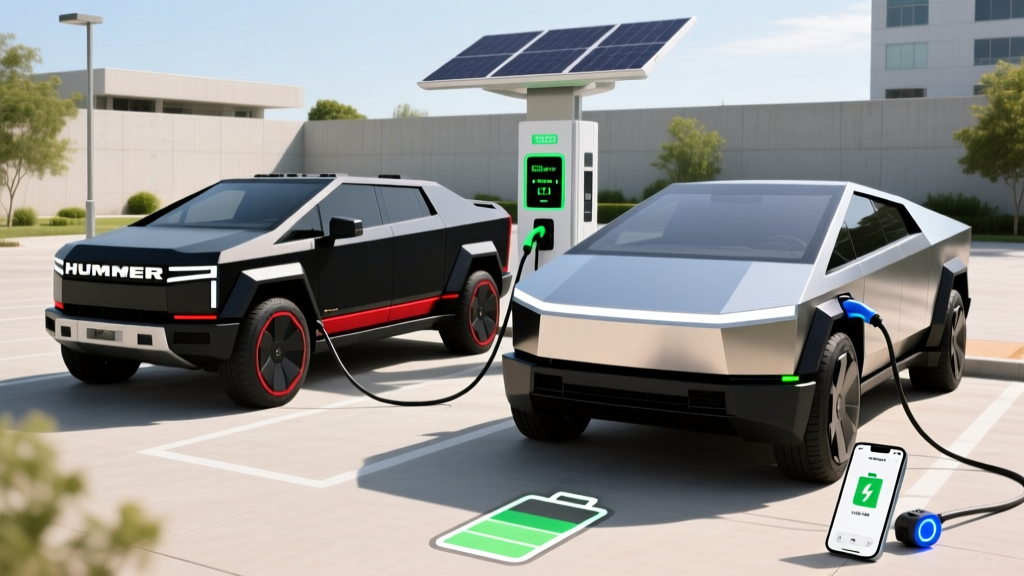
The GMC Hummer EV and Tesla Cybertruck are the two most polarizing electric pickups on the road, and for good reason. One is a 9,000-pound mega-truck with removable roof panels and a crab-walk mode; the other is a stainless-steel wedge with a 48-volt steer-by-wire architecture. But strip away the theatrics and the Hummer EV vs Cybertruck comparison comes down to hard numbers: which one goes farther, charges faster, costs less to own, and actually fits your daily life?
We've driven both, charged both on public DC networks, and cross-referenced every spec against EPA and manufacturer data. Here's the 2026 breakdown.
Side-by-Side Spec Table: Hummer EV vs Cybertruck
| Specification | 2026 GMC Hummer EV Pickup (3X) | 2026 Tesla Cybertruck (AWD) | 2026 Tesla Cybertruck (Cyberbeast) |
|---|---|---|---|
| EPA Range | 381 miles | 340 miles | 320 miles |
| Battery (usable, est.) | ~212 kWh (NMC, Ultium) | ~123 kWh (4680 cells, NMC) | ~123 kWh (4680 cells, NMC) |
| Peak DC Fast Charge | ~350 kW (800V architecture) | ~250 kW (800V architecture) | ~250 kW (800V architecture) |
| 10–80% DC Charge Time | ~22 minutes (est.) | ~17 minutes (est.) | ~17 minutes (est.) |
| Level 2 Charge Rate | 11.5 kW (19.2 kW capable) | 11.5 kW | 11.5 kW |
| 0–60 mph | ~3.0 sec (Watts to Freedom mode) | 3.9 sec | 2.6 sec |
| Horsepower | 830 hp (3-motor) | 600 hp (dual-motor) | 845 hp (tri-motor) |
| MPGe (combined) | 47 MPGe (2.1 kWh/mi) | 68 MPGe (1.5 kWh/mi) | 64 MPGe (1.6 kWh/mi) |
| Towing Capacity | 7,500 lbs | 7,500 lbs | 7,500 lbs |
| Payload | 1,300 lbs | 2,500 lbs | 2,500 lbs |
| Bed Length | 5 ft | 6 ft | 6 ft |
| Cargo (bed + frunk) | ~37 cu ft bed + 7 cu ft eTrunk | ~67 cu ft bed + 7 cu ft frunk | ~67 cu ft bed + 7 cu ft frunk |
| Base MSRP | $98,845 (3X) | $79,990 (AWD) | $99,990 (Cyberbeast) |
| Battery/Powertrain Warranty | 8 yr / 100,000 mi | 8 yr / 120,000 mi | 8 yr / 120,000 mi |
| Curb Weight | ~9,063 lbs | ~6,603 lbs | ~6,843 lbs |
Sources: fueleconomy.gov, GMC official specs, Tesla official specs. Range and efficiency figures are EPA estimates; real-world results vary with temperature, terrain, and driving style.
Range and Efficiency: Physics Favors the Lighter Truck
Hummer EV 3X: EPA 381 mi — expect ~300–320 mi highway at 70 mph; ~240–260 mi in sub-freezing cold.
Cybertruck AWD: EPA 340 mi — expect ~275–295 mi highway; ~220–240 mi in cold.
Cybertruck Cyberbeast: EPA 320 mi — expect ~255–275 mi highway; ~200–220 mi in cold.
The Hummer EV wins the EPA sticker contest at 381 miles, but that number comes with a massive caveat: it's hauling a 212 kWh battery pack that weighs over 2,900 pounds by itself. The Hummer's efficiency is a dismal 2.1 kWh per mile — roughly 47 MPGe combined. For context, the Cybertruck AWD sips 1.5 kWh per mile (68 MPGe), meaning it costs about 30% less per mile to fuel.
On a real-world highway loop at sustained 70–75 mph speeds, both trucks shed 15–20% from their EPA numbers. Cold weather (below 32°F) compounds this with an additional 15–25% loss, depending on cabin heat usage. The Hummer's larger battery gives it a wider absolute buffer, but you're paying for that buffer in electricity and in the premium MSRP.
Range winner: Hummer EV — but only on paper and only because of brute-force battery size. The Cybertruck is meaningfully more efficient and cheaper to charge per mile.
Charging Speed and Network Access
| Charging Level | Hummer EV | Cybertruck |
|---|---|---|
| Level 1 (120V, ~1.4 kW) | ~3 mi/hr added | ~4 mi/hr added |
| Level 2 (240V, 11.5 kW) | ~22 mi/hr added | ~30 mi/hr added |
| DC Fast Charge (peak) | ~350 kW (800V) | ~250 kW (800V) |
| DC 10–80% time (est.) | ~22 min | ~17 min |
| Native Connector | CCS1 (NACS adapter available) | NACS (native Tesla) |
| Tesla Supercharger Access | Via adapter (limited V4 stalls) | Full network access |
This is where the comparison gets nuanced. The Hummer EV has a higher peak charge rate (~350 kW vs. ~250 kW), but it's filling a battery nearly twice the size. The result: both trucks hit 10–80% in roughly similar time windows, with the Cybertruck actually finishing a bit sooner because its smaller pack reaches the charge-curve taper point later relative to total capacity.
Charging curve reality matters here. Both trucks sustain their peak rates only through roughly 30–40% state of charge. Above 60% SoC, charge rates drop progressively. Above 80%, expect rates below 50 kW as the battery management system protects cell health. Neither truck is a good candidate for regular 100% DC charging — plan your road trips around 80% stops.
Network advantage: Cybertruck. Native NACS and full Tesla Supercharger access means over 25,000 reliable, well-maintained stalls nationwide. The Hummer EV can access Superchargers via a GM-provided NACS adapter, but compatibility with older V2 stalls is inconsistent, and you're largely dependent on Electrify America, EVgo, and other third-party networks where uptime and maintenance vary.
Charging speed winner: Tie — the Hummer peaks higher, but the Cybertruck's smaller pack and superior network access make it more practical for road-trip charging.
Performance and Driving Dynamics
Both trucks are absurdly quick for their mass, but the Cybertruck Cyberbeast's 2.6-second 0–60 time edges out the Hummer's 3.0-second Watts to Freedom launch. The standard Cybertruck AWD at 3.9 seconds is still supercar-territory quick and costs $20,000 less than either flagship.
The driving experience diverges sharply beyond straight-line speed. The Cybertruck uses steer-by-wire with a variable-ratio rack — low-speed maneuvering requires barely a quarter turn lock-to-lock, while highway driving feels direct and stable. It's a genuinely novel system, though some drivers find the lack of mechanical feedback unsettling in the first few miles.
The Hummer EV drives like a luxury SUV that swallowed a tank. Air suspension with adaptive damping, four-wheel steering (including CrabWalk diagonal movement), and Extract Mode (which raises the suspension 6 inches for off-road obstacles) give it genuine trail capability. It's also significantly more refined at highway speeds — less wind noise, a more compliant ride, and a conventional steering feel that requires zero acclimation.
Performance winner: Cybertruck Cyberbeast for raw acceleration; Hummer EV for off-road capability and ride refinement.
Price, Tax Credits, and Ownership Costs
The IRS §30D credit offers up to $7,500, split between $3,750 for battery-component sourcing and $3,750 for critical-minerals sourcing. Eligibility requires:
• Buyer AGI below $150K (single) / $300K (joint)
• MSRP under $80,000 for trucks
• Battery components and minerals must meet North American/sourcing thresholds
• Credit can be transferred to the dealer at point of sale as a price reduction
| Cost Factor | Hummer EV 3X | Cybertruck AWD | Cybertruck Cyberbeast |
|---|---|---|---|
| Base MSRP | $98,845 | $79,990 | $99,990 |
| §30D Federal Credit Eligibility | Ineligible (MSRP exceeds $80K truck cap) | Eligible — up to $7,500 (sourcing-dependent) | Ineligible (MSRP exceeds $80K truck cap) |
| Effective Price (after best-case credit) | $98,845 | ~$72,490 | $99,990 |
| Est. Annual Electricity Cost (15K mi/yr, $0.16/kWh) | ~$504/yr (2.1 kWh/mi) | ~$360/yr (1.5 kWh/mi) | ~$384/yr (1.6 kWh/mi) |
| Est. Annual Insurance | ~$3,200–$4,000 | ~$2,800–$3,600 | ~$3,400–$4,200 |
| 5-Year Electricity Cost | ~$2,520 | ~$1,800 | ~$1,920 |
| 5-Year Est. Insurance | ~$18,000 | ~$16,000 | ~$19,000 |
| Maintenance (5-yr est.) | Low (no oil/transmission; tire wear high due to weight) | Low (no oil/transmission; tire wear moderate) | Low (no oil/transmission; tire wear moderate) |
The value math is decisive. The Cybertruck AWD is the only configuration in this comparison that qualifies for the full §30D credit, because it's the only one under the $80,000 MSRP cap for trucks. That drops its effective starting price to around $72,490 — a staggering $26,000 below the Hummer EV 3X and $27,500 below the Cyberbeast.
Running costs compound the gap. The Hummer's 2.1 kWh/mi consumption means you're paying roughly $144 more per year in electricity than the Cybertruck AWD. Insurance premiums are higher on both the Hummer (due to weight, repair complexity, and parts cost) and the Cyberbeast (due to its $100K price tag and performance profile). The Hummer's massive weight also accelerates tire wear — budget for replacement tires every 25,000–30,000 miles at $400–$600 per corner for the 35-inch OE rubber.
Value winner: Cybertruck AWD — by a wide margin, thanks to tax credit eligibility and superior efficiency.
Technology, Interior, and Daily Usability
- 18.5" central touchscreen + 9.4" rear display
- Steer-by-wire with variable ratio
- Integrated 120V/240V bed outlets (up to 11.5 kW export)
- Over-the-air updates with frequent feature additions
- Tesla app ecosystem and Sentry Mode
- 13.4" infotainment + 12.3" driver display (conventional layout)
- Infinity Roof with removable modular panels
- Conventional mirrors (Cybertruck uses camera-only in some configs)
- More rear-seat headroom and a traditional cabin feel
- Physical buttons for climate and terrain modes
The Cybertruck's interior is minimalist to the point of controversy — no physical buttons, no instrument cluster, and a yoke-style steering wheel (a round wheel is now optional). Everything routes through the massive central screen. For tech-forward buyers, this feels like a cockpit from 2030. For traditionalists, it's frustrating — adjusting mirrors, changing wiper speed, and even opening the glovebox require screen taps.
The Hummer EV takes the opposite approach: a layered dashboard with physical knobs, a large head-up display, and GM's proven Super Cruise hands-free driving system (on compatible mapped highways — this remains SAE Level 2, requiring driver attention). The Infinity Roof panels store in the frunk, giving open-air driving that the Cybertruck simply cannot match. Rear-seat comfort is notably better in the Hummer, with more headroom and a higher seating position.
Both trucks offer bioweapon-defense-grade air filtration, over-the-air updates, and sophisticated thermal management systems that precondition the battery for optimal DC charging.
Real-World Charging and Road-Trip Practicality
Taking either truck on a 500-mile road trip reveals the current state of EV truck touring. The Cybertruck's native Supercharger access is its single biggest practical advantage. Tesla's V3 and V4 stalls are well-maintained, reliably deliver their rated power, and the in-car navigation automatically preconditioning the battery for each stop. You pull up, plug in, and get 250 kW almost immediately.
The Hummer EV on a road trip means relying primarily on Electrify America, EVgo, or regional networks. When those stalls work, the Hummer's 350 kW peak capability shines — we've observed sustained 300+ kW pulls from 10–35% SoC on EA Hyperfast chargers. But stall downtime, broken connectors, and CCS compatibility quirks remain real frustrations on third-party networks. The GM NACS adapter opens Supercharger access, but only at stalls equipped to serve non-Tesla vehicles, which is a growing but still incomplete subset.
Both trucks are wide (the Hummer is 86.7 inches wide with mirrors; the Cybertruck is 84 inches) and can be tight fits in older charging stalls designed for compact sedans. Plan for pull-through parking when towing.
Decision Framework: Which Should You Buy?
Choose the GMC Hummer EV if:
- You want maximum EPA range (381 mi) and don't mind paying for the battery mass
- Off-road capability matters — CrabWalk, Extract Mode, and underbody armor are genuine differentiators
- You prefer a conventional driving experience: physical controls, traditional steering, familiar cabin layout
- Open-air driving (removable roof panels) is a priority
- You have reliable home Level 2 charging and rarely road-trip beyond your battery's range
- Budget is not the primary constraint ($98K+ with no federal credit)
Choose the Tesla Cybertruck if:
- Value matters — the AWD at ~$72,490 after the §30D credit is the best price-per-mile truck here
- You road-trip frequently and want seamless Tesla Supercharger access
- You want the best efficiency (68 MPGe / 1.5 kWh/mi) and lowest per-mile charging cost
- Payload capacity matters (2,500 lbs vs. 1,300 lbs in the Hummer)
- You want a longer bed (6 ft vs. 5 ft) and more enclosed cargo volume
- You're comfortable with a screen-centric interface and steer-by-wire driving feel
- You want V2L/V2H power export capability (up to 11.5 kW from the bed)
Frequently Asked Questions
Which has better range: Hummer EV or Cybertruck?
The Hummer EV 3X has the higher EPA rating at 381 miles vs. the Cybertruck AWD's 340 miles. However, the Hummer achieves this with a 212 kWh battery that makes it 2,400 lbs heavier and far less efficient (47 MPGe vs. 68 MPGe). In real-world highway driving, expect ~300–320 miles from the Hummer and ~275–295 from the Cybertruck AWD.
Which is cheaper to own over 5 years?
The Cybertruck AWD wins decisively. After the §30D credit, it starts around $72,490 vs. the Hummer's $98,845. Over 5 years, the Cybertruck's superior efficiency saves roughly $720 in electricity, and its lower insurance premiums save an estimated $2,000. Total 5-year ownership cost advantage for the Cybertruck AWD: approximately $28,000–$30,000.
Does either qualify for the $7,500 federal tax credit?
Only the Cybertruck AWD ($79,990 MSRP) qualifies, as it's the only variant under the $80,000 MSRP cap for trucks. The Cyberbeast ($99,990) and all Hummer EV trims ($98,845+) exceed the cap and are ineligible. Verify current sourcing requirements and your income eligibility at IRS.gov before purchasing.
Can the Hummer EV use Tesla Superchargers?
Yes, via a GM-provided NACS adapter. However, access is limited to Supercharger stalls that Tesla has enabled for non-Tesla vehicles, and compatibility with older V2 stalls may be inconsistent. For reliable road-trip charging, the Hummer still primarily depends on Electrify America and other CCS networks.
Which is better for towing?
Both are rated at 7,500 lbs, but towing any trailer cuts range by 30–50% in either truck. The Hummer's larger battery gives it a longer absolute towing range (~150–200 miles with a heavy trailer vs. ~120–170 for the Cybertruck), but you'll also spend more time and money charging the Hummer's 212 kWh pack. For frequent towing, neither electric truck yet matches a diesel's range convenience.
Which truck has better off-road capability?
The Hummer EV. Its four-wheel steering (CrabWalk), adaptive air suspension with Extract Mode (adding 6 inches of ground clearance), underbody skid plates, and approach/departure angles tuned for rock crawling give it a clear edge. The Cybertruck has decent ground clearance and tow modes but isn't purpose-built for technical off-road trails.
How long will the batteries last?
Both use NMC chemistry with liquid thermal management. GM warranties the Hummer's Ultium pack for 8 years/100,000 miles against degradation below 70% capacity. Tesla warranties the Cybertruck's 4680-cell pack for 8 years/120,000 miles at the same 70% retention threshold. Based on current NMC degradation data, both packs should retain 85–90% capacity at 100,000 miles with normal charging habits (avoiding frequent 100% charges and DC fast-charging only when needed).