Quick Answer: The Huffy Electric Green Machine 24V Is Not an EV
If you searched for the Huffy Electric Green Machine 24V expecting an electric vehicle in the automotive sense, here's the direct answer: this is a battery-powered ride-on drift trike designed for kids and teens (ages 8+), not a road-legal electric vehicle. It uses a 24-volt, 12Ah sealed lead-acid battery pack, a single rear-mounted electric motor rated around 350 watts, and reaches a top speed of roughly 12 mph. It does not qualify for any federal EV tax credit, has no EPA range rating, and cannot be registered, insured, or driven on public roads. If you're researching actual EV ownership—cars like the Chevrolet Equinox EV or Hyundai Ioniq 5—this product sits entirely outside that category.
What the Huffy Electric Green Machine 24V Actually Is
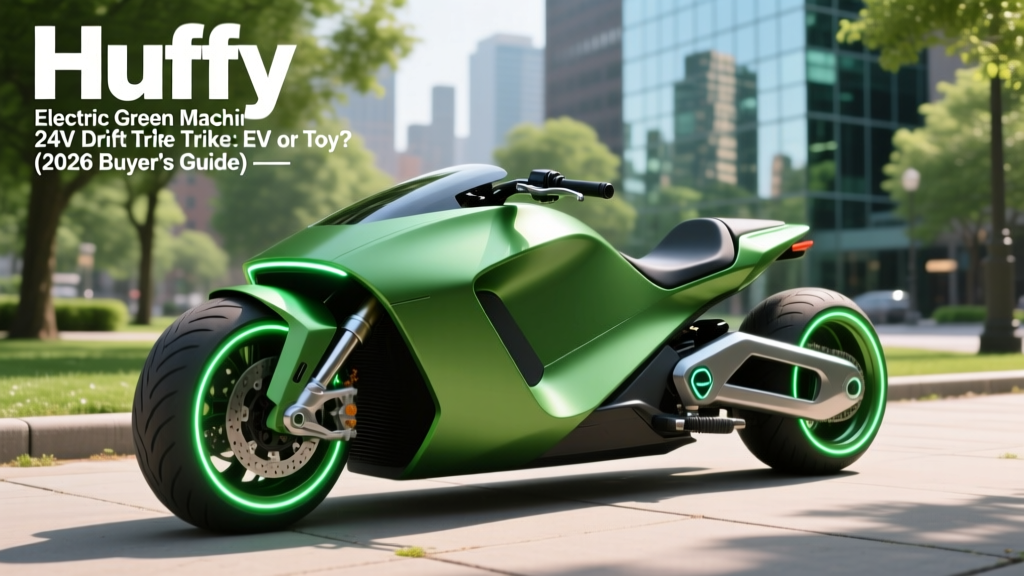
The Huffy Green Machine Electric is a three-wheeled drift trike with a low-slung bucket seat, dual rear hand brakes, and a joystick-style throttle. The "24V" designation refers to its battery system voltage, not its performance class. Here's what the hardware actually delivers:
| Spec | Value |
|---|---|
| Battery Type | Sealed Lead-Acid (SLA), 24V / 12Ah |
| Usable Energy | ~0.288 kWh |
| Motor | ~350W rear hub / chain-drive |
| Top Speed | ~12 mph (varies by rider weight and terrain) |
| Runtime | ~40–60 minutes continuous use |
| Charge Time | 8–12 hours (wall outlet, included charger) |
| Max Rider Weight | 140 lbs |
| Typical Retail Price | $250–$350 |
| Street Legal | No — toy/recreational use only |
For context, a single kilowatt-hour (kWh) is a unit of energy. The Huffy's 0.288 kWh battery stores roughly the same energy as running a 288-watt appliance for one hour. Compare that to a real EV like the 2026 Chevrolet Equinox EV, which carries an 85 kWh usable battery—nearly 300 times more energy storage.
Why This Doesn't Fit the EV Ownership Framework
When we cover electric vehicles at AutoEdgeView, we're evaluating transportation that replaces internal combustion for daily commuting, road trips, and family use. That framework involves EPA range certification, DC fast charging, NACS or CCS connectors, Level 2 home charging infrastructure, battery degradation over years, and federal tax incentives under IRS §30D. None of that applies here.
Common Misconceptions vs. Facts
| Myth | Fact |
|---|---|
| "It's electric, so it qualifies for the $7,500 EV tax credit." | False. The §30D credit applies to qualified plug-in electric vehicles meeting battery sourcing, MSRP caps, and buyer income limits. Ride-on toys are excluded entirely. |
| "24V means it's powerful." | Voltage alone doesn't determine power. The Huffy's 350W motor produces roughly 0.47 horsepower—a real EV produces 200–500+ HP. |
| "Lead-acid batteries are the same as EV batteries." | No. Modern EVs use lithium-ion (NMC or LFP chemistry) with active thermal management. Lead-acid is heavier, degrades faster, and holds far less energy per pound. |
| "I can ride it on the street." | It has no VIN, no headlamps meeting DOT standards, no turn signals, and no registration pathway. It's for private-property recreation only. |
How Real EVs Compare: The Ownership Numbers That Matter
If you arrived here researching electrified transportation, here's what actual EV ownership looks like in 2026. Let's compare a mainstream battery-electric vehicle against a comparable gas car to show the real financial picture.
5-Year Cost of Ownership: 2026 Chevy Equinox EV LT vs. 2026 Honda CR-V EX (Gas)
| Category | Equinox EV (85 kWh) | CR-V Gas (AWD) |
|---|---|---|
| Base MSRP | $33,600 | $34,550 |
| Estimated Federal Tax Credit (§30D) | Up to $7,500 (eligibility varies by income, sourcing, and MSRP caps — see IRS guidelines) | $0 |
| Effective Purchase Price | ~$26,100 | $34,550 |
| Annual Fuel/Energy (15,000 mi/yr) | ~$540 (home charging at $0.14/kWh, 3.3 mi/kWh) | ~$1,715 (gas at $3.40/gal, 29 MPG combined per fueleconomy.gov) |
| 5-Year Fuel/Energy Total | ~$2,700 | ~$8,575 |
| Annual Maintenance | ~$300 (no oil changes, minimal brake wear via regen) | ~$750 (oil, filters, brake pads) |
| 5-Year Maintenance Total | ~$1,500 | ~$3,750 |
| Insurance (avg annual) | ~$1,900 | ~$1,550 |
| 5-Year Insurance Total | ~$9,500 | ~$7,750 |
| 5-Year Total Cost | ~$39,800 | ~$54,625 |
Assumptions: Home Level 2 charging available; electricity and gas prices are national averages; tax credit eligibility not guaranteed—consult a tax professional. Insurance premiums for EVs tend to run 15–25% higher due to repair costs and parts pricing.
What a First-Time EV Buyer Actually Needs to Know
Setting aside the Huffy drift trike, if you're genuinely considering your first electric vehicle in 2026, here are the practical realities that spec sheets don't emphasize:
Home Charging Access Is the Dealbreaker
Over 80% of EV charging happens at home. If you have a garage or driveway where a Level 2 charger (240V, 32–48 amps, 7.7–11.5 kW) can be installed, daily EV ownership is effortless—plug in overnight, wake up to a full battery. If you live in an apartment without charging access or rely entirely on public infrastructure, your experience will be significantly more constrained. A Level 2 home installation typically costs $500–$2,000 for the charger unit plus $500–$3,000 for electrician labor and permitting, depending on whether your electrical panel needs an upgrade from 100A to 200A service.
Real-World Range vs. EPA Stickers
EPA range estimates assume mixed driving at moderate temperatures. Expect a 15–30% reduction in cold weather (below 40°F) due to battery resistance and cabin heating demands. Highway driving at 75+ mph also cuts range by roughly 10–20% compared to the EPA combined figure. A vehicle rated at 300 miles EPA may realistically deliver 210–255 miles on a cold-weather highway trip.
Charging Speed: kW Matters, But the Curve Is Real
A "200 kW peak charge rate" doesn't mean you sustain 200 kW for the entire session. DC fast charging follows a curve: the battery accepts maximum power between roughly 10–50% state of charge, then tapers to protect cell health. A realistic 10–80% session on a 200 kW-capable vehicle takes 18–25 minutes. Above 80%, speeds drop dramatically—often to under 50 kW.
Battery Longevity and Warranty
Modern lithium-ion EV batteries (NMC or LFP chemistry) are warranted for 8 years/100,000 miles with a capacity retention threshold of 70% or better. Real-world degradation data from fleets shows most EV batteries retain 85–92% capacity after 100,000 miles. Full battery replacement costs $8,000–$18,000 depending on the vehicle, but is rarely needed within normal ownership timeframes.
Decision Framework: What Should You Actually Buy?
If X, Then Y
- If you want a fun gift for a kid/teen who loves drifting: The Huffy Electric Green Machine 24V is a legitimate toy in its category—budget $250–$350, expect ~1 hour of runtime per charge, and understand it's strictly for private-property recreation.
- If you want an electric vehicle for daily commuting: Look at the 2026 Chevy Equinox EV ($33,600, 315 mi EPA), Hyundai Ioniq 5 ($42,600, 310 mi EPA), or Tesla Model 3 ($39,990, 341 mi EPA). All support DC fast charging at 150–250 kW and qualify for partial or full §30D credits depending on your income and the vehicle's battery sourcing.
- If you're not ready for full electric but want fuel savings: A plug-in hybrid like the Toyota RAV4 Prime ($44,990, 42 mi electric-only range, 38 MPG combined after battery depletion) offers electric commuting without range anxiety.
- If you don't have home charging access: Either prioritize a PHEV (smaller battery, less dependence on charging infrastructure) or confirm that reliable DC fast chargers exist within 5 miles of your home/work before committing to a BEV.
- If you need a family hauler on a budget: The 2026 Kia EV9 ($54,900, 279 mi EPA, 3-row seating) or the used-EV market (eligible for up to $4,000 under §25E) are worth investigating.
Frequently Asked Questions
Is the Huffy Electric Green Machine 24V considered an electric vehicle?
No. It's a battery-powered ride-on toy. It has no VIN, no road registration, no EPA certification, and does not meet any federal definition of a motor vehicle. It's classified as a consumer recreational product.
Can I get a tax credit for buying the Huffy Green Machine Electric?
No. The IRS §30D Clean Vehicle Credit applies only to qualified plug-in electric vehicles meeting specific battery component sourcing, critical mineral, MSRP cap ($55,000 for cars, $80,000 for SUVs/trucks/vans), and buyer income requirements. Toys, e-bikes, and off-road recreational vehicles are excluded.
How long does the Huffy Green Machine battery last before needing replacement?
Sealed lead-acid batteries typically endure 200–400 full charge cycles before significant capacity loss. With moderate use (a few hours per week), expect 2–4 years before noticeable runtime reduction. Replacement SLA packs cost roughly $40–$80.
What's the difference between lead-acid and lithium-ion batteries?
Lead-acid batteries (used in the Huffy) are heavier per unit of energy, slower to charge, and degrade faster. Lithium-ion batteries (used in all modern EVs) offer 3–5x the energy density, faster charging, longer cycle life (1,000–3,000+ cycles), and active thermal management. The cost per kWh is higher, but the performance gap is enormous.
What should I look for in a real first EV?
Prioritize: (1) EPA range of at least 250 miles for flexibility, (2) DC fast charging capability of 150+ kW for road trips, (3) home Level 2 charging feasibility, (4) battery warranty (8 yr/100,000 mi minimum), and (5) §30D tax credit eligibility for your specific income and the vehicle's sourcing compliance. Check the EPA's fueleconomy.gov for verified range and efficiency data on any model you're considering.
Is a drift trike like the Huffy safe for kids?
Huffy rates this for ages 8+ with a 140-lb max rider weight. It includes dual rear hand brakes and a low center of gravity, but it's designed for controlled drifting on smooth, flat surfaces. A properly fitted helmet and adult supervision are strongly recommended. It is not a substitute for supervised driving education or a licensed vehicle.