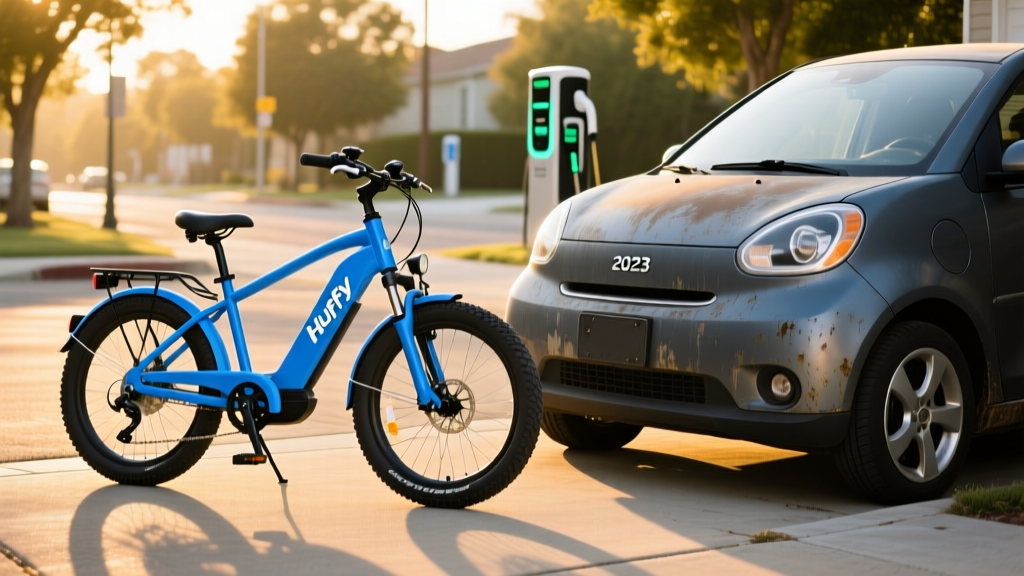
If you've searched for Huffy electric bikes, you're likely weighing a low-cost electric commute against buying a used or new electric vehicle. Here's the direct answer: a Huffy e-bike (typically $500–$1,200, 15–25 mile range, 15–20 mph top speed) is a fair last-mile or campus commuter, but it cannot replace a car for highway travel, bad weather, cargo, or passenger needs. A used EV like a 2023 Chevrolet Bolt EV — averaging $18,000–$22,000 on the used market in 2026 and eligible for the up-to-$4,000 used-EV federal credit under IRS §25E — delivers 259 miles of EPA range, highway capability, climate control, and full safety equipment. The right choice depends entirely on your commute distance, climate, and whether you need a car at all.
Quick Verdict
- Choose a Huffy e-bike if your one-way commute is under 10 miles, you have safe bike infrastructure, and you already own or lease a car for longer trips.
- Choose a used EV if you need a primary vehicle, drive more than 20 miles round-trip, face winter weather, or carry passengers/cargo.
What Huffy Electric Bikes Actually Offer (2026 Specs)
Huffy's electric-bike lineup in 2026 centers on budget-friendly hub-motor models sold primarily through big-box retailers. Most share a common architecture:
- Motor: 250W–350W rear hub motor (Class 1 or Class 2 e-bike)
- Battery: 36V lithium-ion pack, typically 10–14 Ah (360–504 Wh usable energy)
- Range: 15–28 miles per charge (pedal-assist); 12–18 miles on throttle-only
- Top assisted speed: 15.5–20 mph (federally limited for Class 1/2)
- Charge time: 4–6 hours on a standard 120V outlet (roughly 80–100W draw)
- Price: $498–$1,198 MSRP depending on model (e.g., Huffy Ridgeline, Huffy Emerge)
- Weight: 48–62 lbs
- Warranty: Typically 1 year limited on frame and components; battery often 6–12 months
These are perfectly adequate for a 3-mile ride to a train station or a flat campus loop. They are not transportation infrastructure. Battery replacement on out-of-warranty Huffy packs often costs $200–$350, and proprietary connectors can make sourcing a replacement difficult after a model is discontinued.
Used EV Baseline: 2023 Chevrolet Bolt EV
To give the comparison real teeth, I'm using a widely available used EV benchmark: the 2023 Chevrolet Bolt EV (final model year before GM's next-gen replacement). Here's what you're actually getting:
| Spec | 2023 Chevy Bolt EV (2LT) | Huffy E-Bike (typical) |
|---|---|---|
| EPA range | 259 miles | 15–28 miles (pedal-assist) |
| Battery capacity | 65 kWh usable (NMC) | ~0.36–0.5 kWh (Li-ion) |
| Top speed | ~93 mph (electronically limited) | 15.5–20 mph |
| 0–60 mph | 6.5 seconds | N/A |
| DC fast charge (10–80%) | ~55 kW peak, ~45 min | N/A (120V only) |
| Level 2 charge (full) | 11.5 kW, ~7 hours | N/A |
| Cargo capacity | 57.0 cu ft (seats folded) | Panniers / backpack |
| Passengers | 5 | 1 (some models: 2) |
| Climate control | Full HVAC with heat pump option | None |
| Safety (NHTSA) | 5-star overall | Not rated |
| Typical 2026 used price | $18,000–$22,000 | $498–$1,198 new |
| Federal tax credit | Up to $4,000 (§25E used-EV) | None |
The Bolt EV's 55 kW DC fast-charging ceiling is its main weakness — it's slow by 2026 standards (many rivals hit 150–250 kW). For daily driving and overnight Level 2 home charging, it's a non-issue. For frequent 300+ mile road trips, the ~45-minute 10–80% stop adds real time.
Real Costs: E-Bike vs. Used EV Over 5 Years
This is where the comparison gets honest. I'm assuming a 10-mile round-trip commute, 240 working days per year (2,400 miles/year), and national-average electricity at $0.17/kWh and gas at $3.30/gallon (2026 EIA estimates).
| Cost Category | Huffy E-Bike | Used 2023 Bolt EV | Gas Car (30 MPG avg) |
|---|---|---|---|
| Purchase price | $800 | $20,000 | $18,000 |
| Federal tax credit | $0 | –$4,000 (§25E) | $0 |
| Net purchase | $800 | $16,000 | $18,000 |
| Fuel/energy (5 yr) | $68 (~200 kWh/yr) | $680 (~800 kWh/yr) | $2,640 (400 gal/yr) |
| Insurance (5 yr) | $0 (homeowner's policy) | $6,500 | $5,800 |
| Maintenance (5 yr) | $400 (tires, brakes, tune-ups) | $1,200 (tires, cabin filter, fluid top-offs) | $3,000 (oil, brakes, filters) |
| Battery replacement reserve | $300 | $0 (8 yr/100k mi warranty) | $0 |
| Registration/fees (5 yr) | $0 | $750 | $750 |
| 5-year total | $1,568 | $25,130 | $30,190 |
| Cost per mile | $0.13 | $0.76 | $1.01 |
The e-bike wins on pure cost by an enormous margin — but only because it's not a car. The Bolt EV still beats a comparable gas car by roughly $5,000 over five years, primarily through fuel savings and lower maintenance (no oil changes, no transmission fluid, regenerative braking extends pad life 2–3×).
Insurance reality check: EV insurance in 2026 remains 15–25% higher than equivalent gas cars, per industry data. The Bolt EV is one of the cheaper EVs to insure because its repair costs are moderate and parts are widely available. Still, budget $110–$140/month depending on your state and driving record.
Real-World Ownership Factors Most Buyers Overlook
Home Charging Access
Neither an e-bike nor an EV works well without somewhere to plug in. For a Huffy e-bike, any standard 120V outlet is sufficient — you can charge at a desk, in an apartment hallway, or in a garage. For a used Bolt EV, you need at minimum a dedicated 120V circuit (Level 1, ~1.4 kW, adding ~4 miles of range per hour — enough for a 30-mile daily commute if parked 10+ hours). Ideally, you install a 240V Level 2 home charger (7–11.5 kW), which fully replenishes the Bolt overnight in about 7 hours. A basic Level 2 installation on an existing 240V circuit runs $500–$1,200; a panel upgrade from 100A to 200A service can add $1,500–$3,500.
If you live in an apartment without charging access, an e-bike becomes dramatically more practical than an EV. Public DC fast charging works but costs $0.35–$0.55/kWh in most metro areas — roughly triple the home-charging rate.
Cold Weather and Range
Both platforms suffer in winter, but differently. A Huffy e-bike's small lithium-ion pack loses 20–35% of its usable capacity below freezing, cutting a 20-mile range down to 13–16 miles. More critically, you are exposed to the elements. Riding at 15 mph in 25°F wind chill is viable for about 10 minutes before discomfort becomes a safety issue.
The Bolt EV loses roughly 15–25% of its 259-mile EPA range in sustained sub-30°F driving (real-world winter range: ~195–220 miles). The cabin heat pump (available on higher trims) mitigates this somewhat. You stay warm, dry, and safe. For anyone in the upper Midwest, Northeast, or Mountain West, this is not a minor consideration — it's the difference between a year-round vehicle and a seasonal one.
Driving Patterns That Break the E-Bike Math
A 10-mile round-trip commute on protected bike lanes is the e-bike's ideal scenario. The math collapses if you need to:
- Carry a child or second passenger
- Drive on roads with 45+ mph speed limits and no bike shoulder
- Make grocery runs exceeding what two panniers can hold (~30 lbs practical limit)
- Commute more than 15 miles one-way (battery range + return-charge logistics become stressful)
- Ride in rain more than a few days per month
Common Misconceptions, Addressed with Data
| Myth | Fact |
|---|---|
| "E-bikes are basically free to own." | True for energy (~$14/year), but battery replacement ($200–$350 every 3–5 years), flat tires, and brake service add $80–$150/year. |
| "Used EVs need a new battery soon." | The Bolt EV's battery carries an 8-year/100,000-mile warranty (10 years in CARB states). Real-world degradation on GM's Ultium-era packs averages 8–12% over 100k miles per Recurrent Auto data. |
| "A $4,000 used-EV credit is automatic." | It's not. Under IRS §25E, you must buy from a licensed dealer, the vehicle must be under $25,000, your AGI must be under $75k (single) / $150k (joint), and the vehicle must be at least 2 model years old. The credit is non-refundable and can only be claimed once per buyer every 3 years. |
| "E-bikes don't need insurance." | Most states don't require it, but a theft or collision isn't covered by auto insurance. Homeowner's or renter's policies may cover e-bikes up to a limit — check yours. Dedicated e-bike insurance runs $100–$250/year. |
| "Charging an EV is more expensive than gas." | At $0.17/kWh national average, the Bolt EV costs about $0.055/mile in energy. A 30 MPG gas car at $3.30/gallon costs $0.11/mile — exactly double. Public DCFC is pricier but still typically undercuts gas per mile. |
Decision Framework: Which Should You Actually Buy?
If X, then Y
- If your commute is under 10 miles one-way, you have bike lanes, you live in a mild climate, and you already have a car for weekends: Buy the Huffy e-bike (~$800). Park your gas car more. You'll save $1,500–$2,500/year in fuel and maintenance.
- If you need one vehicle to do everything — commute, groceries, road trips, winter driving: Buy a used Bolt EV ($16,000–$20,000 after credit). It replaces a gas car completely and costs less to run over 5 years.
- If you're in an apartment with no EV charging but want to stop driving a gas car for short trips: E-bike now; revisit an EV when you move somewhere with Level 2 access or when your building installs chargers.
- If your commute is 15–40 miles one-way with highway segments: E-bike is not viable. Used EV is the clear answer. Consider a used Tesla Model 3 if DC fast-charging speed matters to you (170 kW peak vs. the Bolt's 55 kW).
- If you want both: A Bolt EV as your primary car + a Huffy e-bike for last-mile or fair-weather errands is a legitimate two-vehicle household strategy under $20,000 total (after the §25E credit).
Frequently Asked Questions
Can I claim a federal tax credit on a Huffy electric bike?
No. The federal e-bike tax credit proposed in Congress has not passed as of 2026. Some states and cities (notably California, Colorado, and Denver specifically) offer point-of-sale rebates of $300–$1,500 on e-bikes — check your local program. Huffy e-bikes do not qualify for any federal vehicle credit because they are not classified as motor vehicles under IRS rules.
How long does a Huffy e-bike battery last before replacement?
Expect 500–800 full charge cycles before capacity drops below 80% — roughly 3–5 years of daily commuting use. Replacement packs cost $200–$350 if available. This is a meaningful long-term ownership cost that budget e-bike reviews often omit.
Is a used Chevy Bolt EV reliable in 2026?
The 2023 Bolt EV (the final model year of this generation) has no major systemic issues. Earlier 2017–2022 Bolt EVs were subject to a battery recall for fire risk; GM replaced affected packs with newer, larger batteries — many of these cars now have more range than when new. Verify recall completion via the VIN at nhtsa.gov/recalls before purchasing.
Can I charge an EV on a standard household outlet?
Yes. Level 1 charging on a 120V/15A outlet delivers about 1.4 kW, adding roughly 4 miles of range per hour to a Bolt EV. For a 30-mile daily commute with overnight parking (10+ hours), Level 1 is sufficient. For longer daily drives or faster turnaround, a 240V Level 2 charger is strongly recommended.
What if I don't have a garage or driveway?
Street-side EV charging remains the hardest problem in EV ownership as of 2026. If you can't install a home charger, your realistic options are: workplace Level 2 charging, public Level 2 near your regular routes (apps like PlugShare map these), or DC fast charging 1–2 times per week at $0.35–$0.55/kWh. If none of these are available, an e-bike (which you can carry inside to charge) is the more practical electric option.
Neither a Huffy electric bike nor a used EV is universally "better" — they solve different problems at different price points. The e-bike is a $800 tool for short, fair-weather trips. The used Bolt EV is a $16,000–$20,000 car that happens to be cheaper to run than its gas equivalent. Know which problem you're solving, and the choice is straightforward.