The Quick Answer: Can You Work on Your Own EV?
Yes — but with strict boundaries. As an EV owner, you can safely handle low-voltage maintenance: cabin air filter replacement, wiper blades, washer fluid, tire rotation, brake pad inspection, and 12V auxiliary battery replacement. These tasks mirror gas-car DIY work and save $150–$400 annually in labor. However, anything touching the high-voltage (HV) traction system — battery pack, inverter, drive unit, HV cabling (the orange wires) — requires a certified EV technician. HV systems operate at 400V–900V and carry lethal energy. The good news: EVs need far less routine maintenance than gas cars, so your dealer visits are shorter and less frequent.
What EV Owners Can Safely Do at Home
The maintenance items accessible to a home mechanic with basic tools are surprisingly familiar if you've worked on conventional cars. Here's what's in your lane:
Cabin Air Filter Replacement
Most EVs use a standard cabin filter located behind the glovebox or under the cowl. A Tesla Model Y filter runs about $15–$25 for an aftermarket set, and replacement takes 15–20 minutes. A dealer charges $60–$90 for the same job. On a Hyundai Ioniq 5 or Ford Mustang Mach-E, access is similarly straightforward. Replace every 15,000–20,000 miles or annually.
Wiper Blades and Washer Fluid
Identical to gas cars. Standard J-hook or proprietary blades, $20–$40 a pair. Washer fluid is universal.
Tire Rotation and Inspection
EVs are heavier (a Model Y weighs ~4,400 lbs vs. a comparable RAV4 at ~3,600 lbs) and deliver instant torque, which accelerates tire wear. Rotate every 5,000–7,500 miles. You can do this with a jack, jack stands, and a torque wrench set to manufacturer spec (typically 90–100 lb-ft for lug nuts). Budget $150–$250 more per tire replacement cycle compared to a gas car, since many EVs require EV-rated tires with low rolling resistance and higher load ratings.
Brake Pad Inspection
Regenerative braking means EV brake pads last significantly longer — often 80,000–120,000 miles vs. 30,000–50,000 on a gas car. But you should still visually inspect pad thickness annually. Caliper slide pins can seize from lack of use, so periodic brake lubrication matters more on an EV, not less. If you're comfortable pulling a wheel and inspecting a rotor, this is well within DIY scope.
12V Auxiliary Battery
Every EV has a standard 12V battery that powers lights, infotainment, and computers. It typically lasts 3–5 years. Replacement is identical to a gas car — usually a group 47 or 48 AGM battery, $120–$180 at an auto parts store. A dead 12V battery is the #1 reason an EV won't "start," even if the main HV pack is full.
What Requires a Certified EV Technician
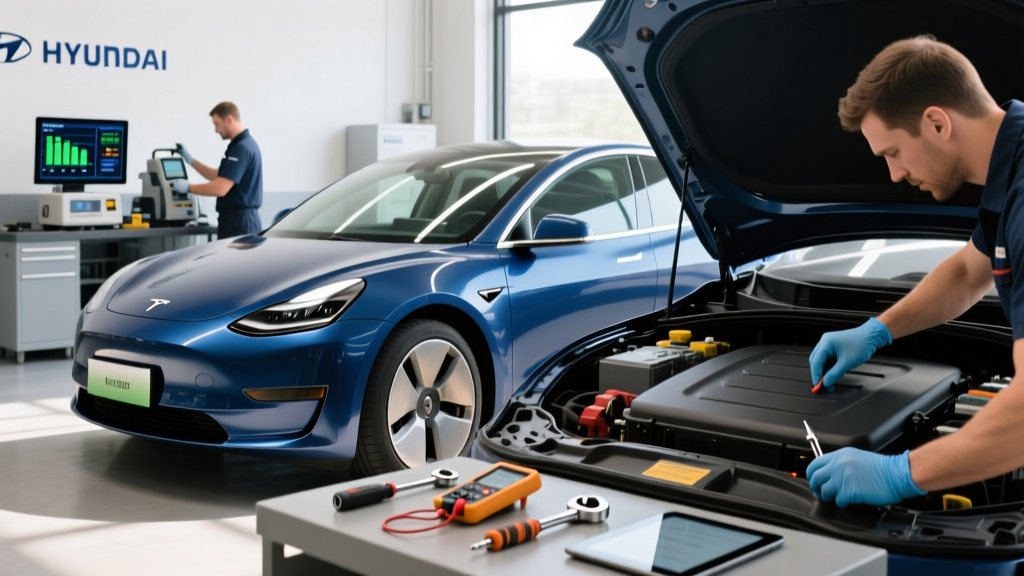
The following systems involve high-voltage components and must be serviced by factory-trained or ASE-certified EV technicians:
- Traction battery diagnostics and replacement: The HV pack (typically 60–100 kWh, operating at 400V–900V) requires specialized lifts, insulation-rated tools, and thermal management system knowledge. A full pack replacement runs $8,000–$22,000 depending on the vehicle, though most are covered under the federally mandated 8-year/100,000-mile battery warranty (capacity retention threshold varies by manufacturer, typically 70% of original capacity).
- Drive unit / electric motor service: Sealed units that rarely fail, but bearing replacement or inverter issues require a dealer.
- Thermal management system: Coolant flushes on the battery cooling loop typically every 5 years or 60,000 miles. The coolant spec is critical (e.g., Tesla uses a specific G48 formulation), and air in the system can cause battery overheating. Dealer cost: $150–$300.
- High-voltage cabling and connectors: Any orange-sheathed wiring is HV. Never probe, disconnect, or modify these.
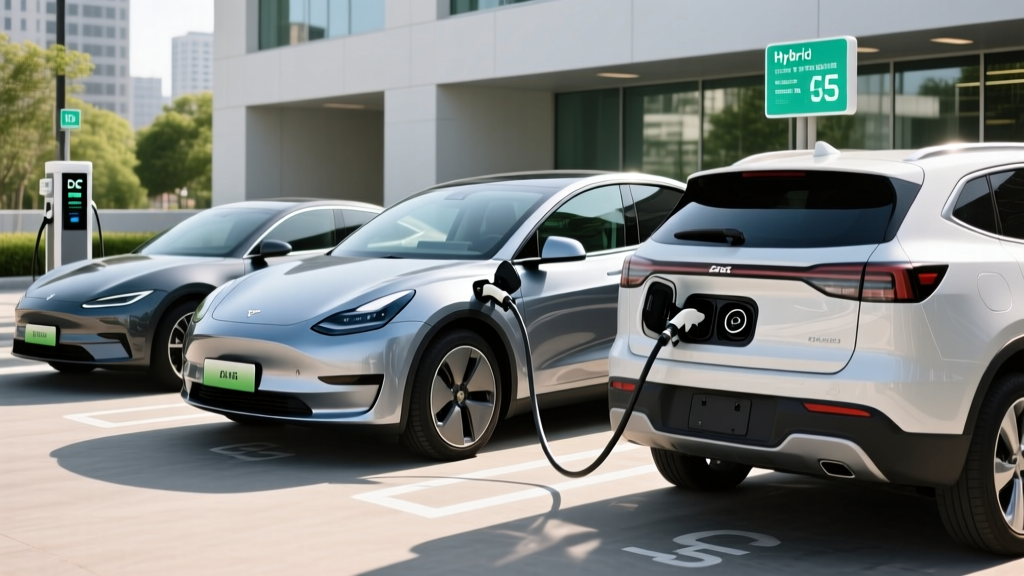
- Onboard charger and charge port repairs: If your car won't accept a charge or charges slowly, the onboard AC charger module or DC fast-charge contactor may be at fault — dealer-only diagnosis.
⚠️ High-Voltage Safety Warning
EV traction batteries store enough energy to be lethal. A 75 kWh pack at 400V contains roughly 300,000 joules of stored energy. Never open the battery enclosure, cut or pierce HV cabling, or work on the drive unit without proper HV de-energization training and CAT III/IV rated PPE. This isn't a 12V system — arc flash and electrocution are real risks.
EV Maintenance Costs vs. Gas Car: The Real Numbers
One of the strongest ownership arguments for EVs is reduced maintenance. The U.S. Department of Energy estimates EV maintenance costs at approximately $0.061 per mile vs. $0.101 per mile for a gasoline vehicle. Over 5 years and 75,000 miles, that's a $3,000 savings.
| Maintenance Item | EV Cost | Gas Car Cost | Notes |
|---|---|---|---|
| Oil changes | $0 | $375–$625 | 5–8 changes at $75 avg; EVs have no engine oil |
| Brake pads | $0–$200 | $400–$800 | Regen braking extends EV pad life 2–3x |
| Tires | $1,200–$1,800 | $800–$1,200 | EV tires cost more; heavier weight + torque = faster wear |
| Cabin air filter | $75–$150 | $75–$150 | Same interval; DIY saves ~$50 per change |
| Coolant flush | $150–$300 | $100–$200 | EV: every ~60k mi; Gas: every ~30k–50k mi |
| Transmission fluid | $0 | $150–$300 | Most EVs use a sealed single-speed reduction gear; no fluid service |
| Spark plugs / ignition | $0 | $200–$500 | Not applicable to EVs |
| Air intake / fuel filter | $0 | $75–$150 | Not applicable to EVs |
| Wiper blades / misc. | $100–$150 | $100–$150 | Identical |
| Total (5-year) | $1,525–$2,600 | $2,275–$3,875 | EV saves ~$1,000–$1,500 |
The tradeoff is tire cost. EV-optimized tires (like the Michelin Pilot Sport EV or Hankook iON) carry a 15–30% price premium over standard all-season tires. Plan for a $600–$900 tire replacement every 30,000–40,000 miles on an EV.
Tools You Need (and Don't Need) for EV DIY
If you're coming from gas-car wrenching, your existing toolkit covers about 80% of EV maintenance:
What You Already Have
- Sockets and ratchets (metric, 10mm–19mm)
- Torque wrench (critical for lug nuts and caliper bolts)
- Floor jack and jack stands (rated for your EV's weight — many EVs exceed 4,500 lbs, so use 3-ton minimum)
- Screwdrivers, trim removal tools
- OBD2 scanner (EV-compatible — see below)
What's Different for EVs
- EV-compatible OBD2 scanner: Standard ELM327 scanners read basic codes, but for EV-specific data (battery state of health, cell voltages, thermal management temps), you need a tool like the OBDLink SX (~$50) paired with apps like ABRP or EVNotify, or a mid-range scanner like the TOPDON ArtiDiag (~$200) that supports EV-specific PIDs.
- Insulated gloves (if inspecting near HV): Class 0 rated (1,000V) insulated gloves, ~$40–$60. You should never need to touch HV components, but if you're working in the vicinity of orange cabling, wear them.
- No need for: oil drain pans, funnel sets, spark plug sockets, fuel line disconnect tools, compression testers, or exhaust work tools.
Software Updates and Diagnostics: The Dealer Dependency
Modern EVs receive over-the-air (OTA) firmware updates that can improve range, charging speed, and ADAS behavior — Tesla, Rivian, Ford, and Hyundai/Kia all push OTA updates regularly. But some updates require a dealer visit, particularly those affecting the battery management system (BMS) or HV safety recalls.
For diagnostics, a dealer scan tool accesses proprietary systems that consumer OBD2 scanners can't reach. If your EV throws a HV isolation fault, a BMS cell-imbalance warning, or a thermal management code, the dealer is your only option. Under the IRS §30D clean vehicle credit rules and manufacturer warranty terms, HV system defects within the 8-year/100,000-mile window are covered at no cost.
Decision Framework: Should You DIY or Visit the Dealer?
If / Then Decision Guide for EV Maintenance
- IF the task involves cabin filters, wipers, washer fluid, 12V battery, or tire rotation → THEN DIY. Saves $150–$300/year in labor.
- IF you need brake pad inspection or replacement → THEN DIY if you've done it on a gas car before. Same caliper/rotor mechanics.
- IF the issue involves the charge port, onboard charger, or slow-charge fault → THEN dealer. HV system, proprietary diagnostics.
- IF you see an orange cable or HV warning light → THEN dealer immediately. Do not attempt to inspect or repair.
- IF you want to monitor battery health → THEN use an OBD2 scanner + app to log State of Health (SoH) quarterly. Dealer can provide a formal SoH report on request (often free during service visits).
- IF the repair is covered under the 8yr/100k battery warranty → THEN always dealer. Never pay out of pocket for a warrantied HV component.
Common Misconceptions About Working on EVs
| Myth | Fact |
|---|---|
| "You can't do anything yourself on an EV." | Cabin filter, wipers, tire rotation, brake inspection, 12V battery — all owner-serviceable. Dealers don't restrict these. |
| "EV batteries need regular maintenance." | Traction batteries are sealed, liquid-cooled, and maintenance-free. No electrolyte top-offs, no cell balancing by the owner. |
| "EV brakes don't need any attention." | Regen extends pad life, but caliper slide pins can corrode from disuse. Annual visual inspection and lubrication recommended. |
| "Working on an EV will void the warranty." | The Magnuson-Moss Warranty Act protects your right to perform your own maintenance. A DIY cabin filter change cannot void your battery warranty. |
| "You need special EV-only tools for everything." | Basic hand tools cover most tasks. The only EV-specific investment is an EV-compatible OBD2 scanner for health monitoring. |
Frequently Asked Questions
Can I change the coolant on my EV myself?
Technically possible, but not recommended. EV thermal management systems use specific coolant formulations (mixing the wrong type can damage battery cooling plates), and the system must be vacuum-filled to avoid air pockets. A dealer flush costs $150–$300 and is only needed every ~60,000 miles. Leave this one to the pros.
Do EVs need inspections in states that require them?
Yes, but EVs typically pass more easily. No emissions test applies. States like Pennsylvania and Virginia require annual safety inspections; EVs are checked for brakes, tires, lights, and suspension — all of which you can pre-inspect at home.
How do I check my EV battery's State of Health?
Use an OBD2 scanner with EV PID support to read SoH as a percentage. Most manufacturers define end-of-warranty as dropping below 70% of original capacity within 8 years / 100,000 miles. In practice, most modern NMC and LFP packs retain 85–92% capacity at 100,000 miles based on long-term fleet data.
Is it safe to jack up an EV?
Yes, but use the manufacturer-specified jack points (consult the owner's manual — EVs often have reinforced lift points to protect the under-floor battery pack). Never place a jack or jack stand directly against the battery enclosure. Use 3-ton rated stands minimum, given EV curb weights of 4,000–5,500 lbs.
What happens if I accidentally damage an HV cable?
Stop working immediately. Do not touch the cable or attempt a repair. Disconnect the 12V battery if safe to do so, move away from the vehicle, and call a tow to the dealer. HV cable repair requires certified technicians and can cost $500–$2,000+ depending on the harness. This is why the rule is simple: don't touch the orange wires.