The Short Answer on Building Your Own EV
If you're searching for how to build an EV car, you likely have one of two goals: converting a gas car to electric, or assembling a kit EV. A DIY EV conversion typically costs $8,000 to $30,000+ in parts alone (not including the donor vehicle or hundreds of hours of labor), yields 40–120 miles of real-world range, and requires significant fabrication, electrical, and programming skill. For most people, purchasing a new or used production EV delivers far more range, safety, reliability, and warranty protection at a comparable or lower total cost — especially with the current federal §30D tax credit potentially reducing a new EV's price by up to $7,500.
What "Building an EV" Actually Means in 2026
There are three realistic paths when someone asks how to build an EV car:
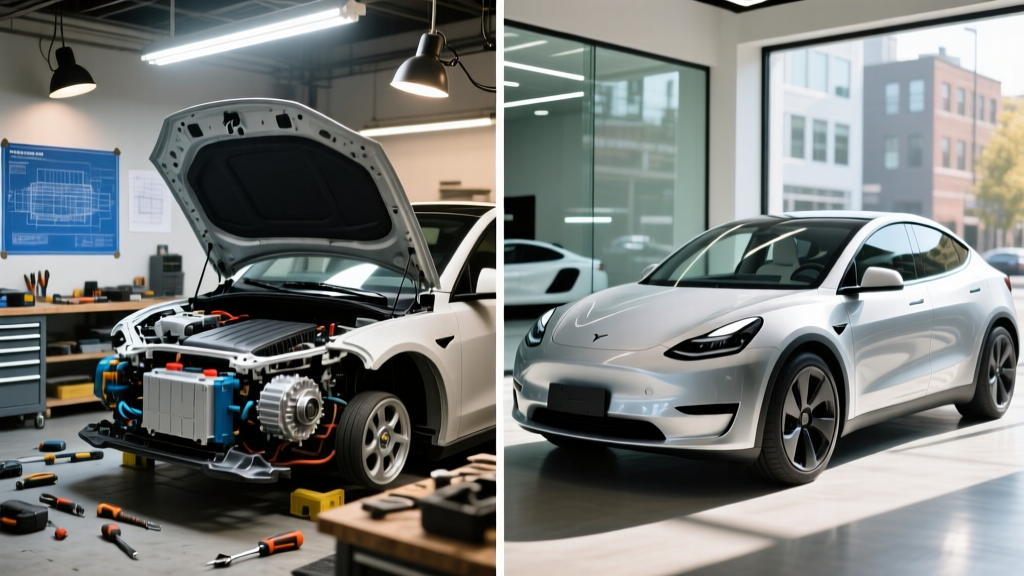
- DIY conversion: Removing the internal combustion engine, fuel tank, and exhaust from a donor vehicle and installing an electric motor, battery pack, controller, and charger. This is the most common interpretation.
- Kit car EV: Purchasing a purpose-built kit (like those from EV West or similar suppliers) that includes a chassis, motor, and battery, which you assemble. These are typically low-speed neighborhood vehicles or track toys, not highway-capable commuter cars.
- Scratch-built EV: Designing and fabricating a complete vehicle from raw materials — extremely rare, requiring engineering-level expertise, and generally not street-legal without extensive DOT/NHTSA certification.
The vast majority of searchers fall into the first category: converting a beloved classic car, truck, or project car to electric power. Let's focus there, because the numbers tell an important story.
Real Cost Breakdown: DIY EV Conversion
A conversion is not a weekend project. Here's what you're actually spending based on 2026 component pricing from major EV conversion suppliers:
| Component | Budget Build | Mid-Range Build | High-Performance Build |
|---|---|---|---|
| Electric motor (e.g., NetGain Hyper9, Tesla drive unit) | $1,500–$2,500 | $3,000–$5,000 | $5,000–$8,000 |
| Battery pack (LFP or salvaged NMC modules) | $2,000–$4,000 (20–30 kWh) | $5,000–$10,000 (40–60 kWh) | $10,000–$18,000 (70–100 kWh) |
| Motor controller | $800–$1,500 | $1,500–$3,000 | $3,000–$5,000 |
| Charger (Level 2 onboard) | $400–$800 | $800–$1,500 | $1,500–$2,500 |
| BMS (battery management system) | $300–$600 | $600–$1,200 | $1,200–$2,000 |
| DC-DC converter, wiring, contactors, fuses | $500–$1,000 | $1,000–$2,000 | $2,000–$3,500 |
| Thermal management (heating/cooling) | $200–$500 | $500–$1,500 | $1,500–$3,000 |
| Fabrication materials, mounts, adapters | $500–$1,500 | $1,500–$3,000 | $3,000–$5,000 |
| Total parts cost | $6,200–$12,400 | $13,900–$27,200 | $27,200–$47,000 |
Add the donor vehicle ($2,000–$15,000 depending on condition and model), and a realistic mid-range conversion lands between $16,000 and $42,000 total — before accounting for your labor, which typically runs 200–500 hours.
Range, Charging, and Performance: What a Conversion Actually Delivers
Here's where building an EV gets sobering compared to buying one. A mid-range conversion with a 40–60 kWh battery pack typically achieves:
Conversion Range Reality
Battery: ~50 kWh usable (salvaged NMC modules typical)
EPA-equivalent range: Not officially rated, but approximately 90–140 miles in mixed driving based on 3–4 mi/kWh efficiency typical of converted vehicles (which are heavier and less aerodynamic than purpose-built EVs)
Real-world highway range: Expect 65–100 miles at 70 mph — conversions lack the thermal management and aerodynamic optimization of production EVs
Cold-weather range: Losses of 25–40% are common without an active battery heating system, which most conversions lack
Charging: Most conversions support only Level 2 AC charging at 3.3–7.2 kW (adding 12–28 miles per hour). DC fast charging is extremely rare in conversions due to cost ($3,000–$6,000+ for the hardware alone) and the complexity of integrating CCS or NACS communication protocols with a custom BMS.
Compare this to a 2026 Hyundai Ioniq 6 SE with its 77.4 kWh battery: EPA-rated 361 miles of range, 800V architecture supporting DC fast charging at up to 235 kW (10–80% in ~18 minutes), and a starting MSRP around $38,650 — potentially $31,150 after the §30D credit if you qualify. The production vehicle delivers 2.5–4x the range, dramatically faster charging, a full factory warranty, crash-test certification, and modern ADAS features.
DIY Conversion vs. Buying a New EV: Side-by-Side
| Factor | DIY Conversion (Mid-Range) | New Production EV (e.g., Chevy Equinox EV, Ioniq 6) |
|---|---|---|
| Total cost (vehicle + build/purchase) | $16,000–$42,000+ | $30,000–$45,000 (before credit) |
| After federal tax credit | $0 (not eligible) | As low as ~$22,500–$37,500 |
| Real-world range | 65–140 miles | 250–360 miles |
| DC fast charging | Rarely available | 150–350 kW standard |
| 10–80% charge time (DC) | N/A typically | 18–35 minutes |
| Warranty | None (parts only) | 3yr/36k bumper-to-bumper; 8yr/100k battery |
| Safety certification | None (not crash-tested) | NHTSA/IIHS rated |
| Insurance | Difficult to insure; specialty carriers only | Standard carriers available (though premiums may be 10–20% higher than gas cars) |
| Resale value | Very low; niche market | Depreciating, but established market |
| Build/ownership labor | 200–500 hours build time + ongoing maintenance | Minimal |
The Tax Credit Problem for DIY Builds
A critical financial factor: DIY EV conversions do not qualify for the federal §30D Clean Vehicle Credit. This credit — worth up to $7,500 for new EVs and up to $4,000 for used EVs (under the 25E used vehicle credit) — applies only to vehicles with a VIN that meets IRS battery-sourcing, critical-mineral, MSRP cap, and buyer income requirements.
For 2026, the §30D credit requires:
- Vehicle MSRP at or below $55,000 (sedans) or $80,000 (SUVs/trucks/vans)
- Buyer AGI under $150,000 (single) / $300,000 (joint)
- Battery components and critical minerals meeting phased-in domestic sourcing thresholds
- Point-of-sale transfer available at participating dealers
A conversion doesn't meet any of these criteria. That $7,500 you'd save on a new EV effectively widens the cost gap between building and buying.
When Building an EV Actually Makes Sense
This isn't to say conversions are pointless. There are legitimate scenarios where building an EV is the right call:
Should You Build or Buy?
Build a conversion IF:
- You're converting a classic or collector car (1960s–1990s Porsche 911, VW Bus, old truck) where the goal is preservation + electrification, and the project's value is emotional/hobbyist, not purely economic
- You have professional-level fabrication, welding, and high-voltage electrical skills — or are willing to pay a conversion shop $30,000–$75,000+ for a turnkey build
- The vehicle will be a weekend/collector car, not your daily commuter requiring 200+ miles of reliable range
- You understand and accept the safety, insurance, and registration limitations
Buy a production EV IF:
- You need a reliable daily driver with 200+ miles of range
- You want DC fast charging for road trips
- You need a vehicle that's insurable at standard rates, crash-tested, and warrantied
- You want to take advantage of the §30D tax credit to reduce purchase cost
- You value your time — a conversion demands hundreds of hours; buying takes a dealership visit
Common Misconceptions About Building an EV
| Myth | Fact |
|---|---|
| "I can convert a car for $3,000" | Budget builds exist but typically use degraded salvaged battery cells with unpredictable lifespan, minimal range (30–50 miles), and no BMS protection — creating a fire risk. A safe, roadworthy conversion starts around $10,000+ in parts. |
| "It'll be cheaper than buying a new EV" | When you factor in the donor car, parts, tools, the lost §30D credit, and specialty insurance, most conversions cost $20,000–$45,000 — overlapping with new EV pricing, especially after incentives. A 2026 Chevy Equinox EV starts around $33,600 and may net ~$26,100 after the credit. |
| "Conversions are just as safe as production EVs" | Production EVs undergo extensive crash testing by NHTSA and IIHS, with engineered crumple zones, airbag integration, and high-voltage disconnect systems. Conversions have none of this certification. Battery placement in a conversion is often ad-hoc, and a collision could compromise a pack not designed for that chassis. |
| "I'll get Tesla-level performance" | A Tesla Model 3 Performance delivers 510 HP and a 3.1-second 0–60 mph time because of its integrated motor, inverter, battery, and thermal system engineered as one unit. Most conversions with a single NetGain or similar motor produce 100–250 HP. High-power builds are possible but push costs well past $40,000. |
| "I can register and insure it easily" | Registration varies wildly by state — some require special "converted vehicle" inspections, others have no clear pathway. Insurance requires specialty carriers (Hagerty, Grundy) and often costs more than a standard EV policy with less coverage. |
What a First-Time EV Buyer Should Know Instead
If your interest in building an EV comes from wanting to save money or understand the technology, here's what delivers more value:
On cost savings: A production EV charged at home on Level 2 (a 240V outlet or wallbox) costs roughly $0.04–$0.06 per mile in electricity depending on your utility rate (national average ~$0.17/kWh, ~3–4 mi/kWh efficiency). A comparable gas car at 28 MPG and $3.30/gallon costs $0.12 per mile. That's a $0.06–$0.08/mile savings, or roughly $720–$960 per year at 12,000 miles. Over five years, fuel savings alone can reach $3,600–$4,800 — and that's before factoring in reduced maintenance (no oil changes, fewer brake replacements due to regenerative braking, no transmission fluid).
On home charging: A Level 2 home charger installation typically costs $500–$2,000 for the equipment and electrician, assuming your electrical panel has capacity. If you need a panel upgrade (100A to 200A), add $1,500–$3,000. This is a one-time cost that makes daily EV ownership dramatically more convenient than relying on public charging.
On maintenance: According to fueleconomy.gov, EVs have lower estimated annual maintenance costs than gasoline vehicles — typically $0.061/mile for EVs vs. $0.098/mile for gas cars when combining fuel and maintenance. Over 5 years and 60,000 miles, that's a potential savings of $2,220+ on maintenance alone.
FAQ: Building vs. Buying an EV
Is it legal to convert a gas car to electric?
Yes, but registration requirements vary by state. Some states (like California) have specific procedures for registering converted vehicles through the BAR (Bureau of Automotive Repair) or DMV inspection process. Others may require a reconstructed vehicle title. Emissions testing is typically waived for EVs, but you'll need to prove the conversion was done safely. Check with your local DMV before starting a project.
How long does an EV conversion take?
For an experienced hobbyist working evenings and weekends, expect 6–18 months. Professional conversion shops typically quote 3–6 months for a turnkey build. First-time builders often take longer due to the learning curve around high-voltage systems, motor-controller programming, and custom fabrication.
Can I use Tesla batteries or motors in a conversion?
Salvaged Tesla drive units (from wrecked Model S, 3, or Y vehicles) are popular in conversions because of their power density and availability on the used market. However, integrating Tesla's proprietary BMS, communication protocols, and thermal management with an aftermarket controller is complex. Companies like EV West and OpenInverter offer adapter kits and documentation, but this is not a plug-and-play swap.
What's the cheapest production EV I can buy instead of building?
For 2026, the most affordable new EVs include the Nissan Leaf S (~$28,140 MSRP, 149-mile range) and the Chevy Equinox EV LT (~$33,600, ~315-mile range). If you qualify for the full $7,500 §30D credit, effective prices can drop to ~$20,640 and ~$26,100 respectively — competitive with or cheaper than many conversion projects, with vastly more range and a full warranty.
Are EV conversion kits worth it?
Conversion kits (from suppliers like EV West, Canadian EV, or Zero EV) simplify parts sourcing by bundling compatible motors, controllers, and hardware. They're worth it if you're committed to a conversion project and want to avoid component-mismatch headaches. But a kit alone typically costs $6,000–$15,000 before batteries, and you still need fabrication skills, a donor vehicle, and hundreds of hours of labor.