The Short Answer: How Efficient Are Electric Cars?
Electric cars convert roughly 75–85% of the energy stored in their battery into motion at the wheels. By comparison, a gasoline engine converts only about 12–30% of the energy in fuel — the rest is lost as heat, friction, and idle waste. In EPA terms, the most efficient EVs achieve 140+ MPGe (miles per gallon equivalent), while the average new EV sits around 100–120 MPGe. A typical midsize gas sedan averages 28–32 MPG combined.
But sticker MPGe doesn't tell the whole story. Real-world efficiency depends on highway speed, ambient temperature, battery preconditioning, and whether you charge at home or rely on public DC fast charging (which carries its own energy overhead). Below, we break down exactly what those numbers mean for your wallet and your daily driving.
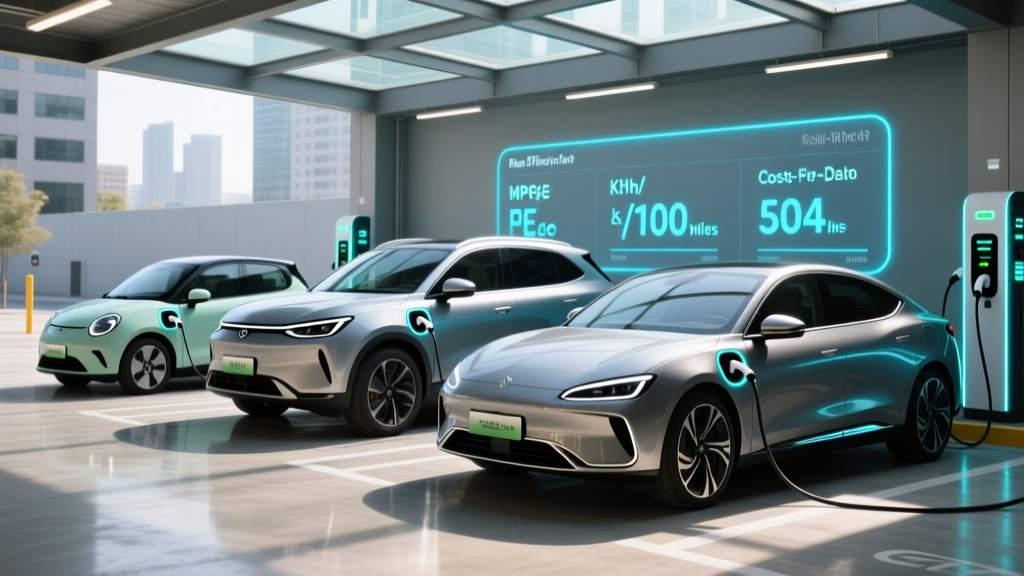
Understanding EV Efficiency: MPGe and kWh/100mi Explained
The EPA rates EV efficiency using two metrics:
- MPGe (miles per gallon equivalent): This translates electrical energy into a gasoline-equivalent number. One gallon of gasoline contains about 33.7 kWh of energy. So if an EV uses 33.7 kWh to travel 120 miles, it earns a 120 MPGe rating. Higher is better.
- kWh/100mi: This is the EV equivalent of liters-per-100km — it measures how many kilowatt-hours of energy the car consumes to travel 100 miles. Lower is better. Most efficient EVs consume 25–30 kWh/100mi; larger or performance-oriented models can hit 35–45 kWh/100mi.
MPGe is useful for cross-shopping against gas cars. kWh/100mi is more practical for calculating your actual charging costs, because your utility bills you per kWh, not per "gallon equivalent."
| Vehicle | MPGe (Combined) | kWh/100mi | Battery (kWh Usable) | EPA Range |
|---|---|---|---|---|
| Lucid Air Pure | 146 MPGe | 23 kWh | 88 kWh (NMC) | 419 mi |
| Tesla Model 3 RWD | 132 MPGe | 25 kWh | 57 kWh (LFP) | 272 mi |
| Hyundai Ioniq 6 SE | 140 MPGe | 24 kWh | 77.4 kWh (NMC) | 361 mi |
| Chevrolet Equinox EV 2LT | 112 MPGe | 30 kWh | 85 kWh (NMC) | 319 mi |
| Ford F-150 Lightning XLT | 70 MPGe | 48 kWh | 98 kWh (NMC) | 230 mi |
| Rivian R1S Dual-Motor | 76 MPGe | 44 kWh | 106 kWh (NMC) | 316 mi |
Source: fueleconomy.gov, EPA ratings for current model-year vehicles.
EV vs Gas vs Hybrid: Efficiency and Cost Compared
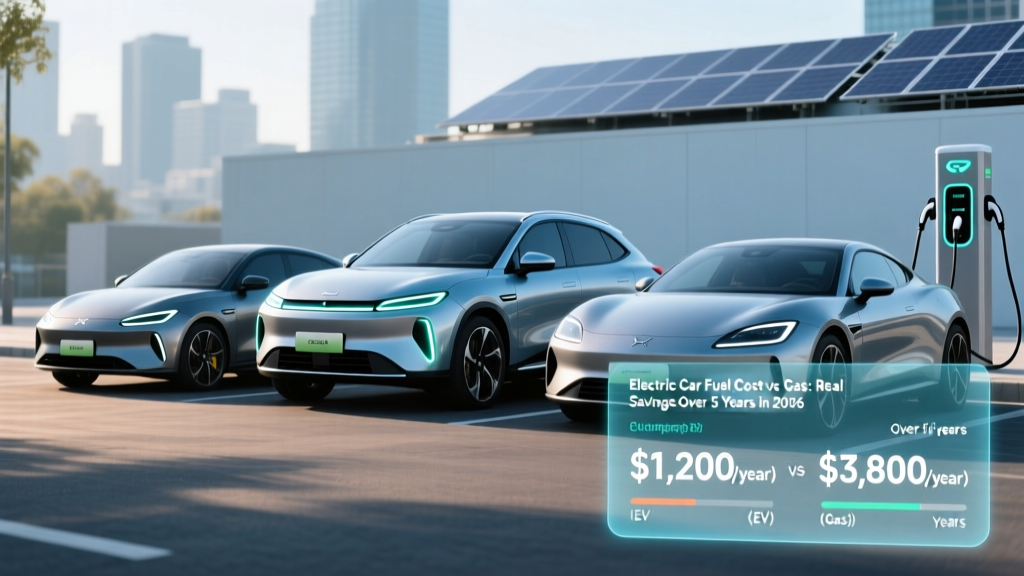
Efficiency only matters when you convert it to dollars. Let's compare a representative EV, a hybrid, and a gas-only sedan over 15,000 miles per year — the US average according to the Federal Highway Administration.
| Vehicle Type | Example | Efficiency | Energy Cost | Annual Fuel/Energy Cost |
|---|---|---|---|---|
| Efficient EV | Tesla Model 3 RWD | 25 kWh/100mi | $0.14/kWh (home avg) | $525 |
| Large EV | Ford F-150 Lightning | 48 kWh/100mi | $0.14/kWh (home avg) | $1,008 |
| Hybrid (HEV) | Toyota Prius LE | 57 MPG combined | $3.40/gal | $895 |
| Gas Sedan | Honda Civic 1.5T | 33 MPG combined | $3.40/gal | $1,545 |
| Gas Truck | Ford F-150 3.5L EcoBoost | 20 MPG combined | $3.40/gal | $2,550 |
Key assumptions: National average residential electricity rate of $0.14/kWh (EIA, 2025 data). National average regular gasoline at $3.40/gal. Public DC fast charging costs significantly more — typically $0.35–$0.55/kWh at networks like Electrify America and EVgo, which can push an efficient EV's cost to $1,312–$2,062 annually if you rely on DCFC exclusively.
This is the single biggest variable in EV ownership economics: home charging access changes everything. Charge at home on a Level 2 (240V) setup at residential rates, and you'll save $500–$2,000+ annually versus gas. Rely on public DC fast charging as your primary fuel source, and your "fuel" costs can equal or exceed a fuel-efficient hybrid.
Real-World Efficiency Losses: What the EPA Sticker Doesn't Show
The EPA test cycle produces useful comparative numbers, but it doesn't replicate every driving condition. Here's where real-world efficiency diverges:
Highway Speed
EVs are most efficient at 30–50 mph, where regenerative braking recaptures energy and aerodynamic drag is modest. At 75–80 mph, efficiency drops 15–25% compared to the combined EPA rating. A Tesla Model 3 rated at 25 kWh/100mi combined may consume 30–32 kWh/100mi at sustained 80 mph. Gas cars face the same drag penalty but are somewhat masked by their already-low efficiency baseline.
Cold Weather
Battery chemistry slows in cold temperatures, and cabin heating draws significant power (EVs have no waste heat from an engine to exploit). Expect 15–30% range and efficiency loss at temperatures below 32°F, and up to 40% loss below 10°F on short trips where the cabin and battery must heat from cold. Vehicles equipped with a heat pump (standard on many 2026 Hyundai, Kia, Tesla, and BMW models) reduce this penalty to roughly 10–20% by moving heat rather than generating it resistively.
Charging Overhead
When you plug in, not every kWh from the wall reaches the battery. Level 2 AC charging is roughly 85–90% efficient (meaning 10–15% is lost as heat in the onboard charger and battery). DC fast charging is more efficient at the vehicle level (90–95%), but the station itself draws additional power for cooling and conversion. These losses aren't reflected in the EPA's kWh/100mi figure, which measures from the battery, not the wall. Add roughly 10–15% to the EPA kWh/100mi number to estimate wall-to-wheels consumption.
Tire and Weight Factors
EVs are heavy — a Model Y tips the scales at 4,400 lbs, and an F-150 Lightning at over 6,000 lbs. That mass increases rolling resistance and tire wear. Many EV-specific low-rolling-resistance tires (like the Michelin e.Primacy or Hankook iON evo) improve efficiency by 3–5% versus standard all-season tires but may trade some wet-weather grip.
Total Cost of Ownership: Where EVs Win and Where They Don't
| Cost Category | Tesla Model 3 RWD ($38,990 MSRP) | Honda Civic 1.5T ($28,000 MSRP) |
|---|---|---|
| Purchase Price (after §30D credit) | $31,490 (if eligible) | $28,000 |
| Energy/Fuel (5 years) | $2,625 (home charging) | $7,725 |
| Maintenance (5 years) | ~$1,200 | ~$2,800 |
| Insurance (5-year avg) | ~$10,500 | ~$7,800 |
| Home Charger Install (Level 2) | $800–$2,000 (one-time) | $0 |
| Estimated Depreciation (5 yr) | ~$14,000 | ~$11,200 |
| Total 5-Year Cost | ~$60,615–$61,815 | ~$57,525 |
Where EVs save money: Energy costs (roughly $5,100 less over 5 years with home charging) and maintenance (no oil changes, fewer brake replacements due to regenerative braking, no spark plugs, no transmission fluid). EV brake pads often last 100,000+ miles because regen handles most deceleration.
Where EVs cost more: Insurance premiums run 15–30% higher on average due to repair costs for battery and sensor-laden body panels. Depreciation has been steeper for some EV models, though this is stabilizing as the market matures. Upfront purchase price is narrowing but still favors gas vehicles at the low end — though the federal §30D tax credit (up to $7,500, subject to MSRP caps, buyer income limits, and battery sourcing requirements) can flip the equation. Always verify current-year eligibility on IRS.gov, as critical mineral and component sourcing rules tighten annually.
Common EV Efficiency Myths — Fact-Checked
| Myth | Fact |
|---|---|
| "EVs are worse in winter, so they're not efficient." | Range drops 15–30% in deep cold, but EVs still convert energy more efficiently than gas cars. A gas car's engine also runs richer in cold and wastes energy idling to produce heat. An EV with a heat pump in 20°F weather still outperforms a gas car's energy conversion in the same conditions. |
| "The electricity comes from fossil fuels, so EVs aren't really clean." | Even on a coal-heavy grid, an EV's well-to-wheels emissions are lower than a gas car's, per EPA analysis. On the US average grid mix (2025), an EV produces roughly 60–70% fewer lifecycle emissions than a comparable gas sedan. As grids decarbonize, that gap widens. |
| "Highway driving ruins EV range." | Efficiency drops 15–25% at 75–80 mph versus combined rating — but this is a penalty shared with gas cars. A 300-mile EPA-rated EV still delivers 230–255 miles at highway speeds. Plan charging stops accordingly. |
| "EV batteries degrade fast and are expensive to replace." | Modern NMC and LFP batteries retain 85–92% capacity after 100,000 miles based on fleet data. Federal warranty requirements mandate 8 years/100,000 miles minimum at 70% capacity retention. Out-of-warranty replacement runs $8,000–$18,000 depending on pack size, but most packs outlast the vehicle. |
| "Charging takes too long to be practical." | At home on Level 2 (7–11.5 kW), you add 25–44 miles per hour of charging — more than enough to replenish a daily commute overnight. On a DC fast charger, modern EVs add 150–250 miles in 15–20 minutes (10–80% SoC). You'll spend more time inside the rest stop than at the plug. |
Decision Framework: Is an EV Efficient Enough for Your Situation?
Choose a battery EV (BEV) if:
- You have access to home or workplace Level 2 charging (this is the single biggest predictor of EV satisfaction).
- Your daily driving is under 80 miles round-trip (covers 90%+ of US commutes).
- You want the lowest per-mile energy cost and minimal maintenance.
- You live in a moderate or warm climate, OR your EV has a heat pump for cold-weather efficiency.
- You qualify for the §30D federal tax credit or state incentives that offset the purchase premium.
Choose a plug-in hybrid (PHEV) if:
- You can charge at home but regularly take trips exceeding 250+ miles where charging infrastructure is sparse.
- You want electric-only commuting (25–50 miles of EV range) without range concerns on road trips.
- You live in an apartment or street-parking situation where reliable daily charging isn't guaranteed.
Choose a conventional hybrid (HEV) if:
- You have no access to any charging (home, work, or reliable public).
- You want maximum efficiency with zero behavior change — no plugging in, no route planning.
- Your budget is under $30,000 and you need the lowest upfront cost with strong MPG.
Hold off on EVs if:
- You live in a recognized charging desert (rural routes with no DCFC within 50+ miles) AND regularly drive long distances.
- You tow heavy loads frequently — towing drops EV efficiency by 40–60%, cutting range in half or worse.
What First-Time EV Buyers Should Know About Efficiency
If you're transitioning from gas to electric, these practical points will shape your ownership experience:
- Install a Level 2 home charger before the car arrives. A 240V/48A hardwired unit (like a ChargePoint Home Flex or Wallbox Pulsar Max) costs $500–$800 for the equipment and $500–$1,500 for licensed electrician installation, depending on panel proximity and permit requirements. This single investment transforms EV ownership from a logistics challenge into a convenience — you wake up "full" every morning.
- Charge to 80% daily, 100% only for road trips. For NMC batteries, keeping daily charge between 20–80% State of Charge (SoC) maximizes long-term battery health. LFP batteries (found in base Tesla Model 3/Y and some Rivian trims) tolerate daily 100% charges better — check your owner's manual.
- Precondition your battery before DC fast charging. Most EVs do this automatically when you navigate to a charger. Preconditioning warms the battery to optimal temperature (roughly 85–95°F internally), enabling peak charge rates. A cold battery at a DCFC might accept only 40–50 kW instead of its rated 250 kW, doubling your stop time.
- Use the EPA rating as a ceiling, not a guarantee. Plan road trips assuming 80–85% of EPA range in mild weather and 65–75% in freezing conditions. Tools like A Better Routeplanner (ABRP) factor in elevation, temperature, and speed to estimate real-world consumption per segment.
- Understand the charge curve. DC fast charging peaks at low SoC and tapers significantly above 80%. A "10–80% in 18 minutes" spec is meaningful; a "0–100% in 45 minutes" number is not, because the last 20% can take as long as the first 60%. Plan to unplug at 80% on road trips and move on.
Frequently Asked Questions
How efficient are electric cars compared to gas cars in real-world driving?
In real-world mixed driving, a midsize EV consumes about 25–30 kWh per 100 miles, equivalent to roughly 112–135 MPGe. A comparable gas sedan achieves 28–35 MPG. On a per-mile energy cost basis, the EV costs $0.035–$0.042/mile on home electricity ($0.14/kWh), while the gas sedan costs $0.10–$0.12/mile at $3.40/gallon. The EV is roughly 3x cheaper to "fuel" per mile when charging at home.
Do electric cars lose efficiency in cold weather?
Yes. Expect 15–30% range and efficiency reduction below 32°F, and up to 40% below 10°F on short trips. A heat pump reduces this penalty to roughly 10–20%. Preconditioning the cabin and battery while still plugged in (using grid power, not battery) mitigates the loss significantly.
Is MPGe a useful number for comparing EVs?
MPGe is useful for comparing EVs against each other and against gas cars in a familiar unit. But for calculating your actual costs, kWh/100mi is more practical. Multiply kWh/100mi by your local electricity rate (per kWh) and divide by 100 to get your cost per mile.
How much does it cost to charge an EV at home versus public chargers?
Home Level 2 charging at the national average of $0.14/kWh costs about $3.50 to add 100 miles of range in an efficient EV (25 kWh/100mi). Public DC fast charging at $0.40/kWh costs about $10 for the same 100 miles. Public Level 2 chargers (often at workplaces, malls, or hotels) range from free to $0.25/kWh.
What affects an EV's efficiency the most?
The biggest factors, in order of impact: (1) ambient temperature and use of cabin heating/cooling, (2) driving speed (each 5 mph above 65 mph costs roughly 5–7% efficiency), (3) vehicle weight and cargo, (4) tire type and pressure, and (5) terrain/elevation changes. Regenerative braking partially recaptures energy on hilly routes, but sustained high-speed highway driving is the least efficient EV scenario.
Are heavier EVs like trucks and large SUVs still efficient?
Relative to their gas equivalents, yes — an electric truck still converts energy 3–4x more efficiently than a gas truck. But in absolute terms, a Ford F-150 Lightning at 48 kWh/100mi uses roughly twice the energy per mile as a Tesla Model 3 at 25 kWh/100mi. The cost savings versus gas are still substantial ($1,008/yr vs $2,550/yr), but the per-mile electricity cost is higher.