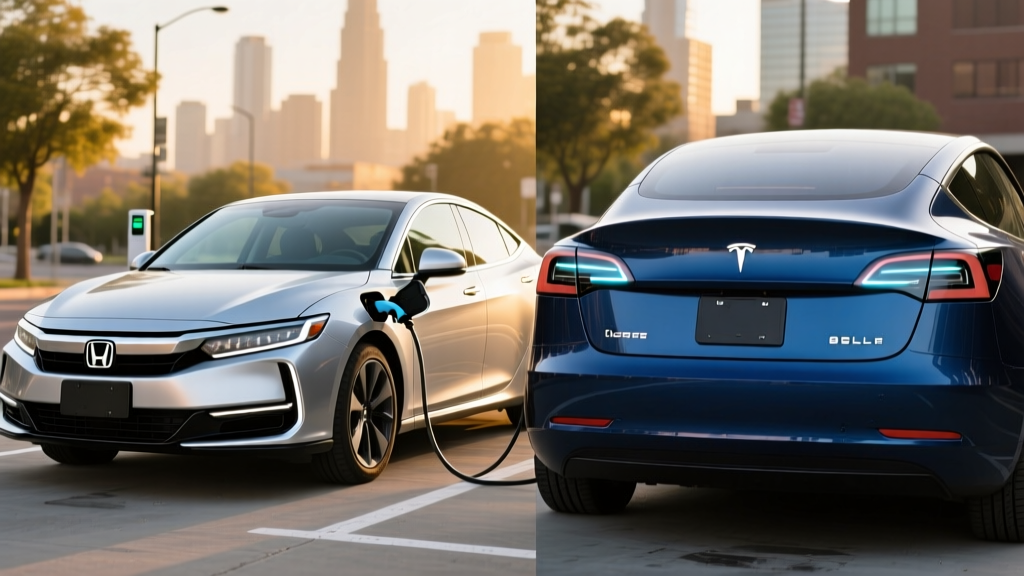
The Honda Clarity Plug-In Hybrid and Tesla Model 3 represent two fundamentally different philosophies for electrified commuting. One gives you a short electric leash with a gas-engine safety net; the other asks you to commit fully to the battery. Neither is universally better — the right choice depends on your daily miles, home charging access, and willingness to plan road trips around DC fast chargers.
This comparison uses the final model-year specs for the Clarity PHEV (discontinued after 2022 but widely available on the used market in 2026) against the current 2026 Tesla Model 3 Long Range. If you're shopping for a new electrified sedan and cross-referencing these two, here's every number that matters.
Side-by-Side Specs: Honda Clarity PHEV vs Tesla Model 3 LR
| Spec | Honda Clarity PHEV | 2026 Tesla Model 3 LR AWD |
|---|---|---|
| Powertrain | 1.5L I4 + electric motor (PHEV) | Dual-motor BEV (NMC battery) |
| Combined HP | 212 hp | ~346 hp |
| 0–60 mph | 7.5 sec | 4.2 sec |
| Battery (usable) | 17.0 kWh (NMC) | ~75.0 kWh (NMC) |
| EPA electric-only range | 47 mi | 341 mi |
| Gas-only range (full tank) | ~290 mi (10.6 gal) | N/A |
| Combined MPGe (electric) | 110 MPGe | 132 MPGe |
| Gas-only fuel economy | 42 mpg combined | N/A |
| Max DC fast charge | None (no DCFC port) | 250 kW peak (CCS/NACS) |
| Level 2 charge rate | 6.6 kW (J1772) | 11.5 kW (NACS) |
| 10–80% DC charge time | N/A | ~25 min |
| Full L2 charge time | ~2.5 hr | ~7 hr |
| Cargo volume | 15.5 cu ft | 21.0 cu ft (trunk + frunk) |
| Drivetrain | FWD | AWD |
| Base MSRP (original / 2026) | $33,400 (2022 MSRP) / ~$18K–$24K used | $47,490 (2026) |
| Federal tax credit (new purchase) | Up to $7,500 (when eligible, now expired for new) | Up to $7,500 via §30D (point-of-sale) |
| Used EV credit (§25E) | Up to $4,000 (income-capped) | N/A (new vehicle) |
| Battery / powertrain warranty | 8 yr / 100K mi (battery) • 5 yr / 60K mi (powertrain) | 8 yr / 120K mi (battery) • 4 yr / 50K mi (vehicle) |
Sources: EPA fueleconomy.gov – Honda Clarity PHEV, EPA fueleconomy.gov – 2025/2026 Tesla Model 3 LR AWD, Tesla specs.
Range and Efficiency: 47 Electric Miles vs 341
Honda Clarity PHEV: EPA 47 mi electric. Expect 35–42 mi on the highway or in cold weather (below 40°F). Once the battery depletes, the 1.5L engine delivers ~42 mpg — giving a total range of roughly 340 miles combined.
Tesla Model 3 LR: EPA 341 mi. Expect 270–300 mi at sustained 75 mph highway speeds; in freezing temps with cabin heat, plan for 230–260 mi. Efficiency drops sharply above 80 mph.
The Clarity's 47-mile electric range is ideal if your round-trip commute is under 40 miles and you can charge at home overnight. You'll burn zero gas on most weekdays. But take a 200-mile road trip and you're running the gas engine for 80% of the drive — albeit at a respectable 42 mpg.
The Model 3 LR's 341-mile EPA range means most drivers can complete a full work week without plugging in, provided daily driving stays under ~65 miles. On road trips, you'll rely on DC fast charging. Tesla's Supercharger network remains the most reliable public charging infrastructure in the U.S., with consistent plug-and-charge functionality that third-party networks still struggle to match.
Charging Speed and Infrastructure
| Level | Honda Clarity PHEV | Tesla Model 3 LR |
|---|---|---|
| Level 1 (120V, 1.4 kW) | ~4 mi/hr added | ~5 mi/hr added |
| Level 2 (240V) | 6.6 kW • ~18 mi/hr • full in ~2.5 hr | 11.5 kW • ~44 mi/hr • full in ~7 hr |
| DC Fast Charging | Not supported | 250 kW peak • 10–80% in ~25 min |
| Connector | J1772 (L2) | NACS (native Tesla / Supercharger) |
The Clarity has no DC fast charging capability — a significant limitation for anyone without reliable home Level 2 access. Its 6.6 kW onboard charger means a full charge takes about 2.5 hours on a 240V outlet, which is fine for overnight top-ups but means you can't meaningfully recharge during a lunch stop.
The Model 3 LR charges at up to 250 kW on a V3 Supercharger, though peak rate only holds between roughly 10–30% state of charge. Expect the curve to taper: 10–80% takes about 25 minutes, but 80–100% can add another 20+ minutes. Preconditioning the battery via the car's navigation routing to a Supercharger is essential for hitting peak rates — skip it and your charge speed may halve.
Price, Tax Credits, and True Cost to Buy
Clarity (used): The federal §25E used EV credit offers up to $4,000 (30% of sale price) for qualifying used PHEVs/BEVs. Requirements: sale price ≤$25,000, buyer AGI ≤$75K single / $150K married, purchased from a licensed dealer. A Clarity PHEV at ~$20,000 from a dealer could net $4,000 off at point of sale.
Model 3 (new): The §30D new clean vehicle credit offers up to $7,500, transferable to the dealer at point of sale. Eligibility depends on buyer AGI (≤$150K single / $300K married), MSRP ≤$55,000 for sedans, and battery critical-mineral/sourcing requirements that change annually. Verify current-year rules on IRS.gov before purchase.
A used Clarity PHEV at $20,000 minus a $4,000 credit lands at roughly $16,000 effective. A new Model 3 LR at $47,490 minus $7,500 (if eligible) comes to $39,990. That's a $24,000 gap — enough to cover roughly six years of fuel and insurance differences.
However, if you're shopping new vehicles only, the Clarity is no longer available. Honda discontinued it after 2022. The used market is your only path, which means accepting a vehicle with existing mileage, a battery that has already seen some degradation, and no new-car warranty.
Ownership Costs: Five-Year Breakdown
| Category | Honda Clarity PHEV | Tesla Model 3 LR |
|---|---|---|
| Purchase price (after credits) | ~$16,000 (used) | ~$39,990 (new) |
| Fuel / electricity (75K mi) | ~$4,200 (mix of electric + gas) | ~$3,000 (home L2 at $0.14/kWh) |
| Insurance (5 yr) | ~$7,500 | ~$10,500 |
| Maintenance (5 yr) | ~$3,500 (oil changes, engine service) | ~$1,800 (cabin filter, tires, wipers) |
| Depreciation (5 yr) | ~$6,000 | ~$16,000 |
| Estimated 5-yr total | ~$37,200 | ~$71,290 |
The Clarity's used-car depreciation curve is far gentler — it's already absorbed its biggest drop. The Model 3 depreciates in dollar terms much more, though Tesla's resale values have stabilized as the brand matures. Insurance for the Model 3 runs 30–40% higher than the Clarity due to repair costs and Tesla's higher collision-loss experience.
Maintenance favors the Model 3 heavily: no engine oil, no spark plugs, no transmission fluid. The Clarity's 1.5L Atkinson-cycle engine still requires conventional ICE maintenance on top of the electric drivetrain.
Category Winners
Pros and Cons at a Glance
Honda Clarity PHEV
Pros:
- Ultra-low effective price (~$16K after credit)
- Zero range anxiety — gas backup everywhere
- 47 mi covers most daily commutes on electricity
- Comfortable ride, quiet cabin, Honda reliability
- No home charger required (can use 120V)
Cons:
- Discontinued — used market only, limited supply
- No DC fast charging
- Modest performance (212 hp, 7.5 sec 0–60)
- Smaller trunk due to battery placement
- Dated infotainment and ADAS tech
- Still requires gas-engine maintenance
Tesla Model 3 LR AWD
Pros:
- 341-mi EPA range eliminates most charging stops
- 250 kW DCFC + Supercharger network = easy road trips
- Strong performance (346 hp, 4.2 sec, AWD)
- OTA updates keep the car current
- Minimal maintenance, low running costs
- Spacious trunk + frunk
Cons:
- $40K+ even after tax credit
- Insurance costs 30–40% more
- Requires reliable home or workplace charging
- Real-world highway range ~270–300 mi, less in cold
- Minimalist interior isn't for everyone
- Repair costs and wait times can be high
Decision Framework: Which Should You Choose?
Choose the Honda Clarity PHEV if:
- Your budget is under $25,000 and you want electrification now
- Your daily commute is under 40 miles round-trip
- You take frequent road trips and don't want to plan around chargers
- You lack reliable home Level 2 charging (120V is enough for the Clarity)
- You prefer a traditional sedan feel with physical buttons and a familiar drivetrain
Choose the Tesla Model 3 LR if:
- You want to eliminate gas purchases entirely
- You have home Level 2 charging or reliable workplace charging
- You value performance, AWD, and modern tech
- You drive 50+ miles daily and want a large battery buffer
- You take road trips but are comfortable using the Supercharger network
- You want a new vehicle with a full warranty and OTA improvements
Frequently Asked Questions
Is the Honda Clarity PHEV still available in 2026?
No. Honda discontinued the Clarity after the 2022 model year. You can find them on the used market, typically priced between $18,000 and $24,000 depending on mileage and condition. Check battery state of health before purchasing — a dealer or independent shop with Honda diagnostic tools can read the traction battery's degradation percentage.
Can the Clarity PHEV charge at Tesla Superchargers?
No. The Clarity has no DC fast charging port at all — only a J1772 Level 2 inlet. It cannot use any DC fast charger, Tesla or otherwise. If you need fast public charging, the Clarity is not the right vehicle.
Which is cheaper to own over five years?
The used Clarity wins on total cost of ownership by a wide margin (~$37K vs ~$71K over 5 years), primarily because of the lower purchase price and gentler depreciation. The Model 3 recoups some of that gap through lower fuel and maintenance costs, but not enough to overcome the $24K purchase-price difference.
Does the Model 3 qualify for the full $7,500 tax credit?
It depends on your income, the vehicle's MSRP, and current-year battery sourcing rules. The Model 3 LR's MSRP is under the $55,000 sedan cap, and Tesla has worked to meet critical-mineral and battery-component requirements. However, these sourcing rules tighten annually. Always verify eligibility on IRS.gov and confirm with your tax professional before relying on the credit.
How much range does the Model 3 lose in winter?
Expect a 20–30% reduction in freezing temperatures (below 32°F). The EPA's 341-mile rating can drop to 230–260 miles in cold weather, especially with cabin heating. The Model 3's heat pump helps, but physics demands more energy to keep the battery warm and the cabin comfortable. Preconditioning while plugged in mitigates some of this loss.
Which is better for a one-car household?
The Clarity PHEV is the safer one-car choice if you regularly take trips beyond 200 miles or live in an area with sparse charging infrastructure. The gas engine eliminates all range planning. The Model 3 works as a sole vehicle if you have reliable home charging and are willing to add 20–30 minutes to road trips for Supercharger stops every 250 miles or so.