Quick Answer: The "Green Machine Huffy Electric" Isn't an EV
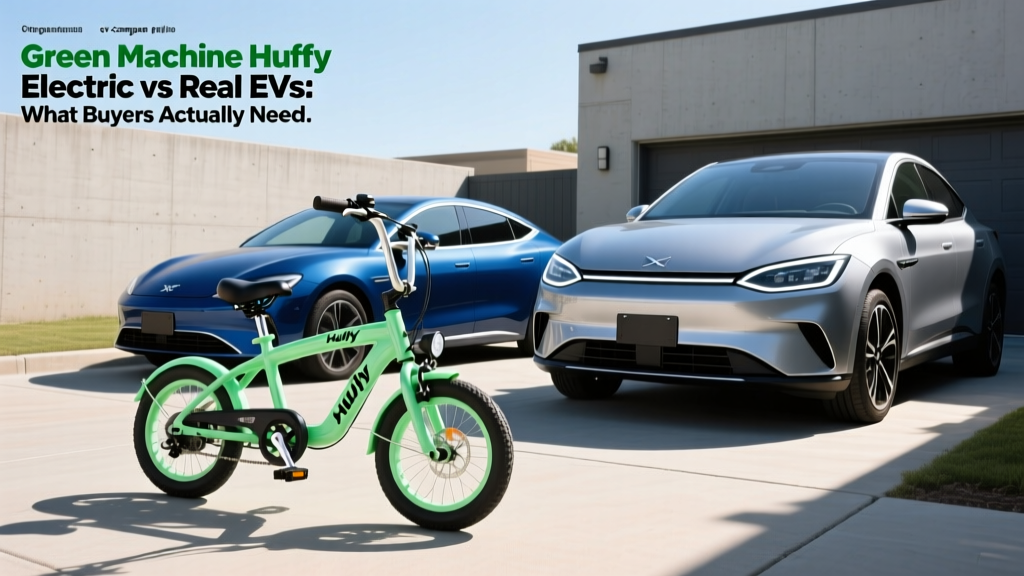
If you're searching for a Green Machine Huffy Electric, here's what you need to know: the Huffy Green Machine is a classic children's tricycle (a low-rider trike with a green frame and slick rear tires for drifting). Huffy has produced electric bicycles and ride-on toys, but there is no current production vehicle called the "Green Machine Huffy Electric" that qualifies as a street-legal electric car. If you're looking for an affordable electric vehicle, you'll want to look at actual EVs starting around $28,000–$38,000 before incentives — or consider an electric bicycle from Huffy or competitors if you need short-distance micro-mobility. Below, we'll cover what real EV ownership looks like in 2026 so you can make an informed decision.
What Is the Huffy Green Machine — and Why Are People Searching for an Electric Version?
The Huffy Green Machine debuted in the 1970s as a low-slung, three-wheeled tricycle designed for kids. Its signature feature was a pair of slick rear tires that allowed riders to spin out and drift on pavement. Over the decades, Huffy released updated versions, including larger models sized for teenagers and adults.
Huffy has also manufactured electric bicycles (e-bikes) sold through retailers like Walmart and Amazon, typically priced between $400 and $1,200 with hub motors in the 250W–500W range and ranges of 15–30 miles per charge. It's likely that search interest in a "Green Machine Huffy Electric" stems from a mix of nostalgia and curiosity about whether Huffy has electrified the iconic trike — or whether an affordable electric ride exists under that name.
The reality: Huffy does not currently produce a street-legal electric vehicle. Their product lines consist of conventional bicycles, e-bikes, children's ride-on toys, and the classic Green Machine trike (non-electric). If you want a real electric vehicle for daily transportation, you'll need to look elsewhere — and that's exactly what we'll help you navigate.
Real EV Ownership in 2026: Costs, Range, and Charging
If your search was motivated by wanting an affordable, efficient electric ride, let's talk about what real EV ownership looks like right now. The EV market in 2026 offers more sub-$40,000 options than ever, and the economics have shifted meaningfully in buyers' favor.
Current Entry-Level EV Pricing
Here's what the most affordable new EVs cost in 2026 before any federal or state incentives:
- Nissan Leaf S (40 kWh battery, 149-mile EPA range): ~$28,140 MSRP
- Chevrolet Equinox EV LT (85 kWh battery, 319-mile EPA range): ~$33,600 MSRP
- Hyundai Kona Electric SE (65 kWh battery, 261-mile EPA range): ~$32,975 MSRP
- Tesla Model 3 RWD (60 kWh LFP battery, 272-mile EPA range): ~$38,990 MSRP
These prices represent base trims. Adding options, destination charges, and dealer fees typically adds $1,000–$3,000.
Understanding the §30D Federal Tax Credit
The IRS §30D Clean Vehicle Credit can reduce your effective purchase price by up to $7,500, but eligibility is not universal. According to IRS guidelines, you must meet several requirements simultaneously:
- Income caps: Modified adjusted gross income (MAGI) must not exceed $150,000 (single), $225,000 (head of household), or $300,000 (joint filing).
- MSRP caps: Vans, SUVs, and pickups must have an MSRP at or below $80,000; sedans and other vehicles at or below $55,000.
- Battery sourcing: A percentage of critical minerals and battery components must be sourced from the U.S. or free-trade-agreement partners — requirements that tighten each year.
- Point-of-sale transfer: As of 2024, you can transfer the credit to the dealer at purchase, reducing your out-of-pocket cost immediately rather than waiting until tax filing.
Always verify current-year eligibility on the fueleconomy.gov tax credit page before committing to a purchase, as battery-sourcing compliance changes model by model and month by month.
| Category | EV (Chevy Equinox EV) | Gas (Toyota RAV4 AWD) |
|---|---|---|
| Purchase price (after incentives) | $28,600 | $32,500 |
| Fuel/energy (5 years) | $3,750 (home charging at $0.14/kWh) | $10,500 ($3.50/gal, 28 MPG) |
| Maintenance (5 years) | $1,800 | $4,200 |
| Insurance (5 years) | $9,500 | $7,800 |
| Estimated depreciation | $12,000 | $11,500 |
| Total 5-year cost | $55,650 | $66,500 |
Source: Author calculations based on EPA efficiency data, AAA maintenance cost averages, and current insurance rate surveys. Actual costs vary by state, driving habits, and electricity rates.
EV vs Gas vs Hybrid: Which Powertrain Fits Your Life?
Choosing between a battery-electric vehicle (BEV), a plug-in hybrid (PHEV), a conventional hybrid (HEV), or a gas-only car depends on your daily driving patterns, home charging access, and climate.
| Factor | BEV (e.g., Equinox EV) | PHEV (e.g., RAV4 Prime) | HEV (e.g., RAV4 Hybrid) | Gas (e.g., RAV4 AWD) |
|---|---|---|---|---|
| EPA range / MPG | 319 mi (113 MPGe) | 42 mi electric + 38 MPG gas | 39 MPG combined | 28 MPG combined |
| Home charging needed? | Essential | Highly beneficial | No | No |
| Annual fuel cost (15k mi) | $750 | $900–$1,400 | $1,340 | $1,875 |
| Maintenance complexity | Low (no oil, fewer moving parts) | Medium (two powertrains) | Medium | Higher |
| Tax credit potential | Up to $7,500 | Up to $7,500 | None (some state rebates) | None |
| Cold-weather range loss | 20–35% | Minimal (gas backup) | Minimal | Minimal |
Real-World Range: What the EPA Sticker Doesn't Tell You
EPA range estimates are measured under controlled conditions. In real-world driving, expect the following adjustments:
- Highway driving at 75+ mph: Subtract 10–20% from the EPA number. Aerodynamic drag increases with the square of speed, and EVs are less efficient at sustained highway speeds than in stop-and-go city traffic (where regenerative braking recovers energy).
- Cold weather (below 32°F): Subtract 20–35%. Battery chemistry slows in cold temperatures, and cabin heating draws significant energy. A heat pump (standard on many 2026 models from Hyundai, Tesla, and BMW) reduces this penalty to roughly 15–20%.
- Mountain driving: Uphill segments consume energy at 2–3x the rated rate, though downhill regenerative braking recovers some of it.
For a 319-mile EPA-rated Equinox EV, plan for roughly 250–270 miles of real-world highway range in moderate weather and 200–220 miles in deep winter conditions.
Home Charging: The Make-or-Break Factor for EV Ownership
Charging at home is where EVs deliver their biggest convenience and cost advantages — but not everyone has easy access. Here's what you need to know.
Charging Levels Explained
| Level | Power | Miles Added per Hour | Use Case |
|---|---|---|---|
| Level 1 (120V outlet) | 1.4 kW | 3–5 miles | Overnight top-up for PHEVs or low-mileage drivers |
| Level 2 (240V, home charger) | 7.2–11.5 kW | 25–44 miles | Daily home charging; full overnight recharge for most EVs |
| DC Fast Charging | 50–350 kW | N/A (10–80% in 18–45 min) | Road trips and quick top-ups |
Level 2 Home Charger Installation Costs
Most EV owners install a Level 2 charger at home. Here's what to budget:
| Item | Typical Cost Range |
|---|---|
| Level 2 charger unit (e.g., ChargePoint Home Flex, Emporia Vue) | $300–$700 |
| Electrician labor (240V circuit, 50-amp breaker) | $500–$2,000 |
| Electrical panel upgrade (if needed, 100A → 200A) | $1,500–$4,000 |
| Permit and inspection | $50–$300 |
| Total (no panel upgrade) | $850–$3,000 |
| Total (with panel upgrade) | $2,350–$7,000 |
Important: If you live in an apartment, condo, or street-parking-only situation, home charging may not be feasible. In that case, rely on workplace charging, public Level 2 chargers, or DC fast-charging networks like Electrify America, EVgo, or Tesla Superchargers. Factor in higher per-kWh costs at public chargers ($0.30–$0.55/kWh vs. $0.10–$0.18/kWh at home) before committing to an EV.
Common EV Myths — Addressed with Data
| Myth | Fact (with data) |
|---|---|
| "EV batteries need replacing every few years." | Federal law mandates battery warranties of at least 8 years / 100,000 miles. Most NMC and LFP batteries retain 85–92% capacity at 100,000 miles based on fleet data from Recurrent Auto. Replacement costs $5,000–$20,000 but is rarely needed within the vehicle's useful life. |
| "There aren't enough chargers." | As of 2026, the U.S. has over 200,000 public charging ports across networks like ChargePoint, EVgo, Electrify America, and Tesla Superchargers (now open to NACS-equipped non-Tesla EVs). Rural charging deserts still exist, but interstate corridor coverage is robust. |
| "EVs are worse for the environment because of battery mining." | Lifecycle analyses from the ICCT and Argonne National Laboratory consistently show that EVs produce 50–70% fewer lifetime greenhouse gas emissions than comparable gas cars, even accounting for battery manufacturing and regional grid mixes. As grids decarbonize, this advantage grows. |
| "EVs are slow and boring to drive." | Electric motors deliver instant torque. A Tesla Model 3 Performance does 0–60 mph in 2.9 seconds. Even the base Kona Electric hits 60 mph in ~6.5 seconds — comparable to many gas-powered sport compacts. |
| "I'll save money immediately." | Upfront EV costs remain higher than comparable gas cars, even after incentives. Savings accumulate over 3–5 years through lower fuel and maintenance costs. High-mileage drivers see payback fastest. |
Your EV Decision Framework: Should You Buy Electric in 2026?
If-Then Guide for First-Time EV Buyers
- IF you have access to home or workplace Level 2 charging AND drive under 250 miles per day → THEN a BEV is likely your best option. Choose a model with at least 250 miles of EPA range for buffer against cold weather and highway driving.
- IF you lack reliable home charging AND have no workplace charging → THEN a PHEV (like the Toyota RAV4 Prime or Hyundai Tucson PHEV) gives you electric-only commuting (30–42 miles) with a gas engine for longer trips, without range anxiety.
- IF you regularly drive 400+ miles in a single day or tow heavy loads → THEN a PHEV or efficient diesel/gas vehicle may still be more practical until DC fast-charging infrastructure and battery energy density improve further.
- IF you live in a cold climate (frequent sub-freezing temps) AND have home charging → THEN choose an EV with a heat pump and preconditioning capability. Plan for 20–30% range loss in winter and select a model with 300+ miles of EPA range.
- IF your budget is under $30,000 and you qualify for the §30D credit → THEN look at the Nissan Leaf, used EV market (eligible for up to $4,000 used-EV credit), or wait for upcoming affordable models from Chevrolet and Hyundai.
- IF you only need a short-distance ride for errands or campus commuting → THEN an e-bike (from Huffy, Rad Power, Lectric, or Trek) at $800–$2,000 may be a better fit than a full EV.
First-Time EV Buyer Checklist
Before signing a purchase agreement, verify the following:
- Charging access: Can you install a Level 2 charger at home, or do you have reliable workplace/public charging? Get a quote from a licensed electrician before buying.
- Tax credit eligibility: Check your MAGI, the vehicle's MSRP, and battery sourcing compliance on fueleconomy.gov. Consult a tax professional if your situation is complex.
- Insurance quotes: EV insurance premiums run 10–25% higher than equivalent gas cars on average. Get quotes from Geico, Progressive, State Farm, and Tesla Insurance (where available) before committing.
- Real-world range test: Take the EV on a route that mirrors your actual commute — highway speeds, hills, climate control on. Don't rely solely on the EPA number.
- Charging network apps: Download PlugShare, EVgo, Electrify America, and ChargePoint apps. Map out charging options along your most common routes.
- Battery warranty: Confirm the battery warranty terms (typically 8 years/100,000 miles with a capacity retention threshold of 60–70%). Read the fine print on what voids coverage.
Frequently Asked Questions
Does Huffy make any electric vehicles?
Huffy manufactures electric bicycles (e-bikes) and children's ride-on toys, but does not produce street-legal electric cars or trucks. Their e-bikes typically feature 250W–500W hub motors, 15–30 mile ranges, and retail for $400–$1,200. The Huffy Green Machine is a non-electric children's tricycle.
What's the cheapest real EV I can buy in 2026?
The Nissan Leaf S starts at approximately $28,140 MSRP with a 149-mile EPA range. If you qualify for the full §30D tax credit (up to $7,500), the effective price can drop to around $20,640. For longer range, the Chevrolet Equinox EV LT at ~$33,600 (319-mile range) offers strong value, particularly after incentives.
How much does it cost to charge an EV at home vs. buying gas?
At the U.S. average residential electricity rate of ~$0.16/kWh (EIA, 2025 data), charging a 65 kWh battery from empty to full costs about $10.40 — delivering roughly 250 miles of range. That's equivalent to $0.04 per mile. A gas car getting 28 MPG at $3.50/gallon costs $0.125 per mile — roughly three times more per mile driven.
Will an EV's battery need to be replaced?
Modern EV batteries (both NMC and LFP chemistries) are designed to last the life of the vehicle. Fleet data shows most batteries retain 85–92% of original capacity at 100,000 miles. Federal warranty requirements mandate coverage for at least 8 years/100,000 miles against defects and excessive degradation (typically below 60–70% capacity). Full battery replacement is rare and costs $5,000–$20,000 depending on the model.
Can I charge a non-Tesla EV at a Tesla Supercharger?
Yes — as of 2025–2026, Tesla has opened many Supercharger stations to non-Tesla EVs equipped with the NACS (North American Charging Standard) connector. Most major automakers (Ford, GM, Rivian, Hyundai, BMW, and others) have adopted NACS for their 2025+ models. Adapters are also available for CCS-equipped vehicles at select Tesla stations via the Magic Dock adapter built into the charger.