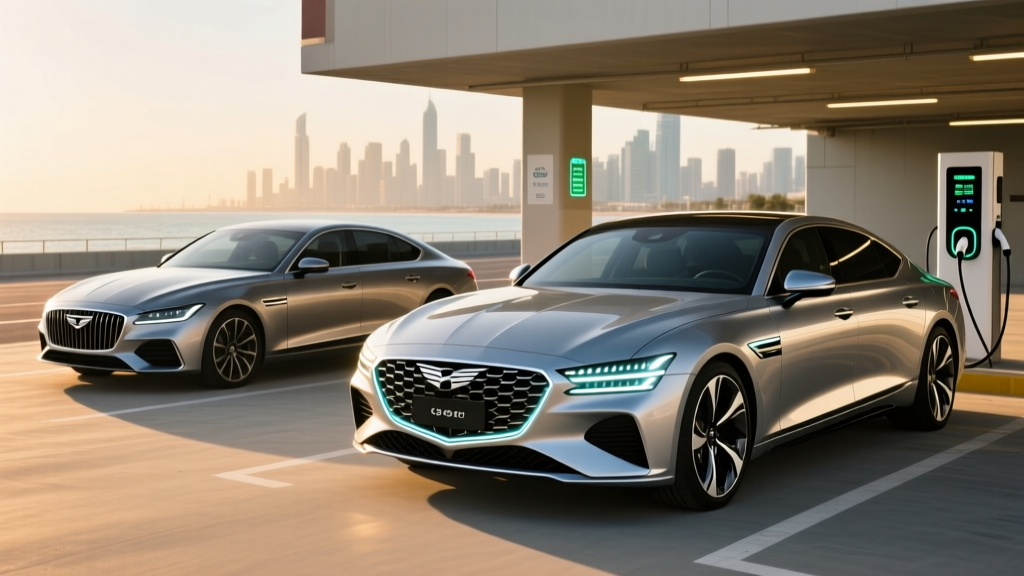
Quick Answer: The Genesis Electrified G80 delivers an EPA-estimated 282 miles of range from its 87.2 kWh battery, peaking at 350 kW DC fast charging (10–80% in ~22 minutes), starting around $79,850. It's a luxury EV aimed at buyers who want Bentley-adjacent refinement without the Tesla aesthetic. However, limited §30D federal tax credit eligibility due to battery sourcing and MSRP caps means most buyers pay full price. If you need 350+ miles of range or a lower entry price, rivals like the Lucid Air or BMW i5 may serve you better.
Genesis Electric Sedan Lineup: What's Available Now
Genesis currently offers one battery-electric sedan in the US market: the Electrified G80. The larger G90 flagship sedan remains gas-only (twin-turbo V6) or mild-hybrid as of the 2026 model year. An electric successor — widely expected to be called the Electrified G90 or a new nameplate — has been previewed through the Genesis Neolun concept but remains unannounced for production.
This matters because luxury sedan buyers cross-shopping Genesis often expect a full electric flagship. Right now, the Electrified G80 fills that gap, sitting between the smaller Electrified GV60 crossover and the GV70 Electrified SUV in the brand's BEV portfolio.
| Spec | Value |
|---|---|
| EPA Range | 282 miles |
| Battery (usable) | 87.2 kWh, NMC chemistry |
| Peak DC Fast Charge | 350 kW (800V architecture) |
| 10–80% DC Charge Time | ~22 minutes (optimal conditions) |
| Level 2 AC Charge Rate | 10.9 kW |
| Level 2 Full Charge Time | ~8.5 hours |
| Drivetrain | Dual-motor AWD |
| Horsepower / Torque | 365 hp / 516 lb-ft |
| 0–60 mph | 4.9 seconds |
| MPGe (combined) | 91 MPGe |
| Base MSRP (Advanced) | $79,850 |
| Battery/Powertrain Warranty | 10 years / 100,000 miles |
| Connector | CCS1 (NACS adapter available) |
Real-World Range Reality: The EPA sticker says 282 miles, but expect roughly 230–250 miles in sustained 75 mph highway driving. In freezing temperatures (below 32°F), range can drop 20–30%, bringing usable range to approximately 195–225 miles. The Electrified G80's heat pump helps mitigate cold-weather losses compared to EVs without thermal management, but physics still wins. Plan road trips around 200-mile legs for comfort.
Electrified G80 vs. Gas G80: Real Cost Comparison
The most common cross-shop is internal: gas G80 vs. Electrified G80. Here's how the numbers stack up over 5 years and 75,000 miles of mixed driving.
| Category | Electrified G80 (EV) | Gas G80 2.5T AWD |
|---|---|---|
| Base MSRP | $79,850 | $58,050 |
| Federal Tax Credit (§30D) | $0 (MSRP/sourcing limits) | $0 |
| Energy/Fuel Cost (5 yr) | ~$5,200 (home L2 avg $0.14/kWh) | ~$11,800 (premium $4.10/gal, 25 MPG) |
| Maintenance (5 yr) | ~$1,800 | ~$4,200 |
| Insurance (5 yr est.) | ~$14,500 | ~$12,000 |
| Estimated Depreciation | ~$36,000 | ~$24,000 |
| Total 5-Year Cost | ~$101,350 | ~$86,050 |
| Cost Per Mile | ~$1.35 | ~$1.15 |
The Electrified G80 saves roughly $6,600 in fuel and $2,400 in maintenance over five years. But the $21,800 higher purchase price and steeper depreciation (luxury EVs depreciate harder than established gas sedans) mean the gas G80 still wins on total cost. This isn't an efficiency play — it's a refinement and technology choice.
Sources: fueleconomy.gov, Genesis USA pricing.
How the Electrified G80 Stacks Up Against EV Rivals
The luxury electric sedan segment has expanded significantly. Here's how the Genesis compares on the metrics that matter most:
| Vehicle | EPA Range | Battery | Peak DC kW | 10–80% | 0–60 | Base MSRP |
|---|---|---|---|---|---|---|
| Genesis Electrified G80 | 282 mi | 87.2 kWh NMC | 350 kW | ~22 min | 4.9s | $79,850 |
| BMW i5 eDrive40 | 295 mi | 84.3 kWh NMC | 205 kW | ~30 min | 5.7s | $67,795 |
| BMW i5 M60 | 256 mi | 84.3 kWh NMC | 205 kW | ~30 min | 3.7s | $85,095 |
| Lucid Air Pure | 419 mi | 88 kWh NMC | 220 kW | ~28 min | 5.2s | $69,900 |
| Mercedes EQE 350+ | 305 mi | 90.6 kWh NMC | 170 kW | ~32 min | 6.2s | $75,050 |
| Tesla Model S LR | 402 mi | 100 kWh NMC | 250 kW | ~25 min | 3.1s | $74,990 |
Where Genesis wins: The 800V architecture enables 350 kW peak charging — faster than every rival listed except the Porsche Taycan. Interior materials and cabin quietness rival vehicles costing $30K more. The 10-year/100,000-mile battery warranty also outpaces BMW (8/80K), Mercedes (8/100K), and Tesla (8/120K but with a 70% retention threshold).
Where Genesis loses: Range. At 282 miles EPA, the Electrified G80 trails the Lucid Air Pure by 137 miles, the Model S by 120 miles, and even the BMW i5 eDrive40 by 13 miles. Efficiency at 91 MPGe also lags behind the Lucid Air Pure (146 MPGe) and Model S (124 MPGe). If maximizing miles per charge is your priority, Genesis isn't the answer.
Charging the Electrified G80: Home and Public Realities
The 800V electrical architecture is the Electrified G80's strongest technical feature. At a compatible 350 kW DC fast charger (like Electrify America's latest stalls), the charge curve peaks near 350 kW up to roughly 40% SoC, then tapers progressively. Expect the 10–80% sprint in about 22 minutes under ideal battery preconditioning. However, most public chargers in the US still max out at 150 kW, where you'll see a 10–80% time closer to 35–40 minutes.
Home charging setup: The 10.9 kW onboard charger means a 48-amp Level 2 circuit (hardwired, 60-amp breaker) delivers about 32 miles of range per hour of charging. An overnight 8-hour session adds roughly 250 miles — enough to replenish nearly a full battery. Expect a home Level 2 installation to cost between $800 and $2,500 depending on panel capacity and run distance from your electrical panel to the garage. If your home has a 100-amp service panel, a panel upgrade to 200 amps can add $1,500–$3,500.
| Component | Low Estimate | High Estimate |
|---|---|---|
| Level 2 Charger (48A) | $500 | $750 |
| Electrician Labor (240V run) | $300 | $1,500 |
| Permit / Inspection | $50 | $250 |
| Panel Upgrade (if needed) | $0 | $3,500 |
| Total | $850 | $6,000 |
NACS vs. CCS: The Electrified G80 ships with a CCS1 port. Genesis provides a NACS adapter for Tesla Supercharger access, but native NACS ports are expected on future Genesis EV models. For 2026, the adapter solution works reliably at V3 and V4 Superchargers.
Federal Tax Credit: Why Most Buyers Won't Qualify
The IRS §30D clean vehicle credit offers up to $7,500 for qualifying new EVs. However, the Electrified G80 faces two disqualifying hurdles:
- MSRP Cap: Sedans are capped at $55,000. The Electrified G80 starts at $79,850 — well over the limit. (SUVs/trucks have an $80,000 cap, but the G80 is classified as a sedan.)
- Battery Sourcing: Critical minerals and battery component requirements under the Inflation Reduction Act have tightened annually. As of 2026, battery components must be manufactured or assembled in North America, and critical minerals must be sourced from the US or FTA partners. The Electrified G80's battery supply chain does not currently meet these thresholds.
- Buyer Income Limits: Even if the vehicle qualified, AGI caps apply ($150K single / $300K joint filers).
Bottom line: Budget the full MSRP. No federal credit applies. Some states offer separate EV rebates (California's CVRP, Colorado's innovative motor vehicle credit, etc.), but these vary by jurisdiction — check your state's energy office for current programs.
Common Misconceptions About the Genesis Electrified G80
| Myth | Fact |
|---|---|
| "It's just a gas G80 with batteries bolted in." | The Electrified G80 uses a dedicated EV platform adaptation with a flat battery floor, dual-motor AWD, 800V architecture, and unique suspension tuning. It's heavier (~5,200 lbs vs. ~4,300 lbs gas), but the low center of gravity improves handling composure. |
| "350 kW charging means 20 minutes everywhere." | Peak 350 kW requires a compatible charger AND battery preconditioning. At ambient 150 kW chargers (the majority of US public infrastructure), expect 35–40 minutes for 10–80%. Always precondition via the navigation-routed charging feature. |
| "EVs are cheaper to own than gas cars." | For luxury vehicles with high MSRPs and no tax credit, total cost of ownership often favors the gas variant due to depreciation and purchase price. EVs win on per-mile energy cost, but the upfront gap matters. Run your own numbers. |
| "The battery will need replacing in 8 years." | Genesis warranties the battery for 10 years/100,000 miles with a 70% capacity retention threshold. Industry degradation data for NMC batteries shows typical 10–15% loss over 150,000 miles. Replacement is rare and covered under warranty if capacity falls below threshold. |
| "Genesis dealer service can't handle EVs." | Genesis requires EV-certified service centers for high-voltage work. Not all dealerships have this certification — confirm your local dealer's EV service capability before purchase. Routine maintenance (cabin filter, tire rotation, brake fluid) can be done at any certified location. |
Decision Framework: Is the Genesis Electric Sedan Right for You?
Choose the Genesis Electrified G80 if:
- You prioritize cabin luxury, materials, and quietness above range maximization
- You have reliable home Level 2 charging and drive under 200 miles daily
- You want 800V fast-charging capability for road trips along Electrify America corridors
- You value a 10-year battery warranty and don't plan to trade within 3 years (avoiding the steep initial depreciation hit)
- You prefer a traditional luxury sedan design over tech-forward styling (Tesla, Lucid)
Look elsewhere if:
- Range is your top priority — the Lucid Air Pure (419 mi EPA, $69,900) delivers far more miles per dollar
- You need a federal tax credit to justify the purchase — the $55K sedan MSRP cap eliminates the G80
- You live in a charging desert with no reliable DC fast charging and no home charging option
- You want the fastest acceleration in the segment — the Tesla Model S (3.1s 0–60) and BMW i5 M60 (3.7s) are significantly quicker
- You plan to sell or trade within 2–3 years — luxury EV depreciation remains steep, and the G80 is no exception
Frequently Asked Questions
Does Genesis make a fully electric G90 sedan?
Not as of the 2026 model year. The G90 remains available with a twin-turbo V6 or mild-hybrid powertrain. An electric flagship sedan has been previewed through concepts but has no confirmed production timeline or US release date.
How much does it cost to charge the Electrified G80 at home vs. public chargers?
At a national average residential rate of $0.14/kWh, a full charge (87.2 kWh) costs approximately $12.20 — yielding about 282 miles of range. Public DC fast charging averages $0.35–$0.50/kWh depending on the network, bringing a 10–80% session to roughly $21–$30. Over a year of 12,000 miles, home charging costs about $580 while exclusive public DC charging would cost $1,500–$2,100.
Can I use Tesla Superchargers with the Electrified G80?
Yes, using the Genesis-provided NACS adapter. The adapter is compatible with Tesla V3 (250 kW) and V4 Superchargers. Charging speed will be limited by the adapter's throughput and the Supercharger's maximum output. Expect peak rates around 150–200 kW via adapter.
What happens if the battery degrades past the warranty threshold?
If your Electrified G80's battery falls below 70% of original capacity within 10 years or 100,000 miles, Genesis will repair or replace the battery at no cost. Out-of-warranty battery replacement for a pack this size typically ranges from $15,000 to $22,000 at current market rates, though prices are expected to decline as battery manufacturing scales.
Is the Electrified G80 eligible for any state EV incentives?
State incentives vary widely. Some states (Colorado, for example) offer credits that stack with or replace the federal credit and may not have the same MSRP caps. Check your state's department of energy or revenue website for current programs, and consult a tax professional for eligibility specifics.
How does the Electrified G80 handle in cold weather?
The heat pump system helps preserve range compared to EVs relying solely on resistive heating. Expect 20–30% range reduction in sustained sub-freezing temperatures, bringing real-world range to roughly 195–225 miles. DC charging speeds also slow in cold weather unless you precondition the battery via the infotainment navigation system before arriving at the charger.