Genesis All-Electric: The Quick Verdict
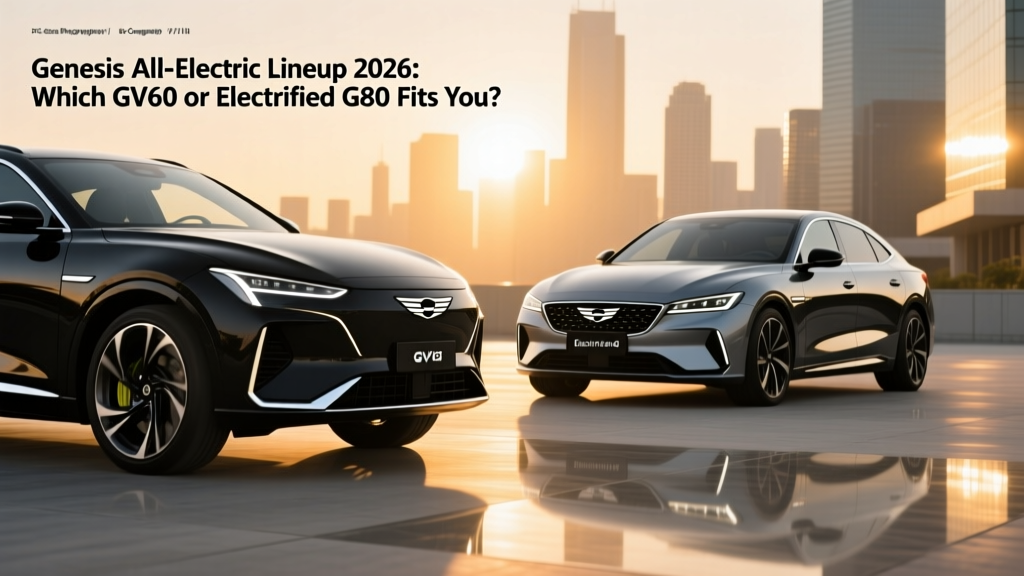
Genesis currently sells three all-electric vehicles in the U.S.: the GV60 compact crossover (EPA 248–294 miles, starting ~$53,350), the Electrified GV70 midsize SUV (EPA 236 miles, starting ~$67,550), and the Electrified G80 full-size sedan (EPA 282 miles, starting ~$80,300). All three ride on Hyundai Motor Group's E-GMP platform (except the G80, which is a converted ICE chassis), share 800V architecture for fast DC charging, and come with a 10-year/100,000-mile battery warranty. The GV60 is the strongest value play; the Electrified G80 is a luxury statement with compromises in cargo and efficiency. None currently qualify for the full §30D federal tax credit due to battery-sourcing rules — always verify current IRS eligibility before purchasing.
Genesis All-Electric Models at a Glance
Genesis has committed to going fully electric by 2030, but as of the 2026 model year, the lineup consists of three production EVs plus the upcoming GV70 redesigned on a dedicated EV platform. Here's how the current three stack up on paper:
| Spec | 2026 GV60 | 2026 Electrified GV70 | 2026 Electrified G80 |
|---|---|---|---|
| Body Style | Compact Crossover | Midsize SUV | Full-Size Sedan |
| Platform | E-GMP (dedicated EV) | E-GMP (dedicated EV) | M3 (converted ICE) |
| Battery (usable) | 77.4 kWh, NMC | 77.4 kWh, NMC | 87.2 kWh, NMC |
| EPA Range | 248–294 mi | 236 mi | 282 mi |
| Drivetrain | RWD or AWD | AWD only | AWD only |
| Horsepower | 225–490 hp | 429 hp (Boost) | 365 hp |
| 0–60 mph | 3.9–7.3 sec | 4.2 sec | 4.9 sec |
| Peak DC Charge | ~240 kW | ~240 kW | ~175 kW |
| 10–80% DCFC | ~18 min | ~18 min | ~22 min |
| Level 2 Rate | 10.9 kW | 10.9 kW | 10.9 kW |
| Base MSRP | $53,350 | $67,550 | $80,300 |
| Battery Warranty | 10 yr / 100,000 mi | 10 yr / 100,000 mi | 10 yr / 100,000 mi |
Sources: Genesis USA GV60, fueleconomy.gov. Specs reflect 2026 model year where published; some trims may vary.
Real-World Range: What the EPA Sticker Doesn't Tell You
EPA range estimates are tested under controlled conditions. In real-world ownership, you'll see variance based on speed, temperature, and terrain. Here's what to expect from each Genesis EV beyond the sticker:
GV60 (294-mi EPA, RWD Standard Range)
Highway (70–75 mph, 65°F): ~240–260 miles
Cold weather (30°F, mixed driving): ~200–220 miles
Realistic daily expectation: Plan around 250 miles for comfortable road-trip legs.
Electrified GV70 (236-mi EPA)
Highway (70–75 mph, 65°F): ~195–215 miles
Cold weather (30°F, mixed driving): ~165–185 miles
Realistic daily expectation: This is the range-constrained model in the lineup. The GV70's boxy SUV profile and AWD-only drivetrain hurt efficiency. Plan charging stops every 180 miles on road trips.
Electrified G80 (282-mi EPA)
Highway (70–75 mph, 65°F): ~235–255 miles
Cold weather (30°F, mixed driving): ~200–220 miles
Realistic daily expectation: The larger 87.2 kWh battery helps, but the heavy converted-ICE chassis limits efficiency to ~2.9–3.2 mi/kWh.
All three models support preconditioning — the battery warms itself when you navigate to a DC fast charger, which is critical for achieving peak charge speeds in cool weather. Without preconditioning, a cold battery at 40°F might only accept 80–100 kW instead of the rated 240 kW.
Charging Speeds: The 800V Advantage
The GV60 and Electrified GV70 use Hyundai Motor Group's 800V E-GMP architecture, which allows peak DC charge rates around 240 kW at compatible stations (350 kW Electrify America or Tesla Supercharger stalls with a NACS adapter). The Electrified G80, on its older 400V converted platform, peaks closer to 175 kW.
| Charging Level | Power (kW) | GV60 / GV70 (mi/hr added) | G80 (mi/hr added) |
|---|---|---|---|
| Level 1 (120V outlet) | ~1.4 kW | ~4–5 mi/hr | ~4–5 mi/hr |
| Level 2 (240V, 48A) | 10.9 kW | ~32–36 mi/hr | ~30–34 mi/hr |
| DC Fast (350 kW station) | Up to 240 kW (GV60/GV70) / 175 kW (G80) | 10–80% in ~18 min | 10–80% in ~22 min |
Charging curve reality check: The "18-minute" claim applies to the 10–80% state-of-charge window. Above 80%, charge speed tapers aggressively to protect the battery — expect 80–100% to take an additional 15–20 minutes. For road trips, plan to charge to 80% and move on; it's faster than waiting for a full battery.
Home charging setup: All three come with a portable Level 1/2 cord. For daily ownership, you'll want a dedicated Level 2 wallbox (ChargePoint Home Flex, Emporia Vue, or Genesis-branded charger). Installation typically runs $800–$2,500 depending on your panel capacity and run length. Homes with 200A service usually handle a 48A charger without a panel upgrade; 100A panels may require a $1,500–$3,000 upgrade. Always get a quote from a licensed electrician before committing.
Genesis EV vs. Gas and Hybrid: Cost of Ownership
Luxury buyers cross-shopping a Genesis EV often compare it against the gas-powered GV70 or GV80, or a hybrid alternative like the Lexus RX 350h. Here's how the numbers shake out over a 5-year / 75,000-mile ownership horizon:
| Cost Factor | Electrified GV70 (AWD) | Gas GV70 (2.5T AWD) | Lexus RX 350h (Hybrid) |
|---|---|---|---|
| Base MSRP | $67,550 | $50,550 | $52,550 |
| Est. Federal Tax Credit | $0–$3,750* | $0 | $0 |
| Fuel/Energy (75k mi) | $2,400–$4,200† | $8,900 | $5,600 |
| Maintenance (5 yr) | ~$800 | ~$2,800 | ~$2,200 |
| Insurance (5 yr avg) | ~$11,500 | ~$9,800 | ~$9,400 |
| Est. Depreciation (5 yr) | ~$28,000 | ~$21,000 | ~$19,500 |
| 5-Year Total Cost | ~$82,250–$88,250 | ~$72,250 | ~$70,250 |
*Tax credit eligibility depends on battery sourcing, buyer income, and MSRP caps per IRS §30D rules. As of early 2026, most Genesis EVs do not qualify for the full $7,500 due to critical-mineral and battery-component sourcing requirements. Verify before purchase.
†Energy cost range assumes $0.13–$0.22/kWh (home vs. public charging mix). Electrify America and similar networks charge $0.40–$0.56/kWh at peak rates.
Key takeaways:
- Energy savings are real but not overwhelming at luxury price points. Home charging at $0.14/kWh saves roughly $5,500–$6,500 over gas across 75,000 miles. Heavy reliance on public DC fast charging erodes savings significantly.
- Maintenance is genuinely cheaper — no oil changes, no transmission fluid, fewer brake replacements thanks to regenerative braking.
- Insurance runs 10–20% higher on EVs due to repair cost data. Get quotes before purchasing.
- Depreciation remains the wildcard. Luxury EVs have depreciated faster than gas counterparts in 2024–2025 due to price wars and rapid tech improvements. The Genesis brand carries less resale strength than Lexus or Porsche.
Federal Tax Credit and Incentives: What Genesis Buyers Actually Get
The §30D Clean Vehicle Credit offers up to $7,500 for qualifying new EVs, but Genesis models face hurdles:
§30D Eligibility Checklist for Genesis EVs (2026)
- MSRP Cap: SUVs ≤$80,000; sedans ≤$55,000 — the Electrified G80 exceeds the sedan cap and is ineligible
- Buyer Income Cap: AGI ≤$150,000 (single), ≤$300,000 (joint)
- Battery Sourcing: Critical minerals and battery components must meet phased-in domestic/free-trade-partner thresholds — most Genesis battery packs currently fall short
- Final Assembly: Must be in North America — GV60 and GV70 are assembled in South Korea (disqualifying); Electrified G80 is also South Korea-sourced
- Point-of-Sale Transfer: If eligible, the credit can be applied at the dealer as a price reduction rather than waiting for tax filing
Bottom line: As of early 2026, most Genesis EVs do not qualify for the federal credit due to both final-assembly location (South Korea) and battery-sourcing requirements. State and local incentives may still apply — check your state's energy office or AFDC state incentive database for details. Hyundai's Ioniq 5 (assembled in Georgia) qualifies more readily; if the tax credit is a dealbreaker, compare accordingly.
Myth vs. Fact: Common Genesis EV Misconceptions
| Myth | Fact |
|---|---|
| "The GV60 is just a fancy Ioniq 5." | They share the E-GMP platform and 77.4 kWh battery, but the GV60 has a unique interior, different suspension tuning, and Genesis-specific software. The driving experience and material quality are noticeably upgraded. |
| "Genesis EVs can't use Tesla Superchargers." | Starting in 2025, Hyundai Motor Group vehicles gained access to Tesla's NACS Supercharger network via adapter (included or available). As of 2026, new Genesis EVs ship with the NACS port natively on select trims, or use a CCS-to-NACS adapter. Confirm with your dealer. |
| "The battery will need replacing in 5 years." | E-GMP batteries have shown strong durability. Hyundai/Kia/Genesis covers the battery for 10 years/100,000 miles against capacity loss below 70%. Real-world data from Ioniq 5 fleets shows ~5–8% degradation at 60,000 miles. |
| "I can charge from 0–100% in 18 minutes." | The 18-minute claim is 10–80%. Charging from 0% takes longer due to low-SoC ramp-up, and 80–100% tapers significantly. Plan for ~30 minutes total for a near-full charge at a 350 kW station. |
| "All-electric means zero maintenance." | You still need tire rotations (EVs wear tires faster due to weight and torque), cabin air filter replacements, brake fluid checks, and wiper/washer service. Budget ~$150–$200/year for basic upkeep. |
Who Should Buy a Genesis All-Electric Vehicle?
Decision Framework: Which Genesis EV (If Any) Is Right for You?
Choose the GV60 if:
- You want the best value in the lineup (~$53k starting)
- You prioritize a dedicated EV platform with flat-floor packaging and a frunk
- Your daily commute is under 60 miles and you can charge at home
- You want 294 miles of EPA range (RWD trim) for occasional road trips
Choose the Electrified GV70 if:
- You need SUV cargo space and all-weather AWD confidence
- You're upgrading from a gas GV70 and want to keep the same form factor
- You accept the 236-mile range trade-off (the weakest in the lineup)
- Most of your driving is within 150 miles of home
Choose the Electrified G80 if:
- You want a full-size luxury sedan with executive rear-seat comfort
- Range (282 mi EPA) matters more than cargo versatility
- You're not price-sensitive (starts at $80k+ and doesn't qualify for §30D)
- You value ride quietness and material quality over sporty handling
Look elsewhere if:
- Federal tax credit eligibility is a priority — consider the Ioniq 5, Tesla Model Y, or Ford Mustang Mach-E
- You need 300+ miles of range for frequent road trips — the BMW iX or Tesla Model X offer more
- You lack home charging access and your area has sparse public DC infrastructure
- Resale value is a top concern — Lexus or Porsche EVs hold value better
What First-Time Genesis EV Buyers Should Know
If you're coming from a gas vehicle, here's what changes with a Genesis EV:
- Home charging is non-negotiable for most owners. Public-only charging is viable but adds 30–60 minutes per week and costs 2–3× more per mile. Confirm your garage or parking situation supports a Level 2 install before purchasing.
- Range planning replaces fuel stops. Use the Genesis Connected Services app or A Better Routeplanner (ABRP) to plan road trips. The built-in navigation will precondition the battery automatically when a DC charger is set as your destination.
- Regenerative braking changes how you drive. Genesis offers adjustable regen levels via paddle shifters. The highest setting enables near one-pedal driving in city traffic, recapturing energy that would otherwise be lost to friction brakes.
- Tire costs are higher. EVs are 500–800 lbs heavier than equivalent gas vehicles and deliver instant torque. Expect tire replacement every 25,000–35,000 miles. Budget $800–$1,400 for a set of four EV-rated tires (Hankook iON, Michelin Pilot Sport EV).
- Software updates improve the car over time. Genesis pushes over-the-air (OTA) updates that can add range optimization, new features, and UI improvements. The 2025 GV60 received a meaningful infotainment overhaul via OTA.
- Genesis offers 3 years of complimentary Electrify America charging (typically 1,000 kWh or ~3,000 miles of DC fast charging) with new EV purchases. This offsets early road-trip costs but isn't a long-term benefit.
Frequently Asked Questions
Does Genesis make a fully electric SUV with third-row seating?
Not yet. The current Electrified GV70 is a two-row midsize SUV. Genesis has announced the GV90 — a large, three-row electric SUV on a next-generation eM platform — expected around 2027. Until then, if you need three rows, the Kia EV9 (also on E-GMP) is the closest corporate cousin with that capability.
What is the real-world efficiency of the GV60 in MPGe?
The GV60 RWD (Standard Range) is EPA-rated at approximately 95 MPGe combined. In real-world highway driving at 70–75 mph, expect closer to 82–88 MPGe. Cold weather drops this further to ~75 MPGe. For reference, 1 MPGe equals the energy in one gallon of gasoline (33.7 kWh).
Can I tow with a Genesis electric vehicle?
The Electrified GV70 is rated for up to 3,500 lbs of towing. The GV60 is not rated for towing in the U.S. market. The Electrified G80 is not recommended for towing. Towing any trailer will reduce range by 30–50% depending on weight and aerodynamics — plan charging stops accordingly.
How does Genesis EV reliability compare to Tesla or BMW?
Hyundai Motor Group (which includes Genesis) has posted solid EV reliability data. The E-GMP platform has been in production since 2021 with few widespread issues. Consumer Reports and J.D. Power data from 2024–2025 placed Hyundai/Kia EVs above average for EV reliability, though below Toyota's limited EV offerings. Genesis dealerships also provide a more traditional luxury service experience than Tesla's service-center model.
What happens if the battery degrades significantly?
Genesis covers the high-voltage battery for 10 years or 100,000 miles against capacity loss below 70% of original. If your battery drops below that threshold within the warranty period, Genesis will repair or replace it at no cost. Out-of-warranty battery replacement for the 77.4 kWh E-GMP pack runs approximately $12,000–$18,000 based on current dealer pricing — though this cost is expected to decline as battery manufacturing scales.
Is the Genesis Electrified G80 worth the premium over the GV60?
Only if you prioritize sedan comfort, rear-seat luxury, and a quieter ride over value and efficiency. The G80 rides on a converted ICE platform, meaning it has a transmission tunnel hump (reducing interior flatness), no frunk, and lower charging speeds. The GV60 is the more modern EV; the G80 is the more traditional luxury car that happens to be electric.