The Short Answer on General Motor EVs in 2026
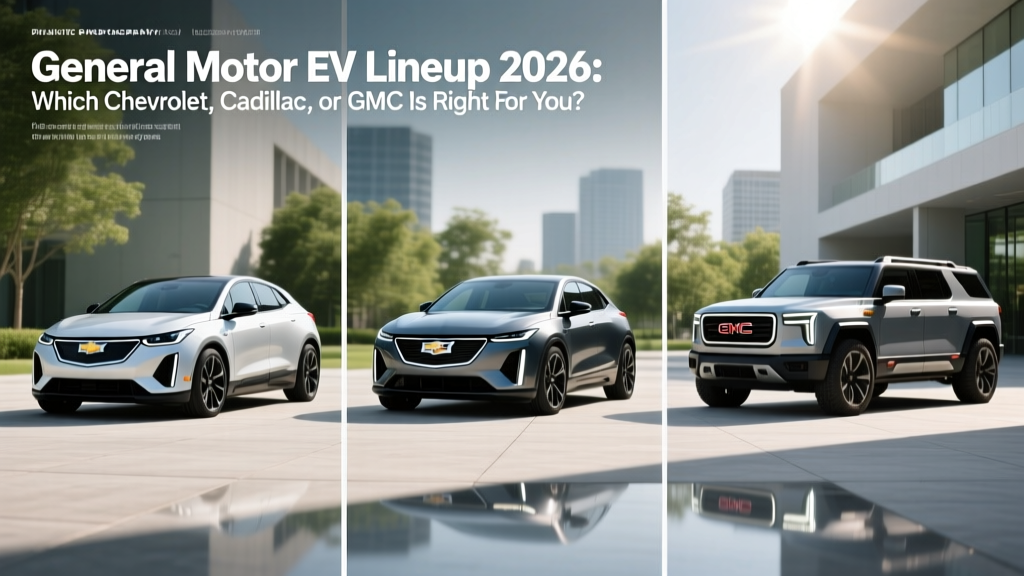
General Motors currently sells six core battery-electric models in the U.S. across Chevrolet, Cadillac, and GMC on its Ultium platform, spanning from the ~$33,000 Chevrolet Equinox EV (319 miles EPA) to the $80,000+ GMC Sierra EV Denali. The best value pick for most buyers is the Chevrolet Equinox EV 3LT at roughly $33,600 before any incentives, offering 319 miles of EPA range and NACS charging at up to 150 kW. If you need truck capability, the Silverado EV and Sierra EV offer up to 492 miles (EPA) but start above $55,000. Federal §30D tax credit eligibility varies by model, battery sourcing, and your income — always verify on the AFDC/IRS guidance page before purchasing.
The Current General Motor EV Lineup at a Glance
GM's Ultium-platform strategy has matured significantly since the first Cadillac Lyriq deliveries in 2023. For the 2026 model year, the lineup covers compact SUVs, midsize crossovers, luxury flagships, and full-size pickups. Here is every current-production General Motor EV with its key specs:
| Model | Trim Highlighted | Usable Battery (kWh) | EPA Range (mi) | Peak DC Charge (kW) | 10–80% Time | 0–60 mph (sec) | Base MSRP |
|---|---|---|---|---|---|---|---|
| Chevrolet Equinox EV | 3LT (FWD) | 85 kWh (NMC) | 319 | 150 kW | ~30 min | 7.8 | $33,600 |
| Chevrolet Blazer EV | 2LT (AWD) | 102 kWh (NMC) | 279 | 190 kW | ~24 min | 5.4 | $47,200 |
| Cadillac Lyriq | Luxury (RWD) | 102 kWh (NMC) | 314 | 190 kW | ~24 min | 5.9 | $58,590 |
| Cadillac Optiq | Luxury (AWD) | 89 kWh (NMC) | 300 | 150 kW | ~28 min | 5.5 | $53,900 |
| Chevrolet Silverado EV | LT (4WT) | 200 kWh (NMC) | 492 | 350 kW | ~20 min | 4.5 (RST) | $55,900 |
| GMC Sierra EV | Denali Edition 1 | 200 kWh (NMC) | 478 | 350 kW | ~20 min | 4.3 | $79,900 |
Source: fueleconomy.gov and GM manufacturer specifications for 2025–2026 model years. Real-world highway range is typically 10–15% below EPA figures; cold-weather (below 32°F) can reduce range by 20–30%.
Real-World Range Reality Check
The Equinox EV's 319-mile EPA rating is impressive on paper. In mixed highway driving at 70–75 mph in moderate temperatures, expect approximately 270–285 miles. In sub-freezing conditions, plan for 220–250 miles before needing a charger. The Silverado EV's 492-mile EPA figure similarly drops to roughly 390–420 miles on the highway and potentially 340–370 miles in cold weather with a heavy load. Always plan road trips around 80% of the EPA sticker to maintain a safety buffer.
EV vs. Gas: What Does a General Motor EV Actually Save You?
The purchase price of a General Motor EV is often higher than a comparable gas vehicle, but operating costs tell a different story. Let's compare the Equinox EV 3LT against the gasoline Equinox LT (1.5L turbo, FWD) over a 5-year ownership period at 15,000 miles per year.
| Cost Category | Equinox EV 3LT (FWD) | Equinox LT Gas (FWD) |
|---|---|---|
| Base MSRP | $33,600 | $28,600 |
| Estimated §30D Federal Credit | Up to $7,500* | $0 |
| Effective Purchase Price | ~$26,100 | $28,600 |
| Fuel/Energy (5 years, 75k mi) | $3,750 (home L2 @ $0.14/kWh) | $9,375 (gas @ $3.50/gal, 28 MPG) |
| Maintenance (5 years) | ~$1,200 | ~$3,500 |
| Insurance (5-year avg) | ~$9,500 | ~$7,800 |
| 5-Year Total Cost | ~$40,550 | ~$49,275 |
*§30D credit eligibility depends on buyer income caps ($150k single / $300k joint), MSRP caps ($55k SUVs / $80k trucks), battery component and critical-mineral sourcing, and point-of-sale transfer availability. Always verify current rules at irs.gov.
The EV wins on total cost of ownership primarily through fuel and maintenance savings — roughly $7,925 saved over 5 years on energy and upkeep alone. However, insurance premiums for GM Ultium EVs typically run 15–25% higher than their gas counterparts due to repair-cost patterns. If you lack access to affordable home charging and must rely on DC fast charging at $0.35–$0.50/kWh, the fuel-cost advantage narrows significantly.
Charging a General Motor EV: NACS, Speeds, and Home Setup
One of the strongest arguments for a General Motor EV in 2026 is the native NACS charge port. GM transitioned its entire EV lineup to the North American Charging Standard (Tesla's connector), giving you direct access to the Tesla Supercharger network — over 28,000 stalls nationwide — without an adapter.
| Charging Level | Power (kW) | Miles Added per Hour | Best Use Case |
|---|---|---|---|
| Level 1 (120V outlet) | ~1.4 kW | 3–5 mi/hr | Overnight top-up, PHEV, low-mileage drivers |
| Level 2 (240V home) | 7.7–11.5 kW | 25–40 mi/hr | Daily home charging (full overnight) |
| DC Fast (Equinox/Blazer) | 150–190 kW peak | ~500–700 mi/hr | Road trips, 10–80% in 24–30 min |
| DC Fast (Silverado/Sierra) | Up to 350 kW peak | ~900+ mi/hr | Road trips, 10–80% in ~20 min |
Home charging setup: Most GM Ultium EVs come with a dual-level portable charge cord capable of 120V (Level 1) and 240V (Level 2) charging. For Level 2 at home, you'll need a NEMA 14-50 outlet or a hardwired wall connector installed on a 40–60 amp circuit. Budget $800–$2,500 for a professional installation depending on your electrical panel's capacity and the distance from panel to garage. If your home has a 100-amp panel and you're adding a 50-amp EV circuit, a panel upgrade to 200 amps can add $1,500–$3,500.
Charging Curve Reality
The Silverado EV advertises a 350 kW peak charge rate. That peak only holds for a narrow window between roughly 10–30% State of Charge (SoC). Above 50%, the rate tapers to ~150 kW, and above 80% it drops below 50 kW to protect battery longevity. The "10–80% in 20 minutes" claim assumes ideal conditions: battery preconditioned to optimal temperature and a functioning 350 kW stall. In practice, plan for 25–30 minutes at a high-power charger.
Common Misconceptions About General Motor EVs
| Myth | Fact |
|---|---|
| "GM EVs can't use Tesla Superchargers." | All 2025+ GM EVs ship with native NACS ports and have full Supercharger access as of 2025. |
| "The Ultium battery will need expensive replacement." | GM covers the battery for 8 years / 100,000 miles against defects and excessive degradation (below 70% capacity). Real-world Ultium degradation data from 2023–2025 Lyriq owners shows approximately 5–8% loss over the first 50,000 miles. |
| "Super Cruise drives the car for me." | Super Cruise is a SAE Level 2 driver-assistance system. It handles steering, acceleration, and braking on mapped highways, but you must remain attentive. An infrared camera monitors your eyes. It is not autonomous driving. |
| "Every GM EV qualifies for the $7,500 tax credit." | Credit eligibility depends on battery sourcing, critical-mineral requirements, your income, and the vehicle's MSRP — all of which shift periodically. Check the AFDC tax credit database for the specific model and trim. |
| "EVs don't work in cold climates." | Range drops 20–30% in freezing temperatures, but GM's Ultium platform includes a heat pump and battery preconditioning that mitigate losses. Owners in Minnesota and Michigan report manageable winter driving with proper planning. |
Ownership Considerations Before You Buy a General Motor EV
Beyond the spec sheet, here are the practical realities that determine whether a GM EV fits your life:
Home Charging Access
If you can install a Level 2 charger at home (garage or driveway with 240V access), a General Motor EV is practical as a daily driver. You'll wake up to a full battery every morning, and public charging becomes relevant only for road trips. If you live in an apartment without charging access, relying solely on public DC fast charging is feasible but adds time, cost ($0.35–$0.50/kWh vs. $0.14 at home), and unpredictability.
Climate and Driving Patterns
The Ultium platform's active thermal management and heat pump help in both hot and cold climates. However, if you regularly drive in sub-20°F weather or tow heavy loads, budget for 25–35% range reduction. The Silverado EV's towing capacity (up to 10,000 lbs on certain trims) dramatically cuts range — expect roughly 50–60% of the EPA figure when towing near max capacity.
Software and Infotainment
GM's Ultium EVs run on a Google-built infotainment system with native Google Maps, Google Assistant, and access to the Play Store. This is a strong point for usability, but note: Apple CarPlay and Android Auto projection are not supported on Ultium vehicles. If you rely on phone projection, this is a significant trade-off to test-drive before committing.
Maintenance Differences
GM EVs eliminate oil changes, spark plugs, timing belts, and transmission fluid. You'll still need tire rotations (EVs tend to wear tires faster due to instant torque and heavier weight), cabin air filter replacement, brake fluid checks, and windshield washer fluid. GM recommends tire rotation every 7,500 miles. Brake pads last significantly longer thanks to regenerative braking — often 100,000+ miles.
Decision Framework: Which General Motor EV Should You Choose?
Choose Based on Your Situation
Choose the Equinox EV if: You want an affordable daily-driver crossover with 300+ miles of range, primarily commute under 60 miles round-trip, and value price-per-mile-of-range above all else. The 3LT FWD at $33,600 is one of the best value propositions in the EV market.
Choose the Blazer EV if: You need more interior space than the Equinox, prefer sportier styling, want available AWD for snow or rain, and can spend $45,000–$55,000. The SS trim's 557 HP and 3.4-second 0–60 make it genuinely quick.
Choose the Cadillac Lyriq if: You want a luxury experience with premium materials, a 33-inch LED display, available Super Cruise, and don't mind paying $58,000+. The Lyriq competes with the BMW iX and Audi Q8 e-tron but offers better range per dollar.
Choose the Cadillac Optiq if: You want a more compact Cadillac EV at a lower entry price than the Lyriq, primarily drive in urban and suburban settings, and value maneuverability over maximum cargo space.
Choose the Silverado EV if: You need a full-size truck for work or towing, want EV torque for job-site or trail use, can accommodate a 200+ kWh battery's weight, and have the budget ($55,900+). The 4WT commercial trim is purpose-built for fleet use.
Choose the Sierra EV if: You want the Silverado EV's capability with GMC's premium Denali treatment, MultiPro tailgate, and are willing to pay a significant premium ($79,900+) for luxury-truck positioning.
Don't buy a GM EV if: You cannot charge at home or work, regularly drive 400+ miles in a single day through areas with sparse charging infrastructure, or need Apple CarPlay. In these cases, consider a PHEV like the Chevrolet Corvette E-Ray or wait for GM's upcoming extended-range models.
Battery Longevity, Warranty, and Resale Outlook
Every General Motor EV comes with an 8-year / 100,000-mile battery and powertrain warranty that covers defects and capacity loss below approximately 70% of original capacity. GM uses NMC (nickel manganese cobalt) chemistry across the Ultium lineup, which offers higher energy density than LFP (lithium iron phosphate) but requires more careful charge management for longevity.
Best practices for Ultium battery health:
- Set daily charge limit to 80% (use 100% only for road trips)
- Avoid leaving the vehicle at very low SoC (below 10%) for extended periods
- Use DC fast charging sparingly — it's fine for road trips, but daily L2 home charging is gentler on the cells
- Precondition the battery before fast charging in cold weather (the vehicle does this automatically when a charger is set as a navigation destination)
Resale value for GM EVs is still establishing itself. The Lyriq has held value comparably to luxury ICE vehicles, while the Equinox EV's value retention will depend heavily on used-EV market conditions and whether the federal used-EV credit (§25E, up to $4,000) remains available to support demand.
Frequently Asked Questions
Do all General Motor EVs use the same charging connector?
Yes. All current-production GM EVs (2025 and later) use the NACS connector natively. Earlier 2024 models may have shipped with CCS1 ports, but GM provides a NACS adapter for those vehicles. NACS gives you direct access to Tesla Superchargers, Electrify America (with adapter), and the growing network of NACS-equipped public chargers.
Is the Chevrolet Equinox EV eligible for the $7,500 federal tax credit?
Eligibility for the §30D Clean Vehicle Credit changes as battery sourcing and critical-mineral supply chains evolve. As of early 2026, the Equinox EV has qualified for at least partial credit for eligible buyers. Your adjusted gross income must fall below IRS caps ($150,000 single / $300,000 joint filer), and the vehicle's MSRP must not exceed $55,000 for SUVs or $80,000 for trucks. The credit can be transferred to the dealer at the point of sale as a purchase-price reduction. Always verify current eligibility on irs.gov or with a tax professional.
How does Super Cruise compare to Tesla Autopilot or Ford BlueCruise?
All three are SAE Level 2 driver-assistance systems requiring driver attention. Super Cruise differentiates itself by operating hands-free (eyes monitored via IR camera) on over 750,000 miles of pre-mapped divided highways in the U.S. and Canada. Tesla Autopilot/FSD (Supervised) works on more roads but requires hands on the steering wheel. Ford BlueCruise also offers hands-free driving on mapped highways (~130,000 miles). Super Cruise's mapped-road approach is more geographically limited but tends to be smoother and more predictable within its operating domain.
What happens if the Ultium battery fails out of warranty?
Out-of-warranty Ultium battery replacement costs are not yet widely established since the platform launched in 2022–2023. Industry estimates for a 100+ kWh pack replacement range from $12,000 to $20,000+ depending on the model. However, early degradation data suggests most Ultium batteries will retain well above 80% capacity at 100,000 miles, and modular pack design may allow individual module replacement rather than a full pack swap, reducing costs.
Can I tow with a General Motor EV?
Yes, but with range caveats. The Silverado EV (4WT/Trail Boss trims) is rated for up to 10,000 lbs towing. The Equinox EV is rated for up to 1,500 lbs. When towing near maximum capacity, expect range to drop by 40–50%. Plan charging stops accordingly — a Silverado EV towing 8,000 lbs may achieve only 250–300 miles between charges on the highway.