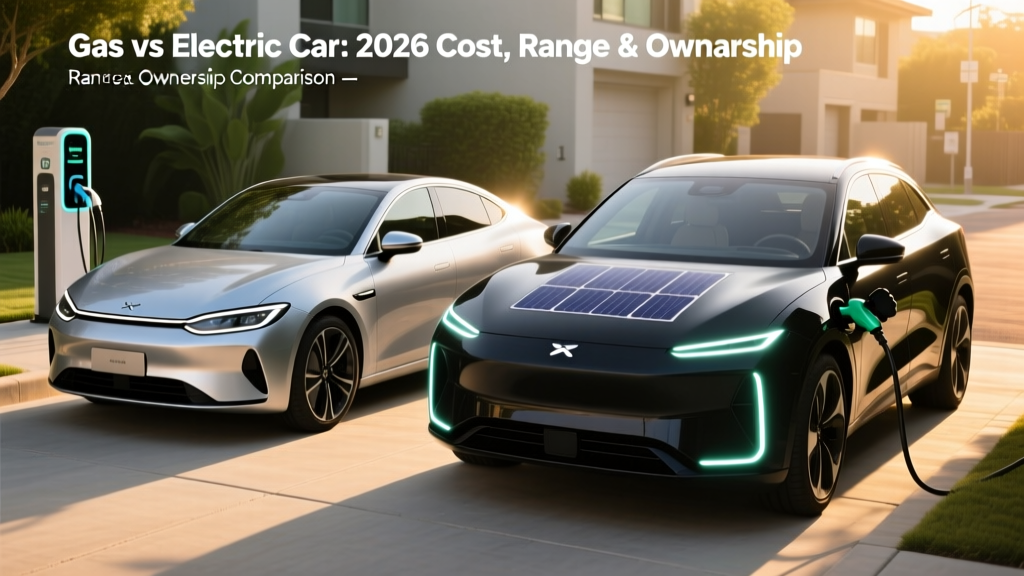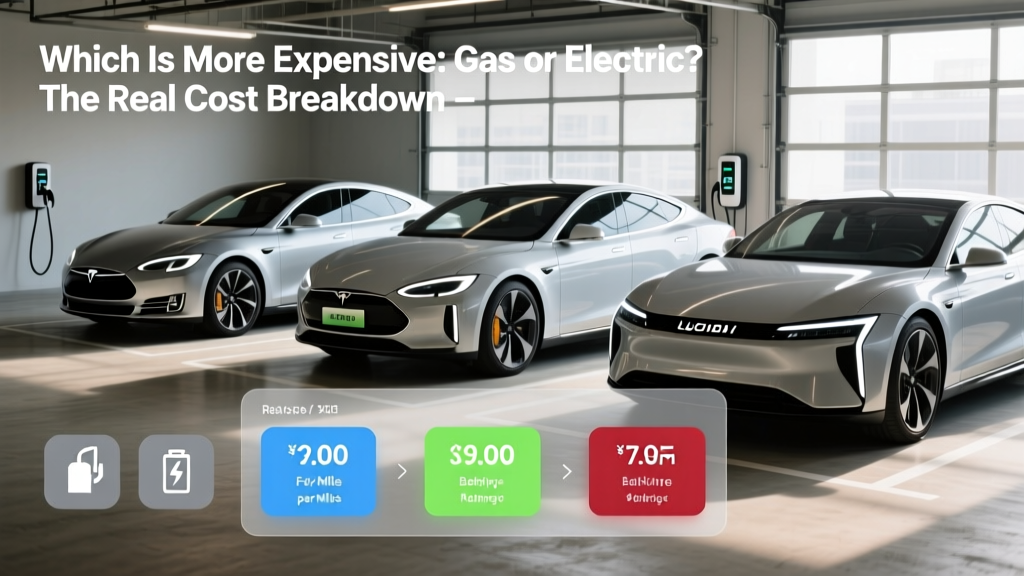
The Short Answer: Which Is More Expensive, Gas or Electric?
Upfront, electric vehicles still cost more to buy — but they are almost always cheaper to own over five years. In 2026, the average new EV starts around $38,000 before incentives, compared to roughly $31,000 for a comparable gas car. However, after applying the federal §30D tax credit (up to $7,500 for eligible buyers and vehicles), lower fuel costs, and reduced maintenance, most EVs reach cost parity within 2 to 4 years. Over a 5-year ownership period, a typical EV saves $4,000–$9,000 in total cost of ownership compared to an equivalent gas vehicle — assuming access to home charging and moderate annual mileage.
The catch: savings depend heavily on your electricity rate, driving habits, climate, and whether you qualify for incentives. Let's run the actual numbers.
Purchase Price: Sticker Shock vs. Real Cost After Incentives
The headline MSRP gap between electric and gas vehicles has narrowed significantly, but it hasn't disappeared. Battery pack costs have fallen below $100/kWh at the cell level for many manufacturers, bringing entry-level EVs into more competitive territory. Here's where things stand in 2026:
| Category | Typical Gas Car | Typical EV | Typical PHEV |
|---|---|---|---|
| Base MSRP Range | $28,000–$38,000 | $34,000–$52,000 | $35,000–$48,000 |
| Federal Tax Credit (§30D) | $0 | Up to $7,500 | Up to $7,500 |
| Effective Price After Credit | $28,000–$38,000 | $26,500–$44,500 | $27,500–$40,500 |
| State Incentives (varies) | $0 | $1,000–$5,000 | $1,000–$3,000 |
The IRS §30D clean vehicle credit can transfer to the dealer as a point-of-sale discount, effectively reducing the purchase price on day one. However, eligibility is not universal. You must meet income caps ($150,000 single / $300,000 joint modified AGI), the vehicle must fall under MSRP caps ($55,000 for sedans, $80,000 for SUVs/trucks/vans), and the battery must meet critical-mineral and component sourcing requirements that tighten annually. Always verify current-year eligibility on IRS.gov or with a tax professional before counting on the credit.
Fuel vs. Electricity: The Biggest Recurring Cost Difference
This is where EVs consistently win — sometimes dramatically. The gap between gasoline cost per mile and electricity cost per mile depends on two variables: your local gas price and your electricity rate.
| Metric | Gas Car (30 MPG combined) | EV (3.5 mi/kWh) | PHEV (electric mode, 4 mi/kWh) |
|---|---|---|---|
| Energy Cost (national avg) | $3.40/gallon | $0.16/kWh (home avg) | $0.16/kWh (home avg) |
| Cost Per Mile | $0.113/mile | $0.046/mile | $0.040/mile |
| Annual Fuel Cost (12,000 mi) | $1,356 | $552 | $480 (electric portion) |
| 5-Year Fuel Cost | $6,780 | $2,760 | ~$3,000 (mixed) |
At national averages, an EV driver spends roughly $800 less per year on energy than a gas car driver — and that gap widens if you have access to off-peak utility rates, solar panels, or free workplace charging. According to fueleconomy.gov, top-efficiency EVs like the Hyundai Ioniq 6 SE (140 MPGe combined) use electricity at roughly one-third the per-mile cost of a 25 MPG gas sedan.
Public DC fast charging changes the math. If you rely exclusively on public DC fast chargers (typically $0.30–$0.50/kWh at networks like Electrify America or EVgo), your per-mile cost rises to $0.09–$0.14/mile — nearly matching or exceeding gasoline. Home Level 2 charging is essential to capturing the full fuel-cost advantage of an EV.
Maintenance Costs: Where EVs Pull Further Ahead
EVs eliminate the most frequent and expensive routine maintenance items that gas car owners face:
- No oil changes — saves $150–$300/year
- No spark plugs, timing belts, or fuel filters
- No transmission fluid (most EVs use single-speed reducers)
- Regenerative braking extends brake pad life to 80,000–120,000+ miles in many cases
- No exhaust system — no catalytic converter failures or muffler replacements
Consumer Reports and industry studies consistently estimate EV maintenance costs at roughly 50% less than gas vehicles over the life of the car. Expect to spend $0.04–$0.06 per mile on EV maintenance versus $0.09–$0.12 per mile for a gas car. Over five years and 60,000 miles, that's a $2,400–$3,600 savings.
The major maintenance cost unique to EVs is eventual battery replacement — but this is rare within the first ownership cycle. Federal law mandates that EV batteries carry a warranty of at least 8 years or 100,000 miles (10 years/150,000 miles in CARB states like California). Most NMC and LFP packs retain 85–92% of original capacity at 100,000 miles based on current degradation data, meaning outright replacement is unlikely during typical ownership.
Insurance, Depreciation, and the Hidden Costs
Not every cost category favors the EV. Insurance premiums for electric vehicles tend to run 10–25% higher than equivalent gas models, driven by higher repair costs after collisions (specialized parts, high-voltage safety protocols, and fewer certified body shops). For a vehicle in the $40,000 range, expect annual premiums of $1,800–$2,400 for an EV versus $1,500–$1,900 for a comparable gas car.
Depreciation has historically been steeper for EVs, partly due to rapid technology advancement and price cuts by manufacturers (Tesla's aggressive repricing in 2023–2024 reset used-EV values industry-wide). However, as the EV market has matured and battery longevity data has solidified, depreciation curves are normalizing. Expect a 5-year depreciation of 45–55% for mainstream EVs versus 40–50% for gas cars — though luxury EVs can lose 60%+.
Total Cost of Ownership: 5-Year Breakdown
Here's how the numbers stack up for a realistic 5-year, 60,000-mile ownership scenario comparing a mainstream EV (e.g., Chevrolet Equinox EV or Hyundai Kona Electric) to a comparable gas compact SUV (e.g., Toyota RAV4 gas or Honda CR-V):
| Cost Category (5 yr / 60k mi) | Gas SUV | Electric SUV (after credit) | Difference |
|---|---|---|---|
| Purchase Price (effective) | $33,000 | $33,500 (after $7,500 credit) | +$500 |
| Fuel / Electricity | $6,780 | $2,760 | −$4,020 |
| Maintenance | $5,400 | $2,700 | −$2,700 |
| Insurance (5 years) | $8,500 | $10,500 | +$2,000 |
| Depreciation | $15,500 | $17,000 | +$1,500 |
| Home Charger Install | $0 | $800–$1,500 | +$800–$1,500 |
| Total 5-Year Cost | $69,180 | $66,960–$67,960 | EV saves $1,220–$2,220 |
The EV wins on 5-year TCO in this scenario, but the margin is modest — roughly $1,200–$2,200. The savings become much larger if you drive more than 12,000 miles per year, have low electricity rates, or live in a state with additional rebates. At 20,000 miles/year, the fuel savings alone push the 5-year advantage past $6,000.
Real-World Variables That Change the Math
The averages above mask enormous individual variation. Your actual savings — or costs — depend on these factors:
Home Charging Access
If you can install a Level 2 home charger (240V, 32–48 amps, delivering 7.7–11.5 kW), you'll pay $0.10–$0.18/kWh depending on your utility and time-of-use plan. This is the single biggest factor in EV cost advantage. Without home charging, reliance on public DC fast charging at $0.35–$0.50/kWh can erase most fuel savings. A typical Level 2 installation costs $800–$1,500 for the equipment and electrician work if your panel has capacity — but a panel upgrade to 200A service can add $1,500–$3,000.
Climate and Range Loss
Cold weather reduces EV range by 15–30% at temperatures below freezing, due to battery chemistry limitations and cabin heating demand. A 300-mile EPA-rated EV may deliver only 210–255 real-world miles in a Minnesota winter. This doesn't directly change your cost-per-mile, but it can force more frequent charging sessions and, if you rely on paid public chargers, higher effective fuel costs. EVs with heat pumps (standard on most 2025+ models from Hyundai, Kia, Tesla, and others) recover 5–10% of that loss.
Driving Patterns
Highway driving at 75+ mph reduces EV efficiency more sharply than it affects gas cars (EVs lack multi-gear transmissions optimized for cruising). An EV rated at 3.5 mi/kWh in combined driving may drop to 2.8–3.0 mi/kWh at sustained highway speeds. If most of your driving is city and suburban, EVs shine — regenerative braking recovers energy in stop-and-go traffic, and efficiency improves to 4.0+ mi/kWh.
Electricity Rate Structure
Time-of-use (TOU) plans from your utility can cut EV charging costs by 30–50% if you charge overnight during off-peak hours (often $0.06–$0.10/kWh). Without a TOU plan, you may pay a flat $0.16–$0.22/kWh. Check your utility's EV-specific rate offerings before purchasing.
Common Misconceptions: Myth vs. Fact
| Myth | Fact |
|---|---|
| "EVs always cost more to own." | After incentives and fuel savings, most mainstream EVs match or beat gas cars on 5-year TCO — especially with home charging and 12,000+ miles/year. |
| "Battery replacement will cost $20,000." | Full pack replacement for a mainstream EV runs $8,000–$16,000 in 2026, but is rarely needed within the warranty period. Most packs retain 85%+ capacity at 100k miles. |
| "Charging an EV costs as much as gas." | Only if you exclusively use expensive DC fast chargers at $0.40+/kWh. Home charging at $0.12–$0.16/kWh delivers fuel costs at roughly 40% of gasoline per mile. |
| "EV insurance is unreasonably expensive." | Premiums are 10–25% higher on average, not double. Shop multiple carriers — some now offer EV-specific discounts. |
| "The $7,500 tax credit applies to every EV." | Eligibility depends on MSRP caps, buyer income, and battery sourcing rules under IRS §30D. Many popular EVs qualify partially or not at all in a given year. |
Decision Framework: Should You Buy Gas, Electric, or Hybrid?
Choose an EV if:
- You have access to home or workplace Level 2 charging
- You drive 12,000+ miles per year (higher mileage = faster payback)
- You qualify for the federal §30D credit and/or state incentives
- Your daily commute is under 200 miles round-trip
- You want the lowest per-mile operating cost and minimal maintenance
- You have a second vehicle for long road trips (or are comfortable planning DC fast-charge stops)
Choose a gas car if:
- You cannot install or access reliable Level 2 charging at home or work
- You regularly drive 400+ miles in a single day in areas with sparse charging infrastructure
- Your budget is strictly under $28,000 and you need the lowest possible upfront cost
- You live in an extreme cold climate and drive long rural distances daily
Choose a PHEV if:
- You want electric-only commuting (typically 25–45 miles of EV range) with gas flexibility for road trips
- You have home charging but frequently drive beyond EV-only range
- You want to reduce fuel costs without committing fully to battery-electric
- Your household has one vehicle that must serve all use cases
Frequently Asked Questions
Is it cheaper to charge an EV at home or buy gas?
Charging at home is almost always cheaper. At the U.S. average residential electricity rate of ~$0.16/kWh and an EV efficiency of 3.5 miles/kWh, you pay roughly $0.046 per mile. A 30 MPG gas car at $3.40/gallon costs $0.113 per mile — more than double. The savings grow if you have solar panels or an off-peak utility rate.
Do EVs really save money in the long run?
Yes, for most drivers. Over 5 years and 60,000 miles, a typical EV saves $4,000–$6,000 in fuel and maintenance alone, offsetting the higher purchase price — especially after applying the federal tax credit. The breakeven point typically arrives between years 2 and 4. High-mileage drivers (15,000–20,000+ miles/year) see the fastest payback.
What is the biggest hidden cost of owning an EV?
Insurance and home charger installation. Insurance premiums run 10–25% higher for EVs, adding $300–$600 per year. A Level 2 home charger installation costs $800–$1,500 if your electrical panel has capacity, or $2,500–$4,500 if you need a panel upgrade. These are one-time or recurring costs that first-time EV buyers often overlook.
Are hybrids cheaper than both gas and electric?
Hybrids (HEVs) sit between gas and electric on cost. A Toyota RAV4 Hybrid achieves ~40 MPG combined, cutting fuel costs roughly in half versus the gas version, with no charging requirement and a lower purchase price than an EV. However, HEVs don't qualify for the federal §30D tax credit, and they still require oil changes, spark plugs, and other gas-car maintenance. PHEVs offer the best of both worlds for the right driver — EV commuting with gas flexibility.
How does cold weather affect EV ownership costs?
Cold weather (below 32°F) reduces EV range by 15–30% and can slow DC fast charging speeds by 20–40% unless the vehicle has active battery preconditioning. This means more frequent charging sessions in winter. If you charge at home, the cost impact is minor. If you rely on public DC fast chargers, expect winter fuel costs to rise by 20–35% compared to summer.
What happens if my EV battery degrades?
Modern EV batteries (both NMC and LFP chemistries) are engineered for longevity. Real-world data shows most packs retain 85–92% of original capacity after 100,000 miles. Federal warranty requirements mandate coverage for at least 8 years/100,000 miles with a capacity retention threshold (typically 70% of original). Full battery replacement costs $8,000–$16,000 depending on the pack size and chemistry but is rarely needed within the first 10–12 years of ownership. For detailed degradation data by chemistry, see our battery technology resources.
Sources: fueleconomy.gov (EPA efficiency and range data), IRS.gov (§30D clean vehicle credit rules). All pricing reflects 2026 model-year MSRP and current federal incentive structures. State incentives vary by jurisdiction — consult your state energy office for local programs.