Ford Mustang Mach-E vs Tesla Model Y: The Ultimate Electric SUV Showdown
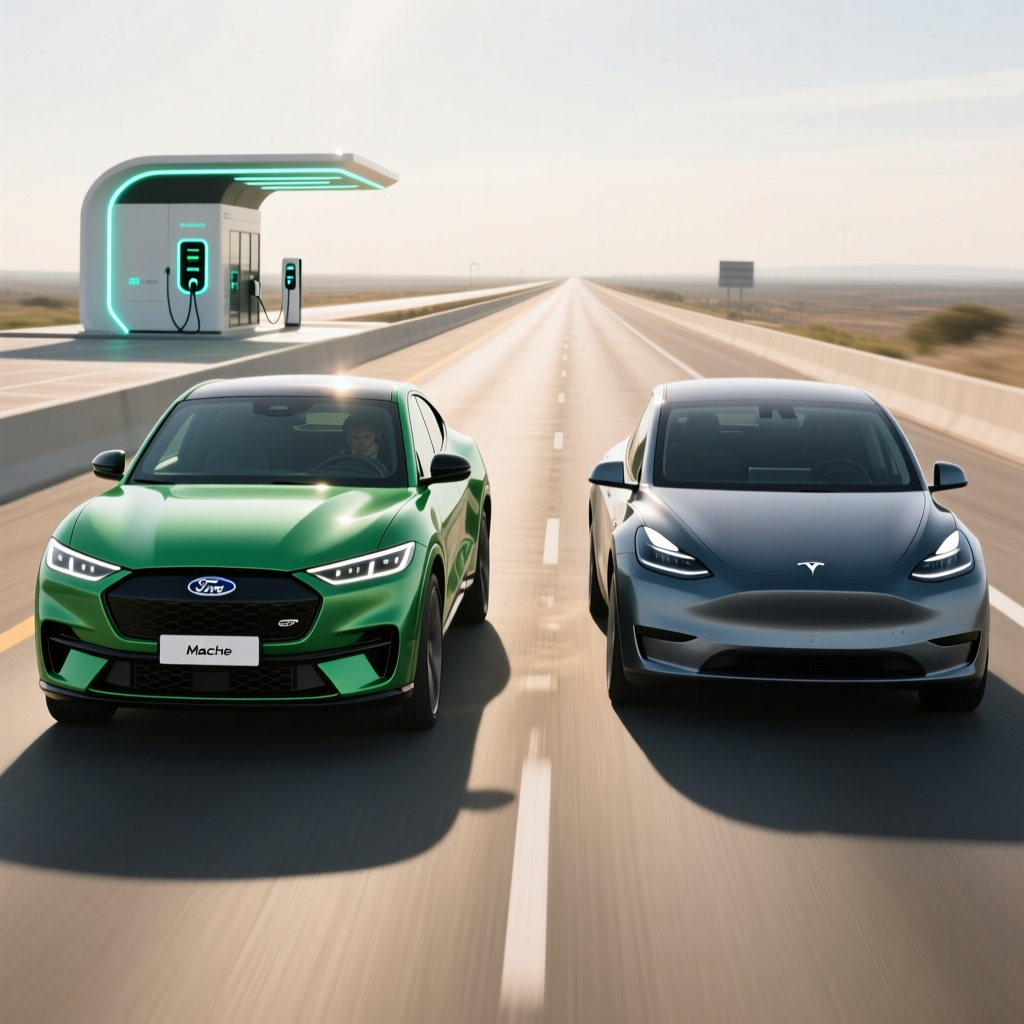
The mid-size electric SUV segment has become one of the most competitive spaces in the entire automotive market, and two nameplates sit squarely at the top of nearly every shopper's shortlist: the Ford Mustang Mach-E and the Tesla Model Y. Both offer compelling blends of range, performance, technology, and everyday practicality, but they take decidedly different approaches to winning your garage space.
The Mustang Mach-E carries Ford's century of automotive engineering experience into the electric era, blending familiar SUV ergonomics with a sporty nameplate and a growing dealer network. The Model Y, on the other hand, represents Tesla's minimalist, software-first philosophy — a vehicle that has consistently ranked among the best-selling EVs worldwide thanks to its efficiency, Supercharger network, and over-the-air update cadence.
In this in-depth comparison, we break down every category that matters to EV buyers — from EPA-estimated range and real-world charging speeds to interior cargo volume, warranty coverage, and infotainment usability. Whether you are cross-shopping these two for the first time or narrowing down your final choice, this guide will give you the clarity you need.
For our full takes on each vehicle individually, check out our Ford Mustang Mach-E review and our Tesla Model Y review. You can also see how both stack up in our best electric SUVs rankings.
Side-by-Side Specifications
Before diving into the nuances, here is a high-level look at the key specifications for the most popular configurations of each vehicle. Note that both models offer multiple trim levels and drivetrain options, so figures may vary depending on the exact configuration you choose.
| Specification | Ford Mustang Mach-E | Tesla Model Y |
|---|---|---|
| Body Style | 5-door crossover SUV | 5-door crossover SUV |
| Drivetrain Options | RWD or AWD | RWD or AWD |
| EPA-Estimated Range (Max) | Up to ~320 miles | Up to ~330 miles |
| Battery Capacity (Usable) | ~70 kWh (Standard) / ~91 kWh (Extended) | ~60 kWh (Standard) / ~75 kWh (Long Range) |
| Peak DC Fast Charging | Up to ~150 kW | Up to ~250 kW |
| 0–60 mph (Quickest AWD) | ~3.5 seconds (GT) | ~3.5 seconds (Performance) |
| Cargo Volume (Behind Rear Seats) | ~29.7 cu ft | ~30.2 cu ft |
| Cargo Volume (Seats Folded) | ~59.7 cu ft | ~72.1 cu ft |
| Front Trunk (Frunk) | ~4.7 cu ft | ~4.1 cu ft |
| Towing Capacity | Up to ~2,300 lbs | Up to ~3,500 lbs |
| Starting MSRP (Approx.) | ~$43,000 | ~$44,000 |
| Basic Warranty | 3 years / 36,000 miles | 4 years / 50,000 miles |
| Battery Warranty | 8 years / 100,000 miles | 8 years / 120,000 miles |
Specs only tell part of the story. Let's explore how these numbers translate into real-world ownership across the categories that matter most.
Range & Efficiency
Range anxiety remains one of the biggest barriers to EV adoption, and both the Mustang Mach-E and Model Y deliver competitive numbers that should satisfy the vast majority of drivers.
The Tesla Model Y Long Range AWD carries an EPA-estimated range of approximately 330 miles, placing it among the most efficient electric SUVs on the market. Tesla's industry-leading energy efficiency — often measured in watt-hours per mile — means the Model Y tends to extract more distance from each kilowatt-hour of battery capacity. Independent real-world highway range tests conducted by outlets like Edmunds have shown the Model Y consistently achieving close to its EPA figure under moderate conditions, a testament to Tesla's thermal management and powertrain optimization.
The Ford Mustang Mach-E with the Extended Range battery and rear-wheel drive achieves an EPA-estimated range of up to roughly 320 miles. While that trails the Model Y by a slim margin on paper, the difference in everyday driving is negligible for most commuters. Where the Mach-E falls slightly behind is in cold-weather efficiency; independent testing has shown that Ford's battery thermal management, while capable, does not quite match Tesla's heat pump system in extreme cold, leading to a somewhat larger range reduction in sub-freezing temperatures.
For drivers who regularly take road trips exceeding 250 miles between charging stops, the Model Y's slight range advantage and superior efficiency can translate into fewer or shorter charging breaks. For daily commuting and moderate-distance travel, both vehicles offer more than enough range to handle a full day of driving with ample buffer.
See how these range figures compare to other electric crossovers in our best long-range EVs guide.
Price & Value
Pricing in the EV segment shifts frequently as manufacturers adjust MSRPs, incentives, and trim configurations, so it is always worth checking the latest figures on the Ford and Tesla configurators. That said, the general pricing landscape provides useful guidance.
The Ford Mustang Mach-E typically starts around the low $40,000s for the Select trim with the Standard Range battery and rear-wheel drive. Moving up to the Premium or GT trims with the Extended Range battery pushes the price into the mid-to-upper $50,000s, where the Mach-E GT Performance Edition competes directly with the Model Y Performance.
The Tesla Model Y generally starts in a similar price bracket, with the Long Range AWD sitting in the mid-$40,000s and the Performance variant climbing into the low $50,000s. Tesla's direct-to-consumer sales model eliminates dealer markups and negotiation, which some buyers find refreshing and others find limiting when it comes to trade-in flexibility.
One significant value differentiator is federal and state incentive eligibility. Both vehicles may qualify for various tax credits and rebates depending on where they are manufactured and your personal tax situation, but the specifics change regularly. We recommend consulting the latest information on fueleconomy.gov and your state's energy office before making a purchase decision.
When you factor in total cost of ownership — including fuel savings, reduced maintenance, insurance costs, and depreciation — both vehicles offer compelling value relative to similarly sized gas-powered SUVs. The Model Y has historically held its resale value well, while the Mach-E benefits from Ford's extensive dealer network for service and warranty work, which can provide peace of mind for buyers in areas with limited independent EV repair options.
Charging Speed & Infrastructure
Charging speed is where the Tesla Model Y has traditionally held a clear advantage, though the gap is narrowing as infrastructure evolves.
The Model Y supports peak DC fast charging rates of up to 250 kW at Tesla Superchargers. In optimal conditions — typically when the battery state of charge is low and the battery is preconditioned — the Model Y can add up to 200 miles of range in approximately 15 minutes. Tesla's Supercharger network is widely regarded as the most reliable and extensive fast-charging network in North America, with thousands of stations strategically placed along major highways and in urban centers. The integrated navigation system automatically routes you through Superchargers on long trips and preconditions the battery for the fastest possible charge upon arrival.
The Mustang Mach-E peaks at approximately 150 kW on DC fast chargers, which translates to roughly 50–60 miles of range added in about 10 minutes under ideal conditions. While this is slower than the Model Y, it is still competitive with many rivals in the segment. Ford has invested heavily in charging access: Mach-E owners gain access to the BlueOval Charge Network, which aggregates tens of thousands of public chargers across multiple providers. Crucially, Ford has arranged access for its EV customers to use Tesla Superchargers through an adapter and the broader NACS (North American Charging Standard) adoption, significantly expanding the Mach-E's fast-charging options on road trips.
For home charging, both vehicles support Level 2 AC charging. The Mach-E supports up to approximately 10.5 kW with the Ford Connected Charge Station, while the Model Y supports up to 11.5 kW with the Tesla Wall Connector. In practice, both vehicles will fully recharge overnight on a properly installed Level 2 home charger, which is how the majority of EV owners do most of their charging.
If fast-charging infrastructure and road-trip convenience are top priorities, the Model Y still holds an edge — though the Mach-E's growing Supercharger compatibility is closing that gap rapidly. Learn more in our complete EV charging guide.
Performance & Driving Dynamics
Both the Mustang Mach-E and Tesla Model Y offer genuinely quick acceleration that will surprise anyone accustomed to gas-powered SUVs, but they deliver that speed with distinctly different personalities.
The Tesla Model Y Performance variant rockets from 0 to 60 mph in approximately 3.5 seconds, a figure that rivals many sports cars. The acceleration is instantaneous and relentless, thanks to Tesla's dual-motor all-wheel-drive system and sophisticated traction control. The Model Y's ride quality has improved over successive updates, with a more compliant suspension tune that absorbs bumps more gracefully than earlier iterations. However, the steering remains relatively light and numb by enthusiast standards, prioritizing efficiency and comfort over feedback.
The Ford Mustang Mach-E GT with the Performance Upgrade matches the Model Y Performance with a 0–60 mph time of approximately 3.5 seconds. Where the Mach-E differentiates itself is in its driving dynamics. Ford's engineers have tuned the chassis to deliver a more engaging, connected feel behind the wheel. The steering is heavier and more communicative, the suspension offers a sportier balance between comfort and body control, and the available MagneRide adaptive dampers on higher trims add an extra layer of sophistication. The Mach-E GT even includes an uncluttered "One-Pedal Drive" mode and a playful "Unbridled Extend" drive mode for track use.
In everyday driving, both vehicles are refined, quiet, and effortless. The Mach-E feels slightly more like a traditional performance SUV — the kind of vehicle that an enthusiast might choose if they are transitioning from a gas-powered sport utility. The Model Y feels more like a technology product that happens to be very fast — impressive in its capability but less focused on the tactile joy of driving.
For a deeper look at how these two handle, see our best performance electric SUVs ranking.
Interior Space, Comfort & Cargo
As family vehicles, interior space and cargo versatility are critical considerations, and both SUVs deliver generous accommodations with some notable differences.
The Tesla Model Y offers approximately 30.2 cubic feet of cargo space behind the rear seats and an impressive 72.1 cubic feet with the rear seats folded flat. That class-leading cargo volume is one of the Model Y's strongest selling points, easily swallowing luggage for a family road trip, bulk hardware store runs, or a full set of camping gear. The rear seat offers adequate legroom for adults, though taller passengers may find the sloping roofline slightly restrictive on headroom. An optional third row is available in some configurations, though it is best suited for small children.
The Ford Mustang Mach-E provides about 29.7 cubic feet behind the rear seats and 59.7 cubic feet with the seats folded. While the total cargo volume trails the Model Y by over 12 cubic feet, the Mach-E's cargo area is well-shaped and includes a useful under-floor storage compartment. The Mach-E's front trunk (frunk) is slightly larger at 4.7 cubic feet compared to the Model Y's 4.1 cubic feet, and it includes a convenient drain plug that makes it ideal for storing wet items or even filling with ice for tailgating.
In terms of passenger comfort, the Mach-E offers a more traditional SUV seating position with good visibility, supportive seats, and physical controls for climate and volume that many drivers find easier to use while driving. The Model Y's cabin is strikingly minimalist — nearly every function is controlled through the central touchscreen, which some buyers love for its clean aesthetic and others find frustrating for simple adjustments like changing the fan speed or adjusting mirrors.
Material quality in both vehicles is competitive for the segment. The Mach-E uses a mix of soft-touch materials and hard plastics, with higher trims offering synthetic leather and accent stitching that elevates the cabin. The Model Y has steadily improved its interior materials, with newer builds featuring ventilated seats, ambient lighting, and improved panel fitment, though some critics still note inconsistency in build quality from vehicle to vehicle.
Technology & Infotainment
Technology is a battleground where both vehicles make strong but philosophically different cases.
The Tesla Model Y is built around a single 15-inch landscape-oriented touchscreen that controls virtually every aspect of the vehicle — from navigation and media to climate settings, glove box release, and mirror adjustments. Tesla's software is widely considered the gold standard in the EV industry: it is fast, responsive, regularly updated over the air, and packed with features like Sentry Mode dashcam recording, a built-in web browser, streaming apps, and even games for charging-station downtime. The navigation system is excellent, with real-time traffic, automatic Supercharger routing, and accurate range predictions. Tesla's Autopilot driver assistance system is standard, and the optional Enhanced Autopilot or Full Self-Driving (FSD) packages add features like automatic lane changes, navigation on Autopilot, and traffic light recognition.
The Ford Mustang Mach-E features a large 15.5-inch portrait-oriented touchscreen running Ford's SYNC 4A system. The interface is visually appealing and includes a physical volume knob at the bottom of the screen — a detail many drivers appreciate. SYNC 4A supports wireless Apple CarPlay and Android Auto, giving drivers the option to use their preferred smartphone interface for navigation, music, and messaging. This is a significant advantage for buyers who prefer Apple Maps, Google Maps, or Waze over a proprietary system. Ford's BlueCruise hands-free driving system is available on mapped divided highways and has earned praise for its smooth operation and driver monitoring, competing directly with Tesla's Autopilot in real-world usability.
One area where Tesla maintains a clear lead is over-the-air software updates. Tesla pushes frequent, substantial updates that can add entirely new features, improve performance, and refine the user interface — sometimes transforming the vehicle in meaningful ways months or years after purchase. Ford does offer OTA updates for the Mach-E, but they tend to be less frequent and less transformative in scope.
If you value smartphone integration and a more traditional interface, the Mach-E's SYNC 4A system with wireless CarPlay and Android Auto is a strong draw. If you prefer a deeply integrated, constantly evolving software ecosystem, the Model Y remains the benchmark. Explore more tech-forward options in our best EV technology roundup.
Warranty & Ownership Experience
Long-term ownership peace of mind depends heavily on warranty coverage and the ease of getting service when something goes wrong.
Tesla offers a 4-year/50,000-mile basic vehicle warranty and an 8-year/120,000-mile battery and drive unit warranty (for Long Range and Performance variants). Tesla's service model relies primarily on mobile service technicians who come to your home or workplace for many repairs, supplemented by a smaller network of service centers. This approach can be convenient for minor issues but may lead to longer wait times for body work or more complex repairs in areas with limited Tesla service presence.
Ford provides a 3-year/36,000-mile basic warranty and an 8-year/100,000-mile battery warranty. While the basic warranty is shorter in both duration and mileage than Tesla's, Ford's advantage lies in its vast network of franchised dealerships across the country. If you live in a rural area or a region without a nearby Tesla service center, having a Ford dealer down the road can be a significant practical benefit. Ford dealers are increasingly training technicians on EV-specific service procedures, though the quality of that experience can vary by location.
Both manufacturers offer roadside assistance programs, and both vehicles benefit from the inherently lower maintenance requirements of electric drivetrains — no oil changes, no spark plugs, no transmission fluid swaps, and significantly reduced brake wear thanks to regenerative braking.
The Verdict: Which Electric SUV Should You Buy?
There is no single "right" answer in the Mustang Mach-E vs Model Y debate — the best choice depends on your priorities, lifestyle, and preferences. Here is our recommendation by buyer type:
- Choose the Tesla Model Y if: maximum range and charging speed are your top priorities, you value best-in-class cargo space, you want the most advanced and frequently updated software experience, you rely on the Supercharger network for road trips, and you appreciate a minimalist cabin aesthetic.
- Choose the Ford Mustang Mach-E if: you prefer a more engaging, driver-focused experience behind the wheel, you want wireless Apple CarPlay and Android Auto, you value physical controls and a more traditional SUV interior layout, you want the convenience of a large dealer network for service, or you simply prefer the Mustang brand heritage and styling.
Both vehicles are outstanding choices that have earned their places at the top of our best electric SUVs list. You genuinely cannot go wrong with either one — the decision comes down to which philosophy of electric mobility resonates more with you.
Frequently Asked Questions
Is the Ford Mustang Mach-E more reliable than the Tesla Model Y?
Reliability data for both vehicles has been mixed, as is common with newer EV platforms. Consumer surveys and independent reliability studies have shown that both the Mach-E and Model Y have experienced some build-quality inconsistencies and software-related issues, particularly in early production years. Tesla has made notable improvements in panel fitment and build quality at its newer factories, while Ford has addressed several early Mach-E software concerns through OTA updates and service campaigns. For the most current reliability data, consult resources like Consumer Reports and owner forums, as reliability can vary by model year and production batch.
Can the Ford Mustang Mach-E use Tesla Superchargers?
Yes. Ford has secured access for its electric vehicle owners to use Tesla's Supercharger network through a provided adapter and the adoption of the NACS (North American Charging Standard) connector. This significantly expands the fast-charging options available to Mach-E owners, particularly on long road trips where Supercharger stations are often the most reliable and widely available option. Access is managed through the FordPass app, which provides real-time station availability and routing.
Which has better resale value — the Mach-E or the Model Y?
Historically, the Tesla Model Y has demonstrated stronger resale value retention compared to most EV competitors, including the Mach-E. Tesla's brand cachet, the desirability of the Supercharger network, and frequent price adjustments on new vehicles all influence used-market pricing. However, EV resale values across the board have been volatile due to rapidly changing new-vehicle pricing, federal incentive adjustments, and the fast pace of battery technology improvements. Both vehicles will likely depreciate more than comparable gas-powered SUVs in the short term, which is typical for the EV segment as the technology matures.
Which is better for families — the Mach-E or the Model Y?
For families, the Tesla Model Y holds a slight edge thanks to its larger cargo area (especially with seats folded), available third-row option for small children, and slightly longer range for road trips. The minimalist interior also means fewer physical buttons for curious toddlers to press. That said, the Mustang Mach-E is an excellent family vehicle in its own right, offering easy-to-use LATCH anchors for car seats, a spacious rear seat, a larger frunk for stowing gear, and the convenience of wireless smartphone integration for rear-seat entertainment. Both vehicles earn strong safety ratings from the NHTSA and IIHS, making either a safe choice for family duty.
Ready to explore more? Browse our complete EV comparison hub for head-to-head breakdowns of every major electric vehicle on the market, or visit our best electric SUVs ranking to see how the Mach-E and Model Y stack up against the full competition.