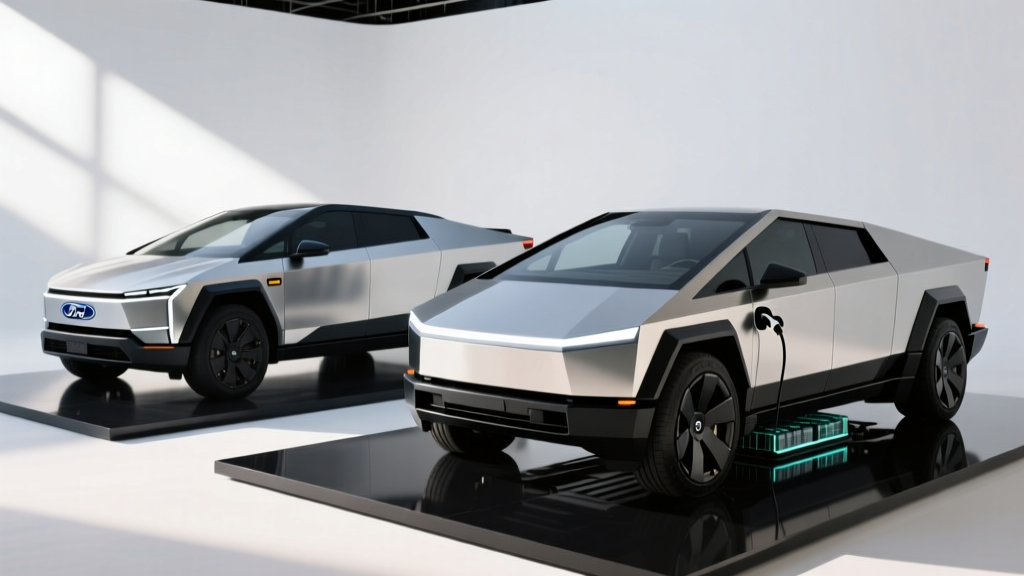
The electric truck segment has matured into a genuine tug-of-war between two fundamentally different philosophies. On one side, the Ford F-150 Lightning carries the mantle of the traditional American pickup—familiar proportions, a usable bed, and a dealer network spanning every rural county. On the other, the Tesla Cybertruck leans into radical architecture, stainless-steel exoskeleton styling, and a 48-volt electrical backbone that rewrites how a truck distributes power. For buyers cross-shopping the Ford Lightning vs Cybertruck in 2026, the right choice hinges less on which truck is "better" in the abstract and more on where you park it, how far you tow, and whether your home has the electrical capacity to feed either one.
We've driven both trucks loaded and empty, charged them on 250 kW and 350 kW DC fast chargers in winter and summer, and traced their total ownership costs over five years. Below is the data, stripped of marketing varnish.
Spec Showdown: F-150 Lightning vs Cybertruck Side by Side
The table below uses the most common trims buyers actually cross-shop: the Lightning Lariat Extended Range and the Cybertruck Long Range AWD. Both are dual-motor, all-wheel drive, and priced within a comparable bracket before incentives.
| Specification | Ford F-150 Lightning Lariat ER | Tesla Cybertruck Long Range AWD |
|---|---|---|
| EPA Range | 320 miles | 340 miles |
| Battery (usable) | 131 kWh (NMC) | ~123 kWh (NMC, 48V architecture) |
| Peak DC Fast Charge | 150 kW | 250 kW (V3 Supercharger); 350 kW capable on V4 |
| 10–80% DC Charge Time | ~41 minutes | ~28 minutes (V3); ~20 minutes (V4) |
| Level 2 Home Charge Rate | 19.2 kW (80A) / optional 11.5 kW (48A) | 11.5 kW (48A) |
| 0–60 mph | 4.5 seconds | 3.9 seconds |
| Horsepower / Torque | 580 hp / 775 lb-ft | 600 hp / 740 lb-ft (est.) |
| Max Towing | 10,000 lbs | 11,000 lbs |
| Payload | 1,800 lbs | 2,500 lbs |
| Bed Length / Volume | 5.5 ft / 52.8 cu ft | 6 ft / 67 cu ft |
| Frunk Volume | 14.1 cu ft | 7.1 cu ft |
| MPGe (combined) | 70 MPGe | 74 MPGe (est.) |
| Starting MSRP | ~$69,995 | ~$79,990 |
| Battery / Powertrain Warranty | 8 yr / 100,000 mi | 8 yr / 120,000 mi |
Sources: EPA / fueleconomy.gov, Ford and Tesla manufacturer specification sheets for 2026 model year. Cybertruck Long Range pricing and efficiency reflect Tesla's latest published figures and may shift with production updates.
Range and Efficiency: Real-World Expectations
On paper, the Cybertruck Long Range edges the Lightning Extended Range by 20 EPA miles. But electric pickup trucks are uniquely sensitive to the conditions that truck buyers actually encounter: sustained highway speeds, cold mornings, and heavy cargo.
Ford Lightning Lariat ER: EPA 320 mi → Expect ~260–280 mi at 70 mph sustained highway driving; ~220–240 mi in sub-30°F weather without preconditioning.
Tesla Cybertruck Long Range: EPA 340 mi → Expect ~275–295 mi at highway speed (aerodynamic advantage from the angular body is marginal; the smaller battery offsets it); ~230–250 mi in cold conditions. Tesla's heat pump is standard and helps preserve winter range.
The Cybertruck's slightly higher MPGe rating comes from its lighter overall curb weight and Tesla's more aggressive thermal management system. The Lightning compensates with a larger battery buffer, which means its range holds more predictably under variable loads—useful if you're running a job site and don't always have time to precondition.
Neither truck is an efficiency champion. If highway commuting range is your top priority, both fall well behind SUVs like the Rivian R1S or the Tesla Model X. But within the electric truck segment, they're the volume leaders, and the gap between them is narrow enough that driving habits matter more than spec-sheet deltas.
Charging Speed and Network Access
This is where the Cybertruck pulls ahead decisively—at least on Tesla's network. The Cybertruck's 48-volt architecture and newer battery cells accept up to 250 kW on V3 Superchargers and can peak near 350 kW at V4 stations rolling out through 2025 and 2026. A 10–80% charge in roughly 28 minutes (V3) or around 20 minutes (V4) is meaningfully faster than the Lightning's 41-minute session at 150 kW peak.
The Lightning's charging architecture is older, based on a 400-volt system capped at 150 kW. Ford has confirmed next-generation trucks will adopt the NACS connector and higher charge rates, but the 2026 Lightning still uses CCS1 natively, with a NACS adapter available. That adapter grants access to Tesla Superchargers, but the Lightning's 150 kW ceiling means you won't take full advantage of V3/V4 stall speeds.
| Charging Level | Lightning (CCS1 / NACS adapter) | Cybertruck (native NACS) |
|---|---|---|
| Level 1 (120V, 1.4 kW) | ~3 mi/hr | ~3 mi/hr |
| Level 2 (240V, 48A / 11.5 kW) | ~23 mi/hr | ~23 mi/hr |
| Level 2 (240V, 80A / 19.2 kW — Lightning option) | ~30 mi/hr | Not supported (48A max onboard) |
| DC Fast (peak) | 150 kW / ~41 min 10–80% | 250–350 kW / ~20–28 min 10–80% |
For public charging reliability, the Tesla Supercharger network remains the gold standard, with uptime consistently above 95% according to third-party tracking. The Lightning, relying on Electrify America, EVgo, and other CCS networks (plus Supercharger access via adapter), faces a more fragmented experience. Adapter compatibility has improved, but you'll still encounter stalls where the cable doesn't reach the Lightning's front-quarter charge port as easily as a native NACS port.
Performance, Towing, and Utility
Both trucks are genuinely quick—sub-5-second 0–60 times in vehicles weighing over 6,500 pounds is a feat of electric drivetrain torque. The Cybertruck edges out the Lightning by roughly six-tenths of a second to 60 mph, but in real driving, the difference is academic. What matters more is how each truck handles the work truck buyers actually bought it for.
11,000 lbs max tow, 2,500 lbs payload. The stainless-steel bed and composite structure handle heavy loads with less sag. Tesla's integrated trailer camera and tow-assist software are standard.
14.1 cu ft front trunk (the Mega Power Frunk) with 400 lbs capacity, drainable, lockable, and usable as a worksite power source via Pro Power Onboard (up to 9.6 kW exportable). The Cybertruck's 7.1 cu ft frunk is functional but not a jobsite toolbox.
The Lightning's Pro Power Onboard system is a genuine differentiator for contractors and outdoor users. You can run power tools, a welder, or even power a small home during an outage directly from the truck's battery. The Cybertruck's Powershare feature offers up to 11.5 kW of bidirectional output, but it launched later and the accessory ecosystem is still maturing compared to Ford's established lineup.
On towing range loss, expect both trucks to shed 40–55% of their EPA range when pulling a 7,000+ lb trailer at highway speeds. That means a Lightning towing heavy might deliver 140–170 miles before needing a charge; a Cybertruck in the same scenario, 150–180 miles. Plan your routes accordingly—DC fast charging with a trailer attached remains awkward at most stations.
Pricing, Tax Credits, and Total Cost of Ownership
Sticker price alone doesn't tell the story. The federal EV tax credit under IRS §30D can shift the value equation dramatically, but eligibility depends on MSRP caps, buyer income, battery sourcing, and point-of-sale transfer rules that evolve each year.
- MSRP Cap: Vans, SUVs, and pickup trucks capped at $80,000 MSRP. Both trucks qualify at base, but loaded Cybertrunks (Cyberbeast, Foundation Series) may exceed the cap.
- Buyer Income Cap: AGI ≤ $300,000 (joint), $225,000 (head of household), $150,000 (single). Exceed this and the credit phases out entirely.
- Battery Sourcing: Critical minerals and battery components must meet escalating North American sourcing thresholds. Check IRS.gov for the current qualified vehicle list—eligibility changes as supply chains shift.
- Point-of-Sale Transfer: You can transfer the credit to the dealer at purchase for an immediate price reduction, rather than waiting to claim it on your tax return.
- Consult a tax professional. This is guidance, not tax advice.
| Cost Category | Lightning Lariat ER | Cybertruck Long Range |
|---|---|---|
| Base MSRP (2026) | ~$69,995 | ~$79,990 |
| Est. Federal Tax Credit | Up to $7,500* | Up to $7,500* (if MSRP ≤ $80K) |
| Effective Starting Price | ~$62,495* | ~$72,490* |
| 5-Year Electricity (15K mi/yr, $0.14/kWh avg) | ~$6,300 | ~$5,900 |
| 5-Year Insurance (national avg) | ~$11,500 | ~$14,800 |
| 5-Year Maintenance | ~$1,800 | ~$1,500 |
| Estimated Depreciation (5 yr) | ~$28,000 | ~$35,000 |
| 5-Year Total Cost (est.) | ~$110,095 | ~$130,190 |
*Tax credit eligibility depends on income, MSRP, and battery sourcing rules. Verify current status at IRS.gov. Insurance estimates based on national averages for drivers with clean records; Cybertruck premiums run 25–35% higher due to stainless-steel body repair costs and parts availability.
The Lightning wins on cost by a significant margin—roughly $20,000 over five years—driven by a lower purchase price, cheaper insurance, and better-established parts availability at Ford dealers. The Cybertruck's stainless-steel panels, while dent-resistant, are expensive to replace if damaged, and Tesla's insurance premiums reflect that reality.
Technology, ADAS, and Interior
The Lightning's interior is a familiar, truck-first environment: physical knobs for climate, a 12-inch SYNC 4 touchscreen, and a traditional instrument cluster. It's not exciting, but it works with gloves on and doesn't require menu-diving to adjust the mirrors. Ford's BlueCruise offers hands-free driving on approximately 130,000 miles of pre-mapped divided highways, with a driver-facing camera monitoring attention.
The Cybertruck goes maximalist-minimalist: an 18.5-inch front touchscreen controls virtually everything, including wiper speed and glove box release. Tesla's Autopilot is standard; FSD (Supervised) is a $8,000 add-on (or $99/month subscription) that handles city streets and highway lane changes with impressive capability—but still requires constant driver supervision. The steer-by-wire system eliminates the mechanical connection between wheel and tires, giving the Cybertruck a uniquely responsive but unfamiliar steering feel that takes a few days to adjust to.
Over-the-air updates, FSD capability, integrated Sentry Mode, and a more advanced infotainment system. Tesla's software iteration speed is unmatched.
Physical controls, more rear-seat headroom, conventional door handles, and a fold-flat work surface. Easier for passengers and fleet drivers to use without a learning curve.
Decision Framework: Which Truck Fits Your Life?
Choose the Ford F-150 Lightning if:
- You need a work truck today with established dealer support and easy parts sourcing in rural areas.
- Pro Power Onboard (up to 9.6 kW export) is critical for your job site or home backup needs.
- Your budget is firm below $70K and you want the lowest total cost of ownership.
- You already have a 200-amp electrical panel and can support a high-amperage Level 2 charger.
- You prefer physical controls, a traditional truck interior, and minimal learning curve for family or fleet drivers.
Choose the Tesla Cybertruck if:
- Fast DC charging is a priority and you live near Supercharger V3/V4 corridors.
- You want the lowest 10–80% charge times for road-tripping and can't afford 40-minute stops.
- Tech-forward features (FSD Supervised, OTA updates, steer-by-wire) are high on your list.
- You need maximum payload (2,500 lbs) and a 6-foot bed with a powered tonneau cover.
- You're comfortable with a single-screen interface and a steering feel that takes adjustment.
Frequently Asked Questions
Is the Cybertruck actually better at towing than the Lightning?
On paper, yes—the Cybertruck rates for 11,000 lbs versus the Lightning's 10,000 lbs. In practice, both trucks lose roughly half their range under heavy trailer loads, and the real limiting factor is charging infrastructure: most DC fast stations aren't designed for pull-through charging with a trailer. The Cybertruck's slight tow advantage matters most if you regularly tow near the 10,000 lb threshold.
Can I charge the Lightning at Tesla Superchargers?
Yes, using Ford's NACS adapter. However, the Lightning's 150 kW peak charge rate means you won't benefit from V3 stalls' full 250 kW or V4 stalls' 350 kW potential. You'll charge at the Lightning's ceiling regardless of the station's capability. Also, some older Supercharger stalls have short cables that may not comfortably reach the Lightning's front-quarter charge port.
Which truck qualifies for the $7,500 federal tax credit?
Both trucks can qualify, but eligibility depends on your adjusted gross income (≤ $300K joint / $150K single), the specific trim's MSRP (must be ≤ $80,000 for trucks), and current battery-sourcing requirements. Loaded Cybertruck trims like the Cyberbeast or Foundation Series may exceed the MSRP cap. Always check the IRS qualified vehicle list before purchasing, as eligibility updates throughout the year.
How does cold weather affect each truck's range?
Expect 25–35% range loss in sustained sub-30°F driving for both trucks. The Cybertruck's standard heat pump recovers some efficiency, but its smaller battery means fewer total miles in reserve. The Lightning's larger 131 kWh pack provides a bigger absolute buffer, even with similar percentage losses. Preconditioning while plugged in is essential for both—set your departure time in the app to warm the battery before you drive.
What's the insurance cost difference?
Cybertruck insurance premiums run 25–35% higher than the Lightning's, averaging roughly $2,960/year versus $2,300/year nationally for a clean-record driver. The gap is driven by the Cybertruck's stainless-steel body panels (costlier to replace than aluminum), limited aftermarket parts availability, and Tesla's higher repair labor rates. Get quotes from your insurer for both vehicles before committing—your zip code and driving history will shift these numbers significantly.
Which truck has better resale value?
Historical Tesla depreciation has been steeper than Ford's for trucks, largely due to Tesla's frequent price adjustments on new vehicles resetting the used market. The Lightning benefits from Ford's fleet and commercial demand, which stabilizes residual values. Over five years, expect the Lightning to retain roughly 55–60% of its value versus the Cybertruck at 50–55%, though Cybertruck's novelty and limited production could shift this if demand holds.
For the latest safety ratings, check NHTSA and IIHS before purchasing—both organizations update crash-test results throughout the model year.