The Short Answer
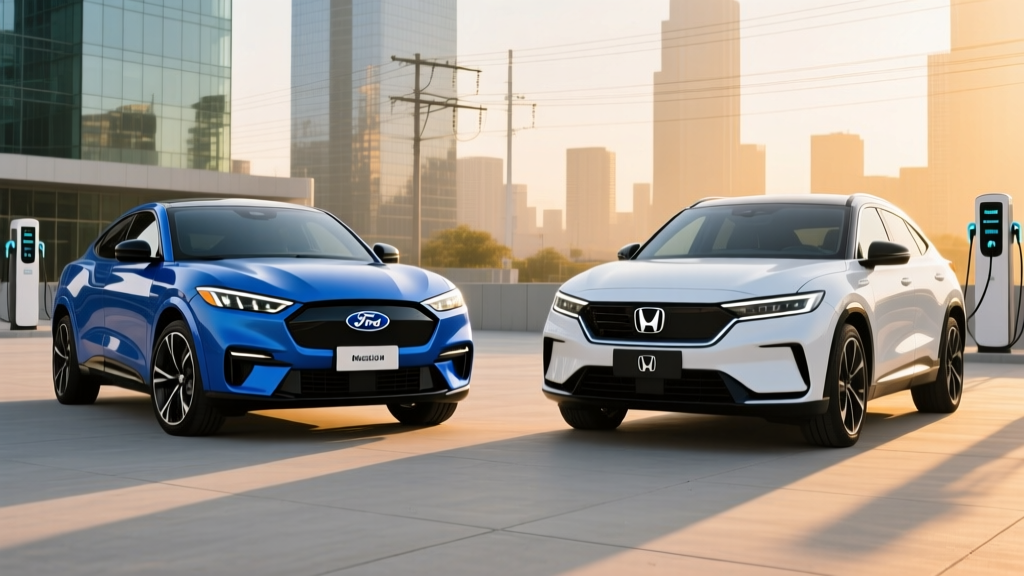
Ford and Honda have taken sharply different paths into electrification. Ford has bet big on full battery-electric vehicles (BEVs) like the Mustang Mach-E and F-150 Lightning, while pivoting some planned EVs to hybrids as market demand shifts. Honda is rebuilding its EV lineup on a dedicated platform after the Prologue (a rebadged GM Ultimum-based SUV) and has committed to a next-generation "0 Series" EV architecture launching in the 2026–2027 timeframe. For buyers today, Ford offers more proven, available BEV options with established Supercharger access; Honda's strongest electrified play right now is its hybrid lineup, with next-gen EVs still ramping up. Your choice depends on whether you want an EV now (Ford) or prefer Honda's hybrid bridge while waiting for their dedicated EVs to arrive.
Ford's EV Strategy: Aggressive Launch, Hybrid Pivot
Ford entered the EV market earlier and more aggressively than Honda. The Mustang Mach-E (EPA range up to 320 miles on the Extended Range RWD trim) and F-150 Lightning (EPA up to 320 miles, Extended Range battery) have been on sale since 2021–2022, giving Ford years of real-world ownership data and charging-network integration.
However, Ford's strategy has evolved significantly. In late 2024 and into 2025–2026, Ford announced it was scaling back several planned next-generation EVs, citing softer-than-expected demand growth and pricing pressure from Chinese manufacturers. Instead, Ford has doubled down on hybrid powertrains across its most popular models — the Maverick hybrid, F-150 PowerBoost hybrid, and a growing roster of hybrid SUVs.
Ford CEO Jim Farley has stated publicly that the company will pursue a "flexible" approach, offering BEVs, hybrids, and plug-in hybrids based on segment demand. The next-generation Ford EVs, built on a dedicated universal platform, are expected around 2027.
Current Ford EV Lineup (2026 Model Year)
| Model | EPA Range | Battery (kWh, usable) | Peak DC Charge | 10–80% Time | Starting MSRP |
|---|---|---|---|---|---|
| Mustang Mach-E Select RWD | 250 mi | 72 kWh (LFP) | 150 kW | ~32 min | $39,995 |
| Mustang Mach-E Premium ER RWD | 320 mi | 91 kWh (NMC) | 150 kW | ~36 min | $47,495 |
| F-150 Lightning Pro Std Range | 240 mi | 98 kWh (NMC) | 120 kW | ~44 min | $54,995 |
| F-150 Lightning Ext Range | 320 mi | 131 kWh (NMC) | 155 kW | ~41 min | $69,995 |
| E-Transit (Commercial) | 126 mi | 68 kWh (NMC) | 115 kW | ~45 min | $49,995 |
Real-World Range Note: The Mach-E Extended Range's 320-mile EPA figure assumes mixed driving. Expect roughly 260–280 miles on sustained highway driving at 70–75 mph, and 200–230 miles in sub-freezing winter conditions without preconditioning. The F-150 Lightning, with its larger frontal area and weight, loses proportionally more range at highway speeds — plan for ~240 miles highway on the Extended Range model.
Honda's EV Strategy: Hybrid Bridge to a Dedicated EV Platform
Honda's electrification journey has been more cautious. After the discontinuation of the original Honda Clarity EV and a long gap in BEV offerings for the U.S. market, Honda launched the Honda Prologue for the 2024 model year — a midsize SUV built on General Motors' Ultium platform (shared with the Chevrolet Blazer EV). The Prologue offered up to 296 miles of EPA range and CCS DC fast charging at up to 150 kW.
But Honda has been clear that the Prologue was a transitional product. The company's long-term play is its proprietary "0 Series" EV platform, announced in early 2024 with production vehicles expected for the 2026–2027 timeframe. Honda has stated the 0 Series will feature:
- Thin, lightweight battery packs with improved energy density
- Aerodynamic "saloon" and SUV body styles
- Next-generation ADAS (Honda's version of Level 2+ driver assist)
- Targeted competitive pricing against Tesla and Hyundai/Kia
Meanwhile, Honda has aggressively expanded its hybrid lineup — the CR-V Hybrid, Accord Hybrid, and Civic Hybrid all deliver strong fuel economy (40+ MPG combined) and serve as Honda's primary electrified offering for buyers who aren't ready for a BEV.
Current Honda Electrified Options (2026)
| Model | Type | Efficiency | Starting MSRP |
|---|---|---|---|
| Prologue EX (FWD) | BEV | 288 mi EPA / 99 MPGe | $47,400 |
| Prologue Touring (AWD) | BEV | 273 mi EPA / 94 MPGe | $53,200 |
| CR-V Hybrid Sport | HEV | 40 MPG combined | $36,350 |
| Accord Hybrid Sport | HEV | 44 MPG combined | $34,995 |
| Civic Hybrid Sport | HEV | 49 MPG combined | $30,395 |
Honda has also adopted the North American Charging Standard (NACS) for future EVs, joining Ford, GM, and others in standardizing on Tesla's connector. Current Prologue models use CCS1, but adapters and future models will support NACS natively, unlocking Tesla Supercharger access.
Ford vs Honda: Cost of Ownership Compared
The financial case for going electric versus hybrid depends heavily on your driving patterns, electricity rates, and access to home charging. Here's a 5-year comparison for a driver covering 15,000 miles per year:
| Cost Factor | Ford Mach-E Premium ER ($47,495) | Honda CR-V Hybrid Sport ($36,350) | Honda Prologue Touring AWD ($53,200) |
|---|---|---|---|
| Purchase Price (MSRP) | $47,495 | $36,350 | $53,200 |
| Est. §30D Federal Tax Credit | $3,750 (partial sourcing)* | N/A (HEV) | $0–$7,500 (GM-sourced battery, verify current eligibility) |
| Fuel/Energy Cost (5 yrs, 75k mi) | ~$4,500 (home L2 at $0.14/kWh) | ~$7,125 (gas at $3.50/gal, 40 MPG) | ~$4,650 (home L2 at $0.14/kWh) |
| Maintenance (5 yrs) | ~$1,800 | ~$3,200 | ~$1,800 |
| Est. Insurance (5 yrs avg) | ~$9,500 | ~$7,200 | ~$9,800 |
| 5-Year Total (est.) | ~$63,295 | ~$53,875 | ~$69,450 |
*Ford's §30D tax credit eligibility varies by trim, battery sourcing, and buyer income. The Mach-E has seen credit amounts fluctuate as Ford adjusts battery component sourcing. Always verify current eligibility at IRS.gov before purchasing.
The Mach-E saves roughly $2,600 in fuel over five years compared to the CR-V Hybrid, but the higher purchase price, insurance premiums, and uncertain tax credit partially offset those savings. The Honda hybrid wins on total cost for buyers who drive moderate distances and lack cheap home electricity.
Real-World Ownership: What First-Time Buyers Must Know
Whether you're eyeing a Ford EV, the Honda Prologue, or a Honda hybrid, these practical realities shape your daily experience:
Home Charging Access Is the Single Biggest Factor
If you can install a Level 2 (240V) home charger, EV ownership is transformative — you wake up with a full "tank" every morning. A typical Level 2 installation (40-amp circuit, hardwired ChargePoint or Wallbox unit) costs $800–$2,000 depending on your electrical panel's capacity. If your panel needs upgrading from 100A to 200A service, add $1,500–$3,000.
Without home charging, EV ownership becomes significantly more inconvenient and expensive. Public DC fast charging costs $0.30–$0.60 per kWh — roughly double or triple the cost of home charging — and requires planning stops into your routine.
Cold Climate Considerations
Both the Mach-E and Prologue use liquid-cooled battery packs with thermal management, but all lithium-ion batteries lose range in cold weather. Expect 20–35% range reduction in sustained sub-30°F temperatures, particularly for short trips where the cabin heater runs frequently without the battery being preconditioned. Ford's Mach-E includes a heat pump on higher trims, which mitigates this loss somewhat compared to resistive heating.
Charging Network Access
Ford EVs gained access to Tesla's Supercharger network (over 20,000 stalls in the U.S.) starting in 2024 via a Ford-provided NACS adapter. This is a significant practical advantage — Tesla's network has the highest reliability rates of any U.S. charging provider. Honda's Prologue currently charges on CCS networks (Electrify America, EVgo), and future 0 Series vehicles will adopt NACS natively.
Common Misconceptions: Ford and Honda EVs
| Myth | Fact |
|---|---|
| "Ford is abandoning EVs" | Ford has delayed some next-gen EV programs and shifted investment toward hybrids, but continues selling and updating the Mach-E and Lightning. A new universal EV platform is planned for ~2027. |
| "Honda has no real EVs" | The Prologue is a fully electric SUV with 273–296 miles of range. Honda's dedicated 0 Series platform is in development for 2026–2027, representing a more serious long-term commitment. |
| "EVs always save money vs. hybrids" | Not necessarily. A Honda CR-V Hybrid at $36K and 40 MPG may have a lower 5-year total cost than a $47K+ EV, especially if you lack home charging or face high electricity rates. |
| "All EVs qualify for the $7,500 tax credit" | Federal §30D credits depend on battery sourcing, critical minerals content, MSRP caps ($55K for SUVs, $80K for trucks), and buyer income limits ($150K single / $300K joint). Many EVs qualify for partial credits or none at all. See fueleconomy.gov for current eligibility. |
| "The Prologue is just a Chevy in disguise" | The Prologue shares GM's Ultium platform and battery hardware, but Honda tuned the suspension, interior, and software to its own specifications. The driving experience and ownership ecosystem differ meaningfully. |
Decision Framework: Which Strategy Fits Your Needs?
Choose Ford's EV If:
- You want an available BEV now with proven range, established Supercharger access, and a growing used-EV market
- You need a truck — the F-150 Lightning remains one of the only full-size electric pickups with real towing capability (7,700 lbs max with Extended Range)
- You have home charging and drive 30–80 miles per day, making daily Level 2 top-ups effortless
- You value performance — the Mach-E GT does 0–60 in 3.5 seconds with 480 hp
Choose Honda's Hybrid If:
- You can't install a home charger (apartment, condo, street parking) — hybrids eliminate charging dependency entirely
- Your budget is under $40K and you want maximum value per dollar
- You take frequent long road trips through areas with sparse charging infrastructure (rural Midwest, mountain West)
- You want proven reliability — Honda's hybrid powertrains in the Accord and CR-V have years of real-world data and strong resale value
Wait for Honda's 0 Series If:
- You prefer Honda's brand and dealer network but want a dedicated EV, not a GM-sourced crossover
- You can wait until late 2026 or 2027 for next-gen vehicles with potentially better range, pricing, and NACS-native charging
- You're currently driving a Honda and plan to transition within the brand when the right product arrives
Ford vs Honda EV Strategy: The Broader Picture
The divergence between these two automakers reflects a broader industry tension: how fast to transition to full EVs when consumer adoption is growing but uneven. Ford's early-mover advantage gives it real-world data, Supercharger access, and brand recognition in EVs — but also exposure to the pricing wars and demand fluctuations that have squeezed EV margins industry-wide.
Honda's hybrid-heavy approach carries lower near-term risk and leverages its engineering strengths (the Civic Hybrid's 49 MPG combined is genuinely impressive), but leaves the company playing catch-up when the EV market does accelerate. The 0 Series platform is Honda's answer — if it delivers competitive range (300+ miles), pricing under $40K, and NACS charging, it could be a strong contender.
For buyers, the takeaway is practical: don't buy based on corporate strategy — buy based on your specific driving needs, charging situation, and budget. Both companies offer viable paths to reducing fossil fuel consumption, whether that's a Mach-E on your driveway charger or a CR-V Hybrid sipping gas at 40 MPG.
Frequently Asked Questions
Does the Ford Mustang Mach-E qualify for the federal EV tax credit in 2026?
Eligibility changes frequently based on battery component sourcing and critical mineral requirements under §30D. The Mach-E has qualified for partial credits ($3,750) at various points, but Ford's sourcing adjustments can shift eligibility. Check the latest status at fueleconomy.gov and consult a tax professional. Point-of-sale transfer is available if you qualify, reducing the purchase price directly at the dealer.
Is the Honda Prologue being discontinued?
Honda has not announced a discontinuation of the Prologue as of early 2026. It remains Honda's only current BEV offering in the U.S. alongside the upcoming 0 Series vehicles. The Prologue received modest updates for the 2025 model year, including NACS adapter availability for Supercharger access.
Which has better charging speed: Ford Mach-E or Honda Prologue?
They're closely matched. The Mach-E Extended Range peaks at 150 kW DC and charges 10–80% in approximately 36 minutes. The Prologue FWD peaks at 150 kW with a similar 10–80% time of roughly 34 minutes. Neither matches the 200+ kW speeds of Hyundai/Kia's E-GMP platform vehicles, which can do 10–80% in ~18 minutes on a 350 kW charger.
Should I buy a Ford hybrid instead of a Ford EV?
It depends on your charging access and driving patterns. The Ford Maverick Hybrid (42 MPG combined, starting around $28,000) is an outstanding value for buyers who can't charge at home. The F-150 PowerBoost Hybrid offers 25 MPG combined with 7,000-lb towing — practical for truck buyers not ready to commit to the Lightning's higher price and charging requirements. If you have reliable Level 2 home charging, the EV delivers lower running costs and a smoother driving experience.
When will Honda's 0 Series EVs actually be available?
Honda has targeted late 2026 for initial 0 Series production in Japan, with U.S. market vehicles expected for the 2027 model year. Specs remain preliminary — Honda has teased thin battery packs, sub-4,000-lb curb weights, and advanced driver-assist features, but final EPA range, pricing, and U.S. availability have not been confirmed. Treat any published specs as estimates until Honda releases official U.S. model details.