Quick Answer: Is Ford's EV Slowdown a Reason to Avoid Buying?
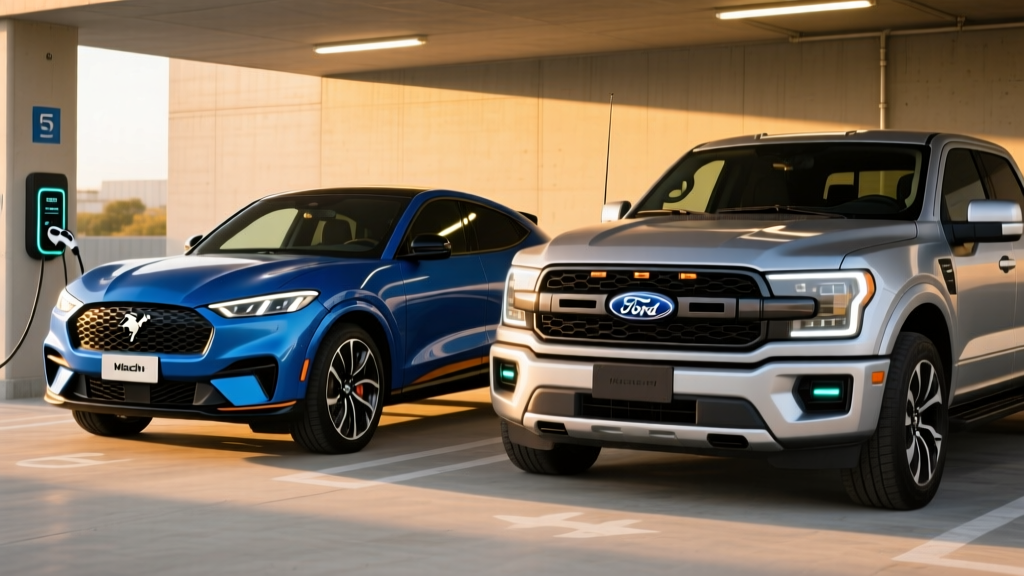
No — but it does change the calculus. The widely reported ford ev sales plunge reflects Ford's strategic retreat from aggressive electrification targets, not a failure of the vehicles themselves. The 2026 Mustang Mach-E (EPA range up to 320 miles, starting ~$42,995) and F-150 Lightning (EPA range up to 320 miles, starting ~$54,995) remain competitive, well-equipped electric vehicles. However, Ford's pivot toward hybrids and its delayed next-gen EV platform mean buyers should weigh strong current product against uncertain long-term brand commitment and potentially softer resale values. If you have home Level 2 charging and your daily drive is under 200 miles, a Mach-E or Lightning can still deliver compelling total cost of ownership — especially with the federal §30D tax credit still available for qualifying buyers.
What the Ford EV Sales Plunge Actually Means for Buyers
Ford's EV division, Model e, posted significant losses through 2024 and 2025, prompting the automaker to scale back production targets, delay its next-generation universal EV platform, and lean harder into its hybrid lineup. Headlines about the ford ev sales plunge capture a real trend: U.S. EV registrations for Ford slowed markedly compared to 2023-2024 peaks, driven by a combination of market saturation in early-adopter segments, intensifying competition from Hyundai/Kia, Tesla price cuts, and growing consumer interest in PHEVs as a bridge technology.
For prospective buyers, this creates a paradox worth understanding:
- The vehicles are mature. The Mach-E entered its sixth model year in 2026; the Lightning its fourth. Software updates, build quality, and charging reliability have improved since early production.
- The business strategy is shifting. Ford is investing more capital into hybrids (the Maverick Hybrid, Explorer Hybrid, and F-150 PowerBoost) and delaying battery-electric successors. This could affect long-term parts availability, dealer EV expertise, and resale trajectory.
- Deals may improve. Slower sales mean dealers are more willing to negotiate, and Ford has periodically offered lease incentives and loyalty cash to move inventory.
2026 Mustang Mach-E: Range, Charging, and Real-World Numbers
The 2026 Mustang Mach-E continues with two battery options and rear-wheel or all-wheel drive. Here are the figures that matter:
| Spec | Standard Range (RWD) | Extended Range (RWD) | Extended Range (AWD) | GT |
|---|---|---|---|---|
| Battery (usable) | 70 kWh (LFP) | 91 kWh (NMC) | 91 kWh (NMC) | 91 kWh (NMC) |
| EPA Range | 250 mi | 320 mi | 300 mi | 280 mi |
| Real-World Highway (~70 mph) | ~210 mi | ~265 mi | ~250 mi | ~230 mi |
| Cold-Weather Loss (est.) | -25% to -30% | -25% to -30% | -25% to -30% | -25% to -30% |
| Peak DC Fast Charge | 135 kW | 150 kW | 150 kW | 150 kW |
| 10-80% DCFC Time | ~36 min | ~41 min | ~41 min | ~41 min |
| Level 2 Rate (240V/48A) | 10.5 kW | 10.5 kW | 10.5 kW | 10.5 kW |
| 0-60 mph | 6.3 sec | 5.8 sec | 5.1 sec | 3.5 sec |
| Horsepower | 266 hp | 290 hp | 346 hp | 480 hp |
| Base MSRP (2026) | $42,995 | $48,995 | $51,995 | $62,995 |
Real-World Range Reality: The Extended Range RWD Mach-E carries an EPA rating of 320 miles, but sustained highway driving at 70-75 mph typically yields 255-270 miles in moderate temperatures. In sub-30°F conditions without preconditioning, expect 210-230 miles. The Mach-E's heat pump (standard on Extended Range trims) helps mitigate cold-weather losses compared to resistive cabin heating, but physics still applies. Plan road trips around ~200-mile segments to maintain a comfortable buffer.
2026 F-150 Lightning: What Truck Buyers Need to Know
The F-150 Lightning remains the only full-size electric pickup from a legacy automaker (Rivian R1T is smaller; Silverado EV is from a different platform). Key specs:
| Spec | Standard Range | Extended Range | Platinum |
|---|---|---|---|
| Battery (usable) | 98 kWh (NMC) | 131 kWh (NMC) | 131 kWh (NMC) |
| EPA Range | 240 mi | 320 mi | 300 mi |
| Real-World Highway | ~195 mi | ~260 mi | ~245 mi |
| Peak DC Fast Charge | 120 kW | 155 kW | 155 kW |
| 10-80% DCFC Time | ~44 min | ~41 min | ~41 min |
| Level 2 (240V/80A) | 19.2 kW | 19.2 kW | 19.2 kW |
| 0-60 mph | 5.7 sec | 4.5 sec | 4.5 sec |
| Horsepower | 452 hp | 580 hp | 580 hp |
| Max Towing | 7,700 lbs | 10,000 lbs | 10,000 lbs |
| Base MSRP (2026) | $54,995 | $69,995 | $82,495 |
Towing caveat: Towing a 7,000+ lb trailer cuts range roughly in half. The Extended Range Lightning towing at max capacity will deliver approximately 140-160 real-world miles before needing a charge. This is a hard physics limitation of all electric trucks today — not unique to Ford. According to EPA data on fueleconomy.gov, the Lightning's combined efficiency ranges from 66-70 MPGe depending on configuration.
Cost Breakdown: Ford EV vs. Gas and Hybrid Alternatives
The ford ev sales plunge partly reflects consumer sticker shock. Let's compare 5-year costs for three realistic scenarios, assuming 15,000 miles/year, $3.40/gal regular gas, $0.14/kWh home electricity, and $0.40/kWh public DC fast charging:
| Category | Mach-E ER RWD ($48,995) | Ford Escape Hybrid AWD ($36,000) | Ford Edge Gas AWD ($41,000) |
|---|---|---|---|
| Purchase Price (MSRP) | $48,995 | $36,000 | $41,000 |
| Est. §30D Tax Credit | $0-$7,500* | $0 (not eligible) | $0 |
| Effective Purchase | $41,495-$48,995 | $36,000 | $41,000 |
| 5-Year Fuel/Energy (80% home) | $5,250 | $8,200 | $12,750 |
| 5-Year Maintenance (est.) | $1,800 | $3,200 | $3,800 |
| 5-Year Insurance (avg.) | $9,500 | $7,800 | $7,200 |
| Estimated 5-Year Depreciation | $19,600-$24,500 | $12,600 | $16,400 |
| Total 5-Year Cost | $52,645-$62,045 | $47,800 | $61,150 |
*§30D tax credit eligibility depends on buyer income caps ($150K single / $300K joint AGI), vehicle MSRP caps ($55K for SUVs/crossovers), and battery critical-mineral/battery-component sourcing requirements that shift annually. Verify current eligibility at irs.gov or consult a tax professional. The Mach-E Select RWD may qualify; higher trims may exceed MSRP caps or lose credit due to sourcing rule changes.
The Mach-E's advantage is clear in energy and maintenance costs — electricity at $0.14/kWh costs roughly 3.5¢ per mile versus 10-12¢ per mile for gasoline. However, higher insurance premiums and potentially steeper depreciation (exacerbated by the brand's uncertain EV commitment) narrow the gap. If you can't charge at home and rely primarily on public DC fast charging at $0.35-0.50/kWh, the Mach-E's energy cost jumps to $6,500-$9,300 over five years, significantly eroding savings.
First-Time EV Buyer Checklist: What You Must Know Before Purchasing
The ford ev sales plunge partly reflects first-time buyers discovering EV ownership requirements they hadn't anticipated. Before committing to a Mach-E or Lightning, work through these realities:
Home Charging Access Is Non-Negotiable for Most Owners
Over 80% of EV charging happens at home. Without access to a garage or dedicated parking spot with a 240V outlet (or the ability to install one), EV ownership becomes significantly more expensive and inconvenient. A Level 2 home charger installation typically costs:
- Charger hardware: $400-$700 (Ford Mobile Power Cord included; dedicated wall unit like ChargePoint Home Flex ~$550)
- Electrical work (50-amp circuit): $800-$2,500 depending on panel proximity
- Panel upgrade (if needed): $1,500-$3,500 for a 200-amp service upgrade
- Permit and inspection: $100-$300
Total: $1,300-$7,000 depending on your electrical panel's capacity and location relative to your parking spot. Always get a quote from a licensed electrician before purchasing the vehicle.
Cold Weather Cuts Range — Plan Accordingly
If you live in a climate where winter temperatures regularly drop below 25°F, expect 20-30% range reduction. A Mach-E Extended Range that delivers 270 miles in July may deliver only 190-210 miles in January. Preconditioning the battery while plugged in mitigates this, but only if you're charging at home. Cold-weather road trips require more frequent stops.
Public Charging Reliability Varies Widely
The Mach-E uses the NACS connector (Tesla-style) as of the 2025 model year, granting access to Tesla Supercharger stations — a significant advantage over CCS-equipped competitors. However, Supercharger stalls in high-traffic urban areas can have queues during peak travel. Rural charging infrastructure remains sparse in many regions. Map your common routes on PlugShare or A Better Routeplanner before buying.
Common Misconceptions About Ford EVs — Myth vs. Fact
| Myth | Fact |
|---|---|
| "Ford is abandoning EVs, so parts and service will disappear." | Ford has scaled back future EV investment but continues to sell, service, and support the Mach-E and Lightning. Existing warranty obligations (3-year/36,000-mi bumper-to-bumper; 8-year/100,000-mi battery) remain fully backed. |
| "The Mach-E battery will need expensive replacement within a few years." | LFP chemistry (Standard Range) is rated for 3,000+ cycles with minimal degradation. NMC packs (Extended Range) typically retain 90%+ capacity at 100,000 miles. Ford's warranty covers replacement if capacity drops below 70% within 8 years/100,000 miles. Full replacement, if ever needed, runs $15,000-$22,000 — rare under normal use. |
| "The F-150 Lightning can't tow like a real truck." | The Lightning tows up to 10,000 lbs — comparable to many gas F-150 configurations. The limitation is range under tow (roughly halved), not pulling power. Electric motors deliver peak torque from 0 RPM. |
| "I'll save $7,500 no matter what." | The §30D credit has MSRP caps ($55K for SUVs/crossovers, $80K for trucks/vans), buyer income caps, and battery-sourcing requirements that change yearly. Many Mach-E trims and most Lightning trims exceed MSRP caps or fail sourcing tests. Always verify on fueleconomy.gov before purchasing. |
| "EVs cost more to insure — it's not worth it." | EV insurance premiums run 15-25% higher on average due to repair costs and battery replacement risk. However, the fuel and maintenance savings often offset this. Shop quotes from multiple carriers — some (like State Farm and Progressive) have narrowed the EV premium gap. |
Decision Framework: Should You Buy a Ford EV in 2026?
Buy the Mustang Mach-E if:
- You have reliable home Level 2 charging (or can install it for under $3,000)
- Your daily commute is under 150 miles round-trip
- You want a well-equipped crossover with competitive tech and don't mind a brand in strategic transition
- You can secure the vehicle below MSRP (dealers are motivated) and qualify for at least a partial §30D credit
- You value NACS/Supercharger access for road trips
Buy the F-150 Lightning if:
- You need a full-size truck for work or towing but your daily driving is local (under 100 miles)
- You have a 240V/80A circuit available for the Lightning's 19.2 kW onboard charger (significantly faster home charging than most EVs)
- You rarely tow long distances — or you're willing to plan around 140-mile tow range
- You can use Pro Power Onboard (V2L) for job-site power or backup home power
Consider a Ford Hybrid Instead if:
- You lack home charging access and rely on street parking
- You regularly drive 300+ miles between stops in rural areas
- You live in an extreme cold climate (below 0°F regularly) and can't precondition at home
- You want to minimize depreciation risk from Ford's uncertain EV strategy
- The Maverick Hybrid (42 MPG combined, ~$28,000) or F-150 PowerBoost Hybrid (24 MPG combined, towing up to 12,700 lbs) meets your needs
Wait or Look Elsewhere if:
- You want to see Ford's next-gen EV platform (announced for late 2027+, specs preliminary)
- Long-term resale value is a top priority and Ford's EV commitment concerns you
- You need a compact or midsize EV with best-in-class efficiency — the Hyundai Ioniq 5 (310+ mi, 800V architecture, 10-80% in 18 min) and Tesla Model Y (320+ mi, lowest cost per mile) may be stronger picks
The Resale Question: Will the Sales Plunge Hurt Your Trade-In Value?
This is the most legitimate concern tied to the ford ev sales plunge. Used EV values have already softened industry-wide since 2023, driven by Tesla's aggressive price cuts, Hertz fleet sell-offs, and improving new-EV incentives. Ford's reduced EV commitment adds a brand-specific headwind: buyers in 2029-2030 may discount a used Mach-E if Ford hasn't launched a compelling successor or has effectively exited the segment.
Current 3-year depreciation estimates for the Mach-E run 40-48% (versus ~35% for the Toyota RAV4 Hybrid and ~38% for the Tesla Model Y). If you plan to own the vehicle for 7+ years and drive it into the ground, depreciation matters less. If you trade every 3 years, lease instead — Ford's lease residuals shift depreciation risk to the lessor, and lease deals on the Mach-E have been competitive (often $299-$399/month with modest down payments).
FAQ: Ford EV Ownership in 2026
Is Ford discontinuing the Mustang Mach-E or F-150 Lightning?
No. As of 2026, both vehicles remain in production and on sale. Ford has delayed its next-generation EV platform and reduced overall EV capital expenditure, but current models continue with annual updates. Ford has not announced an end-of-production date for either vehicle.
Will Ford dealers still service my Mach-E or Lightning in 5 years?
Yes. Ford has over 2,800 U.S. dealerships, and federal warranty law requires manufacturers to honor warranty commitments regardless of production status. Even if Ford eventually discontinues these models, parts availability and service capability will persist for at least a decade — consistent with standard automotive industry practice.
What's the real-world cost to charge a Mach-E at home per month?
At the U.S. average residential electricity rate of ~$0.16/kWh and driving 1,250 miles/month, the Mach-E Extended Range (efficiency ~3.0 mi/kWh) uses approximately 417 kWh/month, costing about $67/month. This compares to roughly $140-$170/month for gasoline in a comparable AWD crossover getting 26 MPG combined at $3.40/gallon.
Does the F-150 Lightning qualify for the $7,500 federal tax credit?
Eligibility is complex and changes with sourcing rules. The Lightning qualifies under the $80,000 MSRP cap for trucks. However, battery component and critical mineral sourcing requirements (per IRS §30D guidelines) may disqualify certain configurations. Additionally, buyer income must not exceed $150,000 (single) or $300,000 (joint). Check the latest eligibility on fueleconomy.gov at time of purchase, and consider the point-of-sale transfer option to apply the credit directly to your down payment.
Should I buy a Ford hybrid instead of a Ford EV?
If you cannot install home charging, regularly drive long distances in areas with sparse public charging infrastructure, or live in an extreme cold climate, a Ford hybrid (Maverick Hybrid, Escape Hybrid, F-150 PowerBoost) may be the more practical choice. Hybrids eliminate range anxiety, require no charging infrastructure, and still deliver meaningful fuel savings — the Maverick Hybrid achieves 42 MPG city for under $30,000. However, if you can charge at home and your daily driving is predictable, an EV's lower per-mile energy cost and reduced maintenance provide stronger long-term economics.