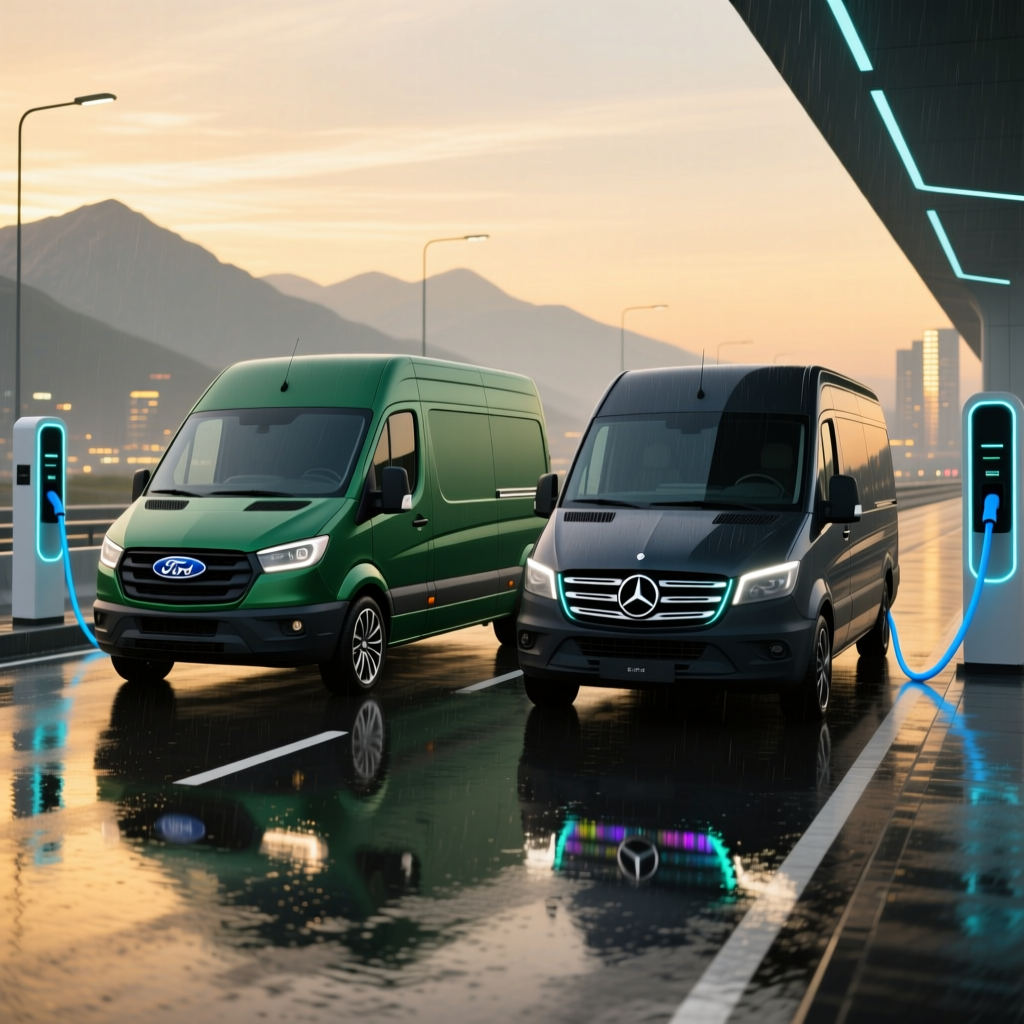
Ford E-Transit vs. Mercedes-Benz eSprinter Cargo Van: The Ultimate EV Commercial Showdown
The commercial vehicle sector is undergoing a massive transformation as fleet managers and independent business owners transition away from internal combustion engines. Electric commercial vans promise lower operating costs, reduced emissions, and a quieter, more refined driving experience for delivery personnel. However, choosing the right electric vehicle (EV) for your business requires a careful analysis of payload capacities, route lengths, and charging infrastructure. In the heavy-duty commercial van segment, two titans dominate the conversation: the Ford E-Transit and the Mercedes-Benz eSprinter.
Both of these zero-emission workhorses are designed to seamlessly integrate into existing fleet operations while offering the instant torque and low-maintenance benefits of electric powertrains. But they approach the market with distinctly different philosophies, battery sizes, and drivetrain configurations. In this comprehensive head-to-head comparison, we will break down everything you need to know to decide which electric cargo van deserves a spot in your depot. For a broader look at the market, be sure to check out our best electric vans rankings.
Vehicle Overview
The Ford E-Transit is the electrified version of America’s best-selling cargo van. Ford’s primary goal with the E-Transit was to create an electric van that mirrors the exact cargo dimensions, upfit capabilities, and familiar driving dynamics of its gas-powered counterpart. By packaging the battery pack entirely under the floor, Ford ensured that fleet managers could use the exact same shelving, partitions, and upfit equipment from their legacy gas vans, drastically reducing the friction of transitioning to an electric fleet.
The Mercedes-Benz eSprinter, on the other hand, brings premium European engineering and a tech-forward approach to the commercial sector. Mercedes-Benz has focused heavily on maximizing cargo volume, offering a slightly larger footprint and a highly sophisticated MBUX infotainment system tailored for commercial use. With a focus on driver comfort, advanced safety features, and a larger available battery pack, the eSprinter positions itself as the premium choice for businesses that require extended range and a more refined cabin experience. Read our full Mercedes-Benz eSprinter review for a deeper dive into its premium offerings.
Side-by-Side Specification Comparison
Before diving into the nuances of daily operation, let’s look at the raw numbers. The following table compares the high-roof, extended-wheelbase cargo variants of both vehicles, which are the most popular configurations for last-mile delivery and regional logistics.
| Specification | Ford E-Transit (Cargo Van) | Mercedes-Benz eSprinter (Cargo Van) |
|---|---|---|
| Usable Battery Capacity | 68 kWh | 113 kWh (High Output) |
| EPA Estimated Range | ~126 miles | ~200 miles |
| Electric Motor Output | 266 hp / 317 lb-ft torque | 201 hp / 295 lb-ft torque |
| Drivetrain | Rear-Wheel Drive (RWD) | Front-Wheel Drive (FWD) |
| Max Cargo Volume | 487.3 cu ft | 532.6 cu ft |
| Max Payload Capacity | Up to 3,880 lbs | Up to 2,624 lbs |
| DC Fast Charging (15-80%) | ~45 minutes (115 kW) | ~40 minutes (115 kW) |
| Level 2 AC Charging | 10.5 kW | 9.6 kW |
Range & Battery Efficiency
Range is often the most scrutinized metric for commercial EVs, and this is where the two vans diverge significantly. The Ford E-Transit is equipped with a 68 kWh usable battery pack that yields an EPA-estimated range of approximately 126 miles for the low-roof cargo van variant (high-roof variants see a slight reduction due to aerodynamic drag). Ford engineered this specific battery size based on extensive telematics data showing that the vast majority of commercial delivery vans travel fewer than 100 miles per day. By keeping the battery relatively small, Ford reduced vehicle weight, maximized payload capacity, and kept the upfront purchase price competitive.
Conversely, the Mercedes-Benz eSprinter offers a much larger 113 kWh usable battery pack in its High Output configuration, pushing the EPA-estimated range to roughly 200 miles. This makes the eSprinter a far more viable option for regional delivery routes, inter-city logistics, and businesses operating in rural areas where charging infrastructure is sparse. However, this massive battery adds significant weight to the vehicle, which directly impacts its maximum payload capacity.
It is crucial for fleet managers to remember that real-world range in commercial vans is highly dependent on payload weight, driving style, and climate control usage. Hauling a full 3,000-pound payload or running the cabin heater in freezing temperatures can reduce range by 20% to 30% in either vehicle. For more tips on optimizing your routes, consult our guide to maximizing EV range.
Pricing & Fleet Value
When evaluating the total cost of ownership (TCO), the initial MSRP is only one piece of the puzzle. The Ford E-Transit generally enters the market at a significantly lower price point than the Mercedes-Benz eSprinter. This lower barrier to entry makes the E-Transit highly attractive for small-to-medium enterprises (SMEs) and large fleets looking to electrify a portion of their lineup without taking on massive capital debt. Furthermore, the E-Transit’s compatibility with existing gas-Transit upfits means businesses can save thousands of dollars by transferring shelving and ladder racks from their retired fleet.
The Mercedes-Benz eSprinter commands a premium price, reflecting its larger battery, advanced technology suite, and brand positioning. However, for businesses that require the 200-mile range to avoid mid-day public charging stops, the eSprinter’s higher upfront cost can be offset by the operational efficiency of completing longer routes without downtime. Both vehicles are typically eligible for various federal, state, and local commercial EV incentives, which can drastically alter the final balance sheet. Be sure to research current commercial EV incentives in your municipality before finalizing a fleet order.
Maintenance savings also play a massive role in fleet value. Both the E-Transit and eSprinter eliminate the need for oil changes, spark plugs, and transmission fluid replacements. Regenerative braking significantly extends the life of the friction brake pads, often pushing brake service intervals well past 100,000 miles. Over a five-year lifecycle, these operational savings frequently bridge the gap between the E-Transit’s lower MSRP and the eSprinter’s premium pricing.
Charging Speed & Infrastructure
For commercial fleets, time spent charging is time not spent earning revenue. Both the Ford E-Transit and the Mercedes-Benz eSprinter support DC fast charging at peak rates of up to 115 kW. Under optimal conditions, both vans can replenish their batteries from 15% to 80% in roughly 40 to 45 minutes. While the eSprinter has a larger battery to fill, its thermal management system is highly efficient, allowing it to sustain peak charging speeds effectively.
Where commercial fleets will spend most of their time, however, is on Level 2 AC charging at the depot. The Ford E-Transit features a slightly faster onboard charger at 10.5 kW compared to the eSprinter’s 9.6 kW system. When plugged into a dedicated 48-amp Level 2 wallbox, the E-Transit can achieve a full overnight charge in roughly eight hours, while the eSprinter’s larger battery will require closer to 12 to 14 hours for a complete 0-100% replenishment. This means eSprinter fleet operators must be meticulous about ensuring vehicles are plugged in immediately upon returning to the depot.
Both manufacturers offer robust fleet charging software integrations. Ford Pro and Mercedes PRO connect allow fleet managers to schedule charging during off-peak utility hours, drastically reducing electricity costs. They also support battery preconditioning, which warms or cools the battery pack while the van is still plugged into the grid, ensuring maximum range and regenerative braking efficiency the moment the driver starts their shift. For a complete breakdown of depot setups, read our fleet charging guide.
Performance & Drivability
The driving dynamics of these two vans are fundamentally different, largely due to their drivetrain layouts. The Ford E-Transit utilizes a Rear-Wheel Drive (RWD) configuration, mirroring the traditional Transit layout. RWD is generally preferred for heavy-duty commercial applications because it provides better traction when the van is fully loaded; the weight of the cargo presses down on the rear drive wheels, reducing slip. The E-Transit’s electric motor produces a robust 266 horsepower and 317 lb-ft of torque, giving it a surprisingly punchy and confident feel when merging onto highways, even with a heavy payload.
The Mercedes-Benz eSprinter employs a Front-Wheel Drive (FWD) layout. The primary advantage of FWD in a commercial van is a lower floor height, which translates to a lower step-in height for drivers making frequent deliveries and a lower load floor for warehouse personnel. FWD also provides better traction in light snow and rain when the van is completely empty. However, when fully loaded, FWD vans can experience slight wheelspin under hard acceleration because the heavy cargo weight shifts away from the front drive axle. The eSprinter’s motor produces 201 horsepower and 295 lb-ft of torque, which is more than adequate for city driving but feels slightly more strained than the Ford when hauling maximum payloads up steep inclines.
Both vans feature multiple drive modes (Eco, Normal, and sometimes a Slippery mode) and adjustable regenerative braking settings. Mastering the one-pedal driving capabilities in either van can drastically reduce driver fatigue in stop-and-go urban delivery environments.
Interior Space & Cargo Utility
Cargo volume is the lifeblood of any delivery business, and both manufacturers have gone to great lengths to ensure the battery packs do not intrude into the cargo area. By mounting the lithium-ion cells entirely beneath the floor, both the E-Transit and eSprinter offer flat, unobstructed cargo floors that match their internal combustion counterparts.
The Mercedes-Benz eSprinter holds a slight edge in maximum interior volume, offering up to 532.6 cubic feet of space in its high-roof, extended-wheelbase configuration. Its slightly wider and longer footprint makes it an excellent choice for bulky, lightweight goods like furniture, floral arrangements, or large appliance deliveries. The eSprinter also features a highly configurable interior with robust tie-down points and optional wood flooring designed to withstand years of abuse from pallet jacks and hand trucks.
The Ford E-Transit maxes out at 487.3 cubic feet in its highest roof and longest wheelbase configuration. While slightly smaller in total volume than the Mercedes, the E-Transit’s square, utilitarian shape is incredibly easy to upfit. Because the E-Transit shares its body-in-white dimensions with the gas Transit, the aftermarket support is virtually limitless. Fleet managers can easily source standardized partitions, bulkheads, refrigeration units, and modular shelving systems from third-party upfitters without needing custom fabrication. Furthermore, the E-Transit’s superior payload capacity (up to 3,880 lbs compared to the eSprinter’s 2,624 lbs) makes the Ford the undisputed king for heavy freight, such as plumbing supplies, auto parts, or beverage distribution.
Technology & Fleet Management
Modern commercial vans are essentially rolling data centers, and the software ecosystems provided by Ford and Mercedes-Benz are critical for fleet optimization. The Ford E-Transit comes equipped with the SYNC 4 infotainment system, featuring a large 12-inch touchscreen, wireless Apple CarPlay and Android Auto, and deep integration with Ford Pro telematics. Ford Pro offers a suite of connected services that provide real-time vehicle health alerts, driver behavior scoring, and automated maintenance scheduling. If a van throws a diagnostic trouble code, the fleet manager is notified instantly, and the system can even locate the nearest commercial service center with the required parts in stock.
The Mercedes-Benz eSprinter features the acclaimed MBUX (Mercedes-Benz User Experience) system, which is widely considered the most visually impressive and voice-responsive interface in the commercial sector. The MBUX system includes advanced navigation that factors in the van’s current state of charge, payload weight, and topographical data to predict range with stunning accuracy. Mercedes PRO connect offers similar fleet management tools to Ford Pro, including geofencing, remote door unlocking for secure drop-offs, and detailed trip analytics. Both systems support over-the-air (OTA) updates, ensuring the vans receive new features and performance tweaks without needing to visit a dealership.
Warranty & Reliability
Downtime is the enemy of profitability, making warranty coverage a paramount concern for commercial buyers. Both Ford and Mercedes-Benz back their high-voltage battery packs with an 8-year or 100,000-mile warranty, guaranteeing that the battery will retain a minimum of 70% of its original capacity. This provides immense peace of mind for fleet operators planning to run their vehicles on rigorous multi-shift schedules.
Ford leverages its massive network of commercial-certified dealerships, offering extended service hours, priority commercial lanes, and mobile service vans that can perform software updates and minor repairs at your depot. Mercedes-Benz also maintains a dedicated commercial van network, though its footprint is generally smaller and more concentrated in major metropolitan areas compared to Ford’s ubiquitous presence. For a complete breakdown of ownership costs, check out our Ford E-Transit review.
The Verdict: Which EV Van is Right for Your Business?
Choosing between the Ford E-Transit and the Mercedes-Benz eSprinter ultimately comes down to your specific operational profile, route lengths, and cargo types.
Choose the Ford E-Transit if: Your business focuses on last-mile delivery, urban routes under 100 miles per day, and heavy payloads. The E-Transit’s lower upfront cost, superior payload capacity, RWD traction, and seamless compatibility with existing gas-Transit upfits make it the most pragmatic and budget-friendly choice for high-volume, stop-and-go delivery fleets like Amazon DSPs, postal contractors, and local tradesmen.
Choose the Mercedes-Benz eSprinter if: Your routes frequently exceed 120 miles, you operate in regions with sparse charging infrastructure, or you haul bulky, lightweight freight that demands maximum interior cubic footage. The eSprinter’s larger battery, premium cabin comfort, and advanced MBUX navigation make it the ideal premium workhorse for regional logistics, high-end courier services, and mobile boutique businesses.
Both vehicles represent the pinnacle of current commercial EV technology and are excellent choices for modernizing your fleet. Explore more options in our electric vehicle rankings to find the perfect match for your business needs.
Frequently Asked Questions
Which electric cargo van has the best payload capacity?
The Ford E-Transit is the clear winner when it comes to payload capacity. Thanks to its smaller, lighter battery pack and robust rear-axle configuration, the E-Transit can handle up to 3,880 pounds of cargo. In contrast, the Mercedes-Benz eSprinter’s massive 113 kWh battery pack adds significant curb weight, limiting its maximum payload to roughly 2,624 pounds. For businesses hauling dense materials like metal parts, liquids, or heavy machinery, the E-Transit is the only viable option between the two.
Can the Ford E-Transit and Mercedes-Benz eSprinter be fast-charged at public stations?
Yes, both vehicles are equipped with CCS (Combined Charging System) ports and support DC fast charging at peak rates of up to 115 kW. This allows both vans to charge from 15% to 80% in about 45 minutes at compatible public charging stations. However, relying on public charging is generally not recommended for daily commercial operations due to the unpredictability of charger availability and the higher cost per kWh compared to depot charging. Fleet managers should prioritize installing Level 2 charging infrastructure at their home base.
How does cold weather affect commercial EV van range?
Cold weather is the natural enemy of all lithium-ion batteries. In freezing temperatures, the chemical reactions inside the battery slow down, and energy must be diverted from the drivetrain to power the cabin heater and warm the battery pack. Fleet operators can expect a range reduction of 20% to 30% in severe winter conditions for both the E-Transit and the eSprinter. To mitigate this, both vans offer battery preconditioning features that warm the pack while the vehicle is still plugged into the depot charger, preserving maximum range for the start of the route.
What are the maintenance differences between electric and gas cargo vans?
Electric cargo vans require significantly less routine maintenance than their internal combustion counterparts. Because EVs lack complex engines, they do not require oil changes, fuel filter replacements, spark plugs, or exhaust system repairs. Additionally, the heavy use of regenerative braking in stop-and-go delivery routes drastically reduces wear on the physical friction brakes, often allowing brake pads to last well over 100,000 miles. The primary maintenance items for the E-Transit and eSprinter are limited to tire rotations, cabin air filter replacements, windshield wiper fluid, and periodic checks of the reduction gear fluid and battery cooling systems.