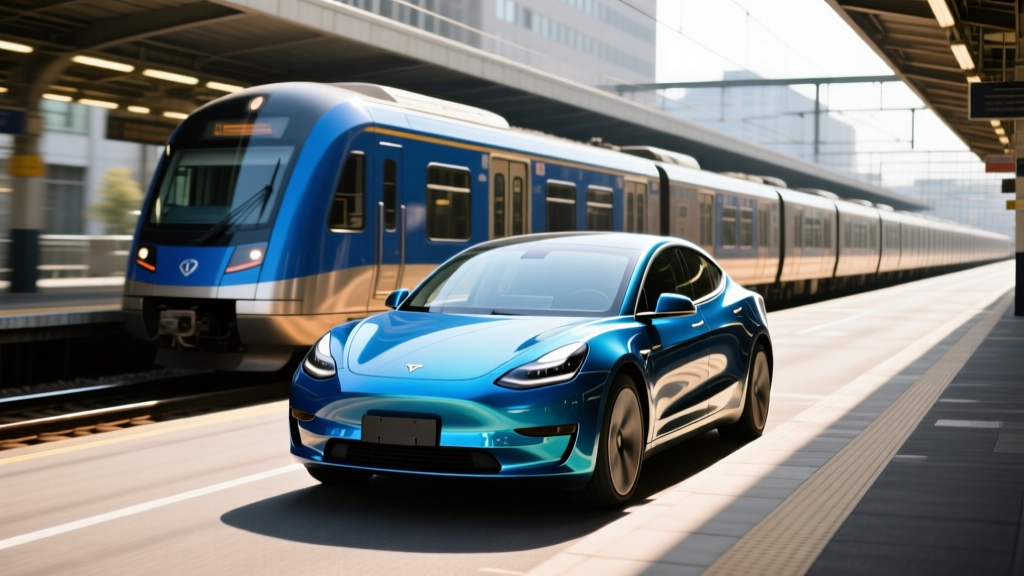
Quick Answer: Electric trains move passengers at roughly 0.15–0.25 kWh per mile per person, while a modern EV like the Tesla Model 3 uses about 0.25–0.30 kWh per mile for the whole vehicle. Trains win on pure per-passenger efficiency in dense corridors, but EVs deliver door-to-door flexibility with zero transfers. The real decision isn't train vs. car—it's whether your commute, climate, and charging access make an EV the right personal transport choice.
Why "Trains Electric" Searches Matter for EV Buyers
If you've searched for trains electric while researching your next vehicle, you're likely weighing a fundamental question: should I buy an EV, or does public electrified transit make more financial and environmental sense? It's a smarter question than most car shoppers ask, and the answer depends on data, not ideology.
The United States operates over 35,000 miles of electrified rail across commuter lines, Amtrak's Northeast Corridor, and urban light-rail systems. Meanwhile, the EV market in 2026 offers models from $29,000 (base Nissan Leaf) to over $100,000, with EPA ranges stretching past 400 miles. Both run on electrons. Neither burns fossil fuels at the tailpipe. But the economics, convenience, and energy math diverge sharply depending on where you live and how you drive.
Let's run the numbers on both—and figure out which electrified option actually saves you money and time.
Energy Efficiency: Electric Trains vs. Personal EVs
The most honest way to compare electrified transport is energy consumed per passenger-mile. This is where electric trains reveal their engineering advantage: steel wheels on steel rails produce far less rolling resistance than rubber tires on asphalt, and a single electric motor can pull dozens or hundreds of passengers simultaneously.
| Transport Mode | Energy per Passenger-Mile | Typical Cost per Mile | Door-to-Door Flexibility |
|---|---|---|---|
| Heavy Rail (e.g., BART, PATH) | ~0.15–0.20 kWh | $0.04–$0.08 | Low (fixed routes/schedules) |
| Light Rail / Streetcar | ~0.20–0.30 kWh | $0.05–$0.10 | Low–Moderate |
| Amtrak Acela (NEC) | ~0.22–0.28 kWh | $0.12–$0.25 | Low |
| Tesla Model 3 (2026, 1 occupant) | ~0.25–0.30 kWh | $0.04–$0.12 (home vs. DCFC) | High |
| Hyundai Ioniq 6 (2026, 1 occupant) | ~0.24–0.28 kWh | $0.04–$0.11 | High |
| Gas Car (28 MPG combined, 1 occupant) | ~1.21 kWh equivalent | $0.14–$0.18 | High |
| Gas Car (28 MPG, 4 occupants) | ~0.30 kWh equiv./person | $0.04–$0.05/person | High |
Key takeaway: A single-occupant EV is remarkably close to rail efficiency per passenger-mile—especially aerodynamic sedans like the Ioniq 6 (EPA 140 MPGe, 0.24 kWh/mi). But a fully loaded commuter train crushes every personal vehicle. If you can carpool an EV to 3–4 passengers, you match or beat most light-rail systems.
The Real Cost Breakdown: EV Ownership vs. Electrified Transit
Energy efficiency is only one variable. Let's model a real-world scenario: a 20-mile each-way commute (40 miles daily, ~10,000 miles/year) in a mid-size U.S. metro area.
| Cost Factor | 2026 EV (e.g., Chevy Equinox EV, ~$33,000) | Monthly Commuter Rail Pass | Gas Car (28 MPG, ~$28,000) |
|---|---|---|---|
| Monthly Fuel/Energy | $40–$90 (home L2 at $0.14/kWh vs. DCFC) | $120–$220 (varies by city) | $150–$190 ($3.40/gal avg) |
| Monthly Insurance | $160–$220 (EVs run ~15–20% higher) | $0 (included in pass) | $130–$180 |
| Maintenance (Annual) | $300–$500 (tires, cabin filter, wipers) | $0 | $800–$1,200 |
| Purchase Price / Upfront | ~$33,000 (before §30D credit) | $0 | ~$28,000 |
| Federal Tax Credit (§30D) | Up to $7,500 (if eligible—see IRS rules) | N/A | $0 |
| Estimated 5-Year Total Cost | $44,000–$54,000 | $7,200–$13,200 | $49,000–$56,000 |
Transit wins decisively on pure cost if a reliable electrified rail line covers your commute. But transit only works if it actually serves your origin and destination. The moment you need a car for weekends, errands, family trips, or areas without rail coverage, the comparison shifts to EV vs. gas—and the EV's lower fuel and maintenance costs start to close the gap within 3–4 years.
Important on the §30D tax credit: For 2026, the IRS clean vehicle credit remains up to $7,500 but requires meeting battery critical-mineral sourcing thresholds, MSRP caps ($55,000 for sedans, $80,000 for SUVs/trucks), and buyer income limits ($150K single / $300K joint). Eligibility shifts as battery supply chains evolve—always verify the current qualified vehicle list before purchasing.
What Electric Train Data Teaches EV Buyers
Rail electrification has operated at scale for over a century, and its lessons directly apply to your EV purchase decisions:
1. Route Density Determines Viability
Electric trains are extraordinarily efficient on high-density corridors (Boston–Washington, Bay Area, Chicago). In rural or low-density areas, diesel buses or personal vehicles dominate. The same logic applies to EVs: if you live in a charging desert—regions with sparse DC fast-charger infrastructure—a plug-in hybrid (PHEV) like the Toyota RAV4 Prime may serve you better than a full BEV.
2. Regenerative Braking Is Proven at Scale
Electric trains have used regenerative braking for decades, feeding energy back into the grid during deceleration. Your EV does the same thing on a smaller scale. Modern EVs recapture 60–70% of kinetic energy during braking, extending real-world range by 10–20% in stop-and-go traffic versus steady highway cruising. This is why city EPA MPGe ratings for EVs are often higher than highway ratings—the opposite of gas cars.
3. Cold Weather Affects All Electric Systems
Transit agencies in cold climates (Montreal, Minneapolis, Chicago) budget for 20–35% range/energy reduction in winter. Your EV will experience similar losses. A 2026 Tesla Model Y with an EPA range of 320 miles may deliver 220–260 miles in sub-freezing highway driving. Models equipped with a heat pump (standard on most 2026 Teslas, Hyundais, and BMWs) mitigate this loss compared to resistive cabin heaters, but the physics of lithium-ion chemistry in cold temperatures cannot be fully engineered away.
Common Misconceptions: EVs, Trains, and Electrification
| Myth | Fact |
|---|---|
| "EVs just shift emissions to coal power plants." | Even on the dirtiest U.S. grids, an EV produces fewer lifecycle emissions than a 28 MPG gas car. On clean grids (Pacific Northwest, upstate NY), the advantage is massive. Source: EPA EV Myths. |
| "Electric trains prove we don't need personal EVs." | U.S. rail covers <2% of passenger-miles nationally. Most Americans need a personal vehicle for daily life. The question is whether that vehicle should be electric. |
| "EV batteries need replacing every 5 years like a phone." | 2026 EV batteries are warranted for 8 years/100,000 miles (10 years/150,000 in CARB states) at 70% capacity retention. Real-world degradation data shows most NMC batteries lose 8–12% over 8 years; LFP batteries (Tesla Model 3 RWD, Ford Mustang Mach-E Select) degrade even less. |
| "Charging takes too long compared to refueling." | Home Level 2 charging (7–11 kW) refills overnight—most owners never visit a gas station or public charger for daily driving. Road-trip DC fast charging at 150–250 kW adds 150–200 miles in 15–20 minutes (10–80% SoC). |
| "EVs are more expensive to insure, so savings disappear." | Insurance premiums run 15–20% higher on average, but the fuel and maintenance savings ($1,000–$2,000/year) typically outweigh the added insurance cost within 2–3 years. |
Decision Framework: Should You Buy an EV, Ride Transit, or Choose a Hybrid?
Use this if/then guide to find your best electrified option:
- IF a reliable electrified rail line covers your daily commute door-to-door within 15 minutes of walking AND you don't regularly need a car for family, errands, or weekend trips → Ride transit. It's cheaper, greener, and zero maintenance.
- IF you have home charging access (garage, driveway, or landlord-approved Level 2 install) AND your daily driving is under 200 miles round-trip → Buy a BEV. The 2026 sweet spot: Chevy Equinox EV ($33K, 319 mi EPA), Tesla Model 3 ($39K, 341 mi EPA), or Hyundai Ioniq 5 ($42K, 303 mi EPA). Expect $0.04–$0.06/mile fuel cost on home power.
- IF you lack reliable home charging AND your area has sparse public DC fast chargers → Consider a PHEV. The Toyota RAV4 Prime (42 mi electric-only, 38 MPG gas) or Hyundai Tucson PHEV (33 mi electric, 35 MPG) eliminate range anxiety while still reducing fuel use 40–60%.
- IF you regularly drive 300+ miles in cold climates or tow frequently → A PHEV or high-range BEV (350+ mi EPA) with a heat pump is essential. Budget for real-world range loss of 25–35% in winter highway driving.
- IF your commute is short (<10 miles) and transit isn't available → A used EV (post-2022, eligible for the $4,000 used-EV credit) offers the lowest total cost.
What First-Time EV Buyers Must Know
If you're transitioning from a gas car—or weighing an EV against an electric-train commute—these ownership realities matter:
Home charging is non-negotiable for convenience. A Level 2 home charger (240V, 32–48 amps, 7.7–11.5 kW) adds 25–45 miles of range per hour. Installation costs $500–$2,500 depending on panel capacity and wiring distance. If your home has a 200-amp electrical panel with spare capacity, expect the lower end. Older 100-amp panels may require a $1,500–$3,000 upgrade. Always get a quote from a licensed electrician before committing to an EV.
Charging speed is about the curve, not the peak. A vehicle advertising "250 kW DC fast charging" only hits that peak briefly at low state of charge (10–30% SoC). The rate tapers significantly above 80% to protect battery health. What matters is the 10–80% time: the Hyundai Ioniq 5 does it in ~18 minutes (peak 240 kW), while the Chevy Equinox EV takes ~30 minutes (peak 150 kW). Plan road-trip stops accordingly.
kW vs. kWh—know the difference. Kilowatts (kW) measure power—how fast energy flows. Kilowatt-hours (kWh) measure energy capacity—how far you can go. A 75 kWh battery charged at 11 kW (Level 2) takes ~7 hours from empty. That same battery charged at 150 kW (DC fast) can gain 60% in ~20 minutes. Confusing these units is the #1 mistake new EV buyers make.
Plan for cold weather. If you live where temperatures regularly drop below 30°F, precondition your EV while plugged in (most models support scheduled preconditioning via app). This warms the battery before driving, restoring range and enabling faster regenerative braking from the first mile.
Frequently Asked Questions
Are electric trains more efficient than electric cars?
Per passenger-mile, yes—when trains run at or near capacity. A fully loaded commuter rail car uses roughly 0.15–0.20 kWh per passenger-mile versus 0.24–0.30 kWh for a single-occupant EV. But an EV with 3–4 passengers matches most light-rail efficiency. The advantage shifts to EVs when trains run off-peak with low ridership.
Can I save more money with an EV or a monthly transit pass?
A monthly commuter rail pass ($120–$220/month) typically costs less than EV ownership when you factor in insurance, depreciation, and maintenance. But transit only covers commuting—you still need a vehicle for other trips. Many households use transit for commuting and own one EV for everything else, which is often the optimal cost combination.
What's the cheapest EV to own in 2026?
The Nissan Leaf S starts at ~$29,000 with 212 miles of EPA range and qualifies for up to $3,750 of the §30D credit (partial credit due to battery sourcing). After incentives, effective cost can drop below $26,000. For longer range, the Chevy Equinox EV LT at ~$33,000 (319 mi EPA, full $7,500 credit potential) offers the best value-per-mile-of-range in the current market.
Do EV batteries degrade like phone batteries?
Not at the same rate. Modern EV battery management systems maintain a charge buffer (you never truly use 0% or 100%), active thermal management keeps cells in the optimal temperature range, and LFP chemistry options offer 3,000+ charge cycles with minimal degradation. Expect 8–12% capacity loss over 8 years for NMC batteries and 5–8% for LFP. Federal warranty requirements mandate 70% retention at 8 years/100,000 miles.
Is it worth buying an EV if my electricity comes from coal?
Yes. Even on the most coal-heavy U.S. grids, an EV's well-to-wheel emissions are lower than a comparable gas car because electric motors are 85–90% efficient versus 20–30% for internal combustion engines. As the grid decarbonizes (U.S. electricity is now ~40% renewable/nuclear per EIA data), your EV gets cleaner over time—a gas car never does.
The electrification of transport—whether trains or personal vehicles—isn't an either/or proposition. Both reduce fossil-fuel dependence, both lower operating costs, and both have real limitations worth acknowledging. Your best move depends on your specific commute, your charging access, your climate, and your budget. Run your own numbers, test-drive before you commit, and don't let anyone—EV evangelist or transit purist—make the decision for you.