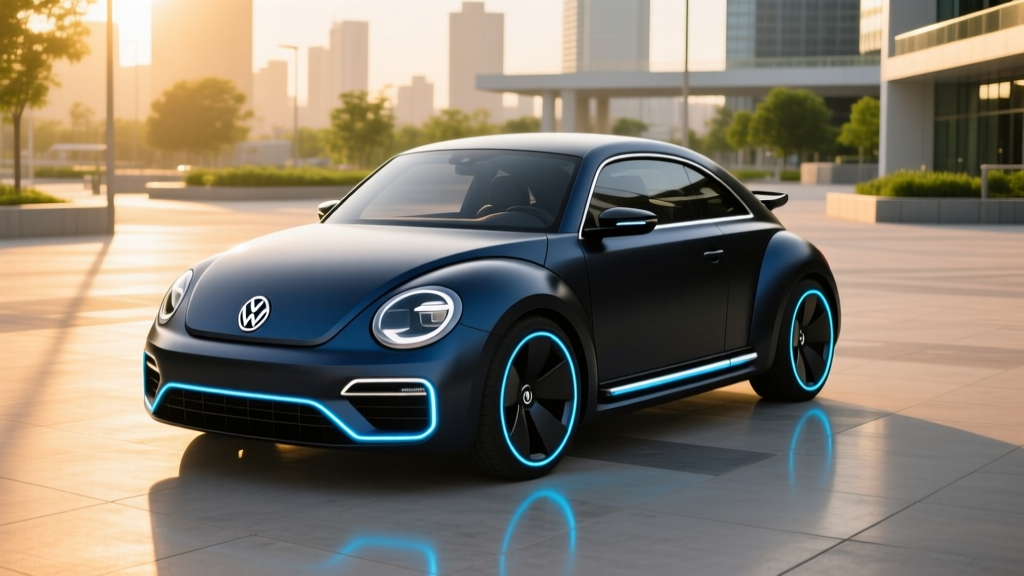
The short answer on an EV VW Beetle: Volkswagen does not sell a factory electric Beetle in 2026 — the last Beetle rolled off the line in 2019. Your options are: (1) an aftermarket EV conversion of a classic Beetle ($25,000–$50,000+ on top of the donor car), (2) Volkswagen's ID. Buzz as the spiritual retro-electric successor (starting ~$59,995, EPA range ~234 miles), or (3) a used e-Beetle concept car that VW never put into production. For most buyers, the ID. Buzz delivers the retro-meets-EV experience with modern safety, warranty, and DC fast charging — at a fraction of a custom conversion's cost.
Why There's No Factory Electric VW Beetle in 2026
Volkswagen discontinued the Beetle globally after the 2019 model year, ending a 21-million-unit production run across two generations. While VW has invested heavily in electrification through its MEB platform — producing the ID.4, ID.5, and the retro-styled ID. Buzz — the company has not announced plans to revive the Beetle nameplate as a production EV.
At the 2019 Frankfurt Motor Show, VW did showcase the e-Beetle concept, a collaboration with specialist firm eClassics that paired a 1966 Beetle body with electric drivetrain components producing 81 hp and a 36.8 kWh battery. However, this remained a one-off show car and was never homologated for sale. VW's production retro-electric energy went into the ID. Buzz, the Microbus-inspired electric van that launched in the US for the 2025 model year.
If you're searching for an "EV VW Beetle" today, you're realistically looking at three paths, each with vastly different cost, range, and ownership profiles.
Your Three Paths to an Electric Beetle Experience
Path 1: Aftermarket EV Conversion of a Classic Beetle
Specialist shops like Zelectric Motors, EV West, and eClassics (Europe) convert vintage air-cooled Beetles (typically 1960s–1970s models) to electric powertrains. A typical conversion includes:
- Motor: NetGain Hyper9 or AC-50, producing 80–120 hp (stock Beetle had 40–60 hp)
- Battery: 20–40 kWh lithium-ion pack (often salvaged Tesla or Nissan Leaf modules)
- Range: 60–120 miles real-world, depending on pack size and driving conditions
- Charging: Level 2 J1772, 3.3–6.6 kW onboard charger; no DC fast charging
- Cost: $25,000–$50,000 for the conversion alone, plus $8,000–$20,000 for a clean donor car
The result is a charming, head-turning daily driver with instant torque and zero tailpipe emissions — but with the safety profile of a 1960s vehicle, no modern crash structures, and limited range for anything beyond city commuting.
Path 2: The VW ID. Buzz — The Spiritual Successor
While it's a van and not a Beetle, the ID. Buzz is Volkswagen's only production retro-styled EV available in 2026. It carries the same emotional appeal — heritage design meets electric future — that a hypothetical electric Beetle would.
| Spec | Value |
|---|---|
| EPA Range | ~234 miles |
| Battery (usable) | 86 kWh (NMC chemistry) |
| Motor Output | 282 hp / 406 lb-ft torque |
| 0–60 mph | ~7.9 seconds |
| DC Fast Charge (peak) | 175 kW (CCS1) |
| 10–80% DC Charge Time | ~26 minutes |
| Level 2 Charge Rate | 11 kW (~7 hours full charge) |
| Base MSRP | ~$59,995 |
| Battery Warranty | 8 years / 100,000 miles (70% capacity retention) |
| EPA Efficiency | ~87 MPGe combined |
Real-world range reality: The ID. Buzz's 234-mile EPA estimate drops to roughly 190–210 miles at sustained 75 mph highway speeds, and cold-weather driving (below 30°F) can reduce range by 20–30%. Expect 165–185 miles on a full charge in winter highway conditions. The boxy aerodynamic profile (Cd ~0.29) is the main efficiency penalty compared to sleeker EVs.
Path 3: Wait and Hope for a Beetle EV Revival
VW executives have periodically floated the idea of a Beetle EV on the MEB platform. In 2022, then-design chief Klaus Zyciora mentioned the Beetle as a possibility within VW's electric lineup. However, as of 2026, no Beetle EV has been formally announced or appeared on VW's product roadmap. Any future Beetle EV would likely use the MEB-Entry or SSP platform with an estimated 250–300 mile range and a $35,000–$45,000 price point — but this remains speculative.
Cost Comparison: Converted Beetle vs. ID. Buzz vs. Gas Alternative
| Cost Category | Classic Beetle EV Conversion | VW ID. Buzz (RWD) | 2026 Honda CR-V (Gas Baseline) |
|---|---|---|---|
| Purchase Price | $40,000–$70,000 (donor + conversion) | $59,995 | $33,000 |
| Fuel/Energy (5 yrs, 12k mi/yr) | ~$2,400 (home L2 at $0.14/kWh) | ~$4,200 (mix home/public) | ~$9,000 (gas at $3.40/gal, 28 MPG avg) |
| Maintenance (5 yrs) | $3,000–$6,000 (specialty EV + vintage parts) | ~$2,500 | ~$4,500 |
| Insurance (5 yrs) | $6,000–$10,000 (specialty/agreed-value) | ~$7,500 | ~$5,500 |
| Federal Tax Credit (§30D) | $0 (not eligible — conversion) | $0–$7,500 (depends on sourcing & income) | $0 |
| Estimated 5-Year Total | $51,400–$92,000 | $66,695–$74,195 | $52,000 |
Tax credit note: The ID. Buzz's eligibility for the §30D federal clean vehicle credit depends on current-year battery sourcing and critical mineral requirements, MSRP caps (vans capped at $80,000), and buyer income limits ($150K single / $300K joint). Always verify eligibility with a tax professional before purchase. The credit can be transferred to the dealer at point of sale as of 2024 rules.
EV vs. Gas: What a Beetle EV Buyer Should Understand
| Factor | EV (ID. Buzz or Conversion) | Gas Vehicle |
|---|---|---|
| Refueling/Fueling Time | Home L2: 7–10 hrs overnight. DC fast: 26 min (10–80%) | 5 minutes at any station |
| Energy Cost per Mile | $0.04–$0.06/mile (home), $0.12–$0.18/mile (public DCFC) | $0.12–$0.15/mile |
| Cold Weather Impact | 20–30% range loss below 30°F | Minimal (~5% MPG reduction) |
| Maintenance | No oil changes, fewer moving parts; brake pads last 100K+ miles with regen | Oil, filters, spark plugs, transmission fluid |
| Home Charging Required? | Strongly recommended; public-only charging costs 2–3x more | No home infrastructure needed |
| Longevity Risk | Battery degradation: expect 10–15% capacity loss over 8–10 years | Engine/transmission rebuilds after 150K+ miles |
Common Misconceptions About an Electric VW Beetle
| Myth | Fact |
|---|---|
| "VW sells an electric Beetle" | VW discontinued the Beetle in 2019. The e-Beetle was a one-off concept. The ID. Buzz is the closest production retro-EV. |
| "An EV conversion is cheaper than buying a new EV" | A quality conversion costs $40K–$70K all-in — often more than a new ID.4 and approaching ID. Buzz pricing — with no warranty, no crash safety, and limited range. |
| "Conversions qualify for the $7,500 tax credit" | The §30D credit applies only to new vehicles from qualified manufacturers. Aftermarket conversions of classic cars do not qualify. |
| "A converted Beetle can road-trip like a modern EV" | With 60–120 miles of range and no DC fast charging, converted Beetles are strictly local-use vehicles. Road trips require a trailer or flatbed. |
| "The ID. Buzz is just as small as a Beetle" | The ID. Buzz is a 3-row minivan (195.1" long, 7,800 lbs GVWR). It's a completely different vehicle class — retro-styled, but a full-size family hauler. |
Real-World Ownership: What First-Time EV Buyers Need to Know
Whether you're considering an ID. Buzz or a converted classic Beetle, these practical factors determine whether EV ownership will work for you:
Home Charging Access Is the Make-or-Break Factor
Charging at home on a Level 2 (240V) circuit is where EVs deliver their biggest cost and convenience advantage. A typical Level 2 home charger installation runs $800–$2,500 including equipment (a quality unit like the ChargePoint Home Flex or Emporia Vue costs $400–$700) and electrician labor. If your electrical panel needs a 200-amp upgrade, add $1,500–$3,500.
Without home charging, you'll rely on public DC fast chargers at $0.30–$0.48/kWh ( Electrify America, EVgo) — which erases most of the fuel-cost savings versus gas and adds 25–40 minutes per charging session to your week.
Climate Matters More Than You Think
The ID. Buzz's large frontal area and boxy shape make it especially sensitive to cold-weather range loss. In sub-freezing climates (Minnesota, New England, Mountain West), budget for 30% less range in winter. A heat pump — standard on the ID. Buzz — helps mitigate cabin heating energy draw, but battery chemistry itself is less efficient in cold. If you live in a cold climate and need 200+ miles of usable winter range, the ID. Buzz's 234-mile EPA rating may feel tight on longer commutes.
Insurance and Registration Surprises
Converted classic Beetles require specialty insurance (Hagerty, Grundy) with agreed-value policies — typically $1,200–$2,000/year. The ID. Buzz, as a $60K+ new EV, carries higher-than-average insurance premiums: expect $1,400–$1,800/year depending on your state and driving record, per IIHS data on EV insurance trends.
Decision Framework: Which EV Beetle Path Is Right for You?
Choose a Classic Beetle EV Conversion if:
- You want a unique, head-turning weekend/city car — not a primary family vehicle
- You have a secure garage and Level 2 home charging already installed
- Your daily driving is under 50 miles round-trip
- You value vintage aesthetics over crash safety, ADAS features, and warranty
- Budget of $40K–$70K is acceptable for a passion project
Choose the VW ID. Buzz if:
- You want retro VW styling with modern safety (IIHS-rated), 3-row seating, and a factory warranty
- You need 200+ miles of real-world range for commuting and road trips
- You want DC fast charging (175 kW) for highway travel
- You want potential §30D tax credit eligibility
- You're okay with a minivan form factor rather than a compact coupe
Wait or look elsewhere if:
- You specifically want a compact, 2-door Beetle-shaped EV — no current option exists
- You need a sub-$40K EV — consider the Chevy Equinox EV (~$33K, 319 mi range) or Hyundai Kona Electric (~$33K, 261 mi range)
- You live in an apartment with no charging access and limited public infrastructure
Frequently Asked Questions
Will VW ever make an electric Beetle?
As of 2026, VW has not announced a production electric Beetle. Executives have mentioned it as a possibility on the MEB platform, but VW's current EV priorities are the ID. Buzz, ID.7 sedan, and next-gen ID.4. If a Beetle EV arrives, expect a 2028–2030 timeframe at the earliest.
How much does it cost to convert a VW Beetle to electric?
A professional EV conversion of a classic Beetle typically costs $25,000–$50,000 for the drivetrain work, plus $8,000–$20,000 for a clean donor car. DIY conversions using kits from EV West or similar suppliers can reduce labor costs but require significant electrical and mechanical skill. Total all-in cost: $35,000–$70,000.
What is the range of a converted electric Beetle?
Most Beetle conversions use 20–40 kWh battery packs, yielding 60–120 miles of real-world range. Highway driving at 65+ mph and cold weather reduce this significantly. These conversions are best suited for city and suburban driving under 50 miles per day.
Does the VW ID. Buzz qualify for the $7,500 federal tax credit?
Eligibility depends on current IRS §30D rules including battery component sourcing, critical mineral requirements, buyer income limits, and MSRP caps. The ID. Buzz (MSRP under the $80,000 van cap) may qualify for partial or full credit depending on the specific model year's battery supply chain compliance. Always check the latest IRS guidance and consult a tax professional.
Is an electric Beetle conversion safe for daily driving?
Converted Beetles retain the original 1960s–70s chassis with no modern crumple zones, airbags, ABS, or electronic stability control. While the electric drivetrain itself is safe when professionally installed, the vehicle's crash protection is vastly inferior to any modern car. Most owners treat conversions as fair-weather weekend cars, not primary daily drivers.
Can I DC fast charge a converted Beetle?
No. Nearly all aftermarket Beetle conversions use Level 2 J1772 charging at 3.3–6.6 kW. Full charges take 4–10 hours. DC fast charging hardware adds significant cost, weight, and complexity, and most conversion shops do not offer it.